Key takeaways
- Colour-coded spreadsheets do not survive the speed and scale of 2026 planning.
- AI planning covers the whole cycle, not just the scheduling step at the end.
- The creative gain is volume of options during ideation, where manual workflows are thinnest.
- Scheduling moves from white-knuckle calendar management to a managed queue.
Why Traditional Social Media Content Planning Fails in 2026
The Scale and Speed Challenge
Legacy planning methods, from color-coded spreadsheets to basic calendar tools, are no match for the pace and complexity of social media in 2026. The volume of channels, formats, and audience touchpoints has grown dramatically. Where planning once meant a few Facebook posts, it now involves managing daily video stories, interactive posts, and time-sensitive trends across Instagram, TikTok, LinkedIn, Threads, and emerging platforms.
Manual workflows struggle to keep up. Each platform rewards highly tailored content, so copying the same update everywhere falls flat. Buffer, for example, is now essential for customizing posts to each channel’s requirements. ContentStudio helps brands stay relevant with timely suggestions. The pace is relentless; algorithms surface trending topics by the hour. If your team is still updating planning docs or chasing approval emails, you’re already behind.
Even mid-sized teams can’t scale content velocity without help. AI-driven planning can cut planning time considerably, helping marketers build detailed calendars faster. Relying on repetitive, manual scheduling simply isn’t sustainable in this environment.
Key Insight: Without automation and AI-driven workflows, even well-resourced brands quickly fall behind the speed and complexity of modern social media.
Consequences of Inefficient Planning
When planning lags, the business impact is immediate. Missed engagement windows – when your audience is most active – lead to fewer views and lower ROI on creative spend. Last-minute scrambles result in inconsistent branding, off-message posts, and missed campaign tie-ins. If your team is still copying captions manually or juggling platform logins, you’re not just wasting time – you’re risking your reputation.
Wasted ad spend and lost opportunities are common outcomes. Launching a campaign after a trend has peaked or posting duplicate content due to poor planning can undermine your efforts. AI-powered tools like PostNext and Predis.ai help prevent these mistakes by suggesting optimal posting times, auto-generating unique captions, and flagging gaps in your calendar. These platforms protect your brand’s voice and budget while saving valuable time.
The lack of real-time adaptation is perhaps the biggest liability. With algorithms favoring fresh, relevant content, yesterday’s plan is already outdated if you’re not tracking trends and performance data as they unfold. Teams often discover too late that their strategy has drifted off course – usually after engagement metrics start to slip.
By 2026, AI social media content planning is no longer a luxury. It’s the baseline for staying visible, relevant, and competitive as platforms and audiences evolve at breakneck speed.
What Is AI Social Media Content Planning? Core Concepts and Components
Defining AI Social Media Content Planning
AI social media content planning uses artificial intelligence to streamline every aspect of social content management, from ideation to publishing and performance tracking. This goes far beyond basic automation. AI-powered tools can predict what will resonate with your audience, adapt strategies in real time, and keep content aligned with brand objectives and current trends.
By 2026, AI solutions are essential for brands managing multiple platforms, formats, and touchpoints. AI moves teams from scattered spreadsheets to consolidated calendars where campaigns are mapped out quickly.
How AI Changes the Content Planning Cycle
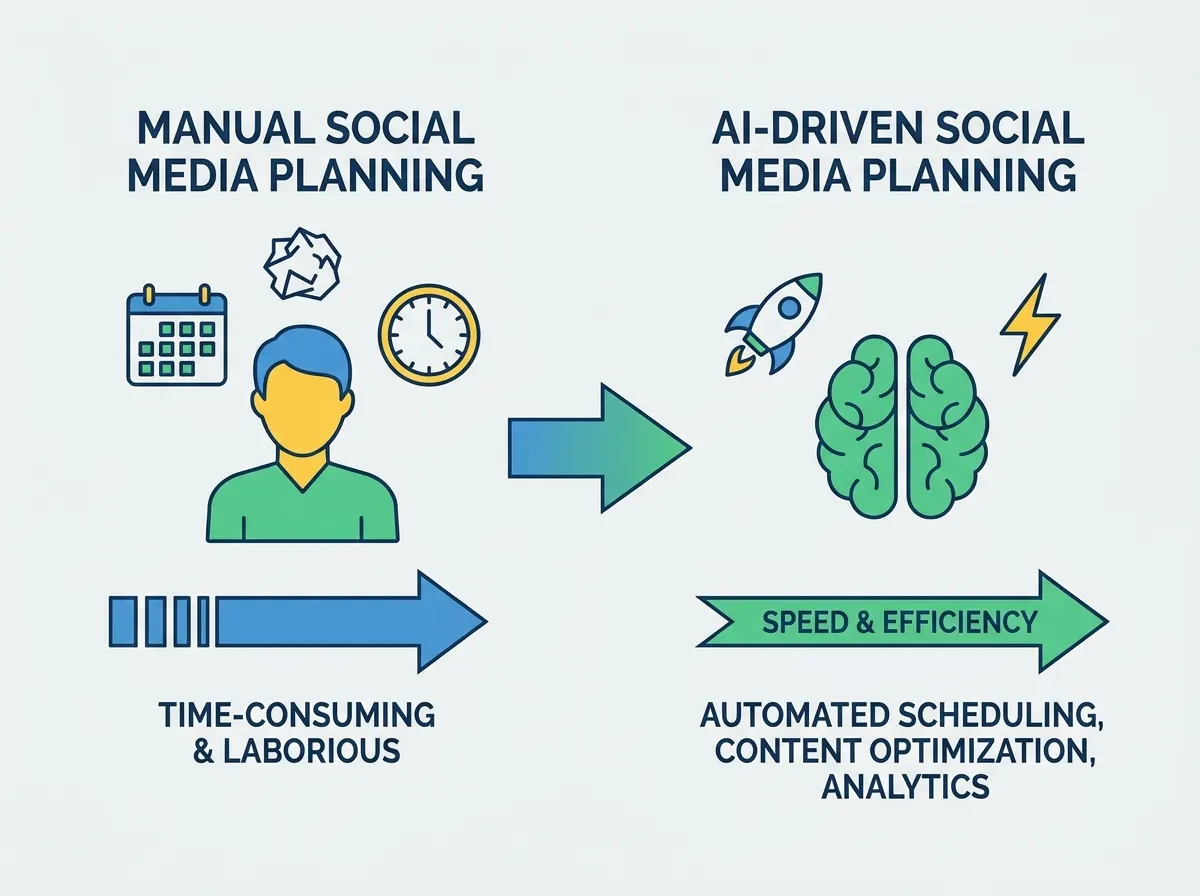
Traditional planning relied on manual research, guesswork, and endless calendar shuffling. AI-driven platforms eliminate bottlenecks with rapid content generation, intelligent scheduling, and actionable insights. FeedHive’s content recycling ensures high-performing posts get a second life, while Buffer’s post customization tailors content by channel for maximum impact.
AI empowers teams to work smarter. Instead of following a static schedule, AI suggests the best times to post, identifies trending topics, and adapts to real-time performance data. This adaptive layer distinguishes true AI social media content planning from simple automation.
Core Components of AI-Driven Content Planning
| Component | What It Does | Why It Matters |
|---|---|---|
| Ideation | Generates content ideas using AI analysis of trends, keywords, and audience data. Tools like Predis.ai can create complete posts from prompts. | Saves hours in brainstorming and ensures topics are timely and relevant to your audience. |
| Content Calendar | Visualizes all posts, campaigns, and deadlines in a single workspace. StoryChief consolidates editing, scheduling, and approvals. | Prevents chaos and last-minute rushes. Helps maintain brand consistency across channels. |
| Auto-Scheduling | Analyzes optimal posting times based on engagement data and audience behavior. Buffer and Hootsuite both offer these features. | Maximizes reach with data-driven timing and reduces manual scheduling errors. |
| Analytics & Insights | Tracks performance metrics in real time, surfaces trends, and offers suggestions for improvement. Sprout Social is known for advanced analytics. | Enables continuous optimization of strategy by learning from what works and what doesn’t. |
The value lies in how these components work together. AI tools not only automate repetitive tasks but also adapt to shifting priorities, market changes, and campaign performance. As platforms like PostNext advance, teams can focus more on strategy and creativity instead of logistics.
How AI Transforms Content Ideation and Creation
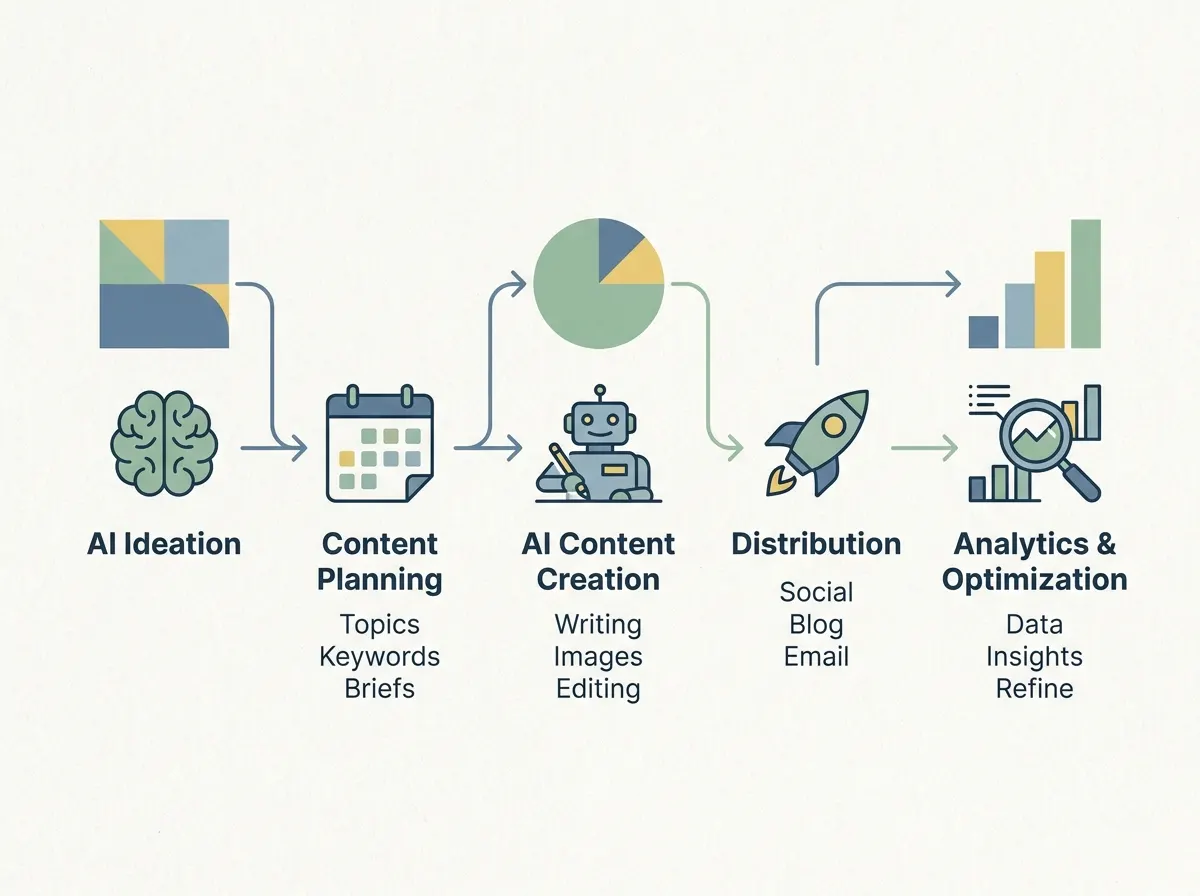
AI social media content planning is about more than efficiency – it unlocks creative possibilities that manual workflows can’t match. The sheer volume of content expected in 2026, across dozens of platforms and formats, makes manual ideation and scheduling nearly impossible. AI tools bridge this gap, handling everything from trend discovery to copywriting, and even recommending visuals that fit your brand’s voice.
Key Insight: AI-powered content ideation doesn’t just multiply your output – it raises the baseline quality of every post by grounding ideas in real-time data and audience insights.
Example: Before and After Using AI for Ideation
| Before (Manual Planning) | After (AI-Powered Planning) |
|---|---|
| • Brainstorm 10 post ideas by hand for the month • Rely on static keyword lists and last year’s trends • Spend hours researching hashtags and visuals • Recycle content infrequently, often missing evergreen topics | • AI scans real-time trending topics and suggests 40+ targeted post ideas • Generates captions and hashtags tailored for each platform • Recommends relevant visuals pulled from your content library and public sources • Automatically identifies top-performing posts and schedules repurposing at optimal intervals |
The before scenario leaves you with a light, generic calendar that rarely taps into what’s trending. With AI, the after version delivers a far greater volume of ideas, each backed by up-to-the-minute data. The workflow shifts from reactive to proactive. Instead of guessing what might resonate, you can build a calendar that’s both timely and strategic – freeing up hours every week for higher-level creative work.
Visual and Caption Generation in Practice
AI takes the grunt work out of content creation by drafting posts, suggesting visuals, and intelligently recycling your best material. Tools like PostNext add trend research, so you’re not just posting more – you’re posting smarter. Its Viral Discovery searches recent high-engagement posts on a topic across X, Instagram, LinkedIn, TikTok and YouTube, so you can adapt ideas that are already working. Matching your own assets to a trend is still your call.
Need a caption that stands out? AI models generate copy in multiple tones and lengths, tailored for the quirks of each platform. You might get a punchy, 80-character hook for X (formerly Twitter), a hashtag-rich description for Instagram, and a more conversational post for LinkedIn – all without manual tweaking.
- Hashtag recommendations are auto-generated based on your topic, current trends, and audience insights from analytics.
- Visual suggestions pull from both your library and stock sources, ranked by relevance and predicted engagement.
- Content intelligence identifies which posts are ripe for repurposing, ensuring nothing high-performing gathers dust in your archives.
This level of automation doesn’t just save time – it creates a feedback loop where the best ideas are surfaced, refined, and redeployed. Of course, AI suggestions aren’t always perfect. Sometimes visual recommendations miss the mark, or a generated caption needs a human touch to fit brand voice. But the lift is dramatic: marketers who once spent hours on ideation and asset selection can now focus on brand storytelling and campaign strategy.
As AI social media content planning tools like PostNext continue to evolve, teams are no longer just keeping up – they’re setting the pace for digital conversation.
AI-Driven Scheduling and Automation: From Calendar to Queue
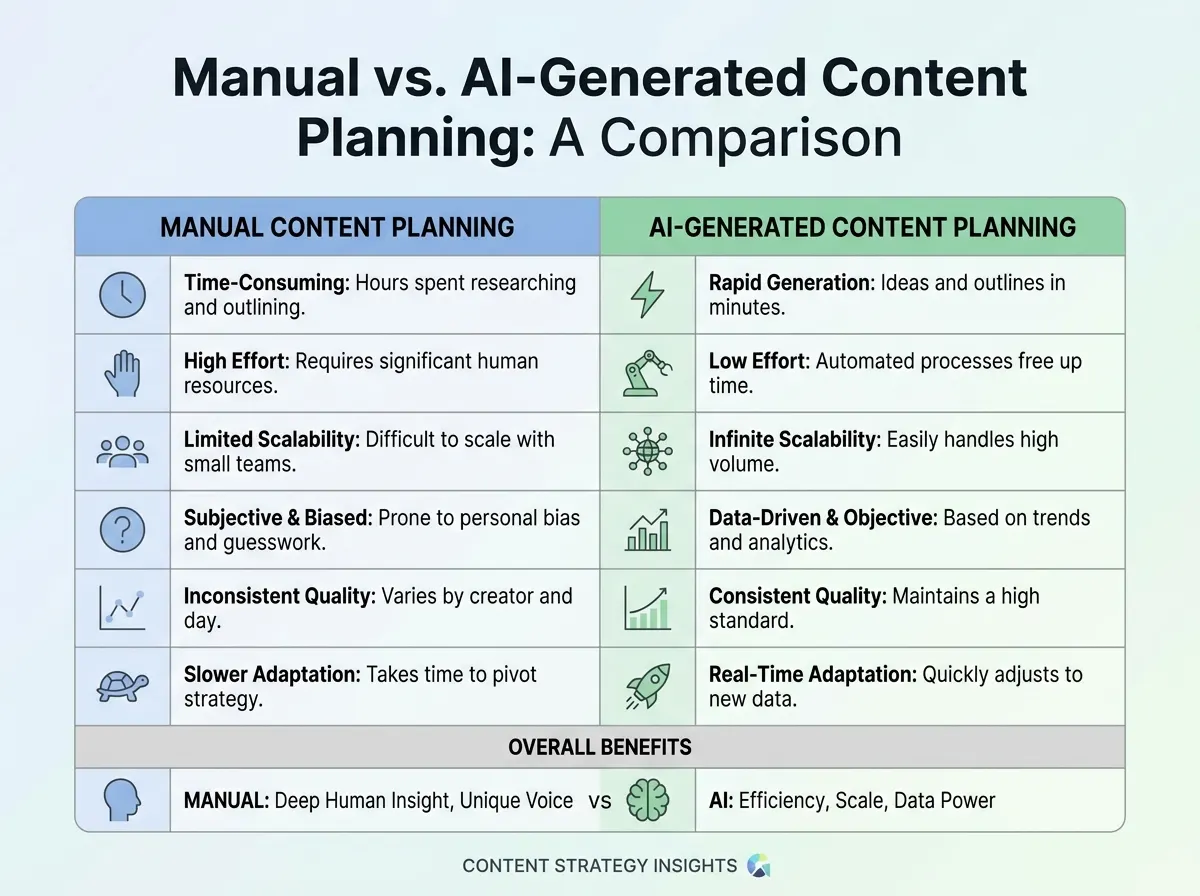
AI social media content planning has fundamentally changed how teams handle scheduling and automation. Gone are the days of white-knuckling content calendars or juggling spreadsheets. AI-powered schedulers now use real audience data and platform insights to optimize every post, ensuring your content hits at the right time, on the right channel.
For instance, on paid plans PostNext ranks time slots by the engagement your own X, Instagram, TikTok and LinkedIn posts earned and suggests the strongest ones when you pick a time. It is based on your history, not a generic chart, and you confirm every slot.
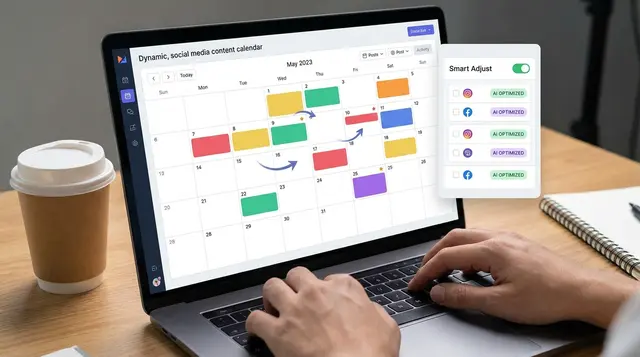
Bulk scheduling is now standard. With most schedulers, you can line up a week – or a month – of content, drag and drop posts on a unified calendar, and shuffle them visually as priorities shift. If a campaign needs to be paused or rescheduled, the system instantly updates every channel. No more scrambling to adjust each network individually.
- Bulk scheduling and drag-and-drop calendars let you batch work and avoid daily manual uploads.
- Automated rescheduling keeps your queue full even when priorities change or posts need to be delayed.
Key Insight: The real power of AI scheduling is its ability to adapt your content plan in real time, turning a rigid publishing calendar into a living, responsive queue.
Real-Time Optimization: How AI Reschedules or Boosts Content in Response to Trends, News, or Engagement Spikes
The biggest leap in AI-driven scheduling is real-time adaptability. When news breaks or a post suddenly goes viral, manual systems can’t keep up. AI-driven platforms, on the other hand, promise to detect an engagement spike on your Tuesday morning Twitter thread, then automatically boost related posts or reschedule less relevant content to make room.
In practice this is still largely a human job. PostNext, for example, has no engagement-triggered republishing or reshuffling: when a post takes off, you decide what to move. You can drag posts to new slots in the calendar, or set an evergreen post to recur on a fixed cadence (automation).
There are limits, of course. AI can’t always anticipate breaking news outside its data sources, and human oversight is still needed for sensitive or brand-critical changes. But for most brands, a calendar that makes rescheduling quick means more time spent refining strategy instead of chasing calendar updates.
AI social media content planning is about more than saving time – it’s about seizing opportunity. The smartest teams treat their publishing schedule as a flexible queue, ready to adapt at a moment’s notice, and let automation handle the heavy lifting.
Predictive Analytics: Forecasting Content Performance with AI
From Guesswork to Data-Driven Decisions
Social media success once depended on gut instinct and trial and error. In 2023, teams might have relied on past campaign spreadsheets and hoped for repeat results. That approach worked when platforms were simpler. In 2026, AI social media content planning tools have transformed the process.
Predictive analytics now estimate reach, engagement, and ROI before a post goes live. Instead of guessing, you can see – based on millions of data points – how a carousel post might perform on LinkedIn versus a short-form video on Instagram. The shift isn’t just about speed; it’s about confidence. Marketers can now act on forecasts with a level of certainty that was impossible with intuition alone.
This new AI-driven approach lets teams set campaign specs, generate content pillars, and build a full calendar in minutes. More importantly, you’re not flying blind. Each post is calibrated against industry benchmarks and real-time trends, giving you a clear path to outperform the competition.
How AI Models Estimate Performance
AI engines analyze vast amounts of data – your historical post metrics, competitor activity, and the latest platform trends – to project key outcomes like engagement rates, virality potential, and channel-specific ROI. Some enterprise analytics tools weigh variables such as hashtag use and video length against what performs in your niche. PostNext does not forecast performance: its analytics report engagement after posts go live, and its best-time panel ranks slots from your own history.
Benchmarks matter here. Say you’re planning a Twitter thread. Compare it against your own average engagement rate for similar posts rather than a generic industry figure, and revise the hook, call to action or timing if that format has been lagging.
| Metric | Formula | Action Trigger |
|---|---|---|
| Engagement Rate | (Likes + Comments + Shares) / Impressions | If below your own average, revise content or format |
| Click-Through Rate (CTR) | Clicks / Impressions | If below your own average, optimize CTA placement |
| Estimated ROI | Projected Revenue / Ad Spend | If below your target, re-evaluate targeting or creative |
Adapting Strategy with AI Forecasts
The real power of AI social media content planning lies in what you do before publishing. If your AI dashboard predicts a drop in engagement due to time of day, you can reschedule. If a format keeps falling below your usual engagement, tweak your hook or try something different. Top platforms now let you run these simulations for multiple posts and channels at once – saving time and avoiding costly misfires.
AI doesn’t guarantee a viral hit every time, but it means you’re never launching in the dark. Every campaign is based on real data and current industry standards. That’s a step up from old-school planning, and it’s quickly becoming the new baseline for growth-focused teams.
Integrating AI Tools into Your Social Media Workflow
Platform Compatibility Checklist: What to Verify Before Integrating an AI Social Media Scheduler with Your Martech Stack
Before committing to any AI social media content planning platform, you need a clear checklist. Not all tools integrate smoothly with your existing martech stack, and a poor fit can create more friction than it solves. Start by mapping out the platforms you use daily – CRMs, analytics dashboards, asset libraries, and project management tools. For example, if your team relies on Slack for communication and Google Drive for creative assets, check if the AI scheduler offers native integrations or robust API access.
Compatibility is about more than connections; it’s about data flow. A good tool should import scheduled campaigns from your project manager, sync approved assets, and push analytics back to your reporting suite. Test the platform’s ability to handle different content types – video, multi-image posts, and stories – across your key networks. If you manage regional accounts or multiple brands, ensure it supports multi-account management and granular permission controls.
- List the channels you publish to (e.g., Instagram Reels, LinkedIn Pages, TikTok) and confirm the AI scheduler supports direct publishing for each.
- Assess data privacy and compliance, especially if you operate in regulated industries.
- Evaluate the tool’s uptime and support reputation – look for platforms with a proven track record and responsive help desks.
Buffer excels at channel-specific customization, while FeedHive’s strength is content recycling. PostNext stands out for AI-powered scheduling and visual content planning. Don’t just review feature lists – run a test campaign and see how smoothly the tool fits with your actual workflow.
Team Adoption Strategies: Ensuring Buy-In, Training, and Process Documentation for Smooth Implementation
Even the smartest tool will flop if your team isn’t on board. The key to successful AI social media content planning integration is structured onboarding with a focus on real-life use cases. Identify workflow bottlenecks – maybe your team spends hours copying captions, or struggles with last-minute approvals. Frame the new tool as the answer to those pain points, not just another layer of software.
Roll out adoption in stages. Select a few power users to pilot the platform, create process documentation, and refine best practices. Use actual campaigns as training material, not generic demos. Then, host hands-on workshops where marketers draft, schedule, and approve posts directly in the new platform.
- Create a shared FAQ and troubleshooting doc – keep it updated as real questions arise.
- Schedule regular check-ins during the first month to surface friction points early.
- Encourage feedback loops: let team members suggest improvements based on their day-to-day experience.
For ongoing success, update your process documentation every quarter. As AI platforms like PostNext add features or integrations, refresh your team’s knowledge with short training videos or live Q&As. This keeps adoption high and prevents old habits from creeping back in.
When integration is handled with care – balancing compatibility checks and real team buy-in – AI tools don’t just automate tasks. They help your brand stay agile, strategic, and ready for what’s next in social media.
Comparison: Leading AI Social Media Planning Tools in 2026
Where the Leaders Stand: Unique Strengths and Differentiators
The AI social media content planning landscape in 2026 is crowded with powerful platforms, but the true value lies in the details. Each tool approaches automation, analytics, and collaboration differently. Choosing the right fit means looking beyond headlines and focusing on your specific workflow needs.
PostNext stands out with deep AI-powered scheduling, auto-generated captions, and a visual calendar that simplifies multi-channel planning. If you need to optimize for both efficiency and creative oversight, PostNext is a strong choice. Buffer continues to excel at customizing posts for different networks, which is essential for brands managing tone and format across diverse channels.
Publer is notable for affordability, offering robust scheduling and analytics at a price point accessible to smaller teams. FeedHive is recognized for content recycling, automatically repurposing top-performing posts to maximize reach. ContentStudio specializes in trend tracking and topical relevance – its AI can surface emerging themes before they hit mainstream feeds.
Predis.ai generates complete post content, not just snippets or captions. For teams with limited creative bandwidth, this is a significant advantage. StoryChief focuses on integrated campaign planning and team workflows.
Eclincher focuses on automation for social engagement and inbox management. Hootsuite remains a reliable all-in-one solution, while Sprout Social offers enterprise-grade analytics and deep listening features for brands that value insights over basic metrics.
Key Insight: In 2026, the best AI social media content planning platform is the one that matches automation and analytics depth with your team’s actual workflow and scale.
Feature-by-Feature: What Sets Each Platform Apart
| Platform | Best For | Key Features | Limitation |
|---|---|---|---|
| PostNext | Visual planners, creators and growing teams | AI captioning, visual calendar, multi-platform scheduling, analytics | One approval step; no social listening or performance forecasting |
| Buffer | SMBs, channel-specific customization | Post tailoring, browser extension, analytics | Limited automation compared to AI-first rivals |
| Publer | Budget-conscious users | Bulk scheduling, automatic recycling, analytics | Fewer integrations, basic AI features |
| FeedHive | Content repurposing | AI content recycling, performance tracking | Basic collaboration tools |
| ContentStudio | Trend-driven brands | Topic discovery, competitor analysis, scheduling | Limited creative automation |
| Predis.ai | Full AI content generation | Post creation, idea generation, multi-language support | Post quality can vary, requires review |
| StoryChief | Campaign-driven teams | AI calendar building, collaboration, approvals | Best suited to multi-channel strategies |
| Eclincher | Engagement automation | Social inbox, automation, analytics | Interface can feel overwhelming |
| Hootsuite | Enterprise, all-in-one users | Scheduling, analytics, ads management | Steep learning curve |
| Sprout Social | Analytics-focused teams | Advanced analytics, social listening, scheduling | More than small teams usually need |
Who Should Use Which Tool?
Startups and lean marketing teams often choose Publer and FeedHive for cost savings and simplified workflows. If your brand relies on posting tailored content to each major network, Buffer’s post customization makes daily management easier.
For growth-focused teams needing AI-driven content creation and visual planning, PostNext and Predis.ai are strong options. StoryChief’s time-saving campaign planning and team collaboration features make it a preferred choice for agencies and content teams handling complex, multi-platform campaigns.
Enterprise brands with advanced reporting and listening needs usually prefer Sprout Social or Hootsuite, accepting higher pricing in exchange for scale and data depth. For organizations where automation of engagement is a challenge, Eclincher can automate inboxes and routine replies, freeing up focus for strategy.
No single tool is perfect. Some platforms prioritize automation depth, while others focus on analytics or campaign workflow. The right choice comes down to your team’s size, content velocity, and appetite for AI-driven planning. As these platforms mature, expect even sharper differentiation – and new opportunities to elevate your social strategy while reclaiming your time.
Maximizing Brand Consistency and Strategic Alignment with AI
AI social media content planning has made it possible to enforce brand standards across every channel and campaign – without sacrificing speed or creativity. The difference between brands that use AI for consistency and those that don’t is clear, both in their feeds and in their results.
Let’s break down how AI-driven templates and brand asset management transform daily life for social teams. With platforms like PostNext, teams save reusable caption templates with placeholder fields, keep a brand profile for voice, and share logos and images in one asset library. Colors, fonts and layouts are not locked or checked automatically, so a quick visual review still matters.
Approval workflows are another area where AI streamlines the process. Instead of manual Slack threads or email chains, teams get automated routing – content flagged for review automatically goes to the right stakeholders. Visibility is built in. This prevents embarrassing mistakes and speeds up the entire process, reducing friction between creative and compliance teams.
Maintaining campaign coherence at scale is where AI systems excel beyond even the most careful human planners. Consider a global campaign running across Instagram, LinkedIn, and TikTok. With traditional methods, teams risk subtle inconsistencies: one post uses an outdated tagline, another has the wrong product image. A central dashboard with a shared asset library and calendar keeps everyone working from the same assets and captions, which cuts copy/paste errors and forgotten edits.
Before/After Example: Manual vs. AI-Enforced Brand Consistency
| Before (Manual Process) | After (AI-Enforced Consistency) |
|---|---|
| • Brand colors sometimes off due to manual hex code entry • Social copy accidentally reused from old campaigns • Approval requests buried in email, leading to missed deadlines • Regional teams publish slightly different taglines | • AI locks brand asset choices – no deviations in colors, fonts, or logos • Content templates enforce consistent voice and up-to-date messaging • Automated approval routing, with real-time visibility for all stakeholders • Instant global updates to all campaign assets and captions from a single dashboard |
The after scenario works because it eliminates manual errors and approval bottlenecks. Teams waste less time chasing down inconsistencies or waiting for reviews. Instead, they focus on campaign strategy and engagement, knowing that the core brand elements are never at risk. This level of automation and oversight is only possible with sophisticated AI content planning tools.
As AI social media content planning becomes standard, marketers gain the confidence to scale campaigns without losing the thread of their brand. The future of brand alignment isn’t in more rules or bigger style guides – it’s in smarter systems that enforce those rules automatically, freeing humans to focus on strategy and creativity.
Key Metrics and Benchmarks for AI Social Media Content Planning Success
Defining the Essential KPIs
A high-impact AI social media content planning strategy is only as effective as the metrics behind it. The most important KPIs fall into four main buckets: engagement rates, consistency, content velocity, and cost savings. Engagement rates capture how well your posts resonate, whether through likes, shares, comments, or saves. Consistency measures how reliably your brand appears across channels, while content velocity tracks how frequently new content goes live. Cost savings reflect the financial efficiency gained from automation and reduced manual effort.
How AI Calculates and Surfaces Actionable Insights
Analytics tools report post performance, and some scheduling tools go a step further. In PostNext, engagement rolls up by content pillar and campaign, so you can spot underperforming themes, and the best-time panel (paid plans) ranks posting slots from your own history. It does not track workflow bottlenecks or time saved, so measure those yourself.
AI analytics go beyond surface metrics. They map audience interaction trends, predict what will perform next, and even estimate potential reach before content goes live. By surfacing patterns, AI empowers teams to double down on what works and quickly pivot from what doesn’t.
KPIs to Track for High-Performing Brands in 2026
| Metric | What to Track | Optimization Example | Connection to Business Outcomes |
|---|---|---|---|
| Engagement Rate | Trend per channel against your own baseline | Test posting windows for each channel | Higher engagement drives organic reach and lead gen |
| Post Consistency | Share of scheduled posts that went out on time | Keep the queue filled a week or two ahead | Boosts brand trust and audience retention |
| Content Velocity | Posts per week, by format | Mix formats across platforms | Keeps your brand top-of-mind across channels |
| Cost Savings | Hours spent planning each week | Batch-generate drafts, then edit | Reinvested hours drive new campaigns or initiatives |
High-performing brands in 2026 aren’t just posting more – they’re posting smarter. Scheduling tools like PostNext help you keep the queue full and track engagement, so you can act on these KPIs week by week and keep content output aligned with business goals. The result is a social presence that’s both efficient and impactful, setting the standard for digital marketing teams worldwide.
What to Avoid: Common Mistakes When Adopting AI for Social Media Content Planning
Overreliance on AI, Underestimating Human Judgment
AI social media content planning tools are powerful, but turning over the keys entirely to automation can lead to brand missteps. When you let AI generate and schedule posts without editorial review, you risk tone-deaf messaging, factual errors, or visuals that miss the mark. Even leading platforms require a layer of human oversight. The best teams use AI to generate options, then refine and approve content – especially for product launches or campaigns where nuance matters.
Skipping Onboarding and Team Training
It’s tempting to plug in a new tool and set it loose. But without proper onboarding, teams can struggle with features or misuse analytics dashboards, leading to confusion and wasted effort. This isn’t just about tutorials. You need clear editorial guidelines, an understanding of the AI’s strengths and limits, and a shared workflow for approvals.
Misinterpreting AI Suggestions
One of the trickiest pitfalls is taking AI-generated insights at face value without context. AI can recommend optimal posting times or content formats based on historical data, but these suggestions aren’t immune to anomalies. For instance, a spike in engagement during a global event might skew future recommendations. Make it a habit to question outliers and understand why the AI is making certain calls. If you see odd patterns, dig deeper before changing your entire strategy.
Underutilizing Analytics and Failing to Recalibrate
AI tools like Sprout Social and Hootsuite offer robust analytics, yet many teams ignore these dashboards after initial setup. The result: missed opportunities to optimize. Schedule monthly reviews to assess what’s working, and be ready to tweak your AI’s posting frequency, channel mix, or content types. AI settings that worked last quarter might not fit this quarter’s campaign goals or new platform algorithms.
- Always pair AI automation with human insight.
- Invest in onboarding and ongoing training for your team.
- Regularly review both AI recommendations and analytics dashboards – don’t set and forget.
The bottom line: AI social media content planning works best when automation is a strategic partner, not a replacement for thoughtful human input. The brands that get it right use AI to scale their efforts, then double down on human creativity and judgment where it counts.
The Future of AI Social Media Content Planning: Trends and Predictions for 2026 and Beyond
Hyper-Personalization at Scale
The next wave of AI social media content planning is all about creating personalized content at scale. Marketers in 2026 are moving past generic brand posts. Instead, AI analyzes historical engagement, audience demographics, and even real-time behavior to build highly specific content variants. For example, a brand’s Instagram campaign might split into dozens of micro-segments, each with unique messaging and visuals tailored to that group’s preferences. AI now adapts tone, timing, and call-to-action language to maximize resonance. This approach is increasingly accessible to lean social media teams.
Real-Time Trend Adaptation and Generative Visuals
Generative AI is transforming the visual side of content planning. In 2026, static media assets are giving way to AI-generated graphics and video tailored to live social trends. If a meme format explodes on TikTok, AI platforms can analyze and replicate the style – sometimes pushing new content live within the hour. Tools like Predis.ai automate post creation, while FeedHive’s recycling capabilities ensure evergreen content never goes stale. The result: brands react to viral moments in real time, not days later. This agility is now the baseline for staying relevant and maintaining high engagement.
Advanced Multi-Channel Orchestration
AI is also stepping up as the conductor in multi-channel orchestration. With dozens of networks and content formats, manual scheduling is a thing of the past. Marketers can now plan, adapt, and publish across Facebook, Instagram, LinkedIn, and emerging platforms from a single dashboard. Analytics are no longer passive reports. AI-driven insights recommend optimal posting times, content types, and campaign pivots based on real-time performance data. Platforms like PostNext offer integrated scheduling and analytics to keep campaigns on target. This orchestration frees marketing teams to focus on strategy, not logistics.
AI-Driven Community Engagement
The most forward-thinking teams are already using AI to drive community engagement. It’s more than automating replies or pushing generic polls. AI analyzes conversations, surfaces emerging topics, and suggests meaningful ways to join or even steer discussions. Eclincher’s engagement automation and Sprout Social’s social listening tools point to a future where brand voices feel both authentic and responsive, at any scale.
The next few years will see the lines blur between human creativity and machine-driven efficiency. As AI social media content planning grows more sophisticated, the brands that pair technology with strategic intent will set the standard for digital engagement.
Frequently Asked Questions
What is AI social media content planning?
AI social media content planning is the process of using artificial intelligence to streamline how you ideate, schedule, and publish social content across platforms. These tools automate repetitive tasks, generate content ideas, and predict what will resonate with your audience. By 2026, many marketers rely on AI-powered platforms to create full calendars, automate post timing, and optimize campaigns with minimal manual effort.
How does AI save time for content planners?
AI-powered tools can dramatically reduce content planning time. The technology generates suggested captions, recommends optimal publishing times, and assembles entire campaign calendars based on your goals. This efficiency is especially valuable for brands juggling multiple channels and high post volumes.
Is AI social media content planning only for large teams?
Not at all. While enterprise teams use AI to coordinate complex campaigns, solo marketers and small businesses benefit just as much. Many platforms – such as Publer and FeedHive – offer affordable pricing and features that scale to your needs. Even if you’re running social media solo, AI can automate scheduling, suggest hashtags, and analyze post performance without requiring a dedicated team.
Can AI-generated content match my brand’s voice?
Brand consistency is a top concern, and AI has made real progress in this area. Tools like PostNext and Hootsuite now allow you to set brand guidelines, approve suggestions, and fine-tune tone. However, AI isn’t perfect. It’s best to use AI for drafts, outlines, or bulk ideation, then review and edit to ensure every post fits your unique style. Human oversight remains crucial for nuanced messaging.
Are there risks in relying too much on AI for social media?
Yes. Overreliance on automation can lead to generic or off-brand content. AI may not fully grasp trending topics, regional slang, or sensitive cultural moments. If you let automation run unchecked, you risk losing the human touch that drives authentic engagement. The best results come from blending AI efficiency with human creativity and judgment.
What’s next for AI in social media content planning?
AI is evolving quickly. Expect hyper-personalization at scale, deeper analytics, and smarter automation. As more platforms add predictive capabilities, marketers will be able to anticipate trends and adapt strategies in real time. The brands that succeed in 2026 will be those that combine AI-driven efficiency with a clear, authentic voice.