Social media marketing for a local business gets customers when it does three jobs: it proves you are open, it shows what people get, and it makes the next step one tap away. Many people find a local business on a map or in search, then check its social accounts before they visit. So fill in your profiles, post three times a week and count where customers come from.
Key Takeaways
- Social is where people check you: in BrightLocal’s July 2026 study, 52% of US consumers started a local search on Google, while 30% used social media at some point before they chose.
- The profile sells before the post does: hours, address, a contact button and one booking or order link answer the questions a visitor has.
- Three posts a week per channel is enough: the work, the people, and one practical post or offer.
- Two channels done well: pick the two where your customers already are, plus your Google Business Profile.
- Replies are part of the sale: a question in the comments is often a booking that has not happened yet.
- Count customers, not likes: ask “How did you hear about us?” and use a code word or a tagged link per channel.
What is social media marketing for a local business?
Social media marketing for a local business is the use of Instagram, Facebook, TikTok and similar apps to bring nearby people through the door, to the phone or to the booking page. The audience lives within driving or walking distance, so the goal is visits and bookings. Follower counts and reach outside your town matter much less.
That one fact changes most of the advice written for national brands. A Reel that reaches 200,000 people in another country does nothing for a hair salon. A plain post that tells 300 neighbours you have two free slots on Saturday can fill both.
A local business also has an advantage a big brand does not: people can see the real place, the real owner and the real result. A florist’s hands, a mechanic’s lift, the bread at 7 a.m. Posts like these are cheap to make and hard for a chain to copy. A trade business can post the same way from each job, as our guides to social media for plumbers, HVAC businesses and carpenters show.
How do local customers use social media before they buy?
Most local customers find a business on Google or a map first, then use social media to check it before they visit. In BrightLocal’s July 2026 study of 1,227 US consumers, 52% started their latest local search on Google Search, and 30% used social media at some point along the way. For many of them, social media is where they check you.
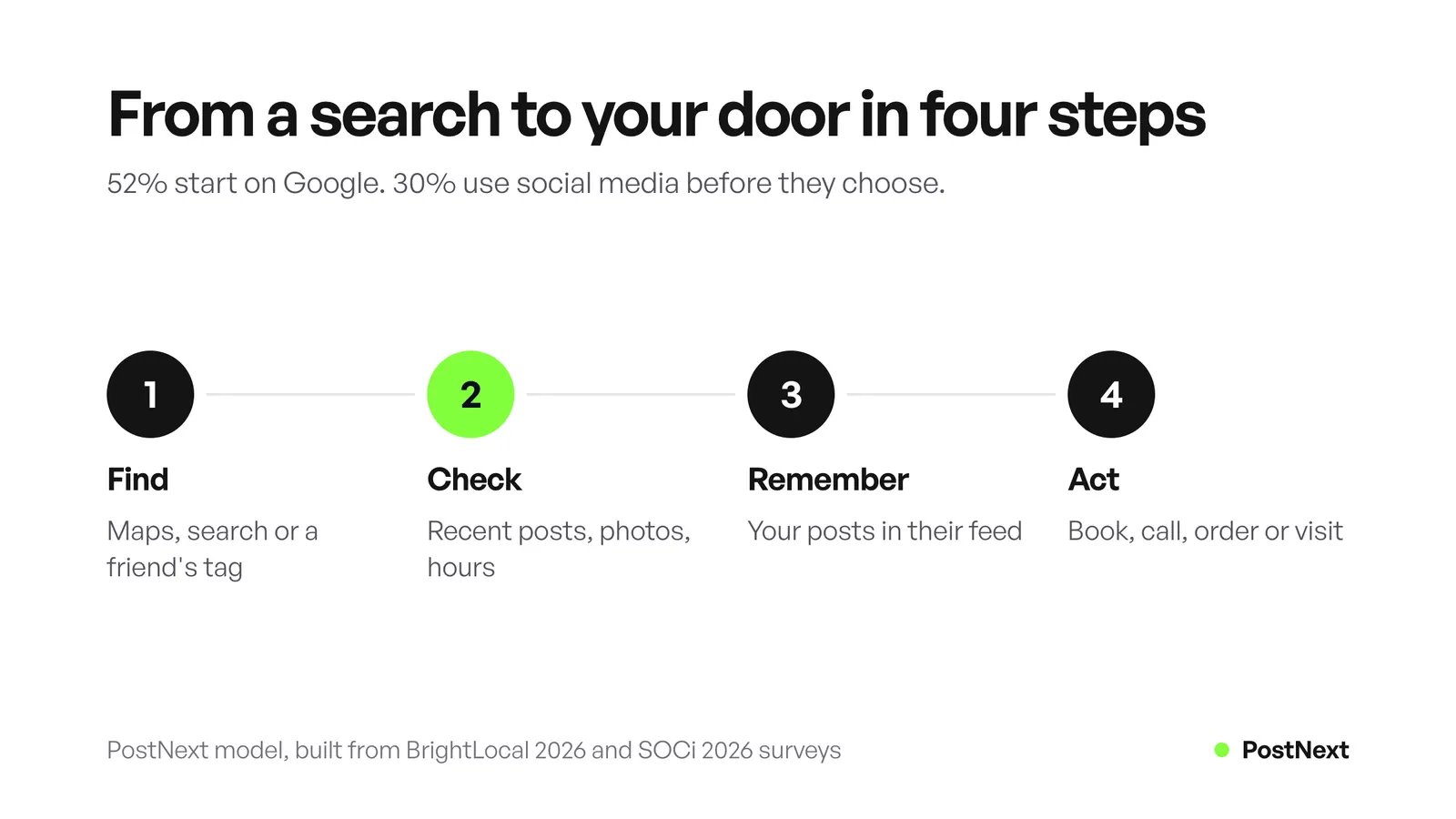
The path has four steps. Each step asks your account to show something different.
| Step | Where it happens | What the customer checks | What your account must show |
|---|---|---|---|
| Find | Maps, search, a friend’s tag, a Reel in a local feed | Is there a place like this near me? | Your town in the name or bio, a clear category |
| Check | Your profile and your last 9 to 12 posts | Is it open, is it good, what does it cost? | Recent posts, real photos, hours, prices or a menu |
| Remember | Their feed, after they follow | Is it still worth going? | Regular posts, so you stay in their feed |
| Act | Your profile buttons, DMs, your booking page | How do I book, order or get there? | One action button and one link that works on a phone |
The four steps are PostNext’s own model, built from the studies below.
Studies disagree on where the search starts, because they ask different questions. GatherUp’s August 2025 survey of 1,000+ US consumers found that just 1% start local business discovery on social media. Yext’s March 2026 survey of 1,120 US adults found that 40% start their local search on social. Both can be true: one asks about the first step of a search, the other about habits.
The studies agree on the Check step. BrightLocal’s 2026 review survey of 1,002 US adults found that 24% visit a business’s social media channels after they read positive reviews. SOCi, a local marketing software company, surveyed 1,000+ US consumers in 2026. 43% use social media to preview what a place is like before they go. 59% say a social post or video has made them a customer of a local business at least once. SOCi sells to local businesses, so read its numbers as a vendor’s survey.
The Check step is where most local accounts lose people. A visitor opens your profile, sees a last post from March, and wonders if you closed. They do not message to ask. They pick the next result.
Which social media platforms should a local business use?
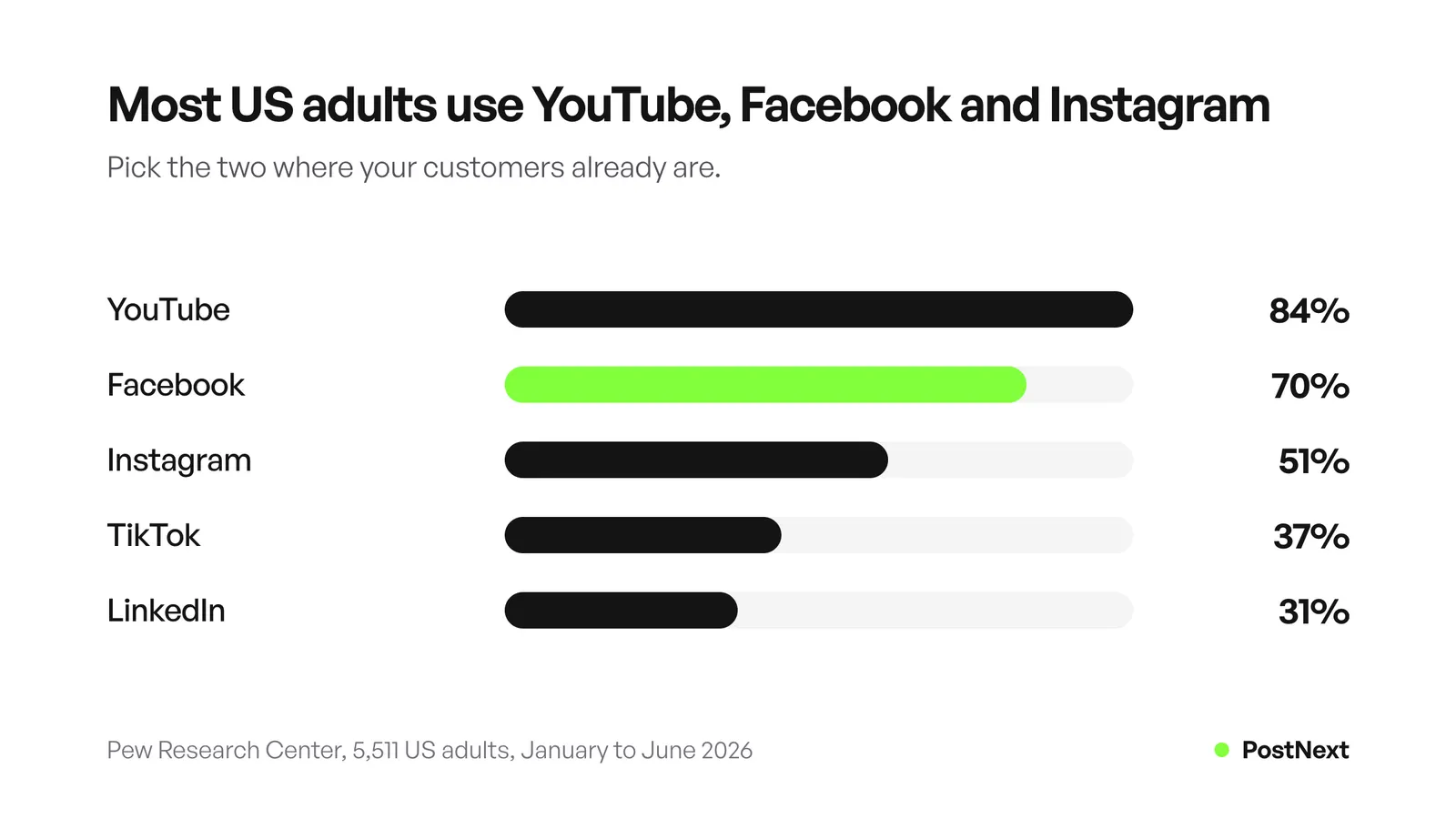
A local business should use the two platforms where its customers already spend time, plus a complete Google Business Profile. For most shops, cafes and salons that means Instagram and Facebook. Add TikTok if your customers are under 35 and your work looks good on video, and LinkedIn only if you sell to other businesses.
| Platform | US adults who use it | Good job for a local business | Scheduling in PostNext |
|---|---|---|---|
| 70% | Events, local groups, customers aged 30 and over | Not yet (on the roadmap) | |
| YouTube | 84% | How-to videos, tours, longer demos | Yes |
| 51% | Photos of the work, Reels, Stories with offers | Yes | |
| TikTok | 37% | Short clips of the work, younger customers | Yes |
| 31% | Local services that sell to other businesses | Yes | |
| Google Business Profile | Not a social network | Hours, photos, offers on your Google listing | Not yet (on the roadmap) |
Share of US adults who ever use each platform, from the Pew Research Center survey of 5,511 adults, January to June 2026. PostNext column from postnext.io, November 2026.
Among people who use social media to find local businesses, SOCi’s 2026 survey found Facebook used by 73%, YouTube by 69%, Instagram by 67% and TikTok by 50%. Facebook’s reach with adults over 30 is why it stays on most local lists, even for businesses that prefer Instagram. Restaurants have their own data on this; our guide to restaurant social media marketing shows where diners look before they book.
Two channels with fresh posts beat five channels where three are dead. If you already run accounts you cannot feed, post once to say where you are active now and pin that post. Our guide to which social media platform is best for business compares each network by audience and effort.
Google Business Profile is not a social network, but it is where many people find you first. Its posts show on your Google listing, and an Update or Event post can carry a Book, Order, Shop, Learn more, Sign up or Call button. Photos follow one spec for every image type; the Google Business Profile image sizes guide lists them.
How do you set up a profile that turns visitors into customers?
Set up each profile so a stranger can answer four questions in five seconds: what you sell, where you are, when you are open and how to book or buy. Use a professional account, put your town in the name field or bio, add your address and contact button, and point your one link at a booking or order page.
On Instagram, a professional account adds a category label and a Contact button for phone, email and directions. A business account can also show one action button, such as Book now, Reserve or Order food, linked to a booking or ordering partner (Instagram Help Center, November 2026).
Work through this list on each channel:
- Name field: your business name plus what you do or where, such as “Rosa Florist Leith”. The name field is searchable.
- Bio: what you sell, one fact that makes buying easy (opening hours, “walk-ins welcome”, delivery area), and the next step.
- Link: your booking page, menu or shop. One link that works well on a phone beats five links. If you need several, a link-in-bio page such as More.You can hold the link in your bio for booking, menu and directions.
- Highlights or pinned posts: prices or menu, how to book, where to park, reviews.
- Last 9 posts: at least one from this week. Real photos of your place, your work and your people.
Write the bio as a promise you can keep. “Same-day repairs” loses a customer the day you cannot do it. Our list of Instagram bio ideas has examples for local businesses with their character counts.
What should a local business post to get customers?
A local business should post five kinds of content and rotate them: the work, the people, the customers, the offer or event, and the practical post. Each answers a question a customer has at the Check step. Most posts should show real things from your business, and about one in four should ask for an action.
The work. Show the product or service as it happens: the cut, the cake, the repair, the before and after. This is proof. A 10-second clip filmed on a phone in good light is enough.
The people. The owner and staff, with a name and one line about them. People buy from people they recognise. A customer who has seen your face three times walks in feeling they know you.
The customers. Reshare tags and stories from happy customers, with their permission. Their friends see the post, and a stranger reads it as proof from someone who has no reason to lie.
The offer or event. A new product, a seasonal menu, a free slot, a workshop with a date. One offer per post, with a clear end date when there is one.
The practical post. Opening hours, holiday closures, how to book, where to park, what to bring. These posts get few likes and many saves and screenshots, because they answer the question people have right before they come. For a mover, the practical post is the USDOT number and how estimates work.
Stories work well for the quick, daily side of this: today’s specials, a free slot, a poll on a new product. Our Instagram Story ideas list ideas by goal, including ones that bring customers in.
How often should a local business post on social media?
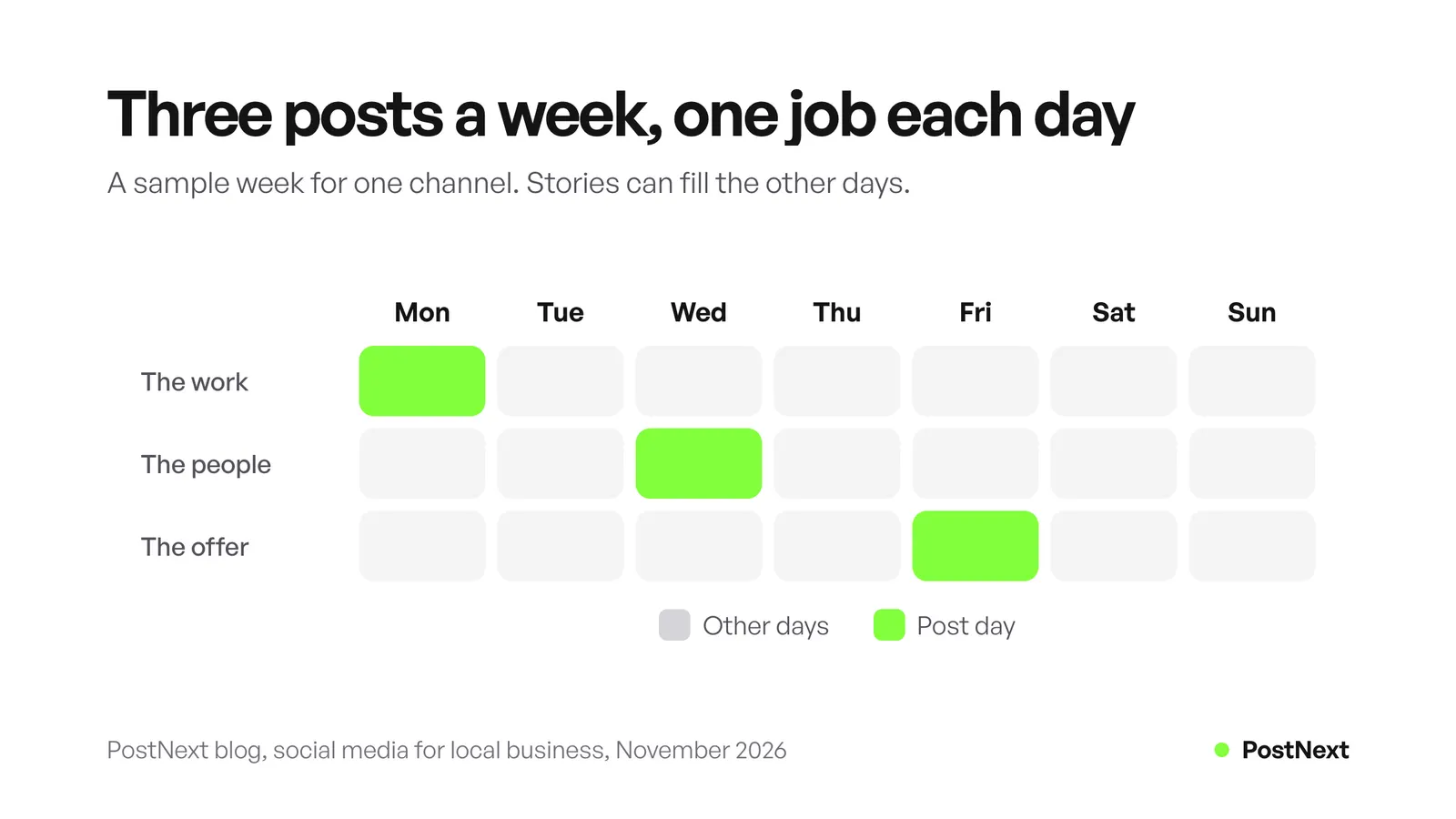
Three times a week per channel is a pace most owners can keep next to the real work. Pick fixed days and give each day one job, such as the work on Monday, the people on Wednesday and an offer or practical post on Friday. A steady rhythm keeps you in your followers’ feeds, and it tells a visitor at the Check step that you are open.
| Day | Post type | Example for a bakery |
|---|---|---|
| Monday | The work | A 10-second clip of the first loaves coming out |
| Wednesday | The people or the customers | The baker who makes the croissants, with her name |
| Friday | The offer or practical post | ”Christmas orders close on 18 December. Order at the counter or online.” |
A sample week for one channel. Stories can fill the other days.
Shoot a week of photos and clips in one 30-minute session when the light is good and the shop is quiet. Write the captions in one sitting and schedule them. When something happens on the day, such as a sold-out batch or a surprise delivery, post it as a Story and keep the plan. A cafe or restaurant can follow the PostNext weekly playbook for restaurants, which includes a shot list for one session.
How do you turn followers into paying customers?
Turn followers into customers by making each post end in one easy action, answering every comment and message on the same day, and giving followers a reason to come in that they cannot get elsewhere. A follower is a customer who has not picked a day yet. Your job is to make that day this week.
One action per post. “Book your Saturday slot with the button on our profile” works better than a post that asks people to like, share, follow and book at once.
Reply the same day. A question in the comments, such as “Do you do gluten-free?” or “Are you open Sunday?”, is a sale in progress. Answer it publicly so the next person sees the answer too. If you get the same question every week, a keyword DM can send the answer and the booking link for you; CreatorFlow shows how restaurants and local businesses automate Instagram DMs.
A follower-only reason. First look at a new menu, a code word to say at the till, a slot released to followers an hour before the website. This gives people a reason to follow and gives you a way to count. Surveys of why people follow brands on social media put previews, useful posts and offers near the top.
Tags and reshares. Ask happy customers to tag you. Put a small card at the till or in the bag with your handle. Each tag shows your business to the customer’s own friends, who mostly live nearby.
Neighbour posts. Make a joint post with the business next door: the cafe and the bookshop, the gym and the smoothie bar. Both audiences are local, and both owners gain.
How do you know if social media brings you customers?
Count the customers each channel sends, not the likes it gets. Ask every new customer “How did you hear about us?” and write the answer down. Use a different code word or tagged link for each channel. After a month, compare the customers from each channel with the hours you spent there, and change one thing at a time.
A one-page monthly check needs five lines per channel:
- Posts published, by type.
- New customers who named this channel, from your till, booking tool or notebook.
- Clicks to your booking or order page, from tagged links.
- The post that brought the most questions or bookings, and why you think it worked.
- One change to try next month.
Likes and views help you compare posts, but a post with 40 likes and 6 bookings beats a post with 4,000 views and none. Read each platform’s own insights for views and profile visits, and keep your customer count next to them.
What mistakes stop local businesses getting customers from social media?
Five mistakes cost local businesses the most customers. They are a feed with no recent posts, a profile with no hours or booking link, and chasing reach outside your town. The other two are stock photos instead of real ones, and questions left without an answer. Each one fails a customer at the Check or Act step, after they have already found you.
- A dead feed. A last post from months ago reads as “maybe closed”. Post something small every week, even in the quiet season.
- Viral thinking. Trends and national hashtags bring followers who will never visit. Local words, local faces and local places bring the ones who will.
- Stock photos. A stranger can tell. Your real shop, even on an ordinary day, is more convincing.
- Too many channels. Five half-empty accounts tell a visitor less than two active ones.
- Slow replies. A question answered two days later is a customer who already booked somewhere else.
Many of these mistakes start from a belief, such as “I have to post every day” or “my customers are not on social media”. We checked seven social media myths against 2026 data from Pew, Buffer and Instagram.
How does PostNext help a local business?
PostNext puts your Instagram, TikTok, LinkedIn, X, YouTube, Threads and Bluesky posts on one calendar, so you can shoot a week of content in one session and schedule all of it in one sitting. Facebook and Google Business Profile are not available yet, so post there in Meta’s and Google’s own tools for now.
The parts that matter most for a local business:
- Recurring posts. Repeat this post reposts your opening hours, a weekly special or a “book your slot” reminder every 1 to 365 days, weeks or months, on every plan.
- Instagram comment inbox. Read, answer and delete comments on your recent Instagram posts in one place, so a “Are you open Sunday?” does not wait. It does not cover DMs or other networks.
- Best-time suggestions. On paid plans, PostNext suggests three posting times for Instagram, LinkedIn and X from your own last 90 days of posts.
- A phone browser is enough. PostNext has no mobile app, but the web app works in a phone browser, so you can check the week between customers.
The free plan covers 1 channel, 10 posts and 10 AI credits a month, which is enough to test one channel. See PostNext’s page for small businesses for a weekly posting plan and caption templates, and the comment inbox for how replies work.
Frequently Asked Questions
What is the best social media for a local business?
The best platforms are the two your customers already use each day, plus a complete Google Business Profile. For most shops, cafes and salons that is Instagram and Facebook. Add TikTok if your customers are younger and your work looks good on video. Ask ten customers which apps they open daily before you choose.
How do I get customers from social media for my local business?
Fill in your profile with hours, address and one booking or order link. Post three times a week with real photos of your work, your people and your customers. Answer every comment and message the same day. Give followers a reason to come in, such as a code word, and ask every new customer how they heard about you.
How often should a small local business post on social media?
Three posts a week per channel is a pace most owners can keep. Use fixed days, such as Monday, Wednesday and Friday, and give each day one post type. Add Stories on busy days for specials and free slots. A steady rhythm matters more than a high number.
Do local businesses need to post every day?
No. Three good posts a week keep you in your followers’ feeds and show visitors that you are open. Daily Stories help if you have daily news, such as today’s specials or a free slot, but a feed post every day is not needed and is hard to keep up next to the real work.
Is social media worth it for a small local business?
Yes, when it is set up for the Check and Act steps. Many people look at a business’s social accounts before they visit, so a fresh, complete profile wins customers who already found you. Measure it by counting new customers per channel each month, not by likes.
What should a local business post on Instagram?
Rotate five types: the work as it happens, the people who do it, happy customers (with permission), offers and events with a date, and practical posts such as hours and how to book. Most posts should show real things from your business. About one in four should ask for an action.
Can I schedule Facebook and Google Business Profile posts with PostNext?
Not yet. PostNext publishes to Instagram, TikTok, LinkedIn, X, YouTube, Threads and Bluesky. Facebook and Google Business Profile are on the roadmap, so schedule those posts in Meta Business Suite and in your Business Profile for now.
Sources
- BrightLocal, Consumer search behavior: channels, 1,227 US consumers who searched for a local business in the last three months, published July 2026, checked November 2026.
- BrightLocal, Local Consumer Review Survey 2026, 1,002 US adults, published February 2026, checked November 2026.
- GatherUp, Beyond the Stars 2025, 1,000+ US consumers, August 2025, checked November 2026.
- Yext, Consumer Search Behaviors Report 2026, 1,120 US adults, March 2026, checked November 2026.
- SOCi, 2026 Local Discovery Index (PDF), 1,000+ US consumers, 2026, checked November 2026.
- Pew Research Center, Social Media Fact Sheet, 5,511 US adults, January to June 2026, checked November 2026.
- Instagram Help Center, About action buttons for Instagram business profiles and About professional accounts on Instagram, checked November 2026.
- PostNext, Social media management for small business (plans, channels and FAQ), Engagement inbox and Automation, checked November 2026.