
Social media for moving companies works as a background check that customers run before they call. The FMCSA lists 11 red flags of rogue movers, and the FTC tells people to check registration, estimates and reviews. A legit mover can answer each check in a post, months before anyone asks. This PostNext guide shows which posts answer which check, and how often to publish them.
Key Takeaways
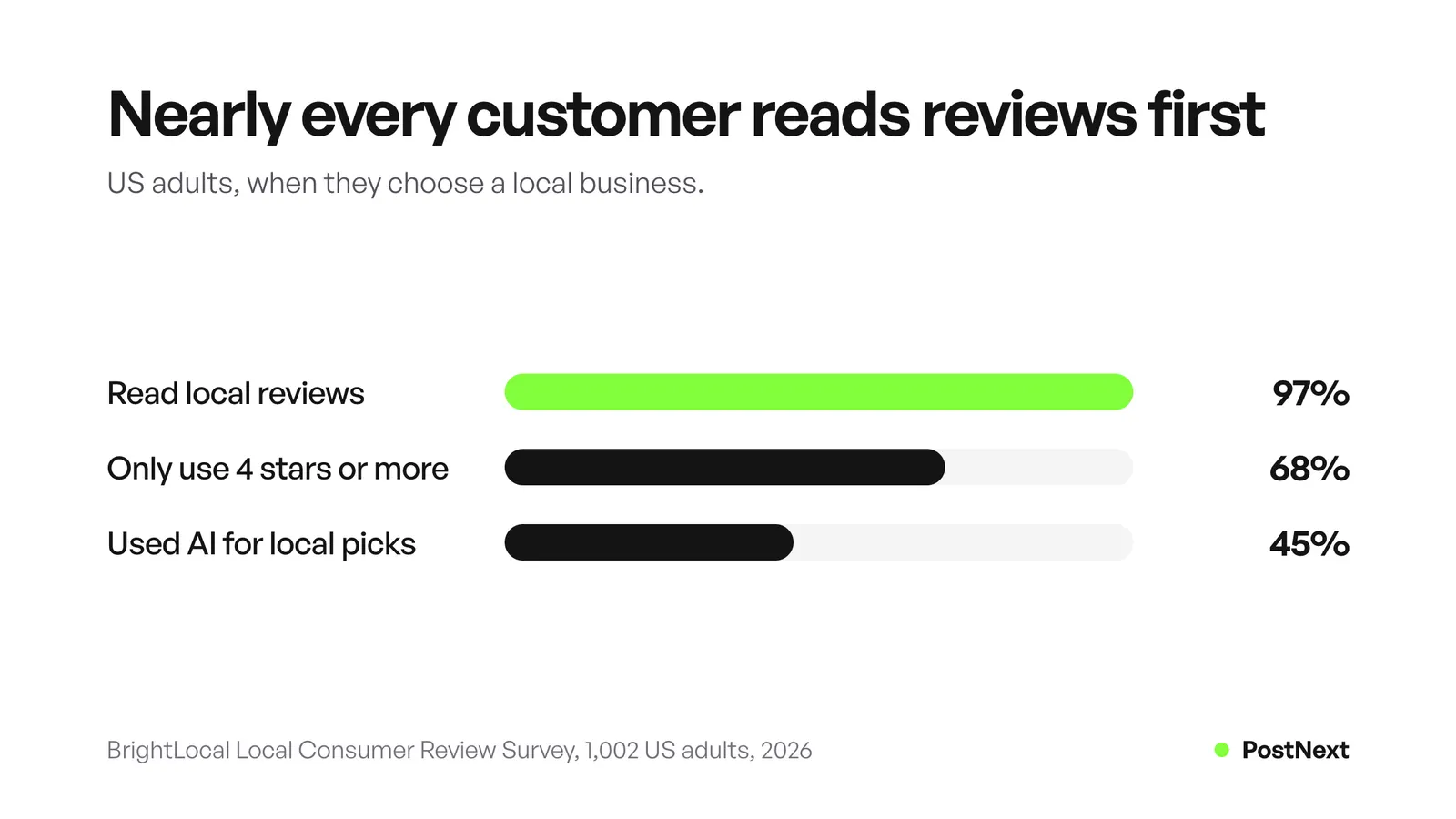
- Customers check you first: 97% of consumers read reviews for local businesses, and 68% will only use a business with 4 stars or more.
- The FMCSA lists 11 red flags of rogue movers: a phone estimate sight unseen, a large deposit, blank forms, no booklet. Each one is a post you can answer.
- Your USDOT number belongs in every ad: federal rules for interstate movers say every advertisement shows it in the form “U.S. DOT No.” plus the number.
- Explain the 110 percent rule: on a non-binding estimate, the customer pays no more than 110% at delivery. On a binding estimate, 100%.
- Explain valuation with one example: Released Value pays no more than 60 cents per pound per article, so a 25-pound TV gets $15.
- Facebook and Nextdoor reach local households: 70% of US adults use Facebook and 18% use Nextdoor.
- Two posts a week is enough: accounts that posted in 20 of 26 weeks got 450% more engagement per post.
Does social media work for moving companies?
Social media works for movers as proof before the booking. A move is rare, costly and stressful, and the customer hands you everything they own. The FTC tells people to read reviews and to search a mover’s name with the words “complaint” or “scam.” Your profile is what they find. A feed of real, recent local moves, with your registration on show, answers the question they came with: is this company real?
| Where customers check a mover | What they look for | Data |
|---|---|---|
| Reviews on Google and Facebook | Star rating, recent reviews, owner replies | 97% read local reviews (BrightLocal, 2026) |
| A search for “name + scam” | Complaints, and how you answered them | FTC tells movers’ customers to do this (2024) |
| The FMCSA mover search | USDOT number and complaint history | Required check for interstate moves (FMCSA) |
| Your Facebook Page or Nextdoor | Recent local jobs, a real crew, replies | 70% of US adults use Facebook, 18% Nextdoor (Pew, 2026) |
| AI assistants | A short list of local businesses | 45% used AI tools for local recommendations (BrightLocal, 2026) |
BrightLocal Local Consumer Review Survey 2026 (1,002 US adults), FTC consumer alert (September 2024), FMCSA Protect Your Move, Pew Research Center Social Media Fact Sheet 2026 (5,511 US adults). Checked November 2026.
Social media will not fill your trucks on its own. Most bookings start with a search, a referral from a real estate agent or a past customer. Your feed decides whether that lead calls you or the next name on the list. If agents send you work, our guide to social media for real estate agents shows what their own feeds need, and where a mover fits in.
How do movers show they are not a rogue mover?
Publish the answer to each red flag before the customer looks for it. The FMCSA’s Protect Your Move pages list 11 signs of a dishonest mover, from an estimate given by phone to a rental truck on moving day. The FTC adds its own short list: check DOT registration, get written estimates, and never pay a big deposit. A mover whose feed already shows the opposite of each sign passes the check in one scroll.
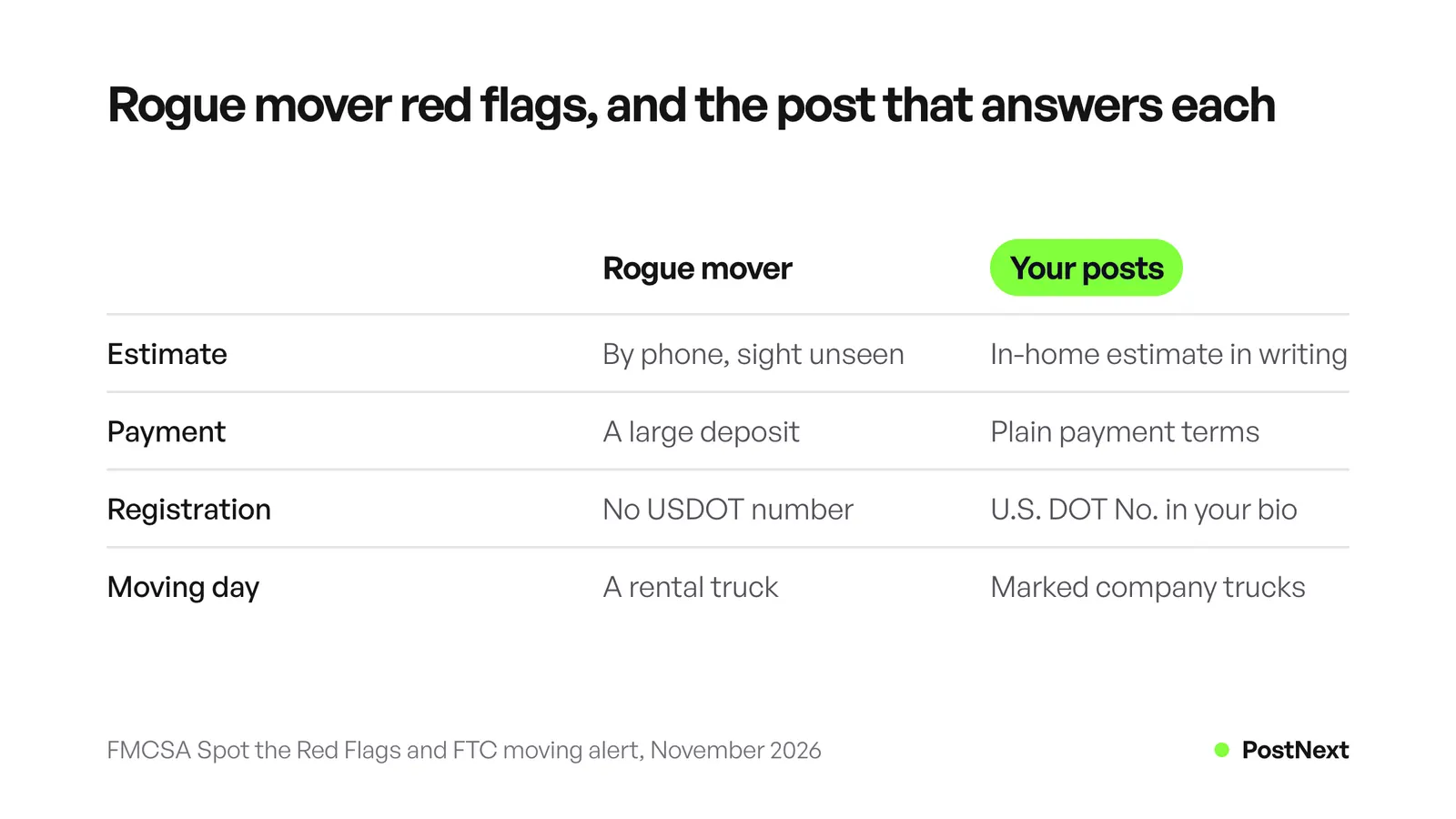
The FTC’s advice is short: “Don’t hire anyone who demands cash or a big deposit before the move,” and “Don’t hire an interstate mover that isn’t registered with DOT.” The FMCSA list is longer. Each red flag below has a post that answers it:
| FMCSA red flag | The post that answers it |
|---|---|
| Estimate by phone or online, without seeing your things | A short video of your estimator walking through a home (with the owner’s permission) |
| No written estimate, or “we will price it after loading” | A photo of your blank estimate form, and what each line means |
| Cash or a large deposit before the move | Your payment terms in plain words |
| You are asked to sign blank documents | ”We never ask you to sign a blank form. Here is what you sign, and when.” |
| No copy of the Your Rights and Responsibilities When You Move booklet | A post with the link to the booklet, and when you hand it over |
| No local address, registration or insurance on the website | Your address, U.S. DOT No. and insurance in every profile |
| ”All goods are covered by our insurance” | A valuation post: Full Value Protection and Released Value (see below) |
| The phone is answered “Movers,” not a company name | A team post with names and faces, and the number they answer |
| Offices and warehouse in poor condition or missing | A tour of your warehouse and your trucks |
| A rental truck arrives on moving day | Your marked trucks, parked at your own yard |
| ”You have more things than we estimated” | A post on how you count items, and what changes the price |
FMCSA, Spot the Red Flags (last updated November 2024), and FTC, Avoid scams when you hire a moving company (September 2024). Checked November 2026.
Avoid the rogue mover’s habits in your own posts too. A post that says “lowest price, book today, cash discount” reads like the warnings above. The FMCSA tells customers that hiring “based solely on the lowest price” can cost them a safe, on-time move. Lead with how you work, and keep the price talk for the written estimate.
Should a moving company put its USDOT number on social media?
Yes, if you move goods across state lines. Federal rules for household goods movers say every advertisement must show your name, as it appears on your DOT registration, and your U.S. DOT number, written as “U.S. DOT No.” followed by the number. The rule defines an advertisement as any communication to the public that offers an interstate move. It also names listings on a website.
The rule does not name social media. Read it the safe way and treat a post that sells an interstate move as an ad, with the number in it. Put it in each profile’s bio, on your cover photo and in the caption of every offer post. It costs you nothing, and it is the first thing the FMCSA tells customers to check. They can look up a mover by name, USDOT number or MC number in the FMCSA search tool, which also shows complaint history.
Two notes. If you are a broker, the FMCSA says your ads must show your physical location, your MC number and that you are a broker who does not move the goods yourself. And for moves within one state, the FMCSA says requirements vary, so check your state’s consumer affairs office or attorney general for the license number you should show.
How should movers explain estimates and valuation in posts?
Explain the two words customers fear most, estimate and coverage, before the move. The FMCSA says that at delivery a customer does not have to pay more than 100% of a binding estimate or 110% of a non-binding estimate. Interstate movers must also offer two kinds of liability, called valuation. One short post on each, in plain words, answers the questions your estimator hears every week.
| Term | What the FMCSA says | One-line post |
|---|---|---|
| Binding estimate | The customer pays no more than 100% of it at delivery | ”Your price is fixed in writing.” |
| Non-binding estimate | No more than 110% at delivery; extra charges are billed 30 days after delivery | ”The 110 percent rule protects you on moving day.” |
| Full Value Protection | The mover pays the replacement value; it is the default unless you choose Released Value | ”What happens if we break something.” |
| Released Value | No extra cost, but no more than 60 cents per pound per article; a 25-pound TV gets $15 | ”Why free coverage can pay $15 for a TV.” |
| Claims | Customers have 9 months after delivery to file a written claim | ”How to file a claim, and how long you have.” |
FMCSA Protect Your Move FAQ and Valuation and Insurance page (last updated November 2024). These are federal rules for interstate moves; in-state rules vary by state. Checked November 2026.
The valuation post is the one that builds the most trust, because it tells customers something a rogue mover would hide. The FMCSA lists “The mover claims all goods are covered by their insurance” as a red flag. A post that says plainly what each option pays shows you have nothing to hide. Ask the FTC’s question for the customer: “what they charge to insure your goods and what they pay if things are damaged.” Then answer it with your own prices from your estimate sheet.
Which social media platforms should moving companies use?
Most movers need a Google Business Profile, a Facebook Page and Nextdoor, plus Instagram or YouTube for short videos of the work. Pew’s 2026 survey of 5,511 US adults found 70% use Facebook, 51% use Instagram, 84% use YouTube and 18% use Nextdoor. Customers also write reviews on Facebook more than anywhere but Google: 34% did in the past year.
| Platform | Best job for a mover | Why |
|---|---|---|
| Google Business Profile | Reviews, service area, photos of trucks and crew | Up to 20 service areas, about 2 hours of driving |
| Facebook Page | Local moves, tips, valuation posts, reviews | 70% of US adults; 34% wrote a review there |
| Nextdoor | Recommendations from neighbours | Free Business Page for home service providers |
| Short videos: the careful wrap, the packed truck | 51% of US adults | |
| YouTube | Longer how-tos: packing a kitchen, what the booklet says | 84% of US adults |
Reach figures from Pew Research Center 2026; review figure from BrightLocal 2026; Google and Nextdoor from their own help pages. Checked November 2026.
Keep your address visible if customers can visit you. Google lets a business that only visits customers hide its address, but the FMCSA counts “no local address” as a red flag. If you have an office or a warehouse, show it on every profile.
What should a moving company post?
Post the care, the crew and the facts that calm a nervous customer. A video of a crew wrapping a dining table shows care in five seconds. A post on what the federal booklet says gives people a reason to save your page. Most of these need no one on camera. Rotate the seven types below.
- The careful detail. Corners padded, a mirror in a crate, every box labelled by room. One line on why it matters.
- The packed truck. A full, tidy load, shot from the back door. Customers read a neat truck as a careful crew.
- The trust post. One red flag from the table above, and how you do the opposite.
- The money post. Binding vs non-binding, the 110 percent rule, valuation. One idea per post.
- The packing tip. How to pack plates, what to keep with you on moving day, what you will not move.
- The team. Names, faces, years with you. The FMCSA warns about phones answered “Movers,” so show who answers yours.
- A real review. A recent review as a post, with the customer’s first name and their permission.
Protect your customers in every photo. Never show a customer’s new address, house number, street sign or car plate, and keep names off box labels in shot. A moving post tells strangers that a home is empty or newly full, so wait until the move is done and crop out anything that locates it. Ask before you film inside a home. For more post ideas sorted by goal, see our guide to what to post on social media for business.
How often should a moving company post?
Two posts a week on each channel is enough for a small moving company: one recent move and one tip, trust post or review. Buffer’s study of more than 100,000 users found that accounts posting in 20 or more of 26 weeks got 450% more engagement per post than accounts posting in 4 weeks or fewer. Keep posting in your quiet months.
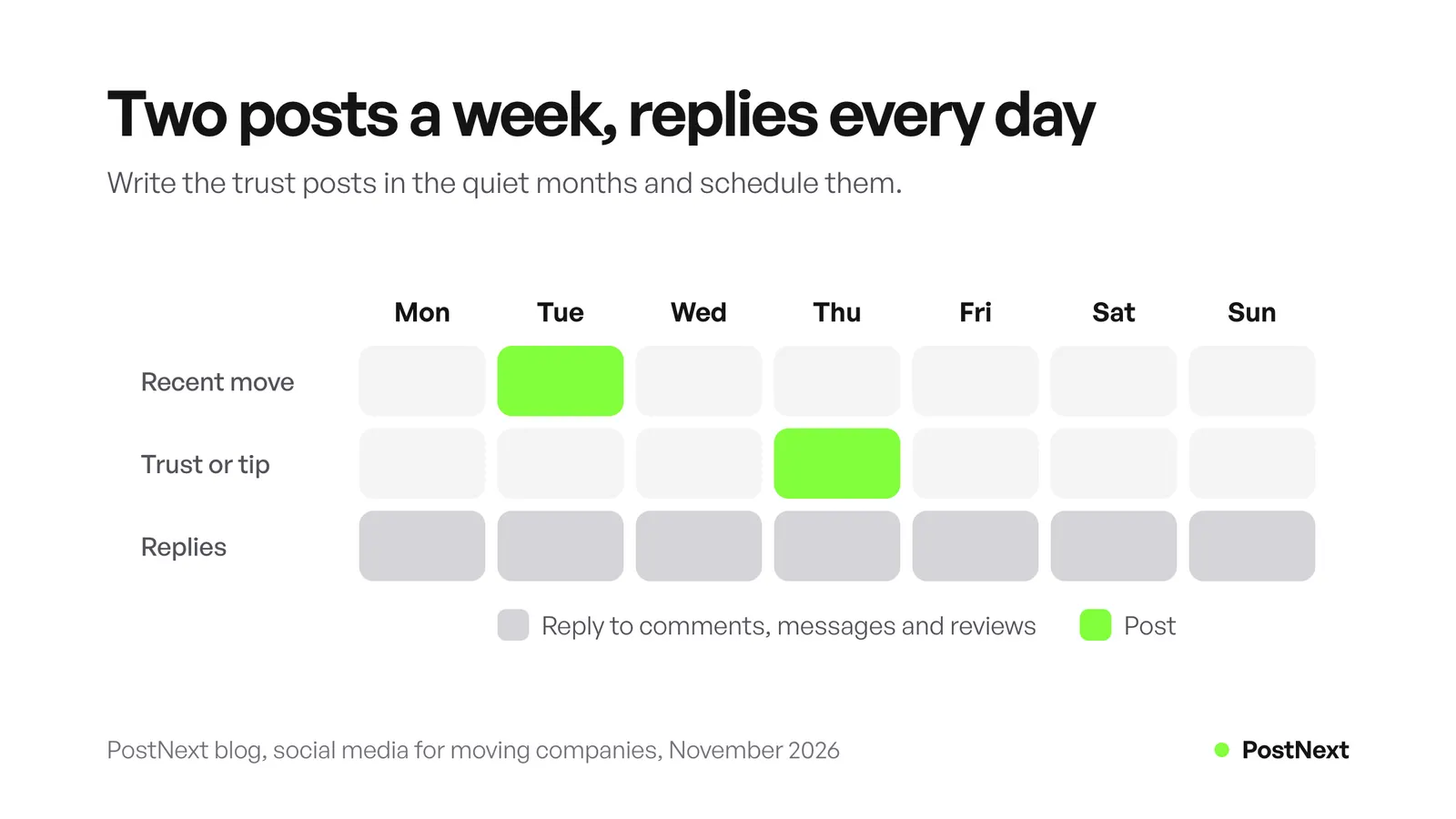
Your busy months leave no time for posts, so write the trust posts in the quiet months and schedule them ahead.
- Tuesday: a move from last week, shot with permission and without the address.
- Thursday: a trust post, a money post or a packing tip.
- Every day: reply to comments, messages and new reviews within a day.
The trust posts do not go out of date. A post on the 110 percent rule is as true next year as today, so publish it again each season. Cleaning companies that do move-out cleans have the same rhythm; our guide to social media for cleaning services covers the before-and-after side of it.
How should movers handle reviews and messages?
Reply to every review and message within a day. BrightLocal’s 2026 survey found 89% of consumers expect owners to respond to reviews, and 80% are likely to use a business that responds to all of its reviews. The FTC tells customers to search your name with “complaint.” Your reply to a bad review is what they find next to it.
Write each reply by hand. BrightLocal found 50% of consumers are put off by templated replies. For a damage complaint, apologise once, say how to file a claim, and remind them they have 9 months after delivery to do it. Offer a phone call. The next customer reads how you handled the broken lamp, not the lamp.
Ask for reviews on moving day, once the last box is in, by text with a direct link. Rating floors are rising: 68% will only use a business with 4 stars or more, up from 55% in 2025. Our guide to social media for plumbers has the review-request steps in detail.
On Instagram, one link fits in your profile. Point it to your quote form. If you need more than one link, a page such as More.You can hold the link in your bio.
How does PostNext help a moving company?
PostNext lets a mover plan a season of trust posts, packing tips and job photos in one sitting and publish each at its time. It posts to Instagram, TikTok, LinkedIn, X, YouTube, Threads and Bluesky from one calendar. Repeat this post sends a recurring post every 1 to 365 days, weeks or months.
Set your valuation post or your 110 percent rule post to repeat every few months with recurring posts, and it stays in your feed without new work. The web app works in a phone browser, so a crew lead can add a truck photo from the yard. On Instagram, the comment inbox lets you read and reply to comments in one place. It does not cover DMs.
PostNext does not post to Facebook or Google Business Profile today, and most movers need both. Both are listed as coming soon on the pricing page. Schedule those in Meta Business Suite and in your Google profile for now, and use PostNext for Instagram or YouTube. The free plan covers 1 channel, 10 posts and 10 AI credits a month. The pricing page also shows what the paid plans add. PostNext for moving companies has a weekly posting plan and caption templates you can copy. For the wider local plan, read our guide to social media marketing for local business.
Frequently Asked Questions
What should a moving company post on social media?
Post careful details, packed trucks, your team, packing tips, real reviews with permission, and trust posts that answer the FMCSA’s red flags. Add your USDOT number, how estimates work and what valuation pays. Two posts a week is enough: one move and one tip or trust post.
Do movers have to show their USDOT number in ads?
Interstate household goods movers do. Federal rules say every advertisement shows the mover’s name as registered and “U.S. DOT No.” followed by the number. The rule does not name social media, so treat any post that sells an interstate move as an ad and include the number.
What is the difference between a binding and a non-binding estimate?
On a binding estimate, the customer pays no more than 100% of it at delivery. On a non-binding estimate, the FMCSA says the customer pays no more than 110% at delivery, and the mover bills any extra charges 30 days after delivery.
What is Released Value protection?
Released Value is the free option interstate movers must offer. The mover pays no more than 60 cents per pound per article. The FMCSA’s example: a 25-pound TV that is lost or damaged gets $15. Full Value Protection is the default unless the customer signs for Released Value.
Can movers post photos of a customer’s home?
Only with the customer’s permission, and only after the move. Never show the new address, house number, street sign or car plate, and keep names off box labels in the shot. A photo of the crew, the truck or a wrapped item tells the story without locating anyone.
Which social media platform is best for a moving company?
Facebook and a Google Business Profile matter most for most movers. Pew’s 2026 survey found 70% of US adults use Facebook and 18% use Nextdoor, which has free Business Pages for home service providers. Add Instagram or YouTube for short videos of the work.
Sources
- FMCSA, Spot the Red Flags, last updated November 2024, checked November 2026.
- FMCSA, Protect Your Move and Steps to Select a Mover, last updated November 2024, checked November 2026.
- FMCSA, Valuation and Insurance, last updated November 2024, checked November 2026.
- FMCSA, Protect Your Move FAQ (binding and non-binding estimates, brokers, mover search), checked November 2026.
- US Federal Trade Commission, Avoid scams when you hire a moving company, September 2024, checked November 2026.
- 49 CFR 375.207, advertising rules for household goods movers, and 49 CFR 375.103, definitions, checked November 2026.
- BrightLocal, Local Consumer Review Survey 2026, 1,002 US adults, February 2026, checked November 2026.
- Pew Research Center, Social Media Fact Sheet, October 2026, checked November 2026.
- Google Business Profile Help, service-area businesses, checked November 2026.
- Nextdoor, Nextdoor for small business, checked November 2026.
- Buffer, Consistent Posting Study (buffer.com/resources/consistent-posting-study), January 2025, checked November 2026. Buffer sells a scheduling tool.
- PostNext, small business page and pricing page, checked November 2026.