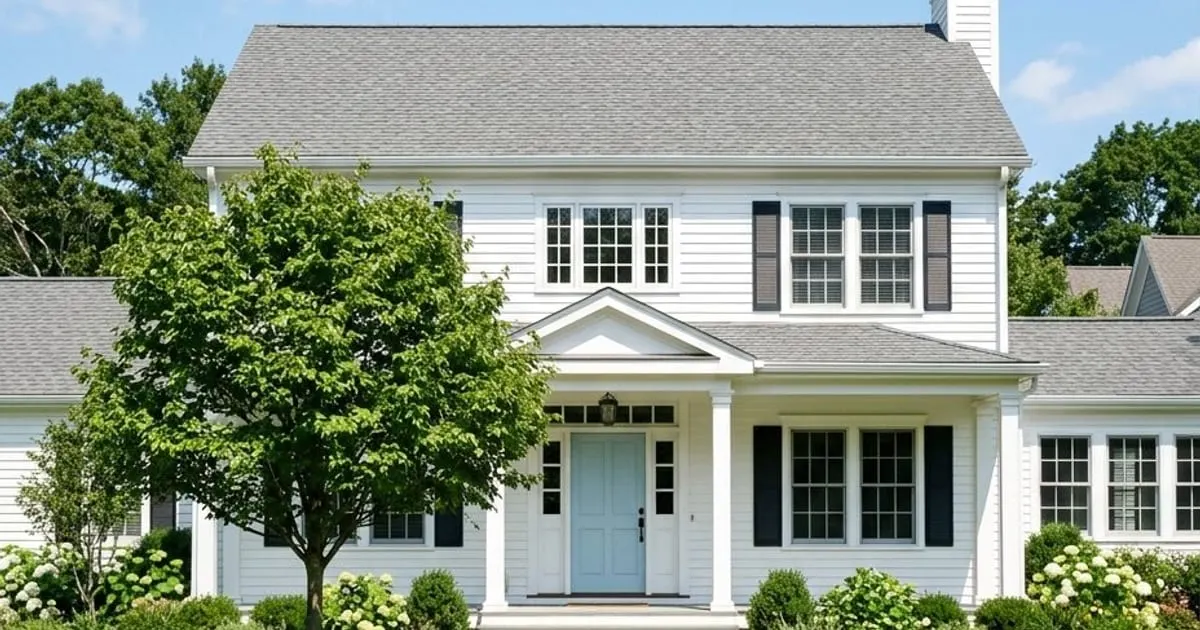
Social media for roofers works as proof before the quote. Homeowners check you before they let you on the roof: BrightLocal’s 2026 survey found 97% of US consumers read reviews for local businesses. After a storm, the FTC tells them to check your license, insurance and reviews. Roofing social media posts that show those things win the call. This PostNext guide shows what to post, and when.
Key Takeaways
- Homeowners check you first: 97% of consumers read local reviews, and 68% will only use a business with 4 stars or more.
- Regulators give homeowners 5 checks after a storm: a local name, a license, insurance, a written contract and no cash up front. Post each one before storm season.
- Facebook and Nextdoor reach local homeowners: 70% of US adults use Facebook and 18% use Nextdoor.
- Follow NRCA’s schedule: it recommends roof inspections at least twice a year, in spring and fall, and after severe storms.
- Safety is content: falls caused 389 of the 1,034 construction deaths in 2024. Show your harnesses and anchors.
- Drone photos for your business need FAA Part 107: a Remote Pilot Certificate and a $5 drone registration.
- Two posts a week is enough: accounts that posted in 20 of 26 weeks got 450% more engagement per post.
Does social media work for roofers?
Social media works for roofers as a trust check before the quote. A roof is a large purchase that people make rarely, and homeowners compare roofers before they sign. The FTC tells them to get estimates from more than one contractor and to read reviews on sites they trust. Your posts and reviews are what they compare. A feed of local jobs shows that your company will still be here next year.
| Where homeowners check a roofer | What they look for | Data |
|---|---|---|
| Reviews on Google, Facebook and Yelp | Star rating, recent reviews, owner replies | 97% read local reviews (BrightLocal, 2026) |
| Your Google Business Profile | Service area, hours, photos, phone | 71% use Google for reviews (BrightLocal, 2026) |
| Your Facebook Page or Nextdoor | Recent local jobs, replies, recommendations | 70% of US adults use Facebook, 18% Nextdoor (Pew, 2026) |
| AI assistants | A short list of local businesses | 45% used AI tools for local recommendations (BrightLocal, 2026) |
| An online search after a referral | Proof that the name is real and active | 74% of homeowners research a referral online first (Scorpion, 2026) |
BrightLocal Local Consumer Review Survey 2026 (1,002 US adults), Pew Research Center Social Media Fact Sheet 2026 (5,511 US adults), and a Scorpion survey of 2,000 homeowners (Scorpion sells marketing). Checked November 2026.
Social media will not fill your calendar on its own. Many homeowners start from a referral or a search, then look the roofer up before they call. Your feed decides which quote they trust. A roofer with fifty dated local jobs on Facebook looks safer than one with a logo and a phone number. Our list of social media myths that local businesses believe covers the other half: what posting cannot do for you.
How do roofers stand out from storm chasers?
Show, before the storm, everything homeowners are told to check after it. The FTC, FEMA and state attorneys general give the same advice: hire a local contractor that people know, check the license and insurance, get a written contract, and never pay cash up front. A roofer whose feed shows years of local jobs, a license number and real reviews passes those checks before the door-knockers arrive.
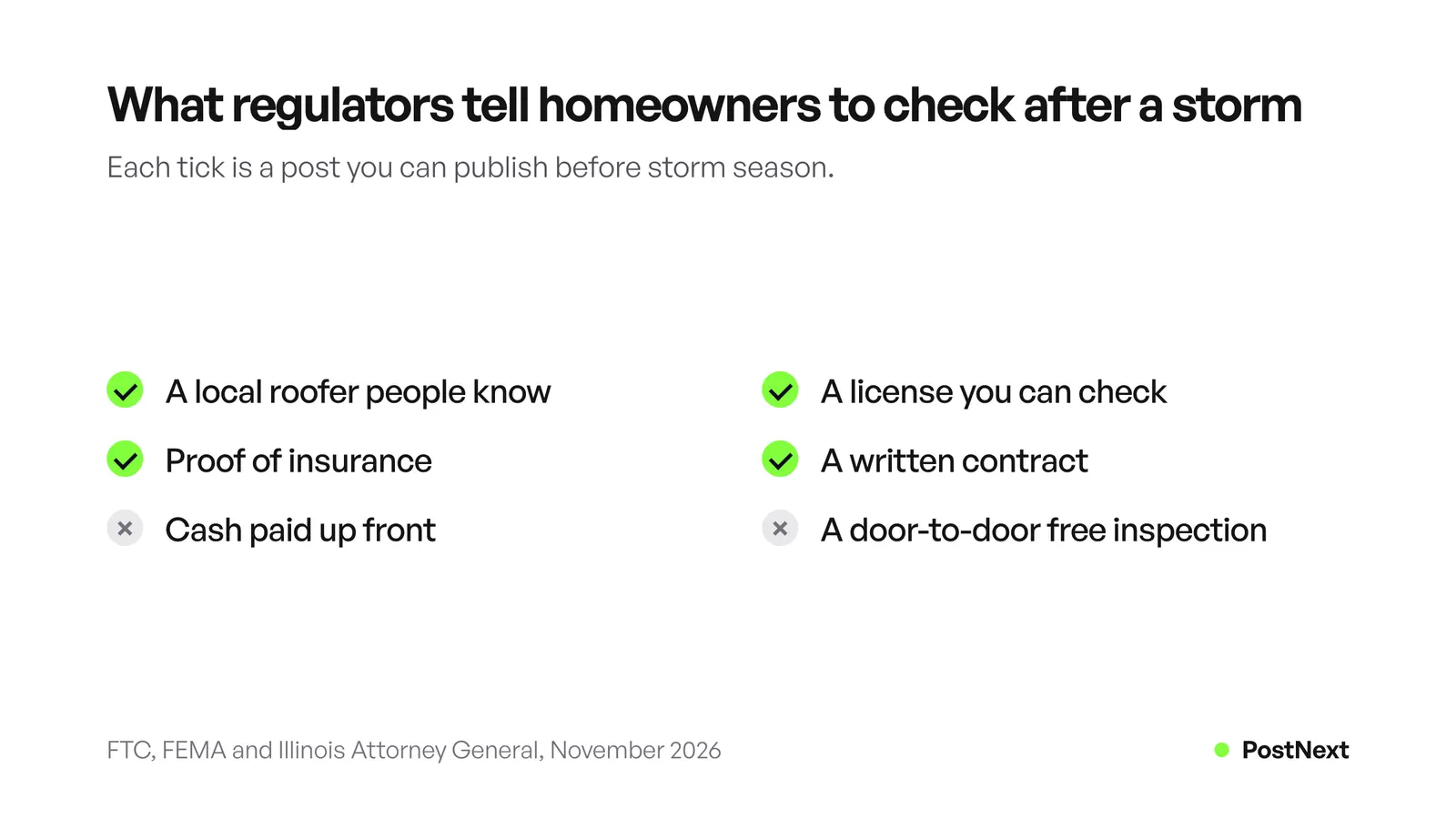
The warnings are blunt. The FTC says “unlicensed contractors and scammers often appear in recovery zones” and “if they want cash up front, walk away.” FEMA says “out-of-town scam artists may be the first to arrive at your front door”. FEMA also recommends “a local contractor, someone who is known in the community.” Each of these 5 checks is a post you can publish in a quiet month:
| What homeowners are told to check | Who says it | The post that answers it |
|---|---|---|
| A local contractor people know | FEMA | Finished jobs tagged with the town, month after month |
| A license they can look up | FTC, Illinois Attorney General | Your license number in the profile, and how to check it |
| Proof of insurance | FTC | A post that says you carry insurance and will show the certificate |
| A written estimate and contract | FTC | A photo of your estimate form, with what it lists |
| No cash or full payment up front | FTC, FEMA | Your payment terms in plain words |
FTC consumer advice on weather emergencies (September 2025), FEMA fact sheet on contractor fraud (September 2025) and the Illinois Attorney General storm alert (June 2023). Checked November 2026.
Then avoid the storm chaser’s habits in your own posts. The Illinois Attorney General warns about contractors who go door to door offering “free” inspections. The FTC warns about discounts that last “only if you sign a contract right away.” A post that says “storm special, sign by Friday” reads like the scam homeowners were warned about. Offer an inspection on your page, with no deadline. A sale signed in the home also carries a 3-day right to cancel under the FTC Cooling-Off Rule, which window installers can post about the same way.
Be careful with insurance claims too. In Texas, the Department of Insurance says it is illegal for a contractor to offer to waive or absorb a deductible. A roofer cannot act as a public adjuster or advertise that they will, and the law counts a website as advertising. Its examples include promising to recover “every dime you are owed” from an insurer. Check your own state’s rules before you post about claims. Other trades have word rules too: pest control posts may not call a treatment “safe”.
A post that teaches helps more than a post that sells. Explain that the NAIC says homeowners do not have to sign an assignment of benefits to get repairs done. Repeat the FTC’s advice never to sign an insurance check over to a contractor. A post like this is worth sharing after a storm, and your name goes with it.
Which social media platforms should roofers use?
Most roofers need a Google Business Profile, a Facebook Page and Nextdoor, with Instagram and YouTube for photo and video work. Pew’s 2026 survey of 5,511 US adults found 70% use Facebook, 51% use Instagram, 84% use YouTube and 18% use Nextdoor. Homeowners also write reviews on Facebook more than anywhere but Google: 34% did in the past year.
| Platform | Best job for a roofer | Why |
|---|---|---|
| Google Business Profile | Service area, reviews, photos of jobs | Up to 20 service areas, about 2 hours of driving |
| Facebook Page | Jobs, tips, reviews, local groups after a storm | 70% of US adults; 34% wrote a review there |
| Nextdoor | Recommendations from neighbours | Free Business Page for home service providers |
| Before-and-after photos, drone shots | 51% of US adults | |
| YouTube | Short clips: a tear-off, a finished roof, a safety talk | 84% of US adults |
Reach figures from Pew Research Center 2026; review figure from BrightLocal 2026; Google and Nextdoor from their own help pages. Checked November 2026.
Pick two and keep them active. Google calls a business that visits customers a service-area business, so list the towns you serve and hide your address if customers never come to it. Then add Facebook, where neighbours ask “does anyone know a good roofer?” after a hailstorm.
What should roofers post on social media?
Post the work, the safety, and advice that homeowners can use. A before-and-after of a storm-damaged roof and the clean replacement shows your work in one look. A short tip on what to check from the ground gives people a reason to save your post. None of these needs you on camera. Rotate the seven types below.
- Before and after. Same angle, one line on what you did. Ask the homeowner first and keep house numbers out of the frame.
- The detail. Flashing around a chimney, a clean valley, a straight ridge. One sentence on why it matters for leaks.
- The seasonal tip. Spring and fall inspections, what to do after hail. See the plan below.
- The safety post. Falls caused 389 of the 1,034 construction deaths in 2024, OSHA says, and roofers need fall protection at 6 feet or more above a lower level. Show the harness, the anchor and the guardrail. OSHA asks companies that hold a safety stand-down to post it with #StandDown4Safety. Homeowners read a careful crew as a careful company.
- The ground-check tip. NRCA does not recommend that homeowners walk on roofs. Post what they can see from the ground instead: curling or split shingles, and debris in gutters and valleys.
- A real review. A recent review as a post, with the customer’s first name and their permission.
- The drone photo. A roof from above shows the whole job. The FAA says that to fly a drone under 55 pounds “for work or business,” you follow Part 107: pass a test for a Remote Pilot Certificate and register the drone, which costs $5 and lasts 3 years. If you do not have the certificate, take photos from the ground or a ladder.
Sharp phone photos are enough. Take one before, one after and one wide shot on every job. Finish trades add a close detail too, like the grout lines in our guide to what tilers should post. For more ideas sorted by goal, see our guide to what to post on social media for business.
What is a seasonal social media plan for roofers?
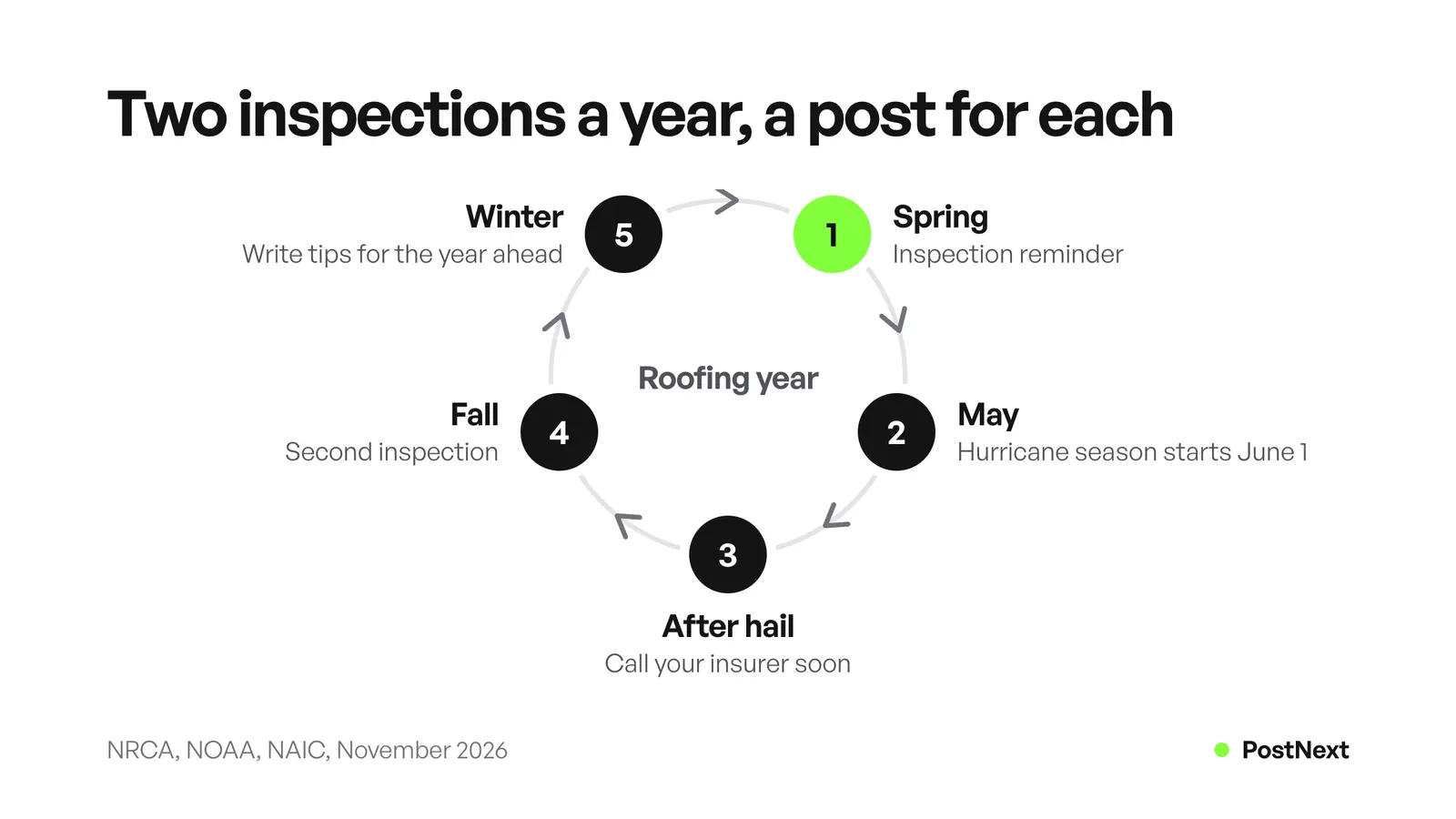
A seasonal plan ties your posts to the weather homeowners worry about, so you never start from a blank page. NRCA recommends roof inspections at least twice a year, in spring and fall, plus checks after hurricanes, tornadoes and hailstorms. The Atlantic hurricane season runs from June 1 to November 30. Each row below comes from a public source.
| When | Post idea | Source |
|---|---|---|
| Spring | Inspection reminder after winter; what to look for from the ground | NRCA |
| May | Get ready before the Atlantic hurricane season starts on June 1 | NOAA National Hurricane Center |
| After a hailstorm | Hail of 1 inch (quarter size) or larger is severe; call your insurer as soon as possible | NOAA NSSL, NAIC |
| Storm weeks | How to spot a storm chaser: no cash up front, a written contract, a license to check | FTC, FEMA |
| Fall | Second inspection; clear debris from valleys, gutters and drains | NRCA |
| Any month | Your crew in harnesses, and your license and insurance | OSHA, FTC |
NRCA guidance in Professional Roofing (October 2013), NOAA National Hurricane Center and National Severe Storms Laboratory pages, NAIC consumer insight, FTC and FEMA consumer pages. Checked November 2026.
Write the storm posts before the storm. On the day after hail, you will be on roofs and the phone will not stop. A “what to do after a storm” post written in March can go out that evening with one new photo. Plan the inspection reminders once a year, and add one fresh job photo each week.
How often should a roofer post on social media?
Two posts a week on each channel is enough for a roofing company: one recent job and one tip, review or safety post. Buffer’s study of more than 100,000 users found that accounts posting in 20 or more of 26 weeks got 450% more engagement per post than accounts posting in 4 weeks or fewer. A steady winter matters as much as a busy summer.
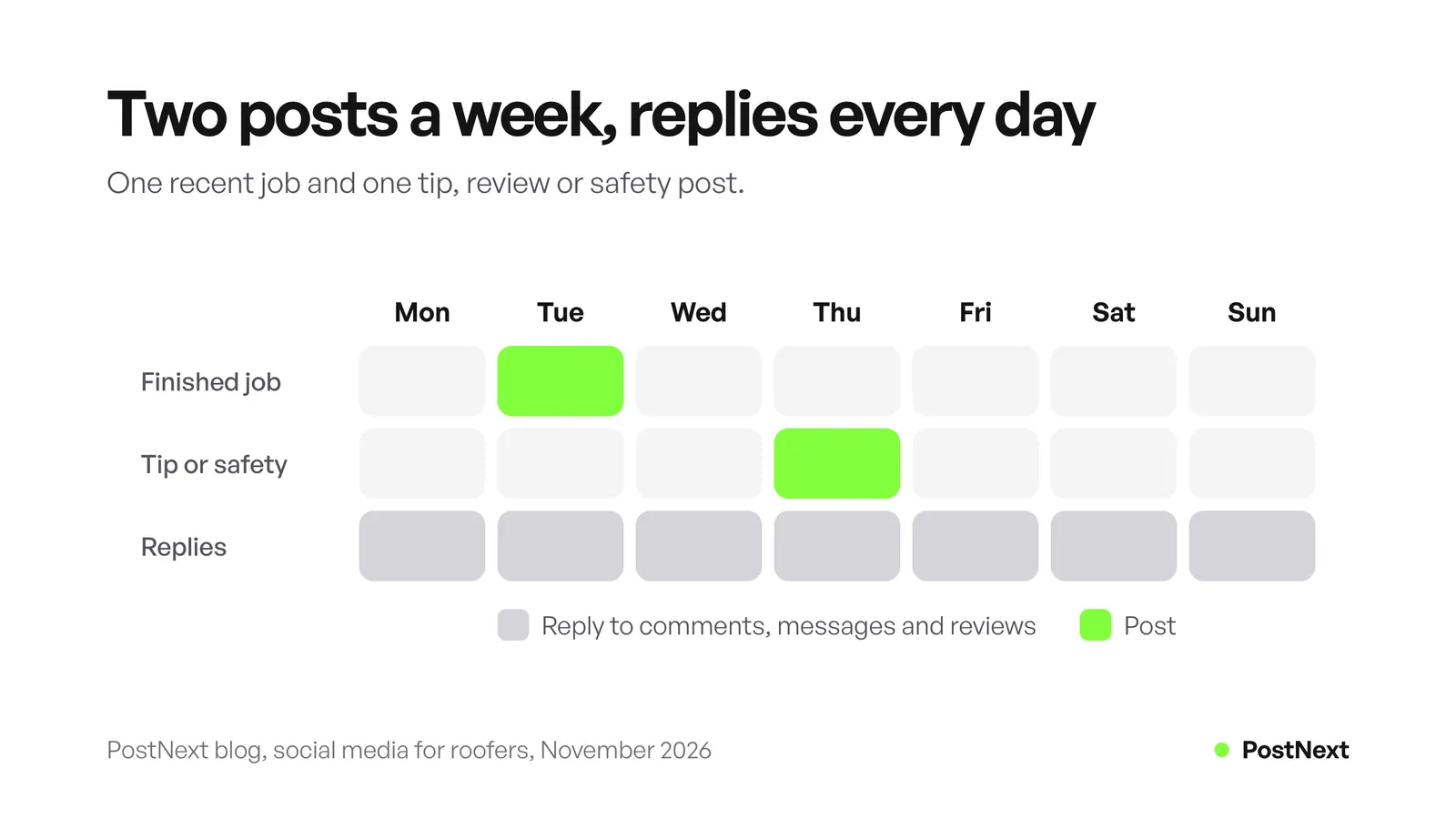
Roofing is seasonal, so use winter for the tips, safety posts and license posts for the year ahead.
- Tuesday: a finished job or before-and-after from the past week.
- Thursday: a seasonal tip, a safety post or a review.
- Every day: reply to comments, messages and new reviews within a day.
How should roofers handle reviews and messages?
Reply to every review and message within a day. In Scorpion’s survey of 2,000 homeowners, 88% expect a response within 24 hours. BrightLocal’s 2026 survey found 89% of consumers expect owners to respond to reviews, and 80% are likely to use a business that responds to all of its reviews.
Write each reply by hand. BrightLocal found 50% of consumers are put off by templated replies. Thank the customer by name, name the job, and keep it to two sentences. For a bad review, apologise once, say what you will fix, and offer a phone call. The next homeowner reads your reply more closely than the complaint.
Ask for reviews on the day you finish, by text, with a direct link. Rating floors are rising: 68% will only use a business with 4 stars or more, up from 55% in 2025. The approach is the same as for any trade; our guide to social media for plumbers has the review steps in detail.
How do roofers get leads from social media?
Make it easy to call from every profile and post. Put your phone number, service area, license number and hours in each profile. End job posts with the town and one line, such as “Free roof inspections in Riverside, call us.” Then ask every new customer how they found you, and write the answer next to the job.
On Instagram, one link fits in your profile. Point it to your booking or quote form. If you need more than one link, a page such as More.You can hold the link in your bio.
Local groups matter most after a storm. Neighbours ask for recommendations in Facebook groups and on Nextdoor. Join as yourself, answer questions without selling, and let past customers recommend you. Our guide to social media marketing for local business covers groups and local pages in more detail.
How does PostNext help a roofing business?
PostNext lets a roofer plan a season of tips, safety posts and job photos in one sitting and publish each at its time. It posts to Instagram, TikTok, LinkedIn, X, YouTube, Threads and Bluesky from one calendar. Repeat this post sends a recurring post every 1 to 365 days, weeks or months.
Set an inspection reminder to repeat every 6 months with recurring posts, and it goes out each spring and fall. The web app works in a phone browser, so you can add a job photo from the truck. On Instagram, the comment inbox lets you read and reply to comments in one place. It does not cover DMs.
PostNext does not post to Facebook or Google Business Profile today, and most roofers need both. Both are listed as coming soon on the pricing page. Schedule those in Meta Business Suite and in your Google profile for now, and use PostNext for Instagram or YouTube. The free plan covers 1 channel, 10 posts and 10 AI credits a month. The pricing page also shows what the paid plans add. PostNext for roofers has a weekly posting plan and caption templates you can copy.
Frequently Asked Questions
What should a roofer post on social media?
Post before-and-after photos, roof details, seasonal tips, safety posts, real reviews with permission, and your license and insurance. Rotate them so you never start from a blank page. Two posts a week is enough: one job and one tip.
Which social media platform is best for roofers?
Facebook and a Google Business Profile matter most for most roofers. Pew’s 2026 survey found 70% of US adults use Facebook and 18% use Nextdoor, which has free Business Pages for home service providers. Add Instagram or YouTube if you have good photos or drone footage.
How often should a roofing company post?
Two posts a week on each channel, all year. Buffer’s study of more than 100,000 users found accounts that posted in 20 or more of 26 weeks got 450% more engagement per post than accounts that posted in 4 weeks or fewer.
Can a roofer post drone photos of a job?
Yes, if the flight follows FAA rules. The FAA says a drone under 55 pounds flown for work or business falls under Part 107. The pilot needs a Remote Pilot Certificate, and the drone must be registered, which costs $5 and lasts 3 years.
How can a roofer show they are not a storm chaser?
Post what homeowners are told to check: years of local jobs, a license number they can look up, proof of insurance, a written estimate and fair payment terms. FEMA recommends a local contractor who is known in the community, so a long feed of local work helps.
Should roofers offer free inspections on social media?
Yes, on your own page, with no deadline and no pressure. The Illinois Attorney General warns homeowners about contractors who go door to door with “free” inspections, and the FTC warns about discounts that need a signature right away. Avoid both shapes in your posts.
Sources
- US Federal Trade Commission, How To Avoid Scams After Weather Emergencies and Natural Disasters, September 2025, checked November 2026.
- FEMA, Beware of Post-Disaster Contractor Fraud, fact sheet, September 2025, checked November 2026.
- Illinois Attorney General, storm-related repair scams alert, June 2023, checked November 2026.
- Texas Department of Insurance, Roofing and insurance: Know the law, updated March 2025, checked November 2026.
- NAIC, After the storm, read the fine print, checked November 2026.
- NRCA, routine maintenance for residential roof systems, Professional Roofing, October 2013, checked November 2026.
- NOAA National Hurricane Center, Tropical cyclone climatology, and NOAA National Severe Storms Laboratory, Severe Weather 101: Hail, checked November 2026.
- OSHA, Fall Prevention Campaign, National Safety Stand-Down and re-roofing fact sheet, checked November 2026.
- FAA, Certificated Remote Pilots including Commercial Operators, updated March 2025, checked November 2026.
- BrightLocal, Local Consumer Review Survey 2026, 1,002 US adults, February 2026, checked November 2026.
- Scorpion, The state of home services marketing, survey of 2,000 homeowners, January 2026, checked November 2026. Scorpion sells marketing services.
- Pew Research Center, Social Media Fact Sheet, October 2026, checked November 2026.
- Google Business Profile Help, service-area businesses, checked November 2026.
- Nextdoor, Nextdoor for small business, checked November 2026.
- Buffer, Consistent Posting Study, January 2025, checked November 2026.
- PostNext, small business page and pricing page, checked November 2026.