
Social media for real estate agents keeps your name in front of people between moves. Sellers in NAR’s 2026 report had owned their home for a median of 12 years, and 92% sold with an agent. Weekly posts of listings, local knowledge and closed deals remind them who that agent is. This PostNext guide covers platforms, a weekly plan and the advertising rules every post follows.
Key Takeaways
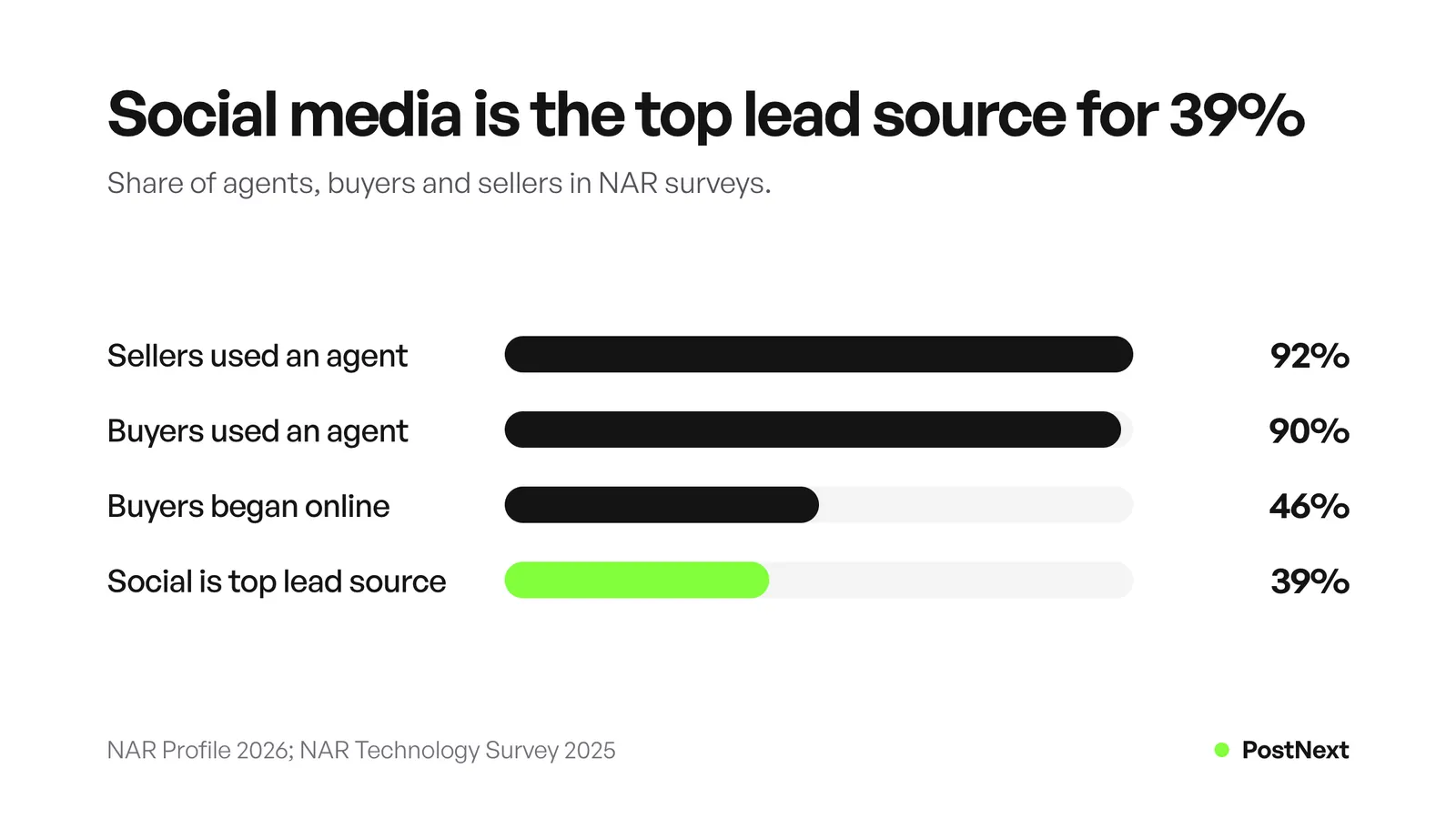
- Social media is the top lead source agents name: 39% picked it in NAR’s 2025 technology survey, ahead of CRM software at 23%.
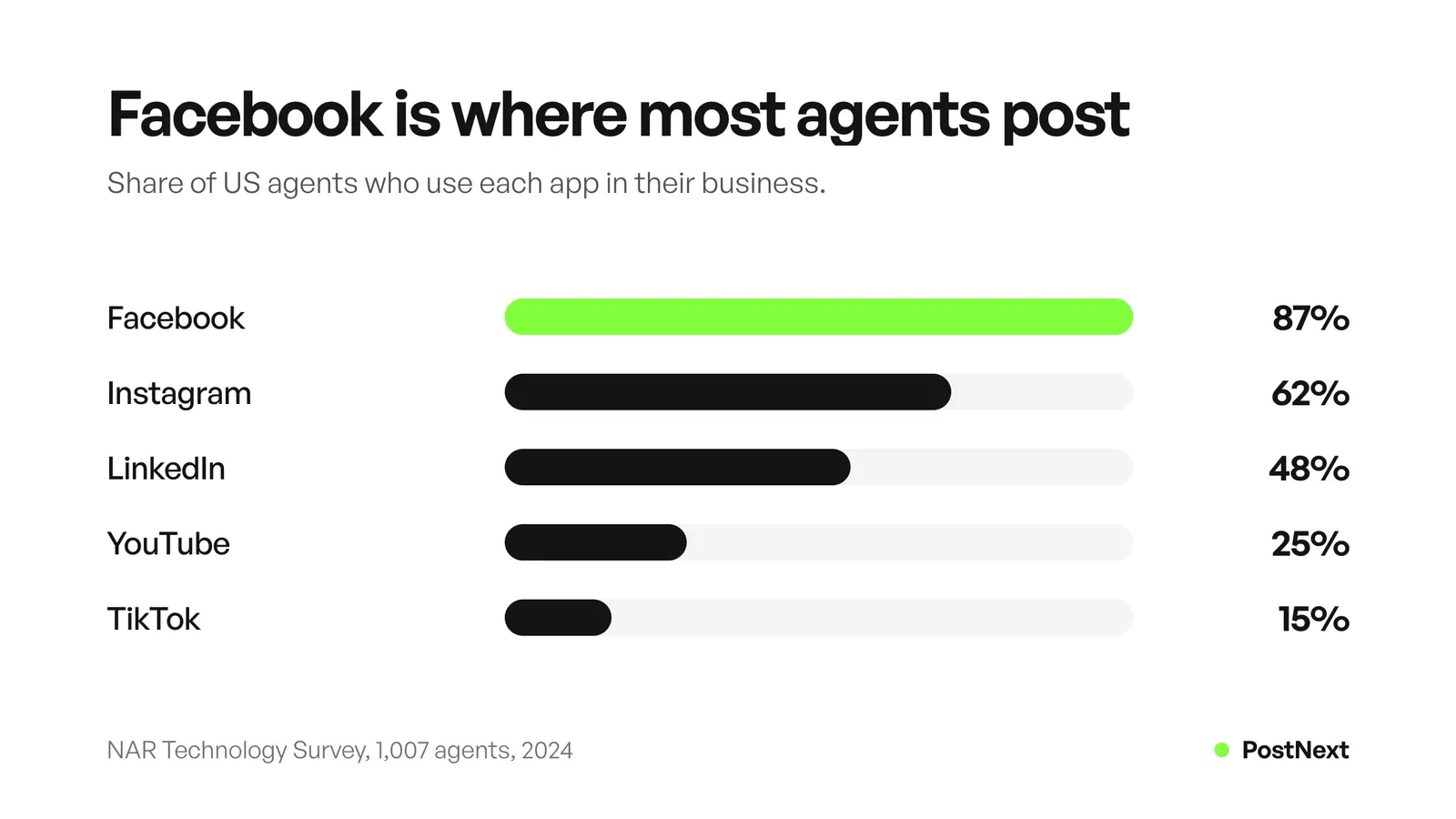
- Facebook first, then Instagram and LinkedIn: 87%, 62% and 48% of agents use them for business (NAR, 2024).
- Referrals still lead: 4 in 10 buyers came to their agent through a friend, neighbour or relative, and 1% through an AI search (NAR 2026 Profile, as reported by Real Estate News).
- Every post is an advert: NAR’s Standard of Practice 12-5 asks for your firm’s name, and California asks for your 8-digit licence number on electronic ads.
- Only claim a sale you worked on: under Standard of Practice 12-7, only the listing or selling broker may say “sold”.
- Three posts a week is enough: one listing or sale, one piece of local knowledge, one post about you.
- Reviews carry weight: 97% of consumers read reviews for local businesses, and the FTC has banned buying them since October 2024.
Does social media work for real estate agents?
Social media works for agents as a lead source and as a memory aid for past clients. In NAR’s 2025 technology survey, 39% of agents said social media brought them the most quality leads, more than any other tool. Its bigger job is slower. Sellers wait a median of 12 years between moves, and your posts keep your name familiar in that gap.
| What the data says | Number | Source |
|---|---|---|
| Buyers who used an agent or broker | 90% | NAR 2026 Profile |
| Sellers who used an agent | 92%, a record | NAR 2026 Profile |
| Median years in the home before selling | 12 | NAR 2026 Profile |
| Buyers whose first step was looking online | 46% | NAR, November 2026 |
| Agents who say social media gives the most quality leads | 39% | NAR 2025 Technology Survey |
| Buyers who found their agent through an AI search | 1% | NAR 2026 Profile, as reported by Real Estate News |
NAR Profile of Home Buyers and Sellers 2026 (7,125 buyers, July 2025 to June 2026) and NAR REALTORS Technology Survey 2025 (1,241 agents), checked November 2026.
The case against spending hours here is real. Real Estate News, reporting the 2026 Profile, found that 4 in 10 buyers were referred to their agent by a friend, neighbour or relative. It also found that only 24% of repeat buyers used the agent they had worked with before, even though 88% of buyers say they would use their agent again or recommend them. Liking an agent does not mean going back to them. Regular posts are a cheap way to close that gap, next to a yearly call to past clients.
Which social media platforms should real estate agents use?
Most agents should run a Facebook profile or Page, Instagram and a LinkedIn personal profile, in that order. NAR’s 2024 technology survey found 87% of agents use Facebook in their business, 62% use Instagram, 48% use LinkedIn, 25% use YouTube and 15% use TikTok. Pick two you can keep active every week, and add a Google Business Profile.
| Platform | Best job for an agent | Data |
|---|---|---|
| Past clients, local groups, open house events | 87% of agents; 70% of US adults | |
| Listing photos as carousels, tours as Reels, the neighbourhood | 62% of agents; 64% of US adults aged 30 to 49 | |
| Relocation, investors, your professional network | 48% of agents; 51% of US college graduates | |
| YouTube | Longer home tours and area guides | 25% of agents; 84% of US adults |
| TikTok | Short tours for younger buyers | 15% of agents; 37% of US adults |
| Google Business Profile | Reviews and your name in local search | Google names real estate agents as individual practitioners |
Agent figures from NAR 2024 Technology Survey (1,007 agents); adult figures from Pew Research Center Social Media Fact Sheet 2026 (5,511 US adults); Google from its Business Profile guidelines. Checked November 2026.
Match the platform to the buyer. First-time buyers in the 2026 Profile had a median age of 40, and Pew found 64% of adults aged 30 to 49 use Instagram. Repeat buyers are 78% of all buyers, with a median age of 62 and a median household income of $127,000. Pew found LinkedIn reaches 45% of US households earning $100,000 or more, which makes it a fit for that group.
Post to LinkedIn under your own name, because people hire an agent, not a brokerage logo. Our LinkedIn post ideas give 30 formats to start from. On Google, if you are the only agent at a branded office, Google’s guidelines say to share one profile named in the format “Brokerage: Your Name”.
What should real estate agents post on social media?
Post the homes, the area and yourself, in roughly equal parts. A feed of listings alone reads like a portal. A feed of local knowledge and closed deals shows that you know the streets and get results. Rotate these seven post types, and every week has something to say even with no new listing.
- The new listing. A carousel of the best photos, with the price, beds, baths and one line about the home. Our Instagram carousel ideas give slide-by-slide outlines you can adapt.
- The video tour. A 30 to 60 second walk through the rooms, filmed on a phone and held steady.
- Just sold. The front of the house, the days on market if it helps the seller, and thanks to your client with their permission. Only post it if you were the listing or selling broker.
- Local knowledge. A café, a park, a school run, a new road. Describe places and things to do, never the kind of person who should live there.
- The market in one number. Median price or days on market for your area this month, with the source named.
- A client review. A real review in the client’s words, with their first name and their permission.
- You at work. A showing, a closing table, a home inspection. Buyers and sellers want to see who they will spend weeks with.
Check that your contract with the listing photographer covers social media use. Your clients will also need a mover, and our guide to social media for moving companies shows what a trustworthy one posts. For more ideas sorted by goal, see our list of what to post on social media for business.
What rules apply to real estate posts on social media?
A real estate post is an advert, so the same rules apply as to a sign or a flyer. The Fair Housing Act bars wording or images that show a preference by race, colour, religion, sex, disability, familial status or national origin. NAR’s Code of Ethics asks for your firm’s name in every ad. Your state may add a licence number.
| Rule | What it means for a post | Source |
|---|---|---|
| Fair Housing Act, 24 CFR 100.75 | No words, photos or symbols that show who the home is “for” by a protected class; no picking media to keep groups from seeing the ad | eCFR, US federal regulation |
| NAR Standard of Practice 12-5 | Your firm’s name in the post, or a link to a page with all required disclosures | NAR Code of Ethics 2026 |
| NAR Standard of Practice 12-7 | Only the listing or selling broker may claim a home is “sold” | NAR Code of Ethics 2026 |
| NAR Standard of Practice 12-10 | No content made by others without credit or permission, and no misleading images | NAR Code of Ethics 2026 |
| California Regulation 2773 | Your 8-digit licence number and your broker’s name on electronic ads, in type no smaller than the rest | California DRE |
| California B&P 10140.8 | Say clearly when a listing photo was digitally changed, including with AI, and make the original available | California DRE advisory, March 2026 |
| FTC Consumer Reviews Rule | No fake reviews, no paying for positive reviews, no fake followers or views | FTC, in effect October 21, 2024 |
Rule text read on eCFR, the NAR 2026 Code of Ethics (effective January 1, 2026), the California DRE and FTC.gov, November 2026. Ask your broker or state regulator for the rules in your state.
Fair housing is where friendly copy goes wrong. “Perfect for a young couple” can read as a preference on familial status, because it describes the buyer and not the home. “Two bedrooms, 10 minutes walk to the train” describes the home. The same rule covers paid posts: 24 CFR 100.75 counts choosing media or locations that keep parts of the market from seeing a housing ad.
AI tools raise a newer risk. California’s Department of Real Estate warned in March 2026 that agents “must independently verify factual claims” in AI-written copy. It also warned that “use of an AI tool will not excuse the violation.” Check every number in a caption before it goes out.
What does a weekly posting plan look like for a real estate agent?
Three posts a week on each active platform is a plan most agents can keep. Monday shows a listing or a sale, Wednesday shares local knowledge, and Friday shows you at work or a client review. Buffer’s study of more than 100,000 users found accounts that posted in 20 or more of 26 weeks got 450% more engagement per post than accounts that posted in 4 weeks or fewer.
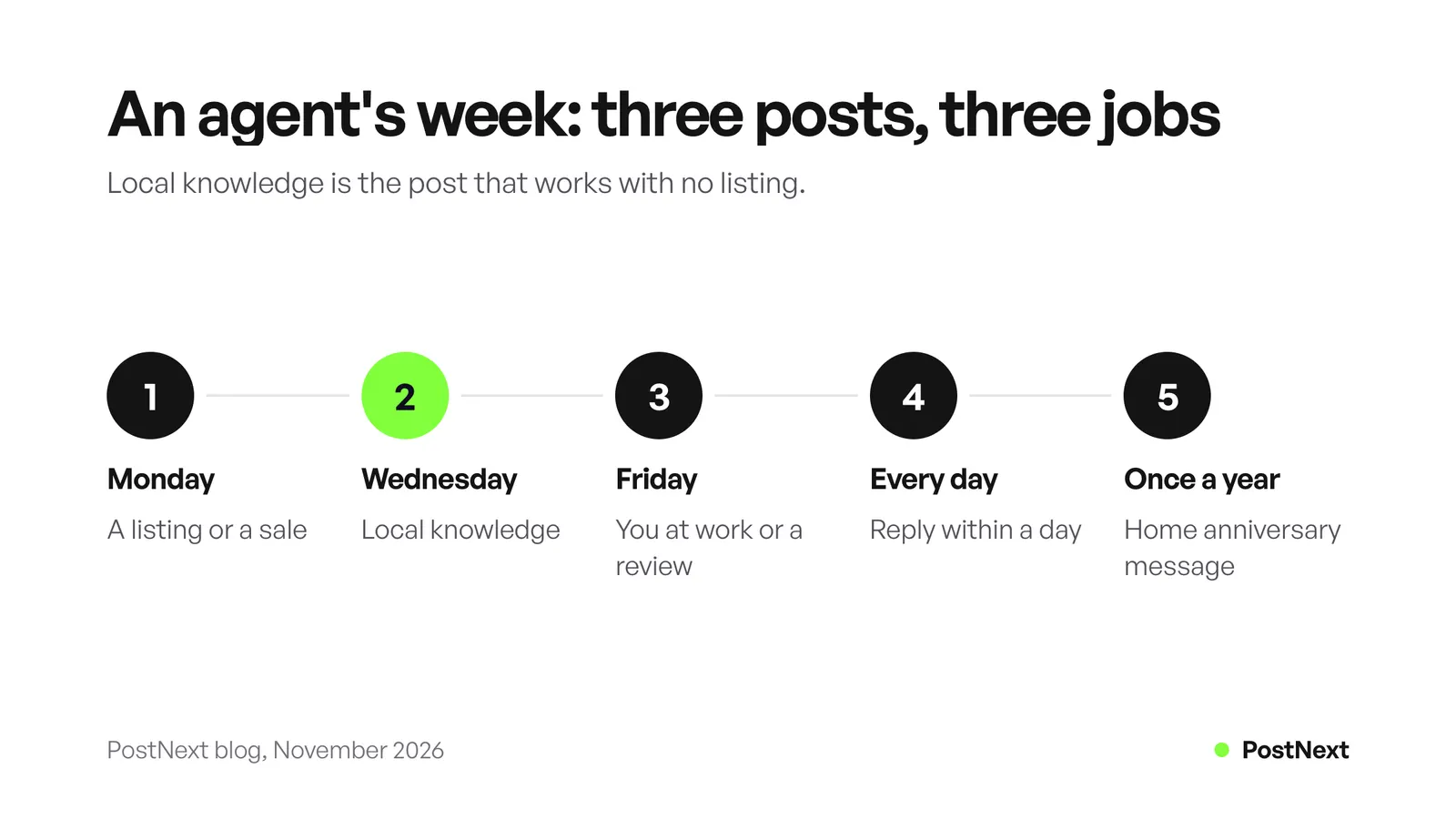
- Monday: a new listing, an open house or a just-sold post.
- Wednesday: local knowledge or the market in one number.
- Friday: you at work, or a client review with permission.
- Every day: reply to comments and messages within a day.
- Once a year: a home anniversary message to each past client.
Wednesday is the post that works with no listing. Write a month of local posts in one sitting: four places, four numbers, four answers to questions buyers ask you. Then each week you only add the Monday listing and a Friday photo from the job.
The home anniversary is the 12-year plan. Note each closing date in your contact list, and send a short private message every year with one local change, such as a new school or road. Social posts keep you visible to everyone. The anniversary message keeps you personal to the people who already know you.
How should real estate agents handle reviews and testimonials?
Ask every client for a review at closing, reply to every review within a day, and never pay for a positive one. BrightLocal’s 2026 survey found 97% of consumers read reviews for local businesses and 89% expect owners to respond. The FTC’s Consumer Reviews and Testimonials Rule, in effect since October 21, 2024, bans buying reviews and faking them.
Asking is allowed. The FTC says “generalized solicitations to purchasers to post reviews” do not break the rule, and a small thank-you is fine if it does not depend on the review being positive. Writing reviews for clients, posting family reviews as client reviews and buying followers or views are not allowed.
Write each reply by hand. BrightLocal found 50% of consumers are put off by templated replies and 80% are likely to use a business that responds to all of its reviews. Thank the client by first name, name the street or the area, not the house number, and keep it to two sentences. When you turn a review into a post, ask the client first and keep their full name out unless they say yes.
How do real estate agents get leads from social media?
Put a way to reach you in every profile and every listing post. Add your phone number, firm name and service area to each bio, end each listing post with one next step such as “Message me for the floor plan”, and keep a link in your bio to your current listings. Then ask every new client how they first heard your name.
On Instagram, the link in your bio is where people go for more. One page with your current listings, a contact form and your booking link is enough; this guide on adding a link to your Instagram bio shows the steps. When a listing post brings many comments asking for the price or the address, CreatorFlow can send the details by DM to everyone who asks.
Leads from social media often arrive looking like referrals: a friend sees your post and passes your name to a neighbour. Ask “where did you first hear my name?” on every first call and record the answer in your CRM. After six months you will know which platform earns your time. Our guide to social media marketing for local business covers the same tracking for any local service, and the plumbers guide shows it in a trade with no listings to post.
How does PostNext help a real estate agent?
PostNext lets an agent plan a week of listing, local and personal posts in one sitting and publish each at its time. It posts to Instagram, TikTok, LinkedIn, X, YouTube, Threads and Bluesky from one calendar. On LinkedIn it publishes to personal profiles only, not Company Pages, which suits an agent who posts under their own name.
Write the open house post once and set Repeat this post to every Saturday morning. Repeats run every 1 to 365 days, weeks or months, stop on a date or after a number of posts, and count toward your monthly posts. Paste the link of a listing page into AI Repurpose and it drafts posts for X, Instagram, LinkedIn and Threads, which you check before anything is published. Instagram carousels take 2 to 10 photos, and a CSV file can add up to 100 posts at once.
PostNext does not connect to the MLS, run ads, answer DMs or follow leads. It does not post to Facebook or Google Business Profile today; both are listed as coming soon on the pricing page, so schedule those in Meta Business Suite and in your Google profile for now. The free plan covers 1 channel, 10 posts and 10 AI credits a month, enough for two posts a week on one channel. PostNext for realtors and real estate agents shows a full listing week, and the LinkedIn scheduler page lists what each LinkedIn post can hold.
Frequently Asked Questions
What should a real estate agent post on social media?
Post new listings, video tours, just-sold posts for deals you worked on, local knowledge, one market number with its source, client reviews with permission, and photos of you at work. Rotate them across three posts a week so you always have something to post, even with no new listing.
Which social media platform is best for real estate agents?
Facebook is the most used: 87% of agents use it for business, according to NAR’s 2024 technology survey. Instagram follows at 62% and LinkedIn at 48%. Most agents do well with Facebook and Instagram, plus LinkedIn for relocation and investor clients.
How often should a real estate agent post on social media?
Three posts a week on each active platform is a plan most agents can keep: a listing or sale, local knowledge, and a post about you. Posting every week matters more than posting every day. Buffer found steady posters got 450% more engagement per post.
Do real estate agents need to put their license number on social media posts?
Yes in some states. California’s Regulation 2773 asks for your 8-digit licence number and your broker’s name on electronic ads that are a first point of contact. NAR’s Standard of Practice 12-5 asks every Realtor to show the firm’s name. Check your state regulator’s advertising rules.
Can real estate agents use AI for social media posts?
Yes, but you are responsible for every word and image. California’s Department of Real Estate says agents must check every factual claim in AI-written copy. Since January 1, 2026, California also requires a clear note when a listing photo was digitally changed, including with AI.
Can I post a “just sold” photo for a home I did not sell?
No, if you are a Realtor. NAR’s Standard of Practice 12-7 says only the listing broker or the selling broker in the deal may claim the home was sold. Before closing, a cooperating broker needs the listing broker’s consent to post a “sold” sign.
Sources
- National Association of REALTORS, 2026 Profile of Home Buyers and Sellers press release, November 5, 2026, checked November 2026.
- National Association of REALTORS, Buyers, sellers rely on agents more than ever, November 10, 2026, checked November 2026.
- Real Estate News, Share of buyers, sellers using agents hits record high, November 11, 2026, reporting NAR’s 2026 Profile, checked November 2026.
- National Association of REALTORS, 2025 REALTORS Technology Survey, September 2025, and 2024 Technology Survey, August 2024, checked November 2026.
- Pew Research Center, Social Media Fact Sheet, October 2026, checked November 2026.
- National Association of REALTORS, 2026 Code of Ethics and Standards of Practice, Article 12, effective January 1, 2026, checked November 2026.
- eCFR, 24 CFR 100.75, discriminatory advertisements, checked November 2026.
- California Department of Real Estate, Regulation 2773 text, effective March 28, 2019, and advisory on AI in California real estate, March 17, 2026, checked November 2026.
- Federal Trade Commission, Consumer Reviews and Testimonials Rule: questions and answers, November 2024, checked November 2026.
- Google Business Profile Help, guidelines for representing your business, checked November 2026.
- BrightLocal, Local Consumer Review Survey 2026, 1,002 US adults, February 2026, checked November 2026.
- Buffer, Consistent Posting Study, January 2025, checked November 2026.
- PostNext, realtors page and pricing page, checked November 2026.