
Social media for window installers works as proof before the in-home quote. New windows cost a lot, and homeowners check you first: BrightLocal’s 2026 survey found 97% of US consumers read reviews for local businesses. They also meet four federal rules in one window sale. Window installer marketing that explains those rules, with real jobs, wins the visit. This PostNext guide shows what to post.
Key Takeaways
- Homeowners check you first: 97% of consumers read local reviews, and 68% will only use a business with 4 stars or more.
- The federal window tax credit has ended: the IRS says it covered improvements made through December 31, 2025. Delete any post that still promises it.
- Buyers have 3 business days to cancel a sale made in their home for $25 or more, under the FTC Cooling-Off Rule.
- Older homes need a lead-safe certified firm: about three-quarters of US homes built before 1978 still contain some lead paint, and window replacement never counts as a minor repair.
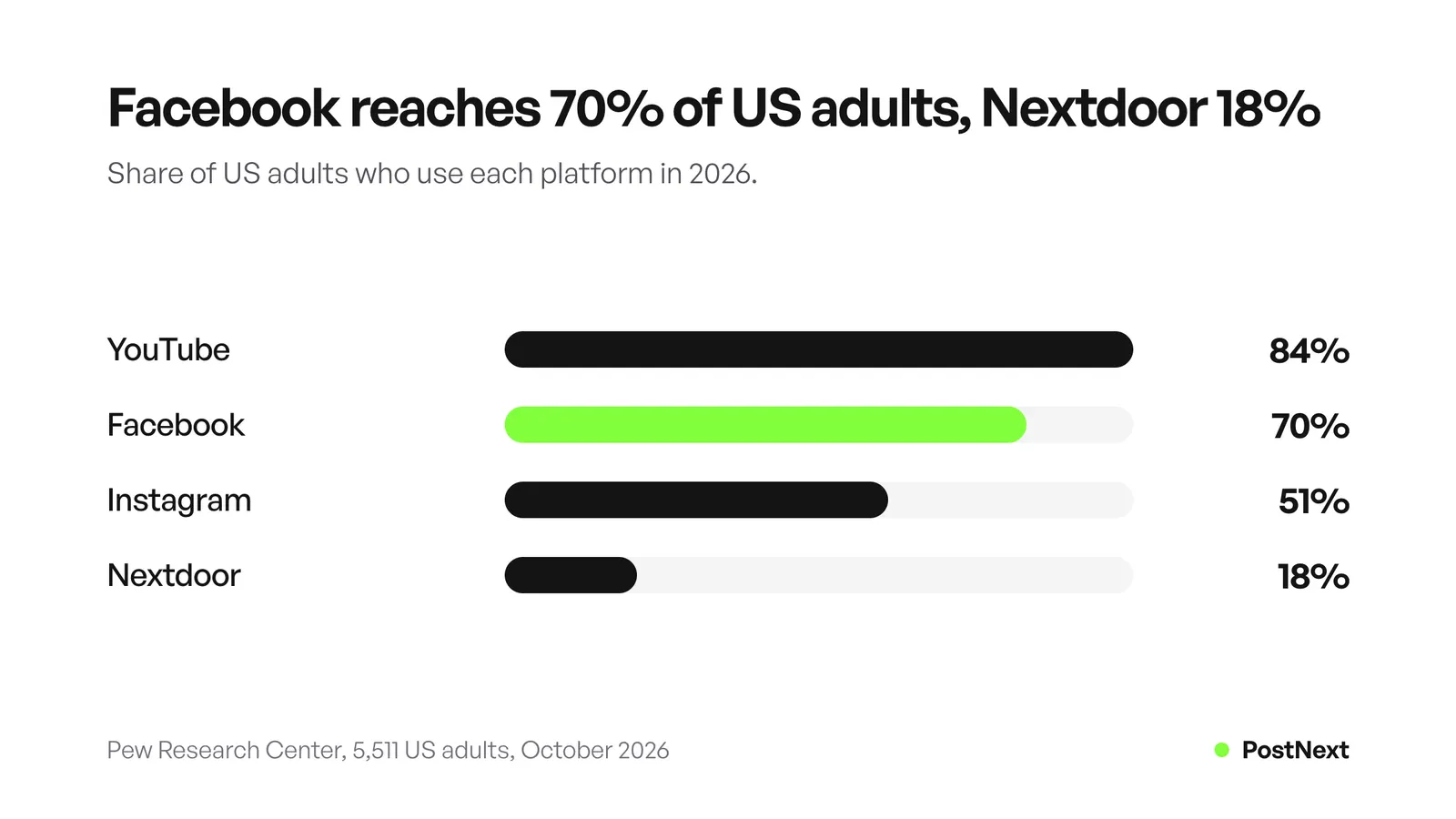
- Facebook and Nextdoor reach local homeowners: 70% of US adults use Facebook and 18% use Nextdoor.
- Two posts a week is enough: accounts that posted in 20 of 26 weeks got 450% more engagement per post.
- Reply within a day: 88% of homeowners expect a response within 24 hours.
Does social media work for window installers?
Social media works for window installers as a trust check between the first call and the signed contract. Homeowners buy windows rarely, the price is high, and most of the sale happens in their home. Before they let a salesperson in, they look you up. Your reviews, your finished jobs and your answers to their questions are what they compare with the next company.
| Where homeowners check a window company | What they look for | Data |
|---|---|---|
| Reviews on Google, Facebook and Yelp | Star rating, recent reviews, owner replies | 97% read local reviews (BrightLocal, 2026) |
| Your Google Business Profile | Service area, photos of jobs, hours | 71% use Google for reviews (BrightLocal, 2026) |
| Your Facebook Page or Nextdoor | Recent local installs, replies, recommendations | 70% of US adults use Facebook, 18% Nextdoor (Pew, 2026) |
| AI assistants | A short list of local companies | 45% used AI tools for local recommendations (BrightLocal, 2026) |
| An online search after a referral | Proof that the name is real and active | 74% of homeowners research a referral online first (Scorpion, 2026) |
BrightLocal Local Consumer Review Survey 2026 (1,002 US adults), Pew Research Center Social Media Fact Sheet 2026 (5,511 US adults), and a Scorpion survey of 2,000 homeowners (Scorpion sells marketing). Checked November 2026.
Social media will not book your calendar on its own. Many jobs start from a referral, a search or a home show. Your feed decides which company the homeowner trusts enough to invite in. A page with fifty dated local installs looks safer than a logo and a phone number. Spend your effort on proof, not on volume.
What rules should window installers explain in their posts?
Explain the four federal rules your buyer meets during one window sale. The federal tax credit for windows ended with 2025. ENERGY STAR certification depends on NFRC ratings and the buyer’s climate. Homes built before 1978 need a lead-safe certified firm. A sale signed at home can be cancelled within 3 business days. A clear post on each one answers questions buyers have before the visit.
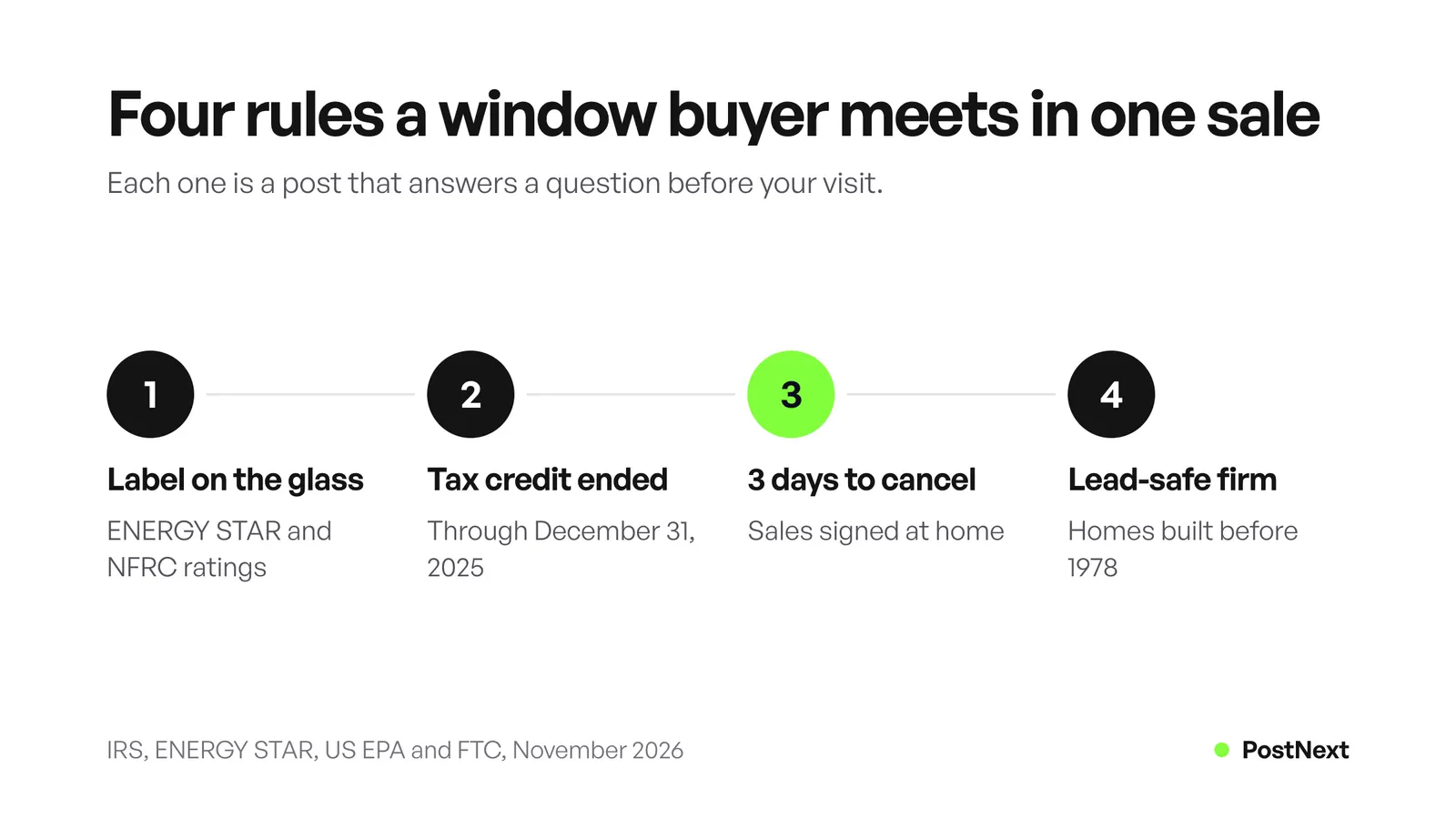
Each rule is a question your buyer has, or will have soon. A post that answers it before the visit makes your sales visit shorter and calmer.
| Rule the buyer meets | Who sets it | The post that answers it |
|---|---|---|
| The federal tax credit for windows ended on December 31, 2025 | IRS | ”Is there still a tax credit for new windows?” with the IRS date |
| ENERGY STAR windows must have NFRC ratings that meet EPA criteria for the buyer’s climate | ENERGY STAR (EPA) | A photo of the labels on a window you install, and which climate your town is in |
| Paid work that disturbs paint in a pre-1978 home needs a lead-safe certified firm | EPA | Your certification, and why you give an EPA lead pamphlet before the job |
| A buyer can cancel a sale made at home within 3 business days | FTC | Your contract page, with the cancellation form shown |
IRS Energy Efficient Home Improvement Credit page, ENERGY STAR key product criteria, EPA Renovation, Repair and Painting Program, 40 CFR 745.83 and 745.84, and FTC Cooling-Off Rule (September 2025). Checked November 2026.
The tax credit post you need to correct
Check your old posts and ads first. The IRS says the Energy Efficient Home Improvement Credit applies to “improvements made through December 31, 2025.” It paid 30% of the cost, with a cap of $600 a year for exterior windows and skylights. It applied only to windows that met ENERGY STAR Most Efficient requirements. A post that says “new windows qualify for a federal tax credit” is now out of date for any 2026 job. Correct it, and say what is true. Customers who installed in 2025 can ask their tax preparer about the credit. The same credit covered heat pumps, so our guide for HVAC social media marketing has the same warning.
The label on the glass
Native.no tells window installers that buyers want a warm, quiet home, not a U-value. That is half right. Lead with the feeling, then show the proof a buyer can check. ENERGY STAR says certified windows are made by an ENERGY STAR partner, are “independently tested, certified, and verified by the National Fenestration Rating Council (NFRC)”, and have NFRC ratings that meet EPA guidelines. Those guidelines vary by climate zone. ENERGY STAR tells homeowners to pick the windows “that make the most sense for your climate.” Post a close-up of the labels on a window you install, and say which climate your service area is in.
The lead rule in older homes
The EPA says “approximately three-quarters of the homes in the United States built before 1978 still contain some lead-based paint.” Window sills are one of the surfaces it names, because friction turns old paint into dust. Anyone paid to disturb paint in those homes must be certified, and the EPA says this “includes all firms, even sole proprietorships.”
The rule has a small-job exemption: 6 square feet of painted surface per room inside, or 20 square feet outside. The rule text says this exemption never covers work that involves “window replacement.” So a window job in a pre-1978 home falls under the rule. The firm must give the owner EPA’s lead pamphlet no more than 60 days before the work starts. If you are certified, post it. The EPA recommends that homeowners hire a lead-safe certified contractor, and it runs a search tool where they can find you. Our guide to social media for painters covers the same rule for paint jobs.
The 3-day right to cancel
Many window sales are signed at the kitchen table. The FTC Cooling-Off Rule gives the buyer until “midnight of the third business day after the sale” to cancel for a full refund. It covers sales of $25 or more at the buyer’s home and $130 or more at temporary locations, such as a booth at a home show. The seller must tell the buyer about this right at the time of sale and give two cancellation forms. A post that shows your contract and says “you have 3 business days to change your mind” tells a careful buyer that you do not use pressure.
Which social media platforms should window installers use?
Most window installers need a Google Business Profile, a Facebook Page and Nextdoor, with Instagram and YouTube for photos and video. Pew’s 2026 survey of 5,511 US adults found 84% use YouTube, 70% use Facebook, 51% use Instagram and 18% use Nextdoor. Homeowners also write reviews on Facebook more than anywhere but Google: 34% did in the past year.
| Platform | Best job for a window installer | Why |
|---|---|---|
| Google Business Profile | Service area, reviews, photos of installs | Up to 20 service areas, about 2 hours of driving |
| Facebook Page | Installs, rule explainers, reviews | 70% of US adults; 34% wrote a review there |
| Nextdoor | Recommendations from neighbours | Free Business Page for home service providers |
| Before-and-after photos, details of the trim | 51% of US adults | |
| YouTube | Short clips: an old frame coming out, a new one going in | 84% of US adults |
Reach figures from Pew Research Center 2026; review figure from BrightLocal 2026; Google and Nextdoor from their own help pages. Checked November 2026.
Pick two and keep them active. Google calls a business that visits customers a service-area business. List the towns you serve, and hide your address if customers never come to it. Then add Facebook, where people ask neighbours for a good window company.
What should window installers post on social media?
Post the job, the proof and the answers buyers need before they sign. A before-and-after shows the change in one look. A close-up of the labels gives them something to check. A short explainer on the rules above answers questions before your visit. None of these needs you on camera. Rotate the seven types below.
- Before and after. The same window from the same angle, inside and outside. Ask the homeowner first and keep house numbers out of the frame.
- The fit. Square frames, clean sealant lines, neat trim. One sentence on why a good fit stops drafts and leaks.
- The label close-up. The ENERGY STAR and NFRC labels on a window before you peel them off, with one line on what they mean.
- The rule explainer. One rule per post: the tax credit that ended, the lead rule, the 3-day cancel right.
- The old frame. Rot, fogged glass, peeling paint on a sill. Say what you found and how you fixed it.
- A real review. A recent review as a post, with the customer’s first name and their permission.
- The crew at work. Drop cloths, plastic sheeting in an older home, the clean-up at the end. Homeowners read a tidy crew as a careful company.
Sharp phone photos are enough. Take one before, one after and one wide shot on every job. For more ideas sorted by goal, see our guide to what to post on social media for business.
How often should a window company post?
Two posts a week on each channel is enough for a window company: one recent install and one explainer, review or crew post. Buffer’s study of more than 100,000 users found that accounts posting in 20 or more of 26 weeks got 450% more engagement per post than accounts posting in 4 weeks or fewer. A steady slow month matters as much as a busy one.
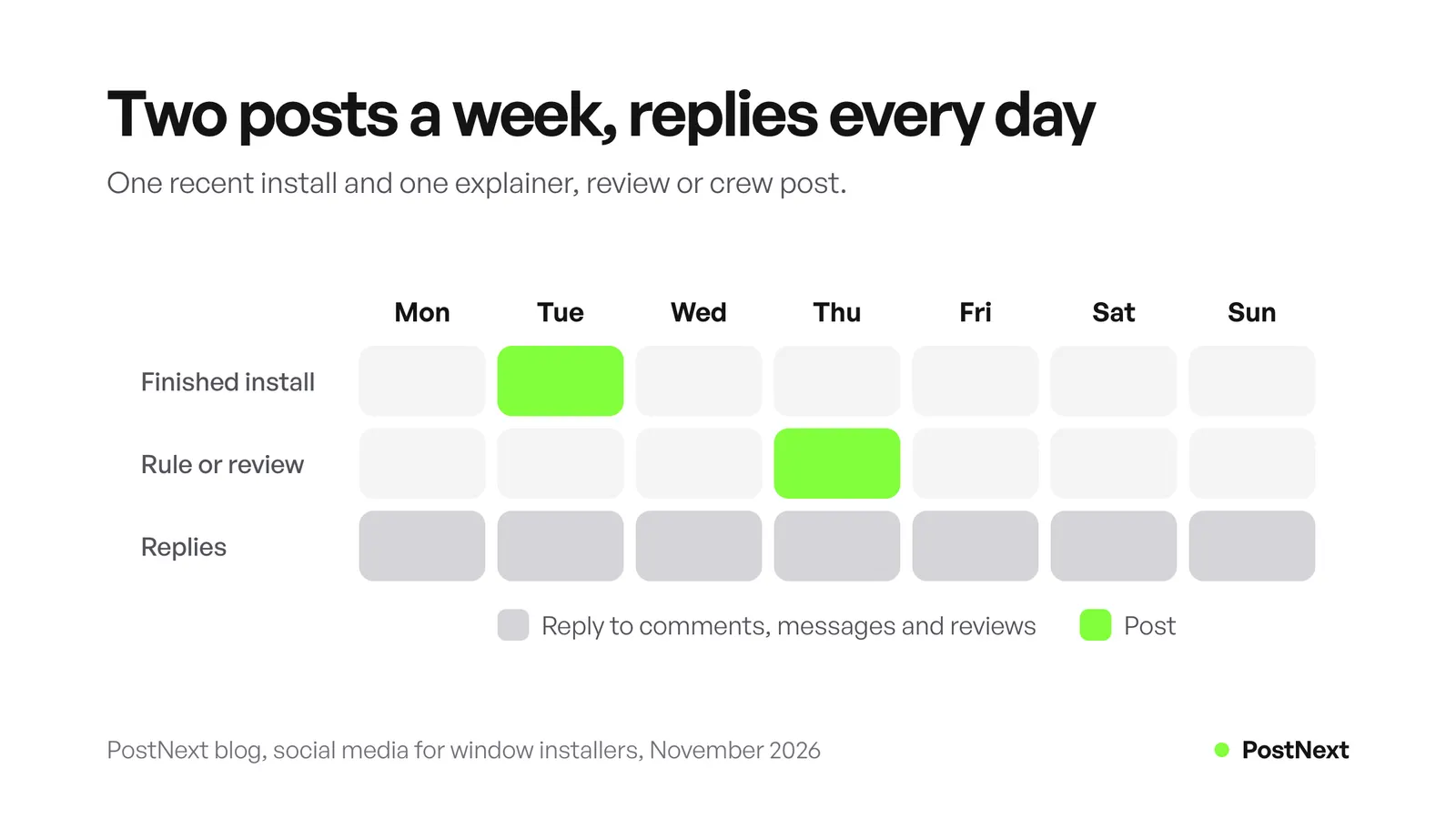
- Tuesday: a finished install or before-and-after from the past week.
- Thursday: a rule explainer, a label close-up or a review.
- Every day: reply to comments, messages and new reviews within a day.
Write the rule explainers once and reuse them. The cancel right and the lead rule do not change from month to month. Before winter, add a post on drafts and cold glass, and keep one fresh job photo each week.
How should window installers handle reviews and messages?
Reply to every review and message within a day. In Scorpion’s survey of 2,000 homeowners, 88% expect a response within 24 hours. BrightLocal’s 2026 survey found 89% of consumers expect owners to respond to reviews, and 80% are likely to use a business that responds to all of its reviews.
Write each reply by hand. BrightLocal found 50% of consumers are put off by templated replies. Thank the customer by name, name the job, and keep it to two sentences. For a bad review, apologise once, say what you will fix, and offer a phone call. The next homeowner reads your reply more closely than the complaint.
Ask for reviews on the day you finish, by text, with a direct link. Rating floors are rising: 68% will only use a business with 4 stars or more, up from 55% in 2025. Our guide to social media for roofers shows how the same trust checks work for another trade that sells in the home.
How do window installers get leads from social media?
Make it easy to book a visit from every profile and post. Put your phone number, service area, lead-safe certification and hours in each profile. End install posts with the town and one line, such as “Free window quotes in Springfield, call us.” Then ask every new customer how they found you, and write the answer next to the job.
Avoid the shapes of a pressure sale in your own posts. The FTC tells buyers to “get estimates from more than one contractor”, and a buyer who signs at home has 3 business days to cancel. A post that says “sign today for this price” works against you. Offer a free quote with no deadline, and say that you leave a written estimate.
Local groups matter too. Neighbours ask for recommendations in Facebook groups and on Nextdoor. Join as yourself, answer questions without selling, and let past customers recommend you. Our guide to social media marketing for local business covers groups and local pages in more detail.
How does PostNext help a window installation business?
PostNext lets a window installer plan a month of install photos and rule explainers in one sitting, then publish each at its time. It posts to Instagram, TikTok, LinkedIn, X, YouTube, Threads and Bluesky from one calendar. Repeat this post sends a recurring post every 1 to 365 days, weeks or months.
Set your “3 business days to cancel” explainer to go out again every 2 months with recurring posts, so new followers see it. The web app works in a phone browser, so you can add a job photo from the van. On Instagram, the comment inbox lets you read and reply to comments in one place. It does not cover DMs.
PostNext does not post to Facebook or Google Business Profile today, and most window installers need both. Both are listed as coming soon. Schedule those in Meta Business Suite and in your Google profile for now, and use PostNext for Instagram or YouTube. The free plan covers 1 channel, 10 posts and 10 AI credits a month. The pricing page shows what the paid plans add. PostNext for window companies has a weekly posting plan and caption templates you can copy.
Frequently Asked Questions
What should a window installer post on social media?
Post before-and-after photos, close-ups of the fit and the labels, short explainers on the rules buyers meet, real reviews with permission, and your crew at work. Two posts a week is enough: one install and one explainer or review.
Is there still a federal tax credit for new windows in 2026?
No. The IRS says the Energy Efficient Home Improvement Credit covers improvements made through December 31, 2025. It paid 30% of the cost, up to $600 a year for windows and skylights that met ENERGY STAR Most Efficient requirements. Check your posts and ads for old claims.
Do window installers need EPA lead certification?
In the US, yes, for paid work that disturbs paint in homes, child care facilities or preschools built before 1978. The EPA’s small-job exemption does not cover window replacement, and the rule applies to all firms, even sole proprietorships.
Can a customer cancel a window contract signed at home?
Yes, in most cases. The FTC Cooling-Off Rule gives buyers until midnight of the third business day after the sale to cancel a sale of $25 or more made at their home. Saturdays count as business days. Sundays and federal holidays do not.
Which social media platform is best for window companies?
Facebook and a Google Business Profile matter most for most window companies. Pew’s 2026 survey found 70% of US adults use Facebook and 18% use Nextdoor, which has free Business Pages for home service providers. Add Instagram or YouTube for before-and-after photos and short clips.
How often should a window company post?
Two posts a week on each channel, all year. Buffer’s study of more than 100,000 users found accounts that posted in 20 or more of 26 weeks got 450% more engagement per post than accounts that posted in 4 weeks or fewer.
Sources
- IRS, Energy Efficient Home Improvement Credit, checked November 2026.
- ENERGY STAR, Key Product Criteria for residential windows, doors and skylights, checked November 2026.
- US EPA, Lead Renovation, Repair and Painting Program, checked November 2026.
- eCFR, 40 CFR 745.83, definitions, and 40 CFR 745.84, information distribution, checked November 2026.
- US Federal Trade Commission, Buyer’s Remorse: The FTC’s Cooling-Off Rule May Help, September 2025, checked November 2026.
- US Federal Trade Commission, How To Avoid Scams After Weather Emergencies and Natural Disasters, September 2025, checked November 2026.
- BrightLocal, Local Consumer Review Survey 2026, 1,002 US adults, February 2026, checked November 2026.
- Scorpion, The state of home services marketing, survey of 2,000 homeowners, January 2026, checked November 2026. Scorpion sells marketing services.
- Pew Research Center, Social Media Fact Sheet, October 2026, checked November 2026.
- Google Business Profile Help, service-area businesses, checked November 2026.
- Nextdoor, Nextdoor for small business, checked November 2026.
- Buffer, Consistent Posting Study (buffer.com/resources/consistent-posting-study), January 2025, checked November 2026.
- Native, Social media for window installers (native.no/blog/social-media-for-window-installers), checked November 2026.
- PostNext, small business page and pricing page, checked November 2026.