Social media for fitness studios and gyms does two jobs. It shows a stranger what a class feels like before they book a trial, and it keeps members coming back. A record 81 million Americans held a gym or studio membership in 2025, and US Google searches for “gyms near me” peaked in January 2026 at 1.5 million. This PostNext guide covers channels, posts, music and filming members.
Key Takeaways
- Social media is the look inside: people check your classes, coaches and room before they book a first visit.
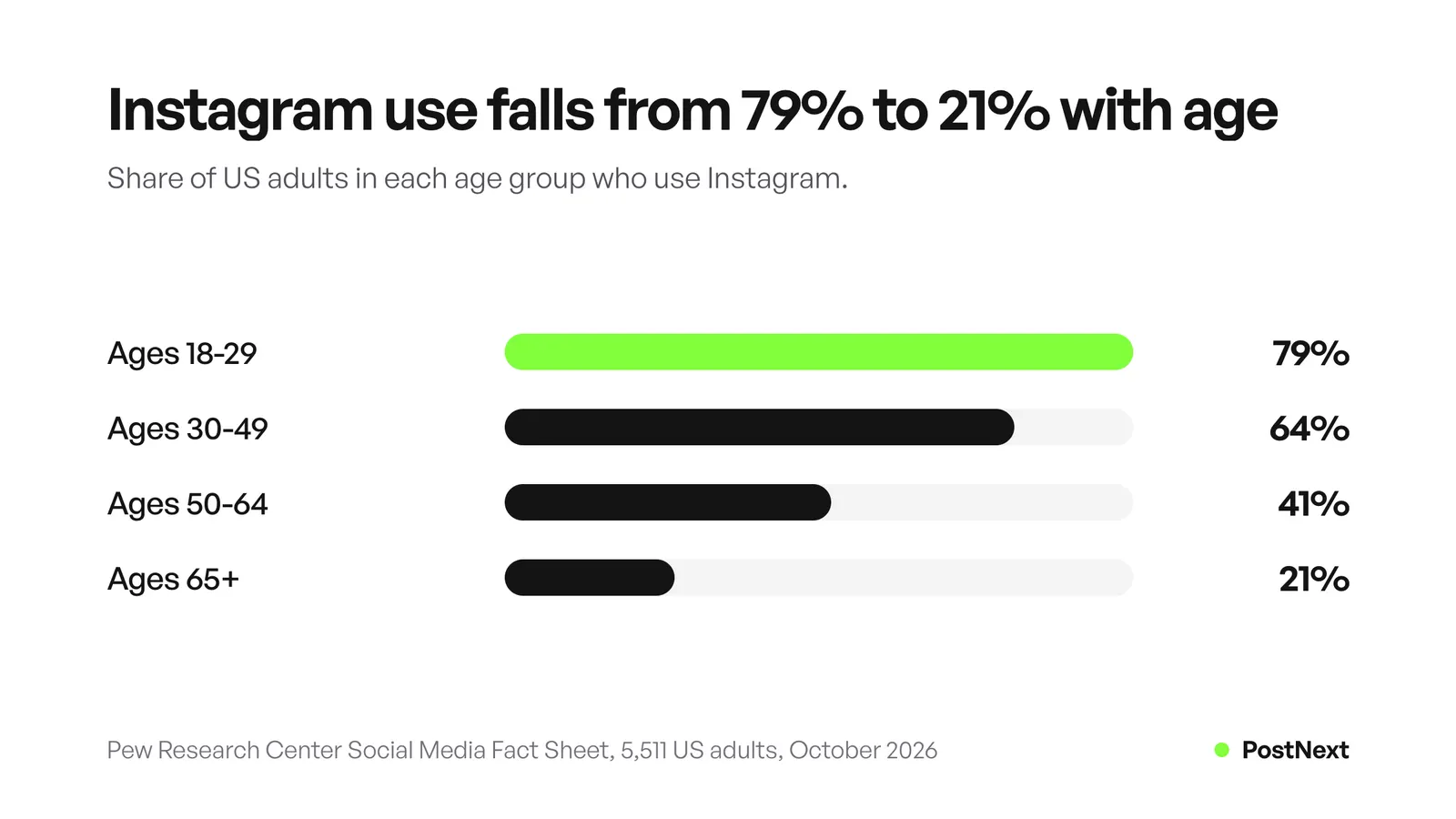
- Instagram and Facebook cover most members: 79% of US adults aged 18-29 use Instagram, and 78% of those aged 30-49 use Facebook.
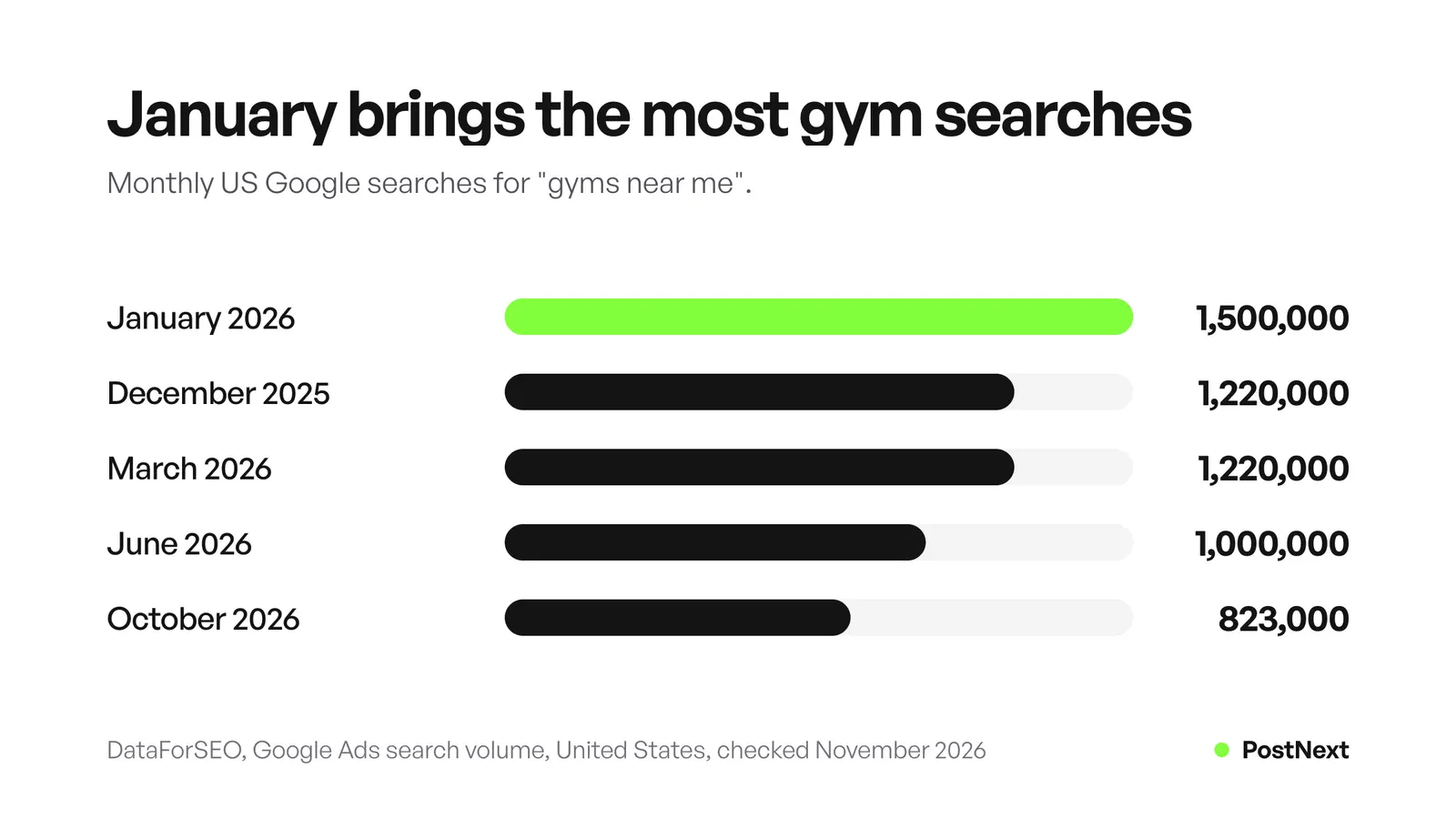
- January is the busiest month: searches for “gyms near me” reached 1.5 million in January 2026, against 1 million in a normal month.
- Four posts a week is enough: the schedule, a class in progress, a coach tip and a member milestone.
- Ask before you film: Meta’s privacy rules do not promise to remove a video of a US adult who asks, so your consent routine protects members.
- Use licensed music only: Instagram’s main music library is for personal use. Business accounts use Meta’s Sound Collection or TikTok’s Commercial Music Library.
- Never trade a free class for a review: Google removes reviews that a business paid for with discounts or free services.
Does social media work for gyms and fitness studios?
Social media for gyms and studios works as a preview and as a reminder. It rarely makes the sale alone. A stranger hears about you, then checks your posts to see the room, the coaches and the people in class. Members see your posts between visits, which keeps classes on their mind. The second job gets less attention, and it is the one that keeps the doors open.
The market is growing. The Health & Fitness Association (HFA, formerly IHRSA) reported in April 2026 that 81 million Americans belonged to a gym, studio or other fitness facility in 2025, up 5.2% on 2024. The share of members who never used their membership fell to 4.6%, an all-time low. Yoga was the most practised activity, with 17.7 million members, and Pilates kept growing.
Retention is where social media earns its keep. An older study of 10,000 UK members, reported by IHRSA in 2016, found that gym-only members cancelled at 27.6 per thousand per month, against 17.7 for members who took group classes. That is a 56% higher risk of cancelling. In a separate IHRSA survey, 23% of former members said they left because they did not use the club. Posts that show this week’s classes, and the people in them, give members a reason to come in.
Social media for gyms has a fair limit. It will not fill a studio that has a weak first offer or a hard sign-up page. Posts send people to those two things, so fix the trial offer and the booking link first. Then post every week.
Which social media platforms should a gym or fitness studio use?
Most gyms and studios should run Instagram and Facebook, plus a Google Business Profile. Pew Research Center’s 2026 survey of 5,511 US adults found 70% use Facebook and 51% use Instagram. Add TikTok if many members are under 30, because 65% of adults aged 18-29 use it. Pick the channels your own members use, not the newest ones.
| Platform | All US adults | Women | Ages 18-29 | Ages 30-49 | Ages 50-64 | Ages 65+ |
|---|---|---|---|---|---|---|
| YouTube | 84% | 83% | 95% | 91% | 85% | 65% |
| 70% | 77% | 69% | 78% | 71% | 59% | |
| 51% | 56% | 79% | 64% | 41% | 21% | |
| TikTok | 37% | 43% | 65% | 45% | 31% | 11% |
Pew Research Center, Social Media Fact Sheet, survey of 5,511 US adults, January to June 2026, published October 2026, checked November 2026.
Match the table to the people in your classes. A Pilates or barre studio with mostly women in their 30s and 40s reaches them on Facebook and Instagram. A CrossFit box, a student gym near a campus or a boxing gym’s fight team has members who live on Instagram and TikTok. HFA found Gen Z adults aged 18-24 had the highest membership rate, at 35.5%, while members aged 65 and over grew fastest, up 8.6% in a year. A studio that runs classes for older adults should keep Facebook active, since 71% of 50-64s use it.
Two channels done every week look better than four that went quiet in March. A last post from months ago makes a visitor wonder if the studio closed. Our guide to which social media platform is best for business covers the choice for other audiences.
How should a fitness studio set up its Google Business Profile?
Set up your Google Business Profile as a storefront, because members come to your address. Add exterior, interior and team photos, your class booking link, and special hours for holidays. Google says a business without permanent signage at its address cannot be a storefront, and an ongoing class at a place you do not own cannot have a profile at all.
Google’s photo guide gives a number for each type. Add at least three exterior photos, so people recognise the door. Add at least three interior photos that show the room as a member sees it, and at least three photos of your team. Google also asks for at least three “photos at work” that show your services, so a class in progress fits there, with consent from the people in it. Google wants photos in focus and well lit, with no heavy filters or AI edits. Videos can run up to 30 seconds. For exact sizes, see our guide to Google Business Profile image sizes.
Three settings matter most for a studio:
- Bookings: under the Bookings tab you can connect a booking provider, and Google says it appears on your profile within a week. The provider might charge you for bookings made through Google. You can also add your own booking link.
- Special hours: set them for holidays and short closures of up to 6 days in a row, so nobody arrives at a locked door on New Year’s Day.
- Posts: Google offers Update, Offer and Event posts, and you can schedule a post to repeat weekly or monthly. A weekly “classes this week” post fits that well.
PostNext cannot publish to Google Business Profile yet; its Google Business Profile page lists the steps in Google’s own tool.
What should a gym or fitness studio post on social media?
Post what a visitor wants to see before they walk in: the class schedule, a class in progress, the coaches, and members who keep showing up. Each post answers a question a nervous beginner has. Is it for someone like me? Who teaches it? What time is it? Classes are the content, so you never start from a blank page.
Rotate these six post types:
- The schedule. This week’s classes, one image or a short list, every Monday. Members can save it, and newcomers see you are open.
- A class in progress. Fifteen to thirty seconds of the room working, filmed from the back or the side. Show real members, with their consent, at a real level.
- One coach tip. One exercise, one cue, filmed in under a minute. “Keep your ribs down in a plank” is enough.
- A member milestone. A first pull-up, a 100th class, a first race. Celebrate what the member did, not how their body looks.
- Behind the scenes. New kettlebells arriving, a coach setting up the room at 5:30 am, the playlist being picked.
- What is coming. A new class, a holiday timetable, a workshop or a challenge, with the date and the booking link.
Milestones are where most studios slip. A post about strength, attendance or a race finish needs no body photos and makes no health claim. The FTC’s guide on endorsements uses a person who “lost 20 pounds in two months” as its example. If that result is not what people generally achieve, the ad must say what the usual result is. Before-and-after body photos carry that duty, and they also put pressure on members who are starting out.
The HFA data gives you content angles too. Free weights have grown faster than any other equipment since 2021, so a short “how to pick your first dumbbell weight” clip fits many members. For more ideas sorted by goal, see our list of what to post on social media for business.
When do gyms get the most interest online?
January is the peak. Google Ads data from DataForSEO shows US searches for “gyms near me” reached 1.5 million in January 2026, about 50% above a normal month of 1 million. December, March and August were also high. Yoga studio searches peaked in November and January, and Pilates searches hit their high in January, March and April.
| Month | ”gyms near me" | "yoga studio near me" | "pilates near me” |
|---|---|---|---|
| November 2025 | 1,000,000 | 90,500 | 450,000 |
| December 2025 | 1,220,000 | 74,000 | 450,000 |
| January 2026 | 1,500,000 | 90,500 | 550,000 |
| February 2026 | 1,000,000 | 74,000 | 450,000 |
| March 2026 | 1,220,000 | 60,500 | 550,000 |
| June 2026 | 1,000,000 | 49,500 | 368,000 |
| August 2026 | 1,220,000 | 74,000 | 450,000 |
| October 2026 | 823,000 | 60,500 | 450,000 |
DataForSEO, Google Ads monthly search volume for the United States, checked 25 November 2026. Google rounds these numbers into ranges, so read them as levels, not exact counts.
A January peak means strangers check your profile in the first weeks of the year. Make sure they find recent posts, a clear beginner offer and a working booking link. Plan it backwards:
- Late November and December: post the January timetable, the beginner class and the holiday hours. Set special hours on Google.
- January: post the schedule every Monday, a beginner-friendly class clip and an answer to “I’ve never done this before” each week.
- February and March: turn to the people who joined. Post first milestones, a “week 6” check-in and coach tips. This is when new members decide whether the habit sticks.
- June and July: yoga and Pilates searches are at their lowest. Use the quiet months to film clips and write posts for the next January.
Do not post only at intake time. Members who joined in January need a reason to come back in May, and they read your posts too.
Can a gym film members in a class and post it?
Yes, with their permission, and the platforms will not do that work for you. Meta’s privacy rules say a photo or video of a child under 13 may be removed when a parent reports it. For adults, removal is listed only for reports from outside the United States where local law gives that right. A US member who dislikes your video depends on you.
So build a consent routine once and use it every time:
- Ask at sign-up. Add a photo and video question to your membership or waiver form, with a yes and a no option. Keep the answers where coaches can see them.
- Say it before you film. “I’m filming the next minute for Instagram. Move to the back row if you’d rather not be in it.” Give people time to move.
- Mark the no-film spots. A corner of the room or a coloured wristband lets members say no without explaining.
- Ask before you tag or name anyone. Ask again before a clip goes into a paid ad.
- Get a parent’s written consent for kids’ and teen classes, and never post a child’s full name or school.
- Take a post down the same day when someone asks, without debate.
Disclosure rules also apply to the people you film. The FTC says an endorsement from an employee or a relative is misleading unless the connection is clear. A coach praising your studio on their own account should say they work there. If a member gets a free month for a testimonial, say so in the post. This guide is general information, not legal advice; check your state’s rules with a lawyer before you change your waiver.
Which music can a gym use in Reels and TikToks?
A business account should use licensed music only: Meta’s Sound Collection on Instagram and Facebook, and TikTok’s Commercial Music Library on TikTok. Instagram says its main music library is for personal, non-commercial use, so some business accounts cannot use it. Meta’s Music Guidelines prohibit music for commercial use without the right licences.
| Platform | Music a business account can use | What the platform says |
|---|---|---|
| Meta Sound Collection | Over 14,000 royalty-free songs and sounds, safe for Reels and Stories, and usable in ads | |
| The main licensed music library | ”Intended for personal, non-commercial use”; certain business accounts have no access | |
| Music you hold a licence for | Commercial use without licences is prohibited; content may be blocked, muted or removed | |
| TikTok | Commercial Music Library | 1 million pre-cleared songs, free for businesses, for organic posts and ads |
Instagram Help Center, “Access to the licensed music library on Instagram”; Meta Music Guidelines; TikTok Ads Help Center, “About the Commercial Music Library” (last updated July 2025). Checked November 2026.
The trap for a studio is the music in the room. A class playlist from a streaming app is someone else’s music. If it plays under your class clip, the rights owner can mute or block the video under Meta’s rules. Film with the music turned down and use your coach’s voice, or replace the sound with a track from the business library. Meta also recommends short music clips over long ones.
How often should a gym post on social media?
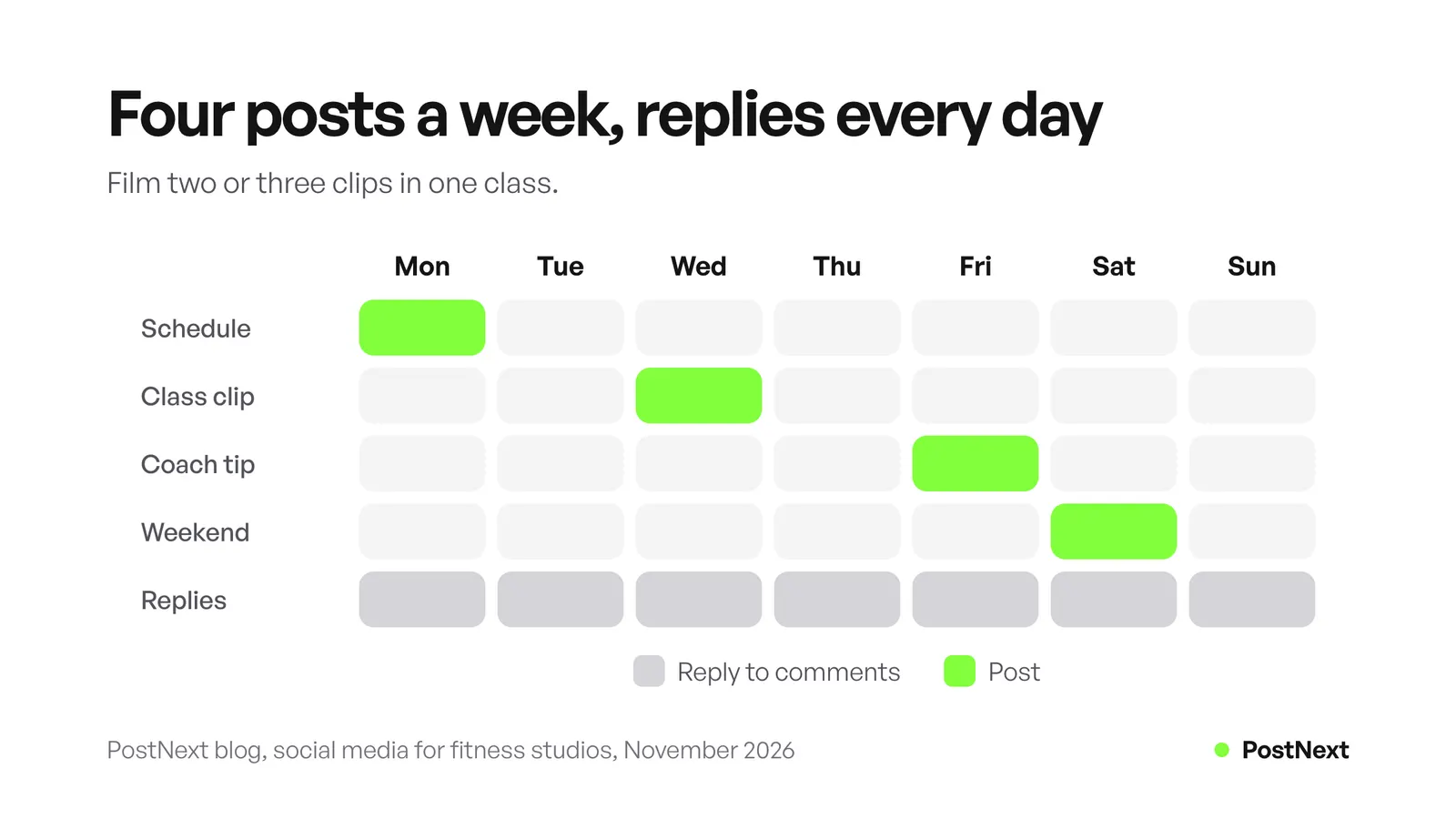
Four posts a week on your main channel is enough for most studios: the schedule, a class clip, a coach tip and a milestone or update. Buffer analysed 2.1 million posts from 102,000 Instagram accounts and found that 3-5 posts a week could raise reach per post by about 12% compared with 1-2. Showing up every week matters more than posting every day.
Buffer’s study of more than 100,000 users found that accounts posting in 20 or more of 26 weeks got 450% more engagement per post than accounts posting in 4 weeks or fewer. For a studio, that means no silent months. A simple week looks like this:
| Day | Post | Channel | Time it takes |
|---|---|---|---|
| Monday | This week’s class schedule | Instagram feed or Story, Facebook, Google | 5 minutes, or set once as a repeat |
| Wednesday | A class in progress, 15-30 seconds | Instagram Reels, TikTok | 15 minutes, filmed during a class |
| Friday | One coach tip | Instagram, TikTok, YouTube Shorts | 10 minutes |
| Weekend | A member milestone or what is coming | Instagram, Facebook | 10 minutes |
| Every day | Replies to comments, messages and reviews | All channels | 10 minutes |
Suggested plan built from the Buffer studies above. Adjust the days to your timetable.
Film two or three clips in one class each week and you have the Wednesday and Friday posts. Write the schedule post once and set it to repeat. Then each week you only add one fresh milestone.
How do gyms turn followers into members?
Make the next step obvious and easy to take. Put one trial or booking link in each bio, name the beginner class in your posts, and reply to every question about price, times or level the same day. Then ask every new member how they found you, so you know which channel earns your time.
Most questions in comments are a sale in progress. “Is this okay for a total beginner?” or “How much is a drop-in?” deserve a public answer, because the next person has the same question. If the same question comes every week, a comment-to-DM tool such as CreatorFlow can send the schedule and the trial link to everyone who comments a word like TRIAL. Messages then go only to people who asked.
Reviews do the rest of the convincing. BrightLocal’s 2026 survey of 1,002 US adults found 97% read reviews for local businesses, and 80% are likely to use a business that responds to all of its reviews. Ask members for a review after a good class, by text, with the link. Never offer a free class or a discount for it: Google’s Maps policy forbids incentives such as “discounts, free goods and/or services” in exchange for a review, and removes those reviews. Our guide to social media marketing for local business covers the review routine in more detail.
How does PostNext help a fitness studio?
PostNext lets a studio plan a month of posts in one sitting and publish each at its time. It posts to Instagram, TikTok, YouTube, LinkedIn, X, Threads and Bluesky from one calendar. Repeat this post publishes the same post every few days, weeks or months, which suits the Monday schedule post.
You can set a repeat to run forever, until a date or for a number of posts, and pause it before a holiday week. Each repeat counts as one post on your plan. The steps are on the repeat a post help page. For Instagram, PostNext publishes Reels and carousels from the Instagram scheduler, and the Instagram comment inbox lets you read and answer comments in one place. It does not cover DMs.
PostNext does not post to Facebook or Google Business Profile today; both are on its roadmap. Schedule Facebook posts in Meta Business Suite, which allows 20 minutes to 29 days ahead, and Google posts in your Google profile. The free plan covers 1 channel, 10 posts and 10 AI credits a month, enough for two posts a week on Instagram. The pricing page shows what the paid plans add. PostNext for gyms and fitness studios shows a weekly timetable post set to repeat, with caption templates you can copy.
Frequently Asked Questions
What should a gym post on social media?
Post the weekly class schedule, short clips of classes in progress, one coach tip a week, and member milestones such as a first pull-up or a 100th class. Add behind-the-scenes moments and upcoming events with a booking link. Film members only with their consent.
Which social media platform is best for a fitness studio?
Instagram and Facebook suit most studios, with a Google Business Profile for people who search nearby. Pew’s 2026 survey found 79% of US adults aged 18-29 use Instagram and 78% of those aged 30-49 use Facebook. Add TikTok if most members are under 30.
How often should a gym post on Instagram?
Three to five posts a week works for most gyms. Buffer’s analysis of 2.1 million Instagram posts found 3-5 posts a week could raise reach per post by about 12% compared with 1-2. Keep posting every week, including quiet summer months.
Can a gym use popular songs in Instagram Reels?
Not for business use. Instagram says its main music library is for personal, non-commercial use, and some business accounts cannot use it. Use Meta’s Sound Collection, which has over 14,000 royalty-free songs and sounds cleared for Reels, Stories and ads. On TikTok, use the Commercial Music Library.
Do I need permission to post members on social media?
Ask first, every time. Add a photo and video question to your sign-up form, announce before you film, and give members a way to stay out of shot. Meta’s privacy rules do not promise to remove a video of a US adult who asks, so your own consent routine is what protects members.
Can I offer a free class for a Google review?
No. Google’s Maps policy does not allow businesses to offer payment, discounts, free goods or free services in exchange for a review, and it removes reviews posted for an incentive. You can ask every member for an honest review, as long as nothing is attached.
Should a gym post before-and-after photos?
Use them with care, or post strength and attendance milestones instead. The FTC says an ad showing an unusual result, such as losing 20 pounds in two months, must make clear what people generally achieve. Body photos also put pressure on new members.
Sources
- Health & Fitness Association, 81 Million Americans Were Members of a Fitness Facility in 2025, 2026 US Health & Fitness Consumer Report, April 2026, checked November 2026.
- Health & Fitness Association (then IHRSA), 5 Reasons Health Club Members Quit, October 2016, reporting The Retention People study of 10,000 UK members, checked November 2026.
- Pew Research Center, Social Media Fact Sheet, published October 2026, checked November 2026.
- DataForSEO, Google Ads search volume for the United States (“gyms near me”, “yoga studio near me”, “pilates near me”), checked 25 November 2026.
- Google Business Profile Help, business types, bookings, business photos, photos and videos, special hours and posts, checked November 2026.
- Google, Maps user contributed content policy, checked November 2026.
- Instagram Help Center, Access to the licensed music library on Instagram, checked November 2026.
- Meta, Music Guidelines, checked November 2026.
- Meta Transparency Center, Privacy Violations, checked November 2026.
- TikTok Ads Help Center, About the Commercial Music Library, last updated July 2025, checked November 2026.
- Federal Trade Commission, FTC’s Endorsement Guides: What People Are Asking, checked November 2026.
- BrightLocal, Local Consumer Review Survey 2026, 1,002 US adults, February 2026, checked November 2026.
- Buffer, “How often to post on Instagram” (buffer.com/resources/how-often-to-post-on-instagram) and “Consistent Posting Study” (buffer.com/resources/consistent-posting-study), checked November 2026. Buffer sells a scheduling tool.
- PostNext, repeat a post, small business page and pricing page, checked November 2026.