
Social media for yoga studios has one main job: show a nervous beginner that the class is for them. CDC data shows 16.9% of US adults practised yoga in 2022, and the most common reason people never try is the belief that yoga is for people who are already flexible. This PostNext guide covers posts, teachers, filming, health claims and timing.
Key Takeaways
- Write for the beginner: flexibility is the top reason people start yoga (61%), so “I’m not flexible” is a reason to come to class.
- Women and adults under 45 practise most: 23.3% of US women and 21.3% of adults aged 18-44 did yoga in 2022, against 10.3% of men.
- Beginners search in March: US searches for “beginner yoga classes near me” peaked at 9,900 in March 2026, while “yoga studio near me” peaked in November and January.
- Never film savasana: film the teacher, the room before class, or volunteers who said yes for this clip.
- Do not promise cures: the FTC needs scientific evidence for any claim that a practice treats a disease, and Yoga Alliance treats “diagnose or treat” claims as yoga therapy.
- Feature your teachers on the studio account: most teachers work in several places, so the studio’s own account must stay the home of its students.
- A teacher in a rented hall cannot list that hall on Google: Google says an ongoing class at a place you do not own is not eligible for a Business Profile.
Who practises yoga, and where do they find a studio?
Yoga is mostly practised by women and by adults under 45, and many of them already belong to a gym or studio. The CDC’s 2022 National Health Interview Survey found 16.9% of US adults did yoga in the past year. Women did it at more than twice the rate of men. Use is highest among adults aged 18-44 and among higher incomes.
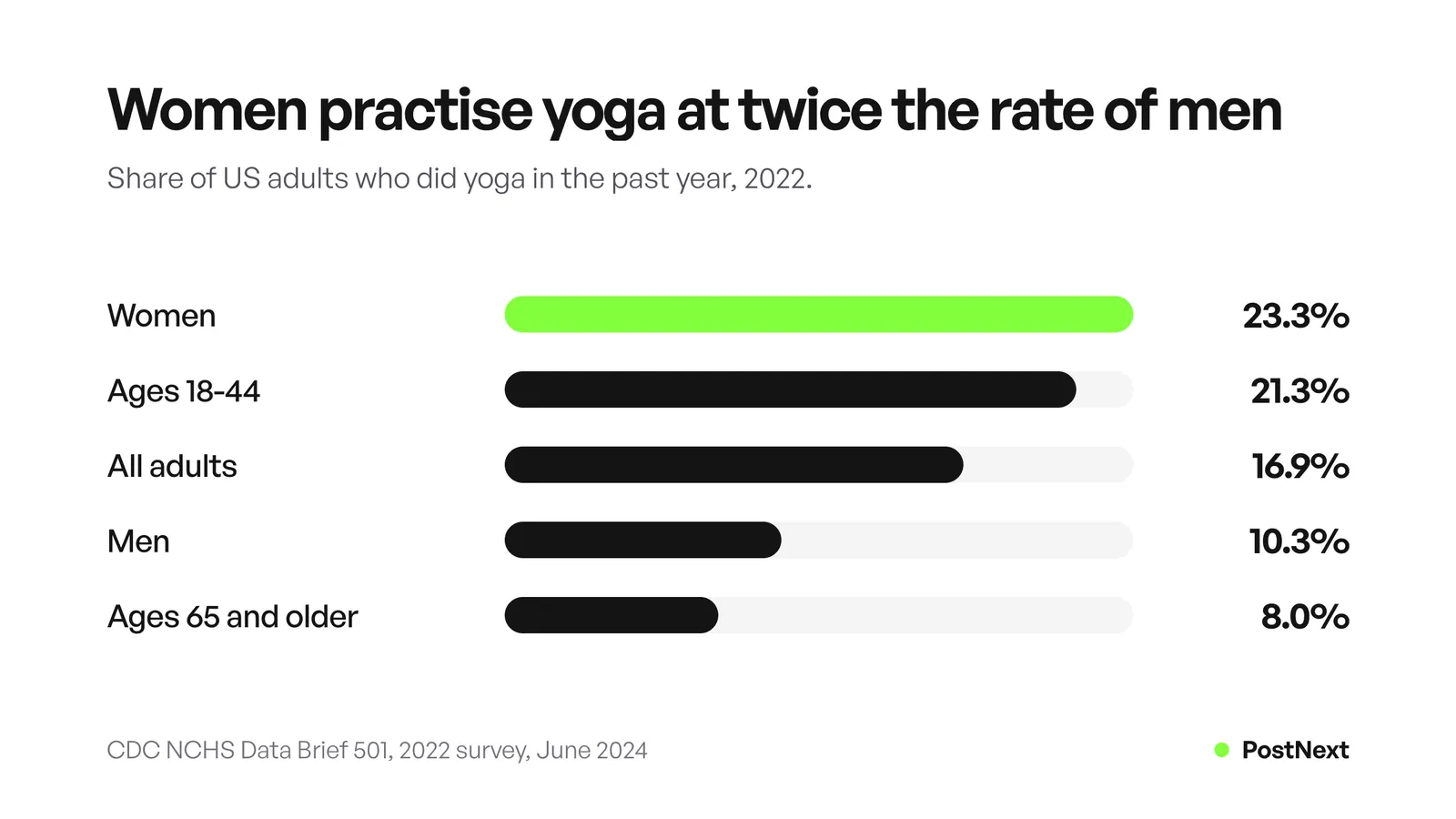
| Group (US adults, 2022) | Practised yoga in the past 12 months |
|---|---|
| All adults | 16.9% |
| Women | 23.3% |
| Men | 10.3% |
| Ages 18-44 | 21.3% |
| Age 65 and older | 8.0% |
| Family income below 200% of the poverty level | 10.4% |
| Family income 400% of the poverty level or more | 23.0% |
CDC National Center for Health Statistics, Data Brief No. 501, National Health Interview Survey 2022, published June 2024. Checked November 2026.
Most of these people practise for their general health. Of the adults who did yoga, 80.0% said they did it to restore overall health, and 57.4% included meditation. The Health & Fitness Association reported in April 2026 that yoga was the most practised activity in US gyms and studios in 2025, with 17.7 million members. Your next student may already do yoga at a gym and want a calmer room.
That audience points to two channels. Pew Research Center’s 2026 survey found 77% of US women use Facebook and 56% use Instagram, against 63% and 45% of men. A studio whose students are mostly women aged 25 to 55 should run Instagram first, keep Facebook active for older students, and keep its Google Business Profile current. Our guide on social media for fitness studios and gyms has the full platform table by age.
What should a yoga studio post to bring in beginners?
Post what answers a beginner’s fears: who the class is for, what happens in the first ten minutes, what to bring, and what the teacher looks like. The 2016 Yoga in America Study found flexibility was the top reason people start yoga, at 61%. Harvard Health, reporting the same study, said the most common reason people do not try is that yoga looks made for the already flexible.
So the beginner who writes “I can’t even touch my toes” is your best customer, and your posts should say so. Rotate these post types:
- The beginner class, explained. A 30-second clip of an empty room with the teacher saying what happens in class, step by step. Name the props: blocks, straps, a blanket.
- “Can I do yoga if I’m not flexible?” Answer it once a month in a new format: a teacher talking, a carousel, a student who started last year (with their written consent).
- One pose, three versions. A teacher shows a pose with a block, with a strap, and in full. People see a version they can do today.
- The weekly schedule. Every Monday, with the beginner-friendly classes marked.
- Meet the teacher. Name, styles, how long they have taught, and one sentence about who loves their class.
- What is coming. A workshop, a new class time, a retreat or a teacher training, with the date and the booking link.
Name class styles in words a beginner knows. “Slow flow for beginners” tells a stranger more than “Vinyasa 1”. Say plainly when a class is heated. NCCIH, part of the US National Institutes of Health, notes that hot yoga carries risks from overheating and dehydration. A clear post about water and breaks shows you take safety seriously.
Short clips can do most of this work. For filming ideas that suit a studio, see our list of Instagram Reel ideas you can film this week.
Should the studio or the teachers be the face on social media?
Both, in that order. The studio account holds the schedule, the room and the booking link, and it features each teacher by name. Teachers can keep their own accounts, but students should follow the studio. In the 2016 Yoga in America Study, only 29% of teachers said yoga was their main source of income, so many teach at several places.
That fact shapes the plan. A teacher who covers your Tuesday class may also teach at a gym across town. If every class clip lives only on the teacher’s account, students follow the teacher, not your studio. The same study found more than half of teachers and trainees post yoga selfies and make instructional videos, so your teachers already create content. Give it a home on the studio account.
Three habits keep this fair for both sides:
- Post together. Instagram’s Collab feature puts one post on both the studio’s and the teacher’s profile. You send the invite in the Instagram app.
- Agree in writing. Write down who may post studio clips, which account owns them, and what happens to them when a teacher leaves. Settle this at hiring, not at the goodbye.
- Credit honestly. A teacher who praises the studio on their own account should say they teach there. The FTC says an endorsement from an employee is misleading unless the connection is clear.
A studio that relies on one star teacher is fragile. Feature the whole team, so a student who loves Maya’s class also knows who teaches on Thursday. Solo teachers without a studio can find more ideas in our guide to social media for personal trainers, which covers building a following as one person.
Can you film students during a yoga class?
You can, with clear consent, but most of a yoga class is the wrong time to film. Students close their eyes, sweat, and rest in positions they would never post. Film the teacher, the empty room, or a short clip with volunteers who agreed to that clip. Never film savasana, the final rest, because nobody can say no with their eyes closed.
Yoga Alliance’s Scope of Practice sets a strict consent rule for hands-on adjustments. Consent must be explicit, “Previous consent does not imply future permission”, and “Silence or lack of resistance, in and of itself, does not demonstrate consent.” That rule covers hands-on touch. The same standard works well for filming, because a student who said yes last month may not want to appear today.
The platforms will not protect your students either. Meta’s privacy rules list removal routes for children and for adults reporting from outside the United States, but none for US adults. So build your own routine:
- Ask on the sign-up form, with a yes and a no, and keep the answers where teachers can see them.
- Announce it before class starts. Tell people which part you will film and where to put their mat to stay out of shot.
- Film from behind or from the side, and never during savasana, meditation or any eyes-closed part.
- Film a demo instead. Ten minutes before class, the teacher and two volunteers can record a flow for Reels.
- Remove a post the same day when someone asks.
Our fitness studio guide has a longer consent checklist, including kids’ classes and paid ads.
What can a yoga studio say about health benefits?
Say what students feel and what research supports, and never promise that yoga treats or cures a condition. The FTC says it is unlawful to advertise that something can prevent, treat or cure a disease without competent and reliable scientific evidence. Yoga Alliance adds its own rule for registered teachers and schools: claims to diagnose or treat count as yoga therapy.
The research is more modest than many captions. NCCIH says yoga may relieve neck pain, headaches and knee osteoarthritis pain. It says yoga “may also have a small benefit for low-back pain.” For people diagnosed with anxiety disorders, a 2021 review could not reach conclusions. There were not enough rigorous studies. A caption that says “yoga heals anxiety” goes far beyond that.
| Claim to avoid | Safer wording | Why |
|---|---|---|
| ”Yoga cures back pain" | "Gentle class for stiff backs. Tell your teacher about any injury.” | NCCIH: a small benefit for low-back pain; a cure claim needs scientific evidence (FTC) |
| “Heal your anxiety" | "An hour to slow down and breathe” | NCCIH: not enough rigorous studies on anxiety disorders |
| ”Our yoga therapy fixes injuries” (RYT only) | “Ask about classes for beginners and people with injuries” | Yoga Alliance: an RYT designation alone cannot be used to claim yoga therapy |
| ”Detox your body in one class" | "A strong, sweaty class. Bring water.” | No source supports it; NCCIH warns about overheating in hot yoga |
| ”Lost 20 pounds with our 30-day challenge" | "Thirty classes in thirty days. Here is how Sam felt on day 30.” | FTC: an unusual result must state what people generally achieve |
Federal Trade Commission, Health Products Compliance Guidance and Endorsement Guides; NCCIH, “Yoga: Effectiveness and Safety”, last updated August 2023; Yoga Alliance, Yoga Therapy Policy. Checked November 2026.
Teachers with a real yoga therapy qualification may use the term. Yoga Alliance allows “yoga therapy” in marketing when the post names the body that gave the credential. Its Scope of Practice also says a Yoga Alliance credential must never be used to suggest skills outside yoga teaching. This is general information, not legal advice; check claims for paid ads with a lawyer.
When do people search for yoga studios and classes?
People search for a yoga studio most in November and January, but beginners search most in March. DataForSEO’s Google Ads data shows US searches for “yoga studio near me” at 90,500 in November 2025 and January 2026. Searches for “beginner yoga classes near me” peaked at 9,900 in March 2026, and were lowest in November and December.
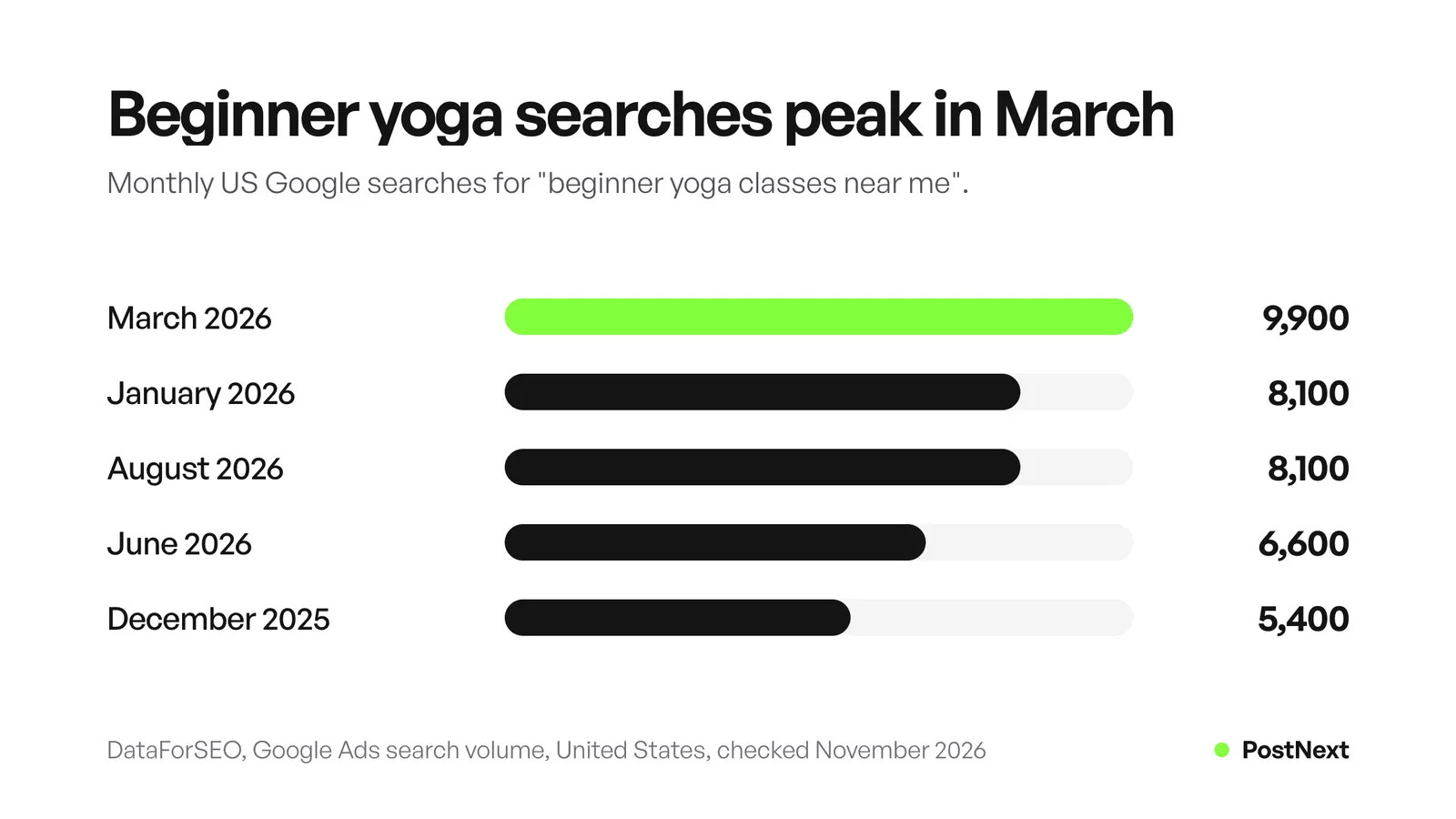
| Month | ”yoga studio near me" | "beginner yoga classes near me" | "yoga teacher training near me" | "yoga workshops near me” |
|---|---|---|---|---|
| November 2025 | 90,500 | 5,400 | 4,400 | 390 |
| December 2025 | 74,000 | 5,400 | 3,600 | 390 |
| January 2026 | 90,500 | 8,100 | 4,400 | 480 |
| March 2026 | 60,500 | 9,900 | 4,400 | 390 |
| May 2026 | 49,500 | 8,100 | 3,600 | 320 |
| June 2026 | 49,500 | 6,600 | 2,900 | 260 |
| August 2026 | 74,000 | 8,100 | 2,900 | 260 |
| October 2026 | 60,500 | 6,600 | 3,600 | 210 |
DataForSEO, Google Ads monthly search volume for the United States, checked 25 November 2026. Google rounds these numbers into ranges, so read them as levels, not exact counts.
Two things stand out. Beginner interest arrives later than the New Year rush, and it stays near 8,100 a month from April to September, apart from a dip in June. And teacher training searches are highest in November, January and March, when people plan the year. Plan your posts around both:
- November to January: post the January schedule, the new-student offer and any teacher training dates with an early booking date.
- February and March: post the beginner series every week. Answer the “not flexible” question again. This is when beginners look.
- May and June: studio searches are at their lowest. Film clips, run a summer workshop, and write the autumn posts.
- August and September: back-to-routine month. Post the autumn timetable and a fresh beginner series.
How should a studio post workshops, retreats and teacher trainings?
Treat each event as a short series of posts, not one announcement. Post the date and what the person gets about six weeks ahead, then the teacher, then a clip from last time, then a reminder when places are almost gone. Teacher trainings cost more and take longer to decide, so post their answers to common questions for months, not weeks.
A sequence that works for a two-hour workshop:
- Six weeks out: the title, the date, who it is for and the booking link.
- Four weeks out: the teacher explains one thing people will learn, in 30 seconds.
- Two weeks out: a clip or photo from the last workshop, with consent from anyone in it.
- Final week: the number of places left, and the time on the day.
Teacher trainings and retreats need longer answers. People ask about hours, dates, cost, payment plans and whether a beginner can join. Answer one question per post. Then pin the answers. If many people comment the same question, a comment-to-DM tool such as CreatorFlow can send the information pack to everyone who comments a word like RETREAT. Messages then go only to people who asked for it.
On Google, add an Event post with the date and the booking link. On Instagram, keep one link in your bio that holds the schedule, the next workshop and the training page. More.You’s guide shows how to add a link to your Instagram bio.
Can a yoga teacher who rents a hall have a Google Business Profile?
A studio with its own address and signage should be a storefront on Google. A teacher who rents a church hall or a community room for weekly classes cannot list that hall. Google’s eligibility rules exclude “an ongoing service, class, or meeting at a location that you don’t own or have the authority to represent.”
This rule surprises many teachers, and it shapes where they should spend time. Google also says a business without permanent signage at its address is not a storefront. So a teacher in a rented hall has three options:
- Ask the venue. A community centre or a studio that rents you its room can list your class in its own profile posts or timetable.
- List your private sessions. A teacher who also visits clients for private sessions may qualify as a service-area business, which hides the address and lists the area served.
- Put the weight on Instagram and Facebook. Post the class, the hall and how to find the door. Pin a post with directions.
A studio has more to set up. Add a booking link, special hours for holidays, and photos of the room, the props and the teachers. Google asks for at least three interior and three team photos. Sizes and specs are in our guide to Google Business Profile image sizes, and PostNext’s Google Business Profile page lists the steps in Google’s own tool. PostNext cannot post there yet.
Which music can a yoga studio use in Reels?
Use the business music libraries: Meta’s Sound Collection on Instagram and Facebook, and TikTok’s Commercial Music Library. Instagram says its main music library is for personal, non-commercial use, and some business accounts cannot use it. Your class playlist is someone else’s music, so turn it down when you film.
Yoga clips often work better with the teacher’s voice or the room’s sound. A calm cue and the sound of breath feel more like your class than a borrowed song. Meta’s Sound Collection holds over 14,000 royalty-free songs and sounds that are safe for Reels, Stories and ads. TikTok’s library has 1 million pre-cleared songs, free for business use. The fitness studio guide above has the full music table.
What does a week of yoga studio posts look like?
Three or four posts a week is enough: the schedule, a beginner answer, a teacher clip, and an event or a student story. Plan them once a week and film two clips in one session. Then answer comments and messages every day, because a question about price or level is a booking in progress.
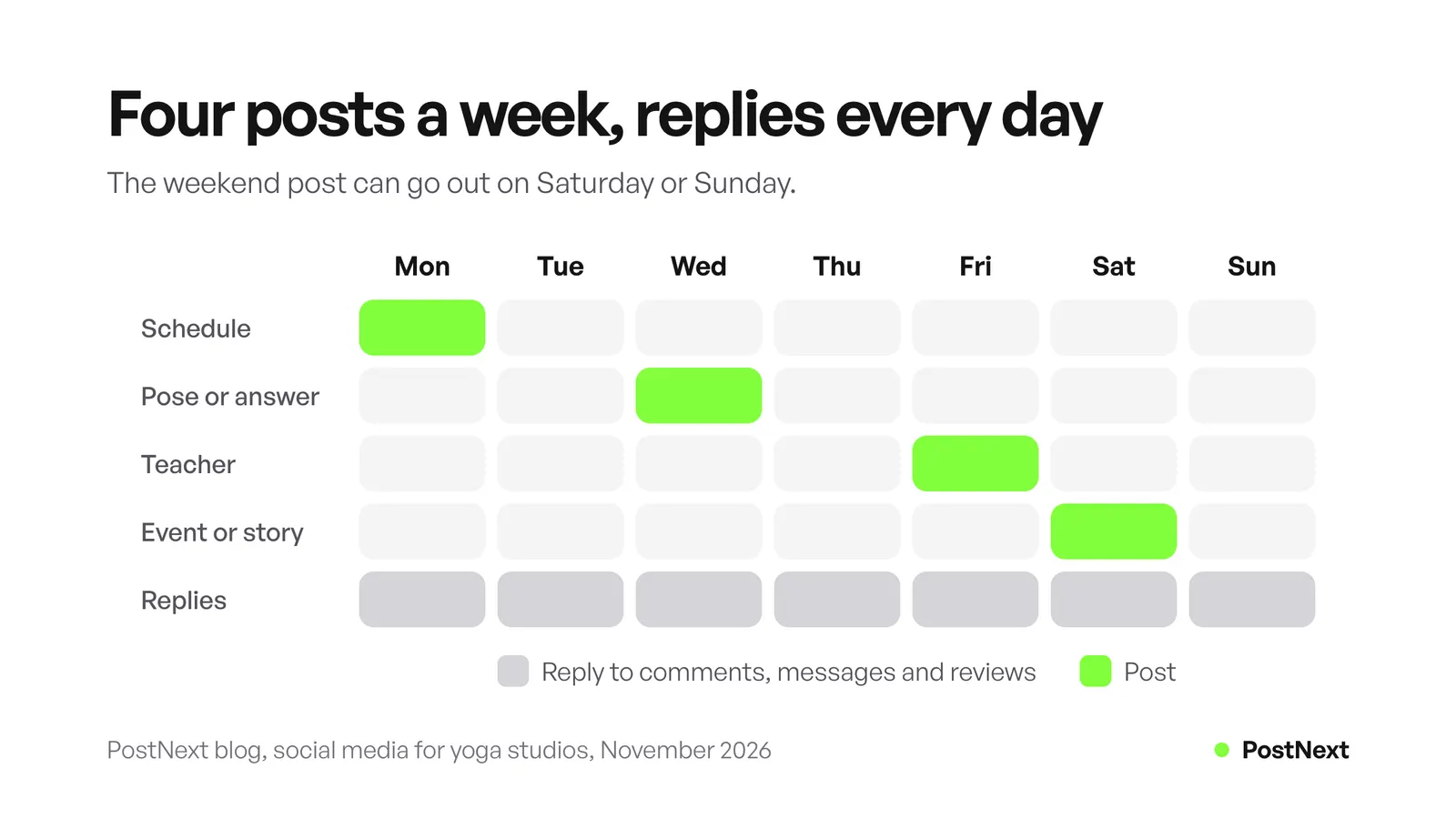
| Day | Post | Channel | Time it takes |
|---|---|---|---|
| Monday | This week’s schedule, beginner classes marked | Instagram, Facebook, Google | 5 minutes, or set once as a repeat |
| Wednesday | One pose, three versions, or a “not flexible?” answer | Instagram Reels, TikTok, YouTube Shorts | 15 minutes, filmed before class |
| Friday | Meet the teacher, or a teacher cue | Instagram, Facebook | 10 minutes |
| Weekend | Workshop, retreat or training post, or a student story with consent | Instagram, Facebook, Google Event post | 10 minutes |
| Every day | Replies to comments, messages and reviews | All channels | 10 minutes |
Suggested plan. Adjust the days to your timetable and keep the same days every week.
Reviews matter as much as posts. Ask students for an honest Google review after a good class, and never offer a free class for one. Google’s Maps policy removes reviews that a business paid for with discounts or free services.
How does PostNext help a yoga studio?
PostNext lets a studio plan a month of posts in one sitting and publish each at its time. It posts to Instagram, TikTok, YouTube, LinkedIn, X, Threads and Bluesky from one calendar. Repeat this post publishes the Monday schedule post every week until you stop it.
You can set a repeat to run forever, until a date or for a number of posts, and pause it during a holiday week. Each repeat counts as one post on your plan. The steps are on the repeat a post help page. For a teacher clip, the PostNext page for coaches shows how one uploaded video posts as a Reel, a TikTok and a Short, each with its own caption. PostNext does not edit video.
The Instagram scheduler publishes Reels and carousels, and the Instagram comment inbox lets you answer comments in one place. It does not handle DMs. Collab invites and location tags are added in the Instagram app. PostNext cannot publish to Facebook or Google Business Profile yet; both are on its roadmap. The free plan covers 1 channel, 10 posts and 10 AI credits a month. See PostNext for yoga studios for how a studio sets it up.
Frequently Asked Questions
What should a yoga studio post on Instagram?
Post the weekly schedule, short clips of one pose shown at three levels, teacher introductions, and posts for workshops, retreats and trainings. Answer the beginner question “Can I do yoga if I’m not flexible?” at least once a month. Film only people who agreed to that clip, and never during savasana.
How do I market a yoga studio to beginners?
Name the beginner classes in plain words, show the props, and explain what happens in the first class. Flexibility is the top reason people start yoga, so say that stiff bodies are welcome. Post the beginner series most in February and March, when US searches for beginner classes peak.
Can a yoga studio say yoga helps with back pain?
Be careful. NCCIH says yoga may have a small benefit for low-back pain, but a claim that yoga treats or cures a condition needs competent and reliable scientific evidence under FTC law. Describe the class and what students feel instead, and ask students to tell the teacher about any injury.
Is it okay to film students in a yoga class?
Only with clear consent for that clip, announced before class, with a place for students who want to stay out of shot. Do not film savasana, meditation or any eyes-closed part of class. Filming the teacher or a short demo with volunteers before class is often the better choice.
Can a yoga teacher get a Google Business Profile?
A teacher with a studio of their own can. A teacher who runs weekly classes in a rented hall cannot list that hall, because Google excludes ongoing classes at a location you do not own. A teacher who visits clients for private sessions may qualify as a service-area business.
How often should a yoga studio post on social media?
Three or four posts a week on the main channel is enough for most studios: the schedule, a beginner answer, a teacher clip and an event or student story. Post every week of the year, including the quiet summer months, and reply to comments daily.
Sources
- CDC National Center for Health Statistics, Yoga Among Adults Age 18 and Older: United States, 2022, Data Brief No. 501, June 2024, checked November 2026.
- Health & Fitness Association, 81 Million Americans Were Members of a Fitness Facility in 2025, April 2026, checked November 2026.
- Yoga Alliance, Highlights from the 2016 Yoga in America Study and Study Highlights for Yoga Teachers and Practitioners (Yoga Journal and Yoga Alliance, 2016), checked November 2026.
- Harvard Health Publishing, New survey reveals the rapid rise of yoga, and why some people still haven’t tried it, March 2016, checked November 2026.
- Yoga Alliance, Scope of Practice and Yoga Therapy Policy, checked November 2026.
- NIH National Center for Complementary and Integrative Health, Yoga: Effectiveness and Safety, last updated August 2023, checked November 2026.
- Federal Trade Commission, Health Products Compliance Guidance and FTC’s Endorsement Guides: What People Are Asking, checked November 2026.
- Pew Research Center, Social Media Fact Sheet, published October 2026, checked November 2026.
- DataForSEO, Google Ads search volume for the United States (“yoga studio near me”, “beginner yoga classes near me”, “yoga teacher training near me”, “yoga workshops near me”), checked 25 November 2026.
- Google Business Profile Help, business eligibility and ownership guidelines, business types, business photos and posts, checked November 2026.
- Google, Maps user contributed content policy, checked November 2026.
- Meta Transparency Center, Privacy Violations, checked November 2026.
- Instagram Help Center, Access to the licensed music library on Instagram, and TikTok Ads Help Center, About the Commercial Music Library, checked November 2026.
- PostNext, repeat a post, coaches page, Instagram channel page and pricing page, checked November 2026.