Social media for dentists is a trust check before the first booking. BrightLocal’s 2026 survey found 97% of US consumers read reviews for local businesses, and a nervous patient also looks at your team, your rooms and your replies before calling. Post twice a week, reply to every review without naming a patient, and get written consent before any patient appears. This PostNext guide shows what to post and what to avoid.
Key Takeaways
- Reviews come first: 97% of consumers read local reviews, and 68% will only use a business with 4 stars or more.
- Your posts are the second check: patients look at faces, rooms and replies to decide if your clinic feels safe.
- Patient photos need written permission: HHS says a valid, written HIPAA authorization is generally needed before a patient’s information goes into a testimonial or social media post.
- Review replies are where clinics get fined: HHS settled with two dental practices, for $10,000 and $23,000, over replies to online reviews.
- Never confirm a patient in public: thank the reviewer, offer a phone call, and leave out names, treatment, dates and insurance.
- Two posts a week is enough: one about people, one tip or answer, every week.
- The year plans itself: National Children’s Dental Health Month in February, sealants before school, National Dental Hygiene Month in October.
Does social media work for dental clinics?
Social media works for dental clinics as proof that the clinic is safe, kind and real. Most new patients find a dentist through a referral, an insurance list or a search, then check you before they book. BrightLocal’s 2026 survey of 1,002 US adults found 97% read online reviews for local businesses, and 54% visit the website after reading a positive review.
So a clinic needs no viral videos. It needs a feed that answers a nervous patient’s questions: who will treat me, what does the room look like, and do they answer when something goes wrong.
| Where patients check you | What they look for | Data |
|---|---|---|
| Reviews on Google, Facebook and Yelp | Star rating, recent reviews, how the clinic replies | 97% read local reviews (BrightLocal, 2026) |
| Your Google Business Profile | Hours, insurance notes, photos, phone, directions | 71% use Google for reviews (BrightLocal, 2026) |
| Your Instagram and Facebook | Faces of the team, the rooms, tips, recent posts | 70% of US adults use Facebook, 51% Instagram (Pew, 2026) |
| AI assistants | A short list of recommended local clinics | 45% used AI tools for local recommendations, up from 6% (BrightLocal, 2026) |
| Your website | Services, new-patient steps, booking | 54% visit the website after a positive review (BrightLocal, 2026) |
BrightLocal Local Consumer Review Survey 2026 (1,002 US adults, February 2026) and Pew Research Center Social Media Fact Sheet (5,511 US adults, October 2026), checked November 2026.
There is a fair case for doing less. A clinic with a full book and good reviews gains little from posting every day; its time is better spent on the Google profile and on asking for reviews. Social media earns its place when you want patients for a service people choose, such as whitening or aligners, or open a new location. Our guide to social media marketing for local business shows how a local customer moves from a search to a booking.
Which social media platforms should dentists use?
Dentists do best with a Google Business Profile, a Facebook Page and Instagram. Pew’s 2026 survey of 5,511 US adults found 84% use YouTube, 70% use Facebook, 51% use Instagram and 37% use TikTok. Facebook reaches the parents who book for the whole family. Instagram suits smiles, rooms and team photos. YouTube fits short “what to expect” videos.
| Platform | Best job for a dental clinic | Reach in the US |
|---|---|---|
| Google Business Profile | Hours, photos, reviews, posts; a profile per public-facing dentist if they qualify | The first place 71% look for reviews |
| Facebook Page | Family patients, reviews, events, local groups | 70% of US adults |
| Team, rooms, technology, before-and-after photos with consent | 51% of US adults | |
| YouTube | Short videos: a first visit, how a crown is fitted, how to floss | 84% of US adults |
| TikTok | Short tips and team videos, if someone on the team enjoys making them | 37% of US adults |
Reach from Pew Research Center 2026; Google figure from BrightLocal 2026; profile rule from Google Business Profile Help. Checked November 2026.
Google has a rule that matters for group practices. A dentist may have their own Business Profile if they work in a public-facing role and patients can contact them at the verified location during stated hours. Support staff should not have one. If a dentist is the only public-facing practitioner at a branded clinic, Google says it is best to share one profile, named “[clinic]: [dentist name]”. The same rule covers optometrists in an optical practice. For photo and post sizes, see our guide to Google Business Profile image sizes.
Pick two channels and post on both every week. Five accounts that went quiet last spring look worse than none.
What can a dental clinic post without breaking HIPAA?
A dental clinic can post anything that does not identify a patient: the team, the rooms, the equipment, oral-health tips, answers to common questions and clinic news. A post that shows or describes a patient needs that patient’s written permission first. HHS lists full-face photographs among the details that identify a person.
In September 2025, Cadia Healthcare Facilities paid $182,000 after posting “success stories” of 150 patients, with names, photos and treatment details, without permission. The OCR Director said: “Generally, a valid, written HIPAA authorization from an individual is necessary before a covered entity or business associate can post that individual’s PHI in a website testimonial or through a social media campaign.” The same rule applies to chiropractic clinics that bill insurance electronically.
Most guides call before-and-after smiles and patient stories a clinic’s best proof. They are also the two posts most likely to break the law:
| Post type | What you need first | Why |
|---|---|---|
| Team, rooms, equipment, tips | Nothing beyond staff agreement | No patient information |
| Before-and-after smile | Written authorization from the patient | A face, or details that point to one person, is protected health information |
| Patient story or video testimonial | Written authorization; a note of what is typical | HIPAA authorization; ADA 5.F.2 on unjustified expectations |
| A review turned into a post | The reviewer’s permission | The post confirms they are your patient |
| A paid creator or influencer post | A clear disclosure in the post; no fee per patient | FTC material connection; ADA 4.E.1 and 5.F.7 |
Rules as read on hhs.gov, ada.org and ftc.gov, November 2026. This is not legal advice: check with your state board or a healthcare lawyer before your first patient post.
Three rules from the American Dental Association’s Code of Ethics (2025 edition, advisory opinions revised to October 2024) apply to every post:
- No promises you cannot keep. Opinion 5.F.2 calls a statement misleading if it is “likely to create an unjustified expectation about results the dentist can achieve.” Show your best case; never caption it “this is what you will get”.
- No claims without evidence. Opinion 5.F.7, on social media, calls claims of superior results or of safety without research false or misleading. It names fluoride claims and “remove toxins” dentistry as examples.
- No fee per patient for promoters. Opinion 4.E.1 says paying a marketer or influencer a share of the fees from patients they send is fee splitting, “social media coupons” included.
If you give an influencer free whitening in return for a post, the FTC counts that as a material connection. The disclosure goes in the post itself, and the FTC calls tags like “sp”, “spon” and “collab” too vague. Write it in plain words, such as “Thanks to [clinic] for the free whitening.”
Use one written form that says which photos, on which channels, for how long, and keep it with the patient’s record. One person, usually the practice manager, checks the form before the post goes out. Our guide to the content approval process shows how to add that check without slowing every post.
What should dentists post on social media?
Dentists should post people, places and plain answers. Introduce the team, show the rooms and equipment, explain a first visit, and answer the questions patients ask at the front desk. These posts show no patient, so they need no consent form. Add before-and-after photos and patient stories only with written permission.
Rotate these twelve post types:
- Meet the team. One person a week: name, role, one thing they like about the job.
- Your first visit, step by step. Film the walk from the front door to the chair, with parking and the waiting room.
- A question from the front desk. “Does whitening hurt?” “Do you see children?” Answer in three sentences.
- The room and the equipment. A new scanner or a calm treatment room, with one line on what it does for the patient.
- A tip from the ADA. Brush twice a day with a soft-bristled brush and fluoride toothpaste. Clean between your teeth once a day.
- The seasonal reminder. Children’s dental health in February, sealants before school, hygienists in October. See the plan below.
- Your hygienists at work. No patient in the frame: tools laid out, a demonstration on a model.
- A before and after, with permission. Same light, same angle, and a caption that does not promise the same result.
- A review, with permission. Quote it with the reviewer’s first name only after they say yes.
- Clinic news. New hours, a new dentist, a new location, the insurance plans you take.
- Behind the front desk. Sterilising instruments, setting up a room. Anxious patients like to see the care.
- The community. A school visit or a charity day, with permission from anyone in the photos.
Take photos at the end of each day, before you close: one person, one room, one detail. That habit gives you more posts than two a week. Our list of what to post on social media for business has more ideas sorted by goal.
How should dentists reply to online reviews under HIPAA?
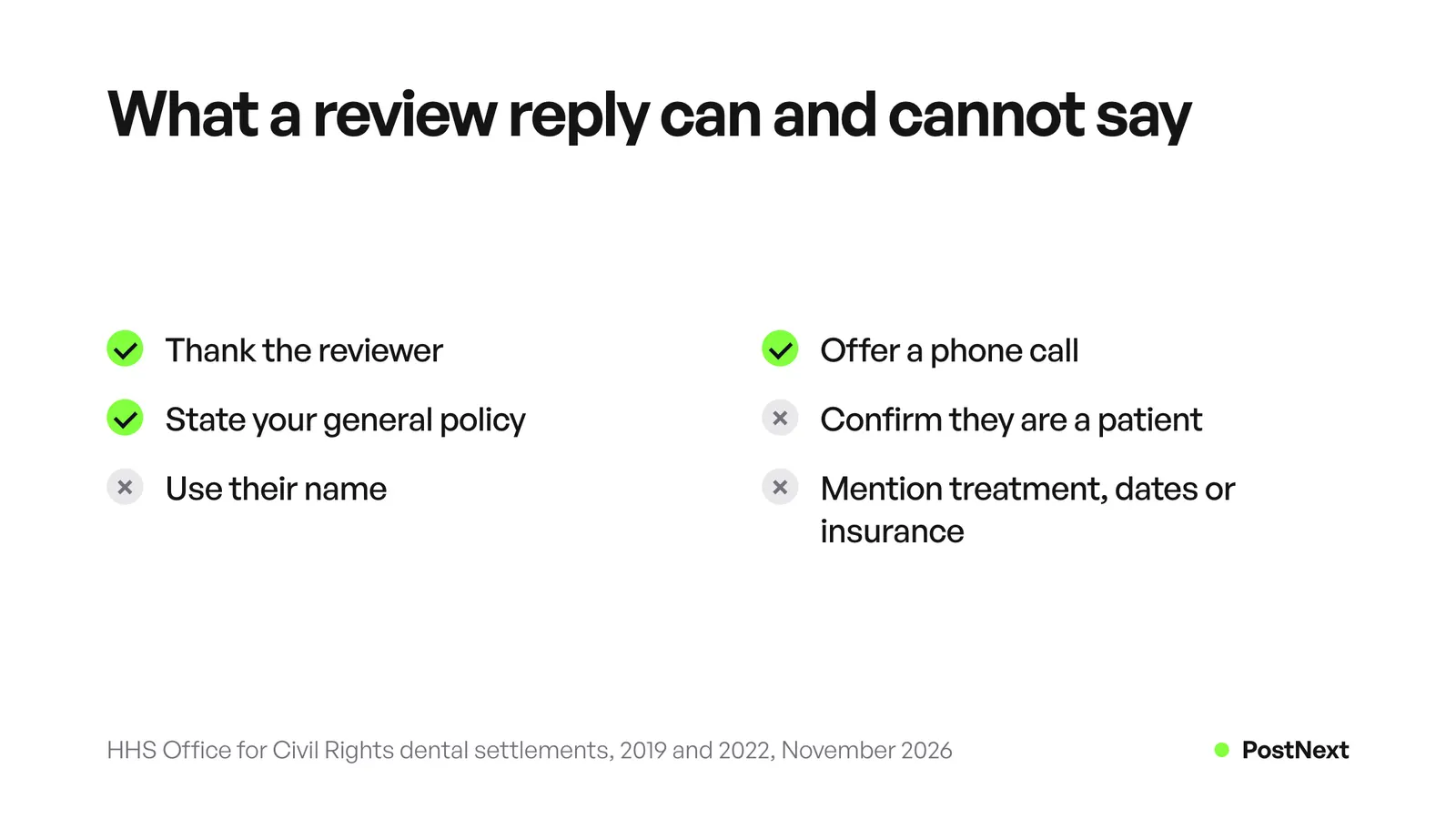
Reply to every review, and never confirm in public that the reviewer is a patient. Thank them, say you take every comment seriously, and offer a private phone call. Leave out their name, their treatment, their visit dates, their insurance and what they paid. HHS has settled with two dental practices over replies that broke this rule.
| Year | Practice | What the reply disclosed | Paid to HHS |
|---|---|---|---|
| 2019 | Elite Dental Associates, Dallas, Texas | Patient information in replies to reviews on social media | $10,000 and a corrective action plan |
| 2022 | New Vision Dental, California | Patient names, treatment and insurance information in replies to online reviews | $23,000 and a two-year corrective action plan |
| 2023 | Manasa Health Center, New Jersey (psychiatric care) | Patient information in a reply to a negative online review | $30,000 and a corrective action plan |
HHS Office for Civil Rights resolution agreements and press releases, checked November 2026.
New Vision Dental is the clearest warning. The complaint to HHS said it answered online reviews with patient names, treatment and insurance details. The OCR Director at the time said: “Providers cannot disclose protected health information of their patients when responding to negative online reviews. This is a clear NO.”
Use these replies as a start, and change the words so each one sounds like your clinic:
- A five-star review: “Thank you for taking the time to write this. The whole team will see it. [Clinic name]”
- A complaint: “Thank you for your feedback. We take every comment seriously. Privacy rules stop us from discussing anyone’s care online, even to confirm a visit. Please call [practice manager’s name] on [number] so we can talk it through.”
- A review you think is fake or about another clinic: “We take every comment seriously, and privacy rules stop us from discussing anyone’s care here. Please call [name] on [number] so we can look into it.” Then report the review through Google if it breaks Google’s rules.
Do not write “We’re glad your crown feels good” or “See you at your next cleaning.” Both sound friendly, and both tell the world this person is your patient. BrightLocal found 50% of consumers are put off by templated replies, so add a detail about your clinic, never about the patient: “We added evening hours last month for this reason.”
Ask for reviews as well, and ask everyone. BrightLocal found 78% of consumers were asked to leave a review in the past year, so asking is normal. Three rules apply:
- Ask every patient, not only the happy ones. Google does not allow businesses to “selectively solicit positive reviews”. The FTC says asking only happy customers could break the FTC Act.
- No rewards for reviews on Google. Google bans discounts, free goods or services in return for any review. The FTC’s rule, in force since October 21, 2024, bans rewards that ask for a positive or negative review.
- Staff do not review the clinic. Google treats reviews from current or former staff as a conflict of interest, and the FTC rule requires insiders to disclose their connection.
Questions arrive in comments and messages too: “How much is whitening?” “Do you take my insurance?” Answer price and booking questions; move anything about symptoms or treatment to a phone call. If the same question comes in dozens of times a week on Instagram, CreatorFlow can send the price list and booking link by message to everyone who comments a keyword and asks for it.
What is a monthly social media plan for a dental clinic?
A monthly plan mixes four kinds of posts: people, a tip, the clinic, and proof. Two posts a week gives you eight a month: two team posts, two tips, two about the clinic or a common question, and two reviews or before-and-after photos with permission. A few dates from the ADA, ADHA and CDC fill the year with topics.
| Month | Post idea | Source |
|---|---|---|
| February | National Children’s Dental Health Month: share the ADA’s free posters and brushing calendar | American Dental Association |
| Before the school year | Sealants: first molars come in around age 6, second molars around age 12 | CDC |
| Before the school year | Sealants can prevent up to 80% of cavities for 2 years | CDC |
| October | National Dental Hygiene Month: introduce your hygienists | American Dental Hygienists’ Association |
| Every 3 months | Replace your toothbrush every three or four months, or sooner if the bristles are frayed | ADA MouthHealthy |
| Any month | Brush twice a day with a soft-bristled brush and fluoride toothpaste; clean between teeth once a day | ADA MouthHealthy |
Advice as worded by the ADA (National Children’s Dental Health Month page and MouthHealthy), the CDC (About dental sealants) and the ADHA (National Dental Hygiene Month 2026), checked November 2026. The ADA says its 2026 children’s month materials continue the 2025 designs.
Inside each month, keep the same rhythm:
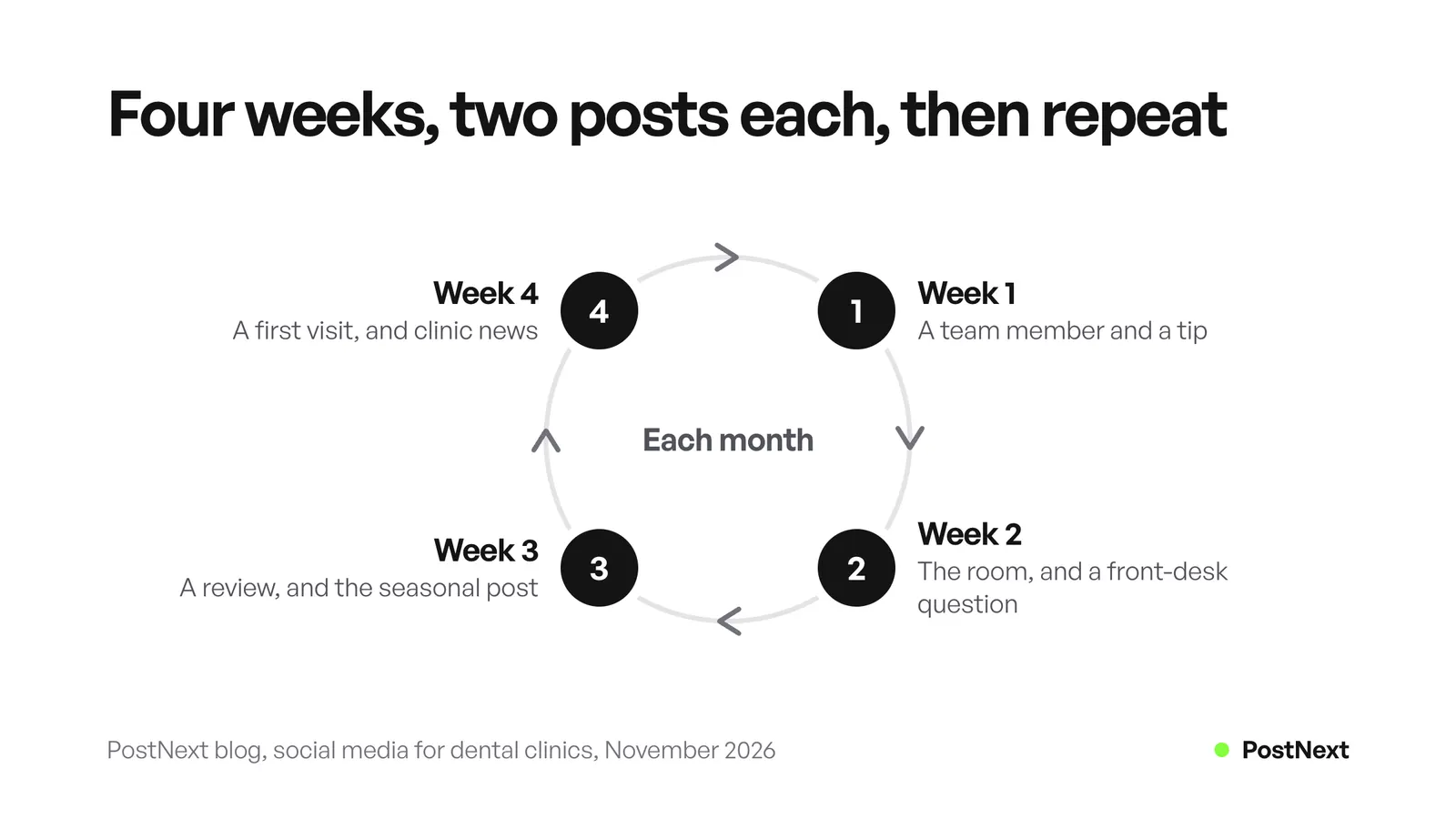
- Week 1: a team member, and a tip.
- Week 2: the room or a piece of equipment, and a question from the front desk.
- Week 3: a review with permission, and the seasonal post.
- Week 4: what to expect at a first visit, and clinic news or a before-and-after with permission.
Write the tips and seasonal posts for a whole quarter in one sitting. Then each week you only add one fresh photo of the team or the rooms.
How often should a dental clinic post on social media?
Two posts a week on each channel is enough for a dental clinic: one about people and one tip or answer. Buffer’s study of more than 100,000 users found accounts posting in 20 or more of 26 weeks got 450% more engagement per post than accounts posting in 4 weeks or fewer. Posting every week matters more than posting every day.
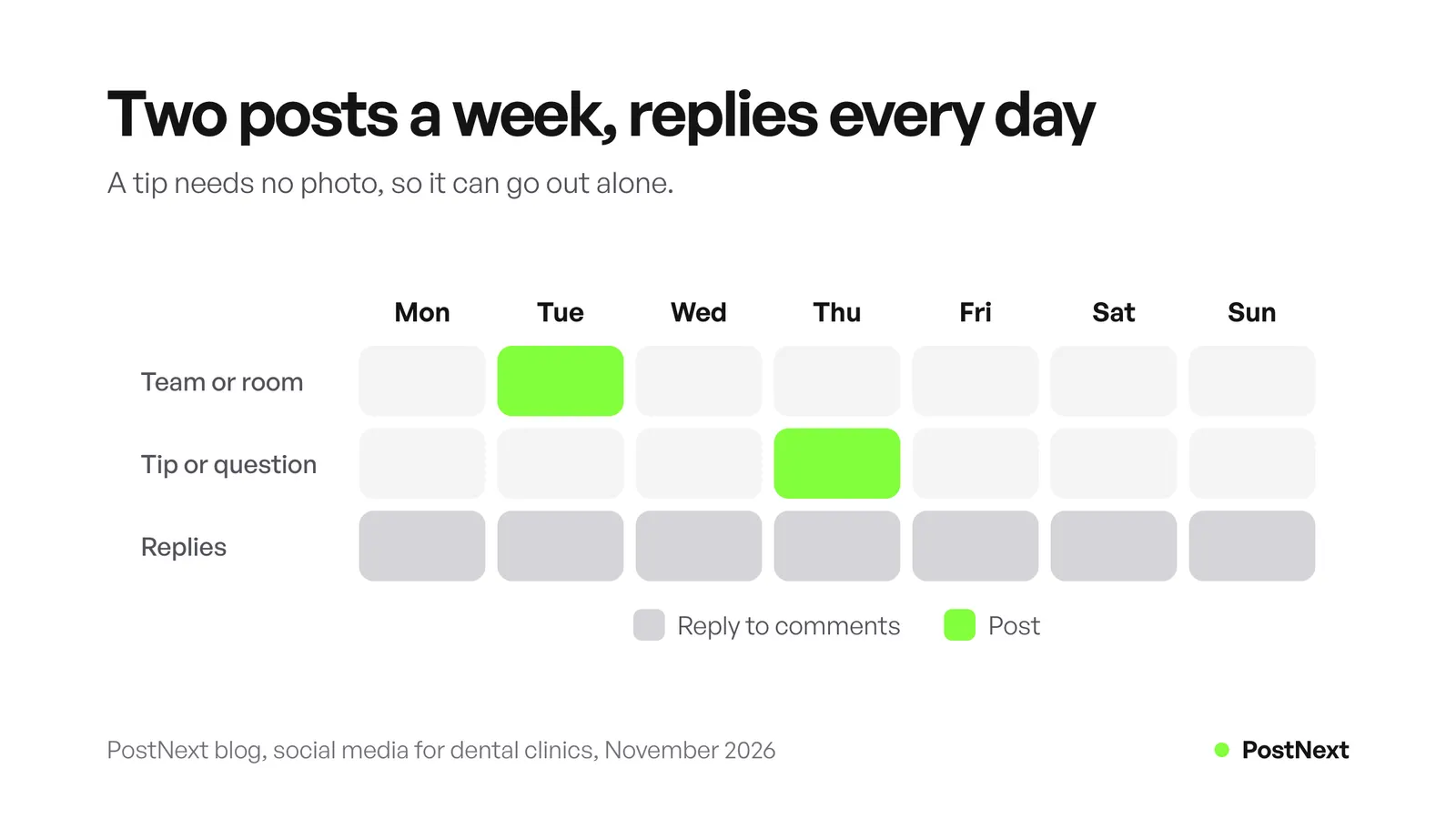
Post a team, room or clinic post on Tuesday and a tip or front-desk question on Thursday. Reply to comments, messages and new reviews within a day. The tips need no photo and no consent form, so in a busy week the tip goes out on its own.
What are the social media rules for dentists in the UK?
In the UK, the General Dental Council’s guidance on using social media applies. Its Standards for the Dental Team say: “You must not post any information or comments about patients on social networking or blogging sites.” You may share identifiable patient information only with the patient’s explicit consent. When you ask for consent, tell the patient how the information will be used, for what purpose and where it will appear.
The GDC adds two warnings that fit every country. Closed groups for dental professionals may still be open to the public, so treat them as public. And several small details, each harmless alone, can identify a patient when posted together: a date, a treatment and a street name in one caption is enough. Check with the GDC or your indemnity provider before you post patient photos.
How does PostNext help a dental clinic?
PostNext lets a clinic plan a month of team posts, tips and seasonal reminders in one sitting and publish each at its time. It posts to Instagram, TikTok, LinkedIn, X, YouTube, Threads and Bluesky from one calendar. Repeat this post sends a recurring post every 1 to 365 days, weeks or months, which suits a toothbrush reminder every three months.
On Instagram, the comment inbox lets you read, answer and delete comments in one place. It does not cover direct messages. On the Teams plan, a post can go to approval before it is scheduled, so the practice manager can check the consent form first. See the Instagram scheduler for posts, Reels, image Stories and carousels.
PostNext does not post to Facebook or Google Business Profile today, two channels most clinics need; both are listed as coming soon on the pricing page. Schedule those in Meta Business Suite and in your Google profile for now. The free plan covers 1 channel, 10 posts and 10 AI credits a month, enough for two Instagram posts a week. The pricing page also shows what the paid plans add. PostNext for dentists has a weekly posting plan and caption templates you can copy.
Frequently Asked Questions
Can dentists post patient photos on social media?
Yes, with the patient’s written authorization first. HHS lists full-face photographs among the details that identify a person, and its Office for Civil Rights says written authorization is generally needed before a patient’s information goes into a testimonial or social media post. Check the wording of your form with a healthcare lawyer or your state board.
How should a dentist reply to a negative review?
Thank the reviewer, say you take every comment seriously, explain that privacy rules stop you from discussing anyone’s care online, and offer a phone number. Do not confirm they are a patient. Do not mention their name, treatment, visit dates or insurance. New Vision Dental paid HHS $23,000 to settle a case over replies that did.
Which social media is best for dentists?
A Google Business Profile, a Facebook Page and Instagram cover most patients. Pew’s 2026 survey found 70% of US adults use Facebook and 51% use Instagram. Add YouTube for short videos about a first visit or a common treatment, since 84% of US adults use it.
How often should a dental office post on social media?
Two posts a week on each channel, every week: one about people and one tip or answer. Buffer’s study of more than 100,000 users found accounts that posted in 20 or more of 26 weeks got 450% more engagement per post than accounts that posted in 4 weeks or fewer.
Can a dental clinic offer a discount for a Google review?
No. Google does not allow discounts, free goods or services in return for any review. The FTC’s rule on consumer reviews, in force since October 21, 2024, also bans rewards that ask for a positive or negative review. Ask every patient for an honest review, with no reward.
Do HIPAA rules apply to a dentist’s personal social media?
Patient information stays protected on any account, so a patient story on a dentist’s personal profile is still a disclosure. The GDC says the same in the UK: standards do not change online. Keep patient stories off personal accounts, and check with your board or adviser.
Sources
- BrightLocal, Local Consumer Review Survey 2026, 1,002 US adults, published February 2026, checked November 2026.
- Pew Research Center, Social Media Fact Sheet, 5,511 US adults, published October 2026, checked November 2026.
- HHS Office for Civil Rights, Cadia Healthcare Facilities settlement, September 2025, checked November 2026.
- HHS Office for Civil Rights, New Vision Dental settlement, December 2022, checked November 2026.
- HHS Office for Civil Rights, Elite Dental Associates resolution agreement, October 2019, checked November 2026.
- HHS Office for Civil Rights, Manasa Health Center resolution agreement, June 2023, checked November 2026.
- HHS, Marketing under the HIPAA Privacy Rule and de-identification guidance, checked November 2026.
- American Dental Association, Principles of Ethics and Code of Professional Conduct, 2025, advisory opinions 4.E.1, 5.F.2 and 5.F.7, checked November 2026.
- Federal Trade Commission, Consumer Reviews and Testimonials Rule: questions and answers and Disclosures 101 for social media influencers, checked November 2026.
- Google, prohibited and restricted content for Maps reviews and Business Profile guidelines for individual practitioners, checked November 2026.
- General Dental Council, Guidance on using social media, effective from June 2016, checked November 2026.
- American Dental Association, National Children’s Dental Health Month and ADA MouthHealthy, brushing your teeth, checked November 2026.
- CDC, About dental sealants, May 2024, checked November 2026.
- American Dental Hygienists’ Association, National Dental Hygiene Month, checked November 2026.
- Buffer, Consistent Posting Study, January 2025, checked November 2026.
- PostNext, small business page, comment inbox, automation and pricing pages, checked November 2026.