
Social media for chiropractors works best as a teaching channel: short exercise clips, plain answers to the questions patients ask at the desk, and a steady flow of honest reviews. Keep every health claim inside what the evidence shows, because the FTC requires scientific proof for claims that you treat a condition. Get written permission before you post a patient. This PostNext guide gives the weekly plan and the rules.
Key Takeaways
- Reviews decide the first visit: 97% of US consumers read reviews for local businesses, and 68% only use a business with four stars or more (BrightLocal, 2026).
- Facebook reaches your older patients: 71% of US adults aged 50 to 64 use Facebook, and 79% of adults under 30 use Instagram (Pew Research Center, 2026).
- Claim what the research shows: the NIH says spinal manipulation may lead to small improvements in low-back pain. Never promise a cure.
- Patient posts need a signed form: under HIPAA, a covered clinic needs a patient’s written authorization to use their health information in marketing.
- State boards add rules: Washington allows chiropractic testimonials only about care from the last five years, with a notarized patient statement.
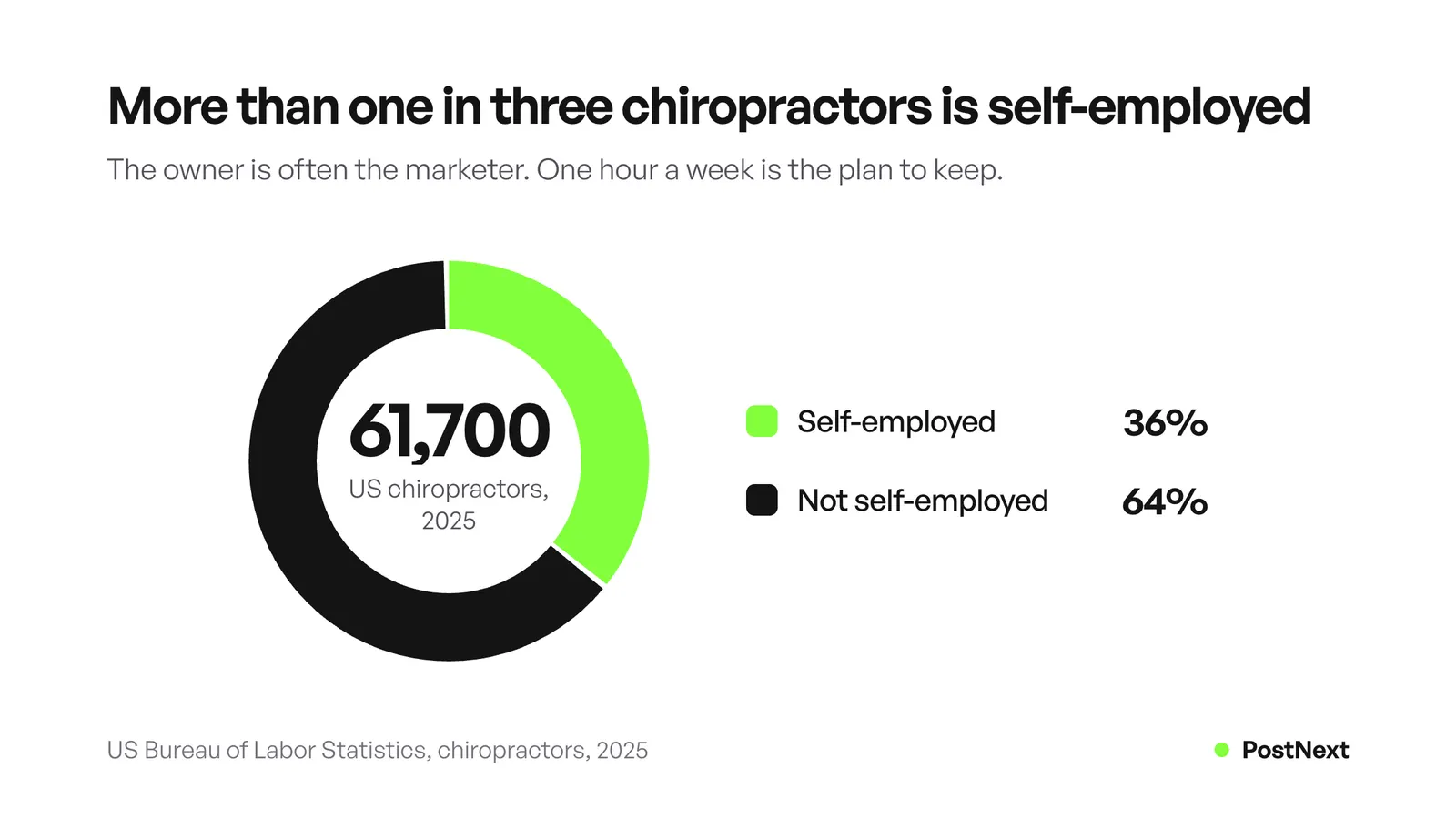
- The owner is often the marketer: 36% of US chiropractors are self-employed (US Bureau of Labor Statistics, 2025).
- Three posts a week is a plan you can keep: one exercise clip, one answered question, one post about your clinic.
Does social media work for chiropractors?
Social media works for chiropractors as proof before the first visit. Most new patients find a clinic on Google first: BrightLocal’s July 2026 study found that 52% of US consumers started their last local search on Google Search and 30% used social media at some point. People find a clinic on Google, then check its reviews, its photos and its posts. A feed with recent, useful posts tells them the clinic is active and the chiropractor explains things clearly.
That makes your social accounts a second window, next to your Google Business Profile. A patient with back pain does not scroll Instagram to find a chiropractor. They search, see three clinics on the map, and open the one whose reviews and photos look real. Your posts answer the questions they have at that moment: what happens at a first visit, who will treat me, and does this person know what they are doing?
The work usually falls on the owner. The US Bureau of Labor Statistics counts 61,700 chiropractor jobs in 2025, with 36% of chiropractors self-employed and 57% working in offices of chiropractors. Its outlook page notes that self-employed chiropractors may also handle marketing, hiring and record keeping. A plan that takes one hour a week is the plan that survives a busy month.
Which social media platforms should a chiropractic clinic use?
A chiropractic clinic should use Facebook and Instagram first, with YouTube for longer exercise videos and Google Business Profile for reviews and booking. Pew Research Center’s 2026 survey of 5,511 US adults found that 70% use Facebook, 84% use YouTube and 51% use Instagram. Age matters: Facebook reaches 71% of adults aged 50 to 64, while Instagram reaches 79% of adults under 30.
| Platform | US adults who use it (2026) | Best use for a chiropractic clinic |
|---|---|---|
| 70% (71% of ages 50-64, 59% of 65+) | Clinic news, holiday hours, posts patients share with family | |
| YouTube | 84% (85% of ages 50-64) | Longer exercise and “what to expect” videos you can link from the website |
| 51% (79% of ages 18-29, 64% of ages 30-49) | 30-second stretch clips, team photos, clinic Stories | |
| TikTok | 37% (65% of ages 18-29) | Optional; posture and desk-work clips for younger patients |
| Google Business Profile | Not a social network | Reviews, photos, booking link, opening hours |
Source: Pew Research Center, Americans’ Use of Social Media in 2026, published October 2026. Google Business Profile is not part of the Pew survey.
Pick the platforms your patients already use. A clinic whose patients are mostly over 50 can run Facebook and Google well and skip TikTok. A sports chiropractor with young athletes should put Instagram and short video first. Two platforms posted every week beat five platforms posted once a month.
What can a chiropractor claim on social media?
A chiropractor can describe what the research shows, in the research’s own strength. The US Federal Trade Commission says it is unlawful to advertise that a product or service can “prevent, treat, or cure human disease” without competent and reliable scientific evidence. Its health guidance adds that customer surveys are never enough. So “may help some people with low-back pain” is defensible. “Cures sciatica” is not.
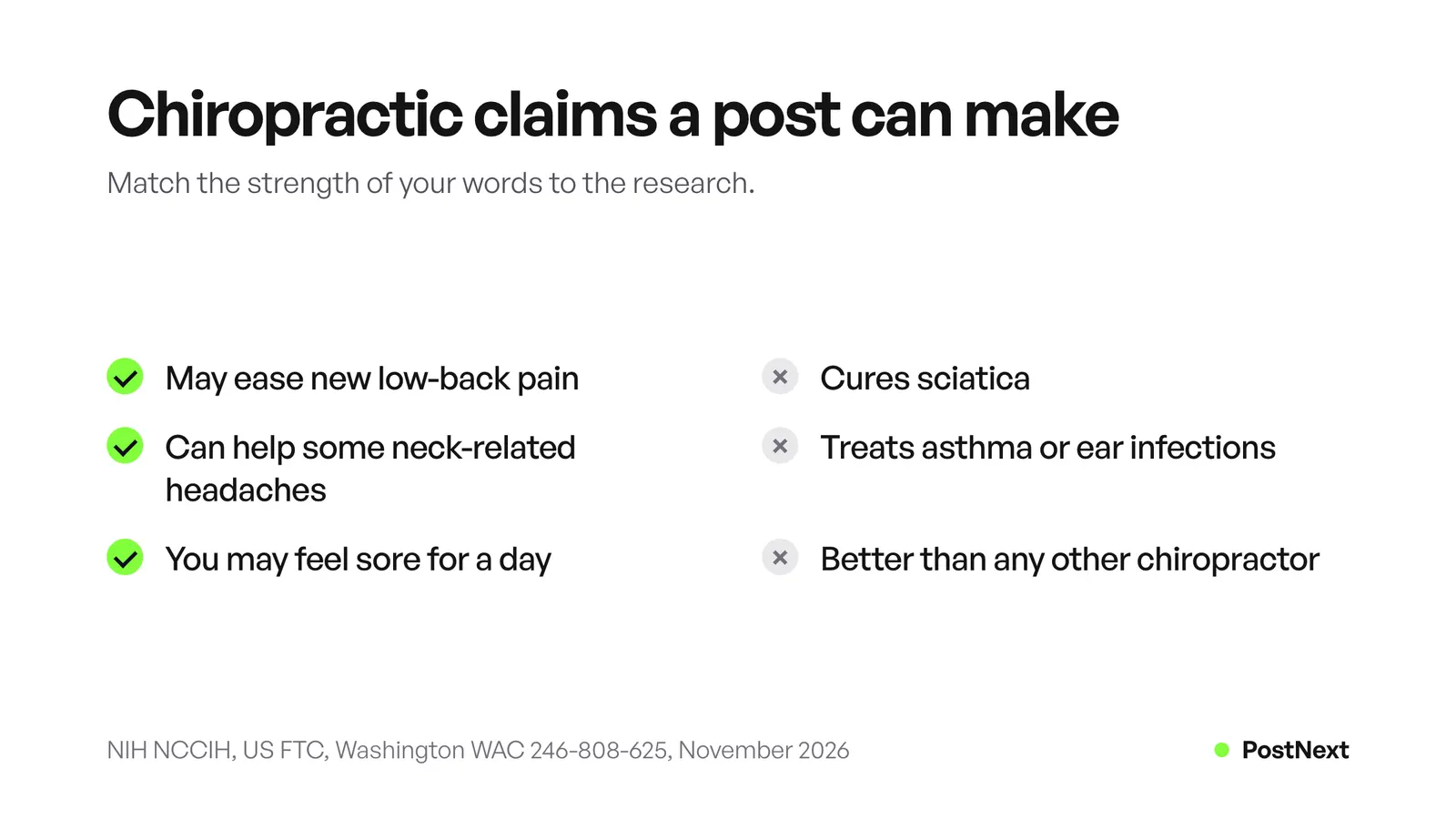
The National Center for Complementary and Integrative Health, part of the US National Institutes of Health, publishes a plain summary of the research. Use it as your wording guide.
| Topic | What the NIH summary says (2026) | Wording that matches it |
|---|---|---|
| Acute low-back pain | Moderate-quality evidence of a modest improvement in pain, similar to anti-inflammatory drugs | ”Adjustments are one option that may ease new low-back pain.” |
| Chronic low-back pain | Short-term relief similar to other recommended treatments such as exercise | ”One of several options for long-term back pain, often next to exercise.” |
| Acute neck pain | Helpful in a small number of studies; results need caution | ”Some patients with new neck pain feel better after treatment.” |
| Headache from the neck | May reduce how often and how strongly it hurts | ”Can help some headaches that start in the neck.” |
| Side effects | Mild soreness or stiffness is common and often goes within 24 hours; serious problems are very rare | ”You may feel sore for a day. Tell us if it lasts.” |
Source: NCCIH, Spinal Manipulation: What You Need To Know, read November 2026.
The last row is the post most clinics never write, and it builds trust. Patients search for side effects before a first visit. A short, honest post about soreness after an adjustment answers that search better than another “feel your best” graphic. Keep conditions outside the musculoskeletal system, such as asthma or ear infections, out of your posts entirely unless you hold the scientific evidence the FTC asks for.
Can a chiropractor post patient photos and testimonials?
Yes, with written permission and within your state’s rules. The HHS lists chiropractors as covered health care providers under HIPAA if they send health information electronically for a standard transaction, such as an insurance claim. The HIPAA Privacy Rule then requires a patient’s written authorization before you use their health information for marketing. A photo of a patient on your table, with their name or story, counts.
Three rules decide what a testimonial post can say:
HIPAA authorization. Use a separate signed form for social media, not the general intake consent. Name the platforms, the type of content (photo, video, quote) and how the patient can withdraw. HHS sets out what a valid authorization contains in 45 CFR 164.508.
Your state board. Rules differ by state, so read your own board’s advertising rule. Washington’s rule (WAC 246-808-625) is a clear example. A testimonial must relate to care given in the last five years, and it needs a notarized patient statement. It may not claim a specific cure, say one chiropractor or technique is better than another, or include a named diagnosis.
FTC and Google review rules. The FTC’s Consumer Reviews and Testimonials Rule, in force since October 2024, bans buying positive reviews, even with a disclosure. Google Maps goes further: a business may not offer any discount or free service in exchange for a review. Ask every patient for an honest review, and give nothing for it.
When you reply to a review, never confirm that the person is your patient or mention their treatment. Thank them, invite them to call the clinic, and keep the details off the page. Our guide to social media for dental clinics covers HIPAA-safe review replies in more detail, and the same logic applies to a chiropractic office.
What should a chiropractor post each week?
A chiropractor should post three types of content each week: one movement or posture clip, one answer to a common patient question, and one post about the clinic and its people. That mix teaches, builds trust and shows the place, without turning the feed into ads. Film several clips in one session and schedule them, so the week’s posts do not depend on a free hour between patients.
| Day | Post type | Example |
|---|---|---|
| Monday | Movement clip (20-40 seconds) | “Three desk stretches for a stiff neck,” filmed by a team member |
| Wednesday | Question answered | ”Is it normal to feel sore after an adjustment?” in a carousel or short video |
| Friday | Clinic and people | The new front desk team member, the treatment room, holiday hours |
| Monthly | Review or patient story | A patient story with signed authorization, or a review shared with permission |
An example plan built from the post types above. Adjust the days to your own quiet hours.
Good topics come from your front desk. Write down every question patients ask for two weeks: what to wear, whether insurance covers visits, how many sessions a typical plan has, whether adjustments hurt. Each one is a post. Answer the insurance and cost questions with your own clinic’s facts, not general claims.
Short video works well for movement content. Our list of Instagram Reel ideas has formats you can film in the clinic in a few minutes. Show the exercise from the side, say how many times to repeat it, and add a line to stop if it hurts and call the clinic. That line protects the patient and keeps the post inside safe advice.
How do patients book a chiropractor from Instagram and Google?
Patients book from Instagram through a Book now button or a link in your bio, and from Google through the booking link on your Business Profile. Instagram’s Book now button needs a business account and a supported booking partner, and booking providers’ help pages say it shows in the mobile app. Google lets a business add up to 10 links for each link type, including “book an appointment.”
Put the same booking link in three places: your Instagram bio, your Facebook page and your Google Business Profile. A link in bio page helps when you need more than one link, for example new-patient booking, directions and an intake form.
Google has a rule for individual practitioners. Each chiropractor who sees patients can have their own profile if they can be reached at the verified location during stated hours. Front desk staff should not have one. A clinic with one public-facing chiropractor uses a single profile named “Clinic name: Practitioner name.” Keep photos real too. Google asks for at least three interior, three exterior, three “at work” and three team photos, without heavy filters or AI edits. Our guide to Google Business Profile image sizes lists the photo specs.
How does PostNext help a chiropractor?
PostNext lets a chiropractor plan a month of exercise clips, patient questions and clinic posts in one sitting and publish each at its time. It posts to Instagram, TikTok, YouTube, LinkedIn, X, Threads and Bluesky from one calendar.
On Instagram, it publishes feed posts, carousels, Reels and image Stories.
The automation features repeat a post every 1 to 365 days, weeks or months. This suits a yearly reminder such as “use your insurance benefits before December.” The comment inbox lets you read and answer Instagram comments in one place on every plan. It sends no direct messages, which keeps health questions out of Instagram DMs and on the phone.
Know the limits. PostNext does not post to Facebook or Google Business Profile today; both are marked “Soon” on the pricing page, so post those in Meta Business Suite and in your Google profile for now. YouTube is open to a limited set of PostNext accounts while Google reviews the app. The free plan covers 1 channel, 10 posts and 10 AI credits a month, which fits two Instagram posts a week. The PostNext for chiropractors page shows what the paid plans add.
Frequently Asked Questions
What should chiropractors post on social media?
Post short movement and posture clips, answers to the questions patients ask at the front desk, and posts about your team and clinic. Add a patient story about once a month, but only with a signed authorization form. Three posts a week, planned in one session, is a pace most solo clinics can keep.
Which social media platform is best for chiropractors?
Facebook and Instagram are the best start for most clinics. Pew Research Center’s 2026 survey found 71% of US adults aged 50 to 64 use Facebook and 79% of adults under 30 use Instagram. Keep your Google Business Profile current too, because most patients find a clinic through Google first.
Can a chiropractor post patient testimonials?
Yes, if the patient signs a HIPAA marketing authorization and the post follows your state board’s advertising rule. Some states set strict terms. Washington, for example, requires a notarized patient statement and bans testimonials that claim a specific cure or name a diagnosis.
Is it legal to offer a discount for a Google review?
No for Google. Google Maps policy bans any incentive, including discounts or free services, in exchange for a review. The FTC allows some incentives only without any pressure to be positive, and bans buying positive reviews. The safe rule is to ask every patient for an honest review and give nothing for it.
Can a chiropractor say adjustments cure back pain?
No. The FTC requires competent and reliable scientific evidence for any claim that a service treats or cures a disease. The NIH summary says spinal manipulation may lead to small improvements in low-back pain. Use wording like “may help” or “one option for,” and never “cures.”
How often should a chiropractor post on Instagram?
Three posts a week is a realistic pace for a small clinic: one movement clip, one answered question and one clinic post. Posting on the same days each week matters more than posting every day. Film several clips in one session and schedule them ahead.
Sources
- BrightLocal, Local Consumer Review Survey 2026, 1,002 US adults, published February 2026, checked November 2026.
- BrightLocal, consumer search behavior study, published July 2026, checked November 2026.
- Pew Research Center, Americans’ Use of Social Media in 2026, 5,511 US adults, published October 2026, checked November 2026.
- US Bureau of Labor Statistics, Occupational Outlook Handbook: Chiropractors, 2025 data, checked November 2026.
- National Center for Complementary and Integrative Health (NIH), Spinal Manipulation: What You Need To Know, checked November 2026.
- US Federal Trade Commission, Health Products Compliance Guidance and Consumer Reviews and Testimonials Rule: Questions and Answers, checked November 2026.
- US Department of Health and Human Services, HIPAA covered entities and HIPAA marketing guidance, checked November 2026.
- Washington State Legislature, WAC 246-808-625, Public testimonial advertising, checked November 2026.
- Google, Maps prohibited and restricted content, Business Profile guidelines for individual practitioners and local business links, checked November 2026.
- Booking provider help pages on the Instagram Book now button: MyTime (help.mytime.com) and Fresha (fresha.com help centre), checked November 2026.
- PostNext, Instagram channel page, comment inbox, automation page and pricing page, checked November 2026.