
Social media for massage therapists works best as a calm, useful feed: your room, your hands at work, plain answers to client questions, and a clear booking link. Keep health claims to what research supports, add your license number where your state asks for it, and ask every client for an honest review. This PostNext guide gives the weekly plan, the platforms and the rules.
Key Takeaways
- More people book massage than before: 10.9% of US adults used massage therapy in 2022, up from 4.8% in 2002 (NIH survey data).
- Many therapists work alone: 36% of the 155,400 US massage therapists were self-employed in 2025 (US Bureau of Labor Statistics).
- Reviews come first: 97% of US consumers read reviews for local businesses, and 68% only use a business rated four stars or more (BrightLocal, 2026).
- Claim only what research shows: the NIH finds massage may help neck and shoulder pain for a short time, with weak evidence for low-back pain.
- Some states require your license number in ads: Florida requires it in any advertisement, online posts included.
- Facebook reaches the widest audience: 70% of US adults use Facebook and 51% use Instagram (Pew Research Center, 2026).
Does social media work for massage therapists?
Social media works for massage therapists as a trust check before the first booking. A new client wants to see the room, the therapist and what a session feels like before they lie down in a stranger’s studio. BrightLocal’s 2026 survey found that 97% of US consumers read reviews for local businesses. Your posts and reviews answer the question “is this a safe, professional place?”
Demand is growing. NIH survey data show 10.9% of US adults used massage therapy in 2022, more than double the 4.8% in 2002. The US Bureau of Labor Statistics expects employment of massage therapists to grow 15% from 2025 to 2035, much faster than average, so more therapists will compete for the same local clients.
Most therapists do their own marketing. The BLS counts 155,400 massage therapist jobs in 2025, with 36% self-employed. Its outlook page notes that self-employed therapists may spend time on client notes, marketing and booking on top of sessions. A plan that takes one hour a week is a plan you will keep.
Which social media platforms should a massage therapist use?
A massage therapist should use Instagram and Facebook first, and Google Business Profile for reviews and booking. Pew Research Center’s 2026 survey found 70% of US adults use Facebook and 51% use Instagram. Women use both more than men: 77% of women use Facebook and 56% use Instagram. Choose the platforms your typical client uses, and keep the list short.
| Platform | US adults who use it (2026) | Best use for a massage practice |
|---|---|---|
| 51% (56% of women, 64% of ages 30-49) | The room, short technique clips, open-slot Stories, Book now button | |
| 70% (77% of women, 71% of ages 50-64) | Gift card seasons, practice news, posts clients share | |
| YouTube | 84% | Self-care stretch videos you link from your website |
| TikTok | 37% (43% of women) | Optional; short educational clips for younger clients |
| Google Business Profile | Not a social network | Reviews, photos, booking link, hours |
Source: Pew Research Center, Americans’ Use of Social Media in 2026, published October 2026.
A sports massage therapist working with runners and gym members can lean on Instagram and short video. A therapist with many older clients and clients referred by a chiropractor or physiotherapist gets more from Facebook and a strong Google profile. Two platforms you post on every week beat four you forget.
What can a massage therapist claim on social media?
A massage therapist can describe what research shows, at the strength it shows it. The US Federal Trade Commission says advertising that a service can “prevent, treat, or cure human disease” is unlawful without competent and reliable scientific evidence, and that customer surveys are never enough. The NIH’s National Center for Complementary and Integrative Health publishes a plain summary you can use as a wording guide.
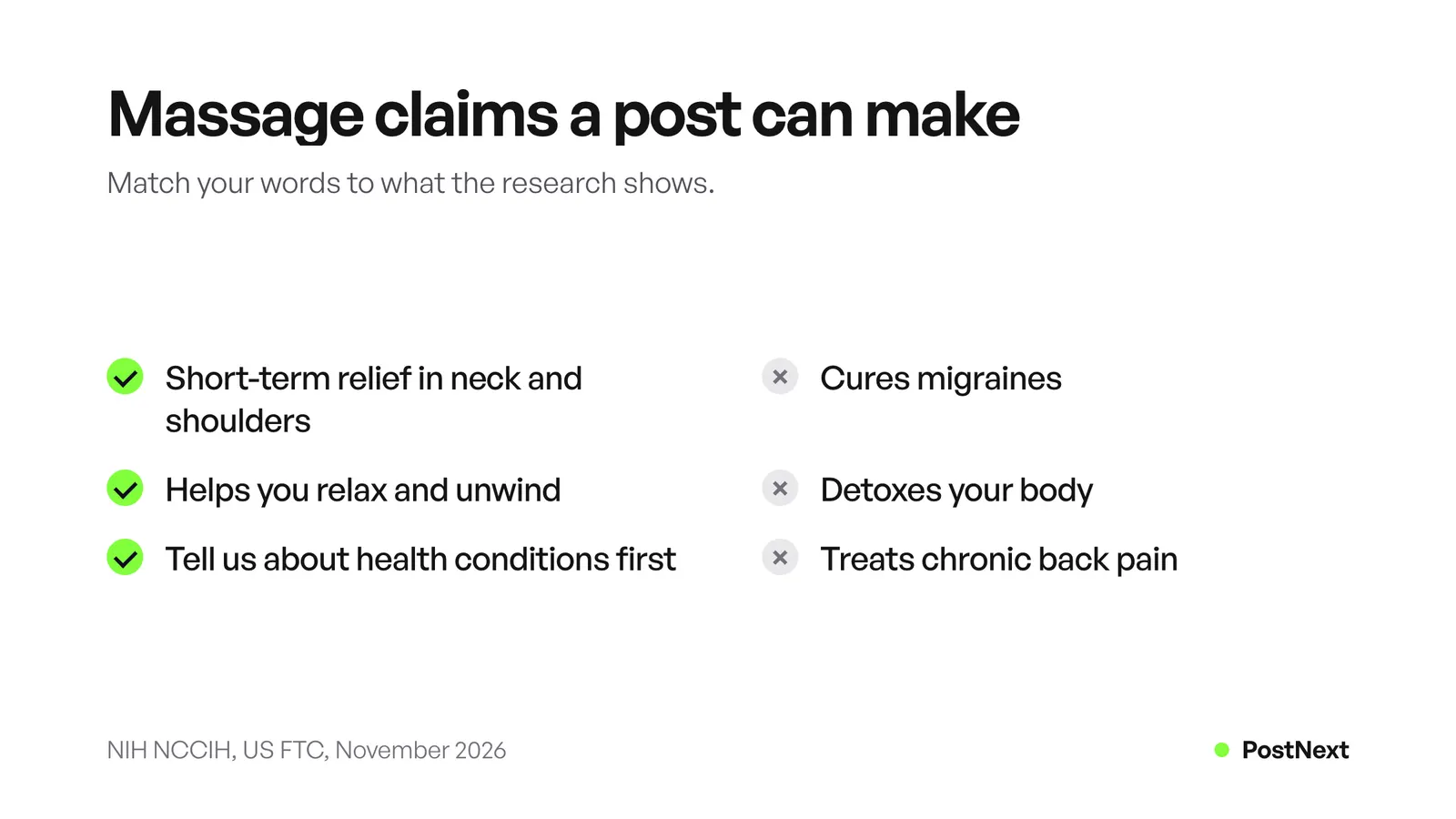
| Topic | What the NIH summary says | Wording that matches it |
|---|---|---|
| Neck and shoulder pain | May help, but benefits may only last a short time | ”Many clients feel short-term relief in the neck and shoulders.” |
| Low-back pain | Only weak evidence that it may help | ”Some clients with back pain find massage helps them relax and move.” |
| Knee osteoarthritis | Small research base suggests short-term pain relief | ”May ease knee pain for a while; ask your doctor about your plan.” |
| Cancer care | Can be part of supportive care with precautions; evidence for pain and anxiety is not strong | ”We adapt sessions for clients in cancer care. Ask your care team first.” |
| Risks | Low risk; rare serious side effects, more often with vigorous massage or higher-risk clients | ”Tell us about health conditions before your session.” |
Source: NCCIH, Massage Therapy: What You Need To Know, read November 2026.
Relaxation, comfort and stress relief are safe things to talk about. “Detox,” “cures migraines” or “strengthens your immune system” are claims you cannot back with the evidence the FTC asks for. Leave them out, even when a product supplier uses them.
What rules apply to massage therapy posts and ads?
Three kinds of rules apply: your state’s advertising rule, health privacy law if you are a covered provider, and the review rules every local business follows. NIH notes that 45 states and the District of Columbia regulate massage therapy. Several of them set advertising rules. Florida’s statute 480.0465 requires every licensed massage therapist and establishment to include the license number in any advertisement, including on the Internet.
State advertising rules. Read your own board’s rule before your first post. Florida also requires the establishment’s physical address and phone number in ads, with an exception for owners of more than five locations in the state. It bans any ad that suggests sexual services. Put your license number in your Instagram bio and on your Facebook page, so every post links back to it.
Health privacy. HIPAA applies to health care providers only if they send health information electronically for a standard transaction, such as an insurance claim. Many cash-pay therapists are outside HIPAA, and many who bill insurance are inside it. Either way, get written permission before you post a client, their story or their photo.
Reviews and free sessions. Google Maps policy bans offering “payment, discounts, free goods and/or services” for a review. The FTC’s Consumer Reviews and Testimonials Rule bans buying positive reviews. If you give a local creator a free session, the FTC says the creator must disclose it in the post itself.
What should a massage therapist post each week?
A massage therapist should post three types of content each week: one useful self-care tip, one look at the room or the work, and one post about you and how sessions run. Never show a client’s body without written consent, and keep draping visible in every photo. A calm, consistent feed signals a professional practice as much as the words do.
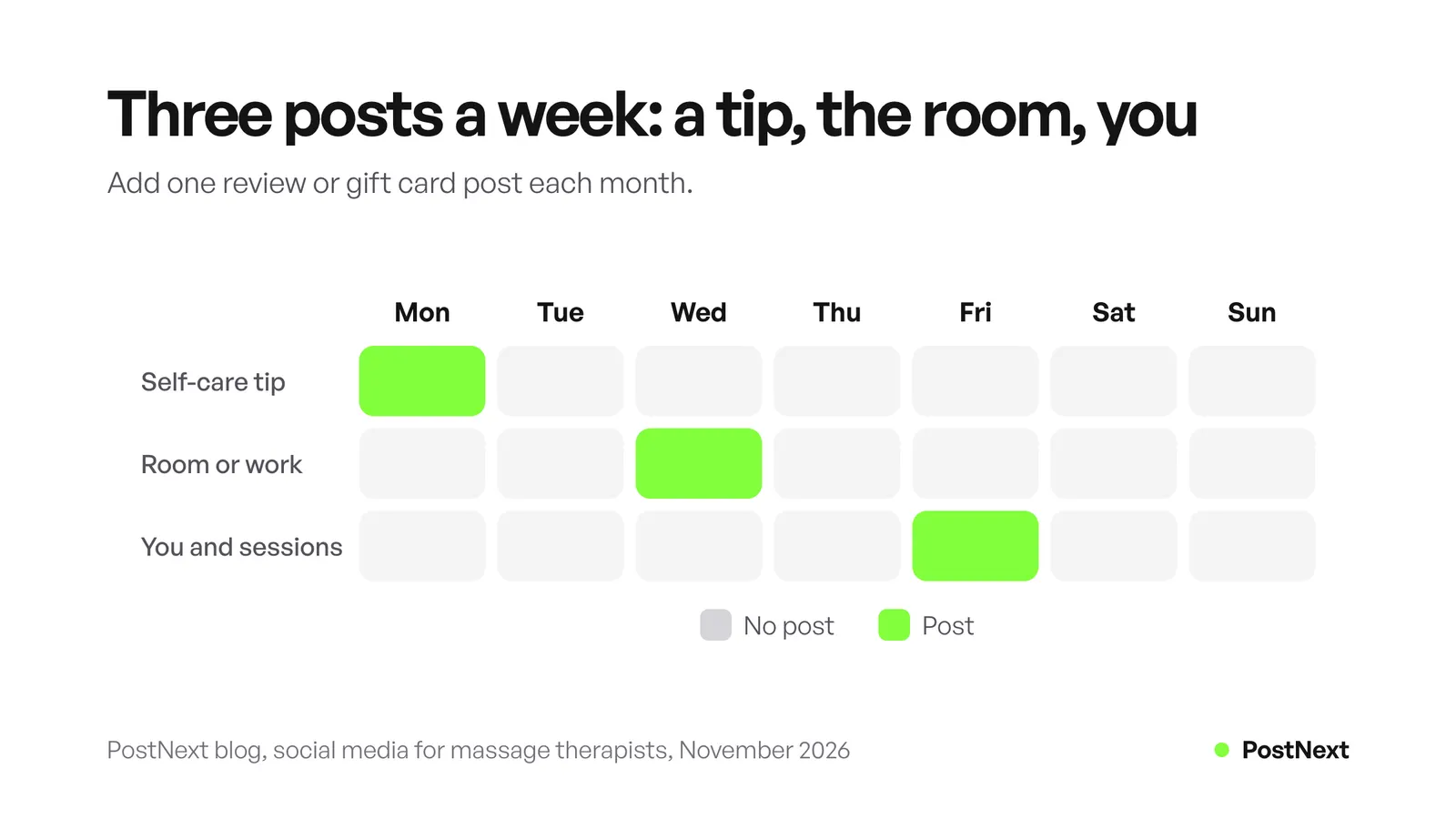
| Day | Post type | Example |
|---|---|---|
| Monday | Self-care tip | ”A 2-minute shoulder stretch for desk days,” filmed by you |
| Wednesday | The room or the work | Hands working on a forearm, warm towels, the table set up |
| Friday | You and your sessions | ”What happens at your first session,” your training, your hours |
| Monthly | Review or offer | A Google review shared with permission, or a gift card reminder |
An example plan built from the post types above. Move the days to fit your schedule.
The best topics come from your intake forms and session notes, without the names. Note the questions clients ask: how often should I book, what should I wear, will a deep tissue massage hurt, can I get a massage while pregnant. Each answer is a post. For pregnancy and health conditions, tell people to check with their doctor and to tell you before the session.
Short video works for technique and self-care content. Our list of Instagram Reel ideas has formats you can film in your room between clients. Use your own hands or a friend who agreed to be filmed, and film in good daylight.
How do clients book a massage from Instagram and Google?
Clients book from Instagram through the Book now button or the link in your bio, and from Google through the booking link on your Business Profile. Instagram’s Book now button needs a business account and a supported booking partner, and booking providers’ help pages say it shows in the Instagram app. Google lets a business add up to 10 “book an appointment” links.
Put the same booking link everywhere: your Instagram bio, open-slot Stories, Facebook and Google. A link in bio page with a booking block can hold booking, gift cards, prices and your intake form in one place.
Gift cards are worth a recurring post. Holidays, Mother’s Day and birthdays bring buyers who are not clients yet, and a gift card brings a new client through your door. Schedule the reminder once a year and let it repeat.
How does PostNext help a massage therapist?
PostNext lets a massage therapist plan a month of tips, room photos and session posts in one sitting and publish each at its time. It posts to Instagram, TikTok, YouTube, LinkedIn, X, Threads and Bluesky from one calendar.
On Instagram, it publishes feed posts, carousels, Reels and image Stories.
A recurring post can repeat every 1 to 365 days, weeks or months, which suits a yearly gift card reminder or a monthly “book your next session” post. The comment inbox lets you read and answer Instagram comments in one place on every plan. It sends no direct messages, which keeps health details out of Instagram and on the phone or in your booking system.
Know the limits. PostNext does not post to Facebook or Google Business Profile today; both are marked “Soon” on the pricing page, so post those in Meta Business Suite and in your Google profile for now. The free plan covers 1 channel, 10 posts and 10 AI credits a month, enough for two Instagram posts a week. The PostNext for massage therapists page shows what the paid plans add.
Frequently Asked Questions
What should a massage therapist post on Instagram?
Post short self-care tips, photos of your room and your hands at work, and posts about how a first session runs. Add a Story when a slot opens, with your booking link. Never post a client’s body or story without written consent, and keep draping visible in every photo.
Do massage therapists need their license number in social media posts?
In some states, yes. Florida requires the license number in any advertisement of massage therapy services, including on the Internet. Rules differ by state, so read your own board’s advertising rule. Putting the number in your bio is a simple habit.
Can a massage therapist say massage relieves pain?
Only at the strength the evidence supports. The NIH summary says massage may help neck and shoulder pain for a short time, and finds only weak evidence for low-back pain. Use wording like “may help” or “many clients feel,” and never “cures” or “treats.”
Does HIPAA apply to massage therapists?
HIPAA applies to a health care provider only if it sends health information electronically for a standard transaction, such as an insurance claim. Many cash-pay therapists are not covered. Either way, get written permission before you post any client photo or story.
Can I offer a discount for a Google review?
No. Google Maps policy bans any reward for a review, including discounts and free sessions. The FTC also bans buying positive reviews. Ask every client for an honest review after the session and give nothing in return.
How often should a massage therapist post?
Three posts a week is a pace most solo therapists keep: one tip, one look at the room or the work, and one post about you. Plan the week in one sitting and schedule the posts, so a full booking week does not leave your feed empty.
Sources
- National Center for Complementary and Integrative Health (NIH), Massage Therapy: What You Need To Know, checked November 2026.
- US Bureau of Labor Statistics, Occupational Outlook Handbook: Massage Therapists, 2025 data, checked November 2026.
- The Florida Legislature, 2026 Florida Statutes, section 480.0465, Advertisement; prohibitions, checked November 2026.
- BrightLocal, Local Consumer Review Survey 2026, 1,002 US adults, published February 2026, checked November 2026.
- Pew Research Center, Americans’ Use of Social Media in 2026, 5,511 US adults, published October 2026, checked November 2026.
- US Federal Trade Commission, Health Products Compliance Guidance, Consumer Reviews and Testimonials Rule: Questions and Answers and Disclosures 101 for Social Media Influencers, checked November 2026.
- US Department of Health and Human Services, HIPAA covered entities, checked November 2026.
- Google, Maps prohibited and restricted content and local business links, checked November 2026.
- Booking provider help pages on the Instagram Book now button: MyTime (help.mytime.com) and Fresha (fresha.com help centre), checked November 2026.
- PostNext, Instagram channel page, comment inbox, automation page and pricing page, checked November 2026.