
Social media for opticians does two jobs: it shows frames people want to wear, and it reminds them an eye exam is due. Patients check reviews and photos before they book. BrightLocal’s 2026 survey found 97% of US consumers read reviews for local businesses. Post two or three times a week, and keep each post inside the FTC and FDA rules on eye care. This PostNext guide shows how.
Key Takeaways
- Reviews come first: 97% of consumers read local reviews, and 24% visit a business’s social media after reading good ones.
- Facebook and Instagram fit most practices: 70% of US adults use Facebook and 51% use Instagram, according to Pew’s 2026 survey.
- The exam schedule is your reminder calendar: the AOA advises an exam at least every 2 years from age 18 to 64, and every year from 65.
- Prevent Blindness gives you 12 months of topics: glaucoma in January, dry eye in July, contact lens safety in October.
- Colored contact lenses need a prescription: about 45 million US residents wear contacts, and the FDA calls any lens sold without a prescription illegal, Halloween lenses included.
- Free exam offers carry 2 conditions: under the FTC Eyeglass Rule, the patient gets the prescription before you offer glasses, and the exam never depends on buying them.
- Two or three posts a week is enough: one frame, one eye health tip, and a team photo or review when you have one.
Does social media work for opticians?
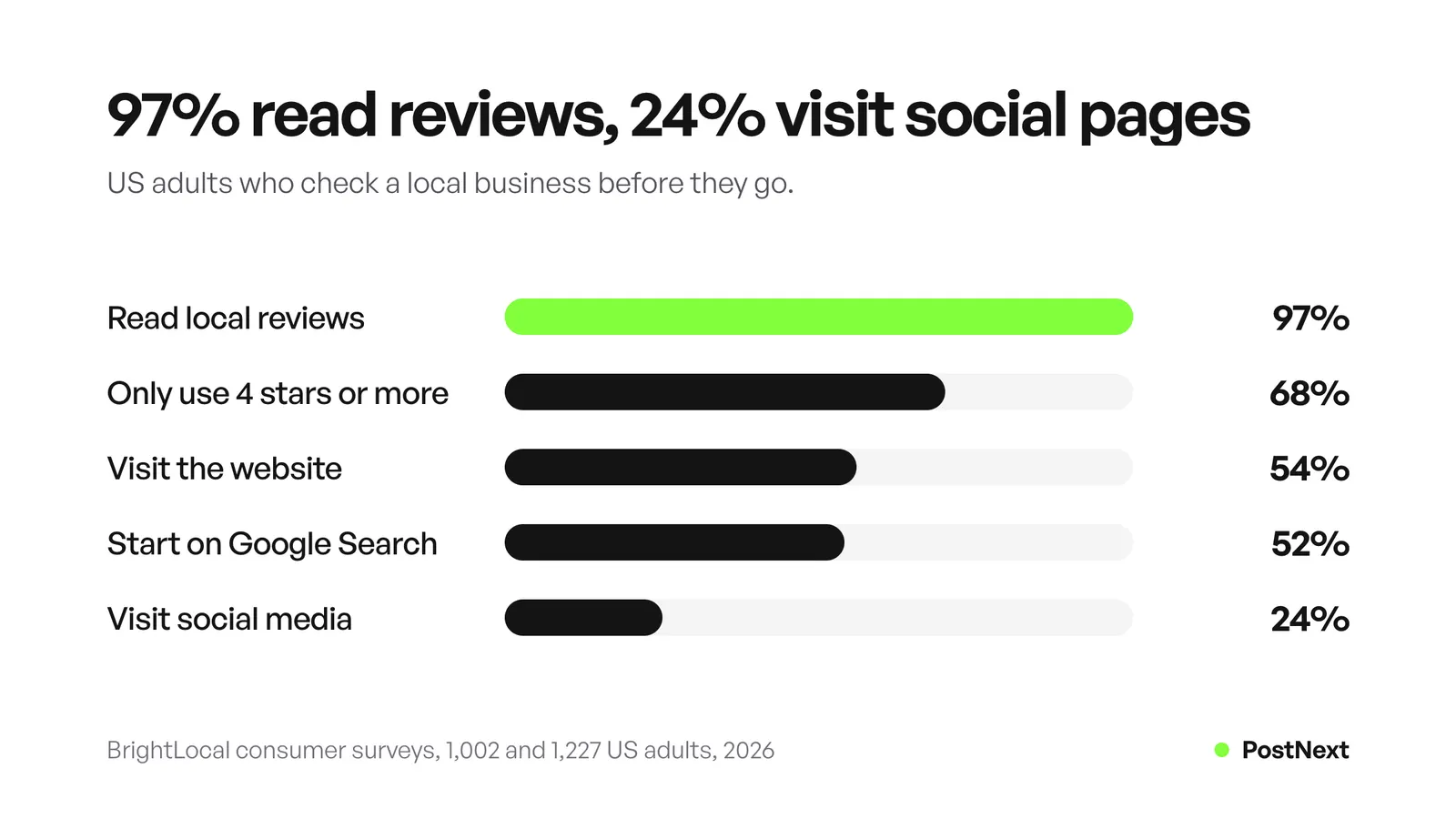
Social media works for opticians as a reminder and a trust check. An eye exam is easy to put off, and frames are chosen by look. Posts keep both in front of people. BrightLocal’s 2026 survey of 1,002 US adults found 97% read reviews for local businesses, and 24% visit the business’s social media channels after reading positive reviews.
That shapes what your posts are for. A new patient who hears your name from a friend searches for you, sees last week’s frame arrivals and a friendly team, and books. An existing patient sees a post about glaucoma month and remembers it has been three years since the last exam. Neither post needs to go viral.
| Where patients check you | What they look for | Data |
|---|---|---|
| Reviews on Google and Facebook | Star rating, recent reviews, owner replies | 97% read local reviews; 68% only use a business rated 4 stars or more |
| Google Business Profile | Hours, address, photos, booking link | 52% started their latest local search on Google Search |
| Facebook Page and Instagram | New frames, team, eye health tips | 24% visit social media channels after positive reviews |
| Your website | Services, insurance, booking | 54% visit the website after positive reviews |
BrightLocal Local Consumer Review Survey 2026 (1,002 US adults) and BrightLocal consumer search behavior study (1,227 US adults, July 2026), checked November 2026.
A fair counterpoint: social media will not fill an empty appointment book alone. If your Google profile has few reviews, fix that first. Posting matters most once people already have a reason to look you up.
Which social media platforms should opticians use?
Opticians do best with a Google Business Profile, a Facebook Page and Instagram. Pew’s 2026 survey of 5,511 US adults found 70% use Facebook and 51% use Instagram. Instagram suits frames, which people choose by look. YouTube, used by 84% of US adults, fits short eye health answers.
| Platform | Best job for an optical practice | Reach (US adults) |
|---|---|---|
| Google Business Profile | Hours, photos, reviews, posts, a profile for each optometrist | Search, not a feed |
| Facebook Page | Exam reminders, reviews, local events | 70% |
| New frames, try-on Reels, before-and-after looks | 51% | |
| YouTube | Short answers such as “how often should my child have an eye exam?“ | 84% |
| TikTok | Frame try-ons for younger buyers | 37% |
Reach figures from the Pew Research Center Social Media Fact Sheet, October 2026; Google Business Profile rules from Google’s own guidelines. Checked November 2026.
Google treats doctors as individual practitioners. Each optometrist who sees patients in a public-facing role and is reachable at the location during stated hours should have their own Business Profile, next to the practice’s profile. If one optometrist is the only practitioner at a branded location, Google advises one shared profile named “brand: practitioner name”. For photo and post sizes, see our guide to Google Business Profile image sizes.
Pick two channels and keep them current. A Facebook Page and a Google profile updated every week look more reliable than five accounts that went quiet in spring.
What should opticians post on social media?
Post the frames and post useful eye health advice. A new frame on a real face shows style in one look, and a short tip, such as the 20-20-20 rule for screen work, gives people a reason to save and share. Mix both every week, so you are the place people remember for a new look and for an exam.
Rotate these post types:
- Frame of the week. One frame, on a person, in daylight. Name the shape and the color, and say which face shapes it suits.
- A try-on Reel. Three frames on one face in 15 seconds. Ask the viewer which one wins.
- The exam reminder. The AOA advises adults aged 18 to 64 to have an eye exam at least every two years, and adults 65 and older every year.
- The eye health tip. The 20-20-20 rule, sunglasses that block 100% of UV-A and UV-B, or why children need an exam before first grade.
- The team. Your optician adjusting a frame, the lab bench, a new staff member. People want to know who will look after their eyes.
- A real review. A recent review turned into a post, with the person’s written permission.
Every post needs a next step. Put the booking link in your profiles, and if you send people to several pages (booking, frames, insurance), a single page for the link in your bio keeps them in one place. Our list of what to post on social media for business has more ideas sorted by goal.
What can opticians say in a social media post?
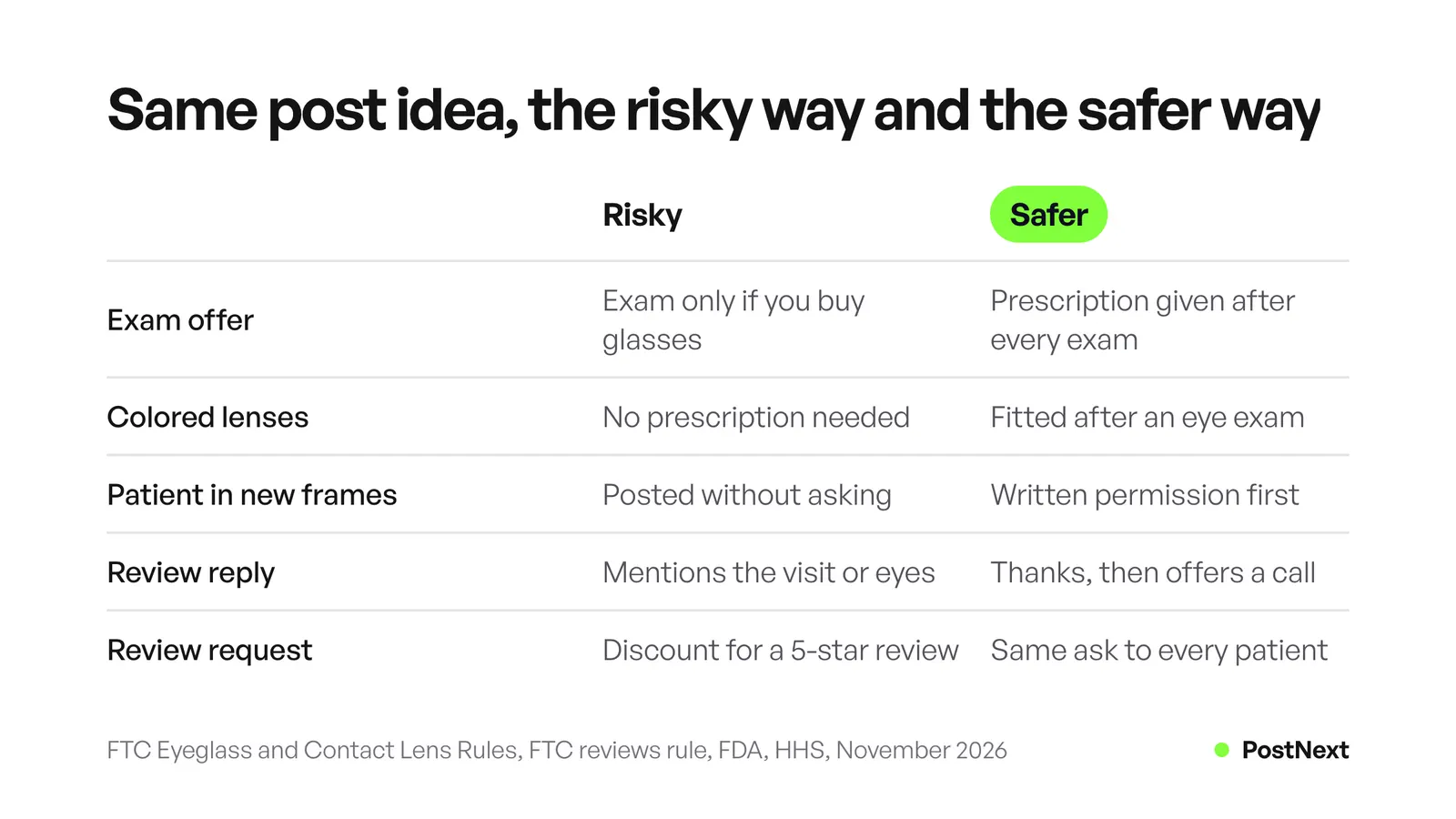
Opticians are free to post offers, frames and advice, but five federal rules shape how. The FTC Eyeglass Rule and Contact Lens Rule cover exam and prescription offers. The FDA treats every contact lens, colored ones included, as a medical device that needs a prescription. HIPAA covers patient photos and review replies, and the FTC’s 2024 reviews rule covers how you ask for reviews.
| Post you might write | The rule | Source |
|---|---|---|
| ”Free eye exam with any pair of glasses” | Allowed as a bundle, but the patient still gets the prescription before you offer glasses, and the exam cannot depend on buying them | FTC Eyeglass Rule |
| ”Take your prescription anywhere” | True by law: you give the eyeglass prescription right after the exam, without being asked and without an extra fee | FTC Eyeglass Rule |
| ”Colored lenses for Halloween” | All contact lenses need a valid prescription, decorative and plano lenses included | FDA; FTC Contact Lens Rule |
| A patient in new frames | For HIPAA-covered practices, written authorization before their health information is used in marketing | HHS, HIPAA Privacy Rule |
| ”Leave us a 5-star review for 10% off” | Incentives tied to a positive review are banned | FTC Consumer Reviews and Testimonials Rule |
Rules as worded on ftc.gov, fda.gov and hhs.gov, checked November 2026. US federal rules only, and not legal advice: your state board of optometry or opticianry may add its own.
Exam bundles. The FTC’s Eyeglass Rule guidance says you may advertise one price for an exam and frames, or a free exam with the purchase of glasses. The patient must still get the prescription before you offer to sell them glasses, with the choice to pay the routine exam cost and leave with it. A post that says “book your exam, keep your prescription” is a trust signal, and it is also the law.
Colored and Halloween lenses. The FDA says “All contact lenses must be prescribed by a doctor, including decorative lenses,” and calls lenses sold without one illegal. The FTC’s Contact Lens Rule FAQ agrees that decorative, cosmetic and plano lenses need a valid prescription, and it bars sellers from suggesting customers can get lenses without one. So an October post shows colored lenses after a fitting, never as an add-on to a costume.
Patients and reviews. If your practice bills insurance electronically, HIPAA almost certainly applies, because it covers health care providers that send information electronically for standard transactions. Get written authorization before a patient appears in a post, and never confirm in a review reply that the reviewer is a patient. Our guide to social media for dental clinics covers the HHS settlements over review replies.
In the UK. The Association of Optometrists notes that the General Optical Council’s standards for individual registrants ban misleading, confusing or unlawful statements in advertising, and that the ASA regulates ads in every medium. The AOP also warns practices not to claim they diagnose or treat dyslexia.
What is a monthly social media plan for an optical practice?
A monthly plan ties each month’s posts to an eye health observance, so you never start from a blank page. Prevent Blindness publishes a calendar every year: National Glaucoma Month in January, Dry Eye Month in July, Children’s Eye Health and Safety Month in August and Contact Lens Safety Month in October. Each comes with numbers you can quote.
| Month | Observance (Prevent Blindness 2026) | Post idea |
|---|---|---|
| January | National Glaucoma Month | More than 2.8 million Americans aged 40+ have glaucoma, and nearly half do not know it |
| March | Workplace Eye Wellness Month | The AOA’s 20-20-20 rule: every 20 minutes, look 20 feet away for 20 seconds |
| June | Cataract Month | More than half of all Americans will have cataracts by age 80 |
| July | Dry Eye Month | Nearly 16 million Americans have dry eye; pair it with sunglasses that block 100% of UV |
| August | Children’s Eye Health and Safety Month | The AOA advises an exam before first grade and every year after |
| September | Sports Eye Safety Month | Sports glasses for young athletes |
| October | Contact Lens Safety Month | About 45 million US residents wear contacts; Halloween lenses need a prescription |
| November | Diabetes-related Eye Disease Month | More than 8.1 million Americans aged 40+ have diabetic eye disease |
| December | Give the Gift of Sight Month | Gift cards for frames or sunglasses |
Observances and figures from the Prevent Blindness 2026 Eye Health and Safety Observances table; exam intervals, the 20-20-20 rule and UV advice from the American Optometric Association. Checked November 2026. Prevent Blindness changes some months each year, so check the next calendar before you schedule.
Plan the year in one sitting. Write the twelve observance posts in December, schedule them, and add one fresh frame photo each week. The observance posts carry the health side, and the frames carry the style side.
How often should an optician post on social media?
Two or three posts a week on each channel is enough for most optical practices: one frame, one eye health post, and a team photo or review when you have one. Buffer’s study of more than 100,000 users found accounts posting in 20 or more of 26 weeks got 450% more engagement per post than accounts posting in 4 weeks or fewer.
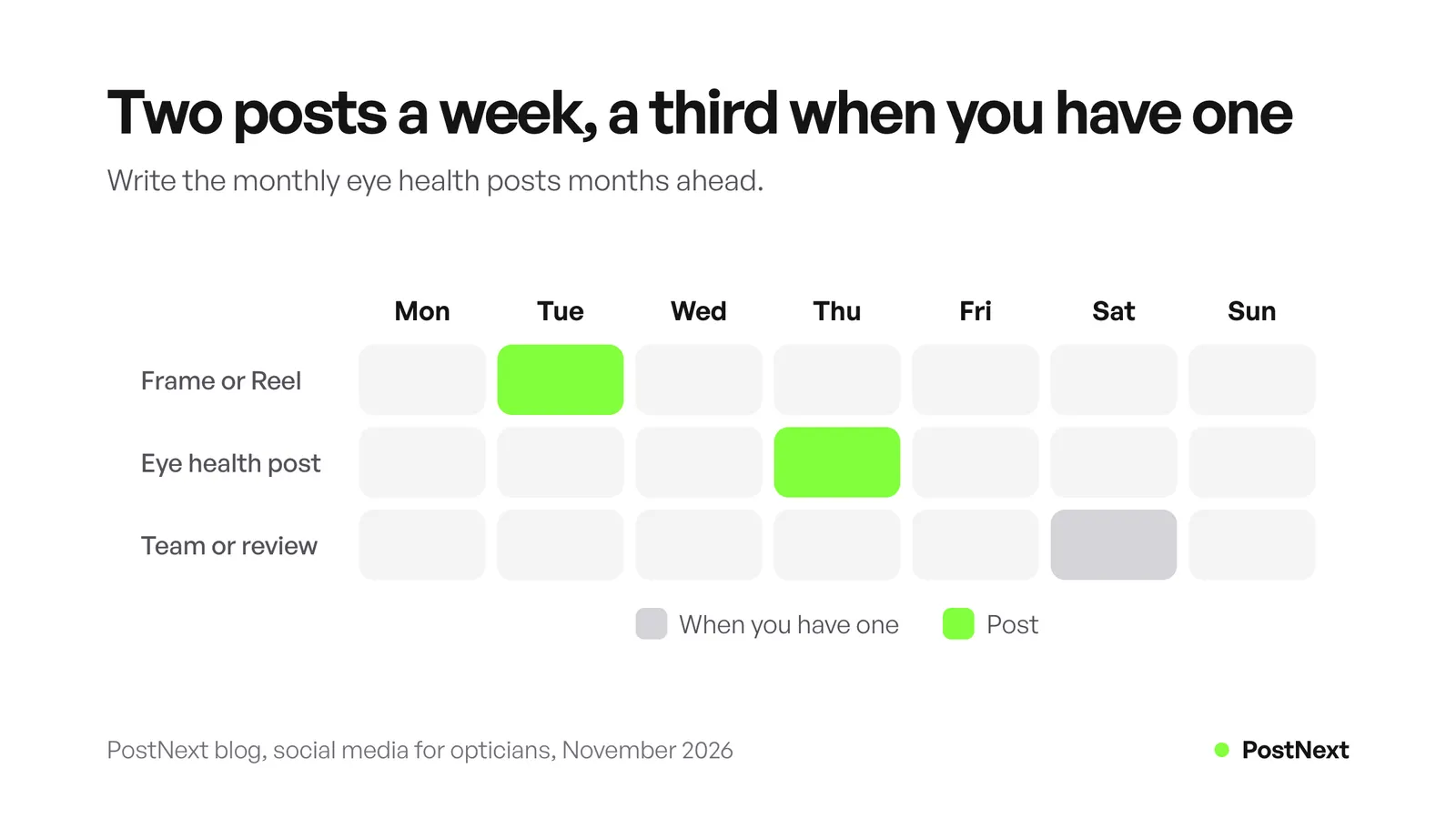
So a steady week matters more than a busy one. The observance posts are written months ahead, which leaves only the frame photo for the week itself. A simple week looks like this:
- Tuesday: frame of the week or a try-on Reel.
- Thursday: the monthly eye health post, an exam reminder or a common question.
- Saturday, when you have one: a team photo or a review shared with permission.
Give one person the job. In many practices the optician or the practice manager owns the posts, and the optometrist checks anything that makes a health claim before it goes out.
How should an optical practice reply to reviews?
Reply to every review, by hand, within a day or two, and never confirm that the reviewer is a patient. BrightLocal’s 2026 survey found 89% of consumers expect owners to respond to reviews, 80% are likely to use a business that responds to all of them, and 50% are put off by templated replies.
For a good review, thank the person for writing it and sign with the practice name. Skip lines such as “we’re glad you like the new frames”, which tell the world the reviewer is your patient. For a bad one, say you take every comment seriously, explain that privacy rules stop you from discussing anyone’s care online, and give a phone number. Do not mention names, visit dates, prescriptions or insurance.
Ask for reviews too. BrightLocal found 78% of consumers were asked to leave feedback in the past year, so asking is normal. Under the FTC’s rule, in force since October 21, 2024, you may offer an incentive for a review only when it does not depend on the review being positive. The FTC says a line such as “Tell us how much you loved your visit to John’s Steakhouse and get a $5 coupon” already implies the review must be positive.
How does PostNext help an optical practice?
PostNext lets an optical practice plan a year of eye health posts in one sitting and publish each at its time. It posts to Instagram, TikTok, YouTube, LinkedIn, X, Threads and Bluesky from one calendar. Recurring posts repeat every 1 to 365 days, weeks or months, which suits yearly reminders such as Contact Lens Safety Month.
CSV import takes up to 100 rows at a time, so a year of observance posts goes in from one spreadsheet. The Instagram comment inbox lets you read and answer comments in one place on every plan; it does not cover direct messages. The web app works in a phone browser, so the optician adds a frame photo between fittings. For a group with several locations, the Teams plan lets a manager approve a post before it is scheduled, with a 5-user minimum. See post automation for the repeat and import settings.
PostNext does not post to Facebook or Google Business Profile, the two channels this guide puts first. Schedule those in Meta Business Suite and in your Google profile, and use PostNext for Instagram, YouTube or TikTok. The free plan covers 1 channel, 10 posts and 10 AI credits a month, enough for two posts a week on one channel. The pricing page lists what the paid plans add. PostNext for opticians has a weekly posting plan and caption templates you can copy.
Frequently Asked Questions
What should an optician post on social media?
Post frames on real faces, try-on Reels, eye exam reminders, eye health tips, your team and real reviews shared with permission. Tie one post a month to an eye health observance, such as National Glaucoma Month in January or Contact Lens Safety Month in October.
Which social media platform is best for optometrists?
Facebook and a Google Business Profile matter most for most practices, with Instagram for frames. Pew’s 2026 survey found 70% of US adults use Facebook and 51% use Instagram. Google’s guidelines give each optometrist who sees patients a profile of their own, next to the practice’s profile.
Can opticians post about colored contact lenses?
Yes, as long as the post makes clear the lenses need an exam and a prescription. The FDA says all contact lenses, decorative ones included, must be prescribed by a doctor, and the FTC Contact Lens Rule bars sellers from suggesting customers can buy them without a valid prescription.
Can an optometry practice advertise a free eye exam?
Yes. The FTC allows a free exam with the purchase of glasses, or one price for an exam and frames. The patient still gets their prescription right after the exam, before you offer glasses, and the exam cannot depend on buying them.
How often should an optical practice post?
Two or three times a week on each channel, every week. Buffer’s study of more than 100,000 users found accounts that posted in 20 or more of 26 weeks got 450% more engagement per post than accounts that posted in 4 weeks or fewer.
Can opticians share patient photos on social media?
Only with the patient’s written permission. For practices covered by HIPAA, the Privacy Rule requires written authorization before health information is used in marketing. Keep the signed form, and keep prescriptions, dates and insurance details out of the caption.
Sources
- BrightLocal, Local Consumer Review Survey 2026, 1,002 US adults, published February 2026, and consumer search behavior study, 1,227 US adults, July 2026, checked November 2026.
- Pew Research Center, Social Media Fact Sheet, published October 2026, checked November 2026.
- Federal Trade Commission, Complying with the Eyeglass Rule, The Contact Lens Rule: A Guide for Prescribers and Sellers and FAQs: Complying with the Contact Lens Rule, checked November 2026.
- Federal Trade Commission, Consumer Reviews and Testimonials Rule: questions and answers, checked November 2026.
- US Food and Drug Administration, Decorative contact lenses for Halloween and more, checked November 2026.
- US Department of Health and Human Services, Marketing under the HIPAA Privacy Rule and Covered entities, checked November 2026.
- American Optometric Association, Comprehensive eye exams, Computer vision syndrome and UV protection, checked November 2026.
- Prevent Blindness, 2026 Eye Health and Safety Observances, checked November 2026.
- Google Business Profile Help, Guidelines for representing your business, individual practitioners, checked November 2026.
- Association of Optometrists, Advertising standards, checked November 2026.
- Buffer, Consistent Posting Study (buffer.com/resources/consistent-posting-study), January 2025, checked November 2026.
- PostNext, small business page, automation page and pricing page, checked November 2026.