
Social media for vets is where pet owners check that a clinic is kind, open and honest before they book. The AVMA counts dogs in 43.7% of US households and cats in 34.1%. Post two or three times a week, give general advice only, never diagnose a pet in the comments, and ask the owner before their pet appears. This PostNext guide shows what to post and what to avoid.
Key Takeaways
- Your feed is a trust check: 97% of US consumers read reviews for local businesses, then look at your team, your rooms and your replies.
- General advice is fine online, advice about one pet is not: the AVMA calls patient-specific advice telemedicine, and it needs a veterinarian-client-patient relationship (VCPR).
- HIPAA does not cover pets, but your ethics code does: AVMA principles say records are confidential and may only be released by law or with client consent.
- Surgery photos have rules: on Facebook and Instagram, visible innards get a warning screen and an 18+ limit, and sensitive posts cannot run as ads.
- Reply to every review in two sentences: thank the reviewer, take complaints offline, and never make a third reply.
- The year plans itself: pet dental health in February, poison prevention in March, fireworks before July 4, toxic foods before the holidays.
Does social media work for veterinary clinics?
Social media works for vet clinics as proof of care, not as a source of viral reach. Most new clients find a vet through a search, a friend or a move to a new town, then check the clinic online. BrightLocal’s 2026 survey of 1,002 US adults found 97% read online reviews for local businesses. Your posts and replies are the second thing they read.
The audience is large. The AVMA’s 2026 Pet Ownership and Demographic Sourcebook, based on 7,547 people surveyed in early 2026, counts 58.9 million US households with dogs and 46.0 million with cats. Those households spend an average of $595 a year on veterinary care for dogs and $426 for cats.
| Where pet owners check you | What they look for | Data |
|---|---|---|
| Reviews on Google, Facebook and Yelp | Star rating, recent reviews, how the clinic replies | 97% read local reviews (BrightLocal, 2026) |
| Your Google Business Profile | Hours, holiday hours, photos of the rooms and team, phone | Google asks for at least 3 photos of each: outside, inside, at work, team |
| Your Facebook Page | Clinic news, closures, the team, local pet owners | 70% of US adults use Facebook (Pew, 2026) |
| Your Instagram | Patients with permission, the team, short videos | 51% of US adults use Instagram (Pew, 2026) |
| YouTube | ”What to expect” videos, care how-tos | 84% of US adults use YouTube (Pew, 2026) |
BrightLocal Local Consumer Review Survey 2026 (1,002 US adults), Pew Research Center Social Media Fact Sheet (5,511 US adults, October 2026), AVMA U.S. pet ownership statistics (2026) and Google Business Profile Help, checked November 2026.
There is a fair case for doing less. A clinic with a full schedule and a waiting list gains little from a busy feed; its time is better spent on the Google profile and on replies to reviews. Social media earns its place when you open a new location, add a service such as dentistry or exotics, or need to fill appointments in a slow month. Our guide to social media marketing for local business shows how a local customer moves from a search to a booking.
Which social media platforms should a vet clinic use?
Most vet clinics need three channels: a Google Business Profile, a Facebook Page and Instagram. Pew’s 2026 survey found 70% of US adults use Facebook and 51% use Instagram. Facebook reaches adults aged 30 to 49 best, at 78%. Instagram reaches 79% of adults under 30, who are often first-time pet owners.
| Platform | Best job for a vet clinic | Reach in the US |
|---|---|---|
| Google Business Profile | Hours, holiday hours, photos, posts, reviews | Where most clients read your reviews |
| Facebook Page | Closures, clinic news, local pet owners, reviews | 70% of adults; 78% of ages 30-49 |
| Patients with permission, team, Reels from the clinic | 51% of adults; 79% of ages 18-29 | |
| YouTube | Short care videos: trimming nails, giving a pill, a first visit | 84% of adults |
| TikTok | Team videos, if someone on the team enjoys making them | 37% of adults; 65% of ages 18-29 |
Pew Research Center Social Media Fact Sheet, survey of 5,511 US adults, January to June 2026, checked November 2026.
Keep the Google profile right before you post anywhere else. Set special hours for holidays and short closures, because a client who drives to a closed clinic with a sick pet does not come back. Add real photos of the outside, the waiting room, the team and the exam rooms. Google asks for at least three of each and says photos should have no excessive filters or AI. For sizes, see our guide to Google Business Profile image sizes.
Pick two channels and post on both every week. A Page that went quiet in March looks like a clinic that closed.
What should a vet clinic post on social media?
Vet clinics should post the team, the rooms, happy patients with the owner’s permission, and general care advice. Show who will hold the pet, explain what happens at a first visit, and answer the questions your front desk hears every day. Seasonal safety posts with dates from the AVMA and ASPCA fill the gaps.
Rotate these twelve post types:
- Meet the team. One person a week: name, role, their own pets.
- A first visit, step by step. Film the walk from the parking lot to the exam room, with the scale and the treat jar.
- A happy patient, with permission. A puppy at its first checkup or a senior dog back on its feet. Ask the owner first, every time.
- A question from the front desk. “Do you see rabbits?” “What do I bring to the first visit?” Answer in three sentences.
- How to do it at home. Trim nails, brush teeth, give a pill. These videos get saved and sent to friends.
- A seasonal safety post. Ticks, fireworks, holiday food. See the calendar below.
- Behind the scenes. Cleaning a surgery room, preparing a kennel, a vet nurse on a night shift.
- The poison hotline. Post the ASPCA Poison Control number, (888) 426-4435, and your own emergency number. People search “pet poison control” between 12,100 and 18,100 times a month in the US (Google Ads data via DataForSEO, November 2025 to October 2026).
- Clinic news. New hours, a new vet, a new service, holiday closures.
- Adoptions and lost pets, by your rules. The AVMA says lost-pet posts “can quickly add up and overwhelm” a Page. Decide once if you share them, and say so in your Page rules.
- A review, with permission. Quote it with the reviewer’s first name only after they say yes.
- Myth or fact. “Dogs and cats rarely get cavities” is a fact from the AVMA. Short myth posts start comments.
Take photos at the end of each day: one person, one room, one patient whose owner said yes. That habit gives you more posts than you need. Our list of what to post on social media for business has more ideas sorted by goal.
Can a vet answer pet health questions in comments or DMs?
A vet can give general advice online, but should not diagnose or treat one pet in a comment or DM. The AVMA splits advice into two kinds. General advice, such as “pets in mosquito areas need heartworm prevention all year”, is open to anyone. Advice about one pet is telemedicine, and the AVMA says it is allowed only inside a veterinarian-client-patient relationship (VCPR).
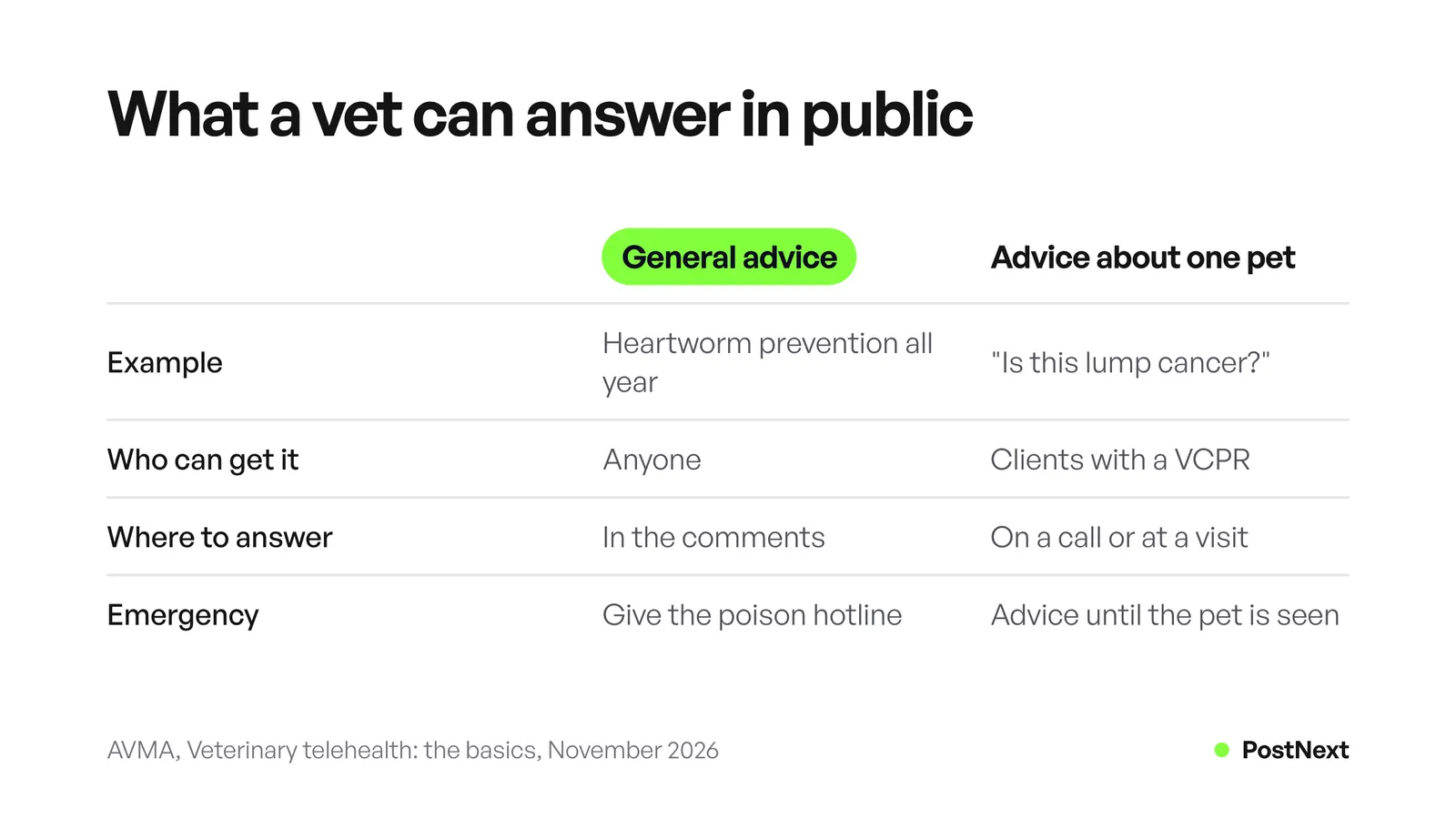
The AVMA’s definition of a VCPR needs four things. The vet has taken responsibility for the pet’s care and the client agreed to follow the vet’s instructions. The vet knows the pet well enough to make at least a preliminary diagnosis, through a timely exam in person or visits to where the animal lives. The vet is available for follow-up or has arranged emergency cover. And records are kept. A stranger who posts a photo of a lump under your Reel has none of these.
The federal definition in 21 CFR 530.3, which applies to the extra-label use of animal drugs, says a VCPR “can exist only when the veterinarian has recently seen and is personally acquainted with the keeping and care of the animal(s)”. State practice acts add their own rules, and some states now allow a VCPR to start by telehealth. Check your state board before you answer health questions from current clients online.
Use one test before every reply: does this answer depend on this pet? If yes, move it to a call or a visit.
| The comment says | Reply with | Why |
|---|---|---|
| ”When should puppies get their shots?” | General advice, plus “Book a puppy visit and we will make a plan for yours.” | General advice is open to anyone |
| ”My dog ate grapes an hour ago, what do I do?" | "Call us now on [number], or ASPCA Poison Control on (888) 426-4435.” | The AVMA allows emergency advice until the pet can be seen; triage refers, it does not diagnose |
| ”Is this lump on my cat cancer?” [photo] | “We can’t tell from a photo. Please call [number] so we can see her.” | Advice about one pet needs a VCPR |
| ”Dr. Lee told me X, is that right?" | "Thanks for asking. Please call us so the vet who saw your pet can go through it with you.” | Confirms nothing about a client in public |
AVMA Veterinary telehealth: the basics and Principles of Veterinary Medical Ethics; 21 CFR 530.3, checked November 2026. This guide is general information, not legal or veterinary-board advice.
The same rule covers DMs. If the same booking and price questions arrive dozens of times a week on Instagram, CreatorFlow can send your booking link and opening hours by DM to everyone who comments a keyword and asks for them. Keep symptom questions for a person on the phone.
Do vets need permission to post pet photos?
Yes, ask the owner first. HIPAA does not cover animals: its rules protect health information about a person, “the individual”. But the AVMA’s ethics principles say the information in veterinary medical records “is confidential” and must not be released “except as required or allowed by law, or by client consent”. A pet’s photo, name and diagnosis can point straight to its owner.
Three more reasons to ask, all from the rules:
- Many states have their own laws. State veterinary practice acts and board rules set confidentiality rules of their own. Ask your state board what applies to you.
- Testimonials count as advertising. The AVMA’s principles say “Testimonials or endorsements are advertising”. They say a vet “should limit their use and only permit representations that are readily subject to verification.” A “cured in a week” caption is a claim you must be able to prove.
- The platform will not take it down for them. Meta removes reported photos of people only in narrow cases, such as minors and some reports from outside the United States. A US client who regrets a post has to ask you.
A consent routine takes two minutes at checkout:
| Step | What to do |
|---|---|
| 1. Ask at checkout | ”Can we share a photo of Bella on our Instagram and Facebook?“ |
| 2. Write it down | Note in the record: which photos, which channels, first name of the pet only or not |
| 3. Leave out the record | No surname, address, diagnosis or bill in the caption unless the owner agreed to it in writing |
| 4. Tag only on request | Tag the owner’s account only if they ask you to |
| 5. Take it down fast | If the owner changes their mind, delete the post the same day |
Our routine, built on AVMA Principles of Veterinary Medical Ethics section 7 and Meta’s privacy violations policy, checked November 2026.
One person, usually the practice manager, checks the record note before a patient post goes out. Our guide to the content approval process shows how to add that check without slowing every post. Dental clinics work under HIPAA and much stricter consent forms; our guide to social media for dental clinics shows that version.
Can a vet clinic post surgery photos on social media?
Yes, but surgery photos with blood or open tissue get limited on Facebook, Instagram and TikTok. Meta puts a warning screen on images of animals with visible innards and shows them only to adults. Images with visible blood are limited to users 18 and older. TikTok may hide “excessive blood” from the For You feed. A limited post also reaches fewer of your own followers.
| What the photo shows | Meta (Facebook, Instagram) | TikTok |
|---|---|---|
| Open surgery, visible organs | Warning screen, 18+ only | Not allowed if “extremely gory”; otherwise 18+ or off the For You feed |
| Visible blood, a wound, a birth with blood | 18+ only | ”Excessive blood”: 18+ or off the For You feed |
| An injured animal in pain | 18+ only | Can be 18+ or off the For You feed |
| An animal going from alive to dead | Warning screen, 18+ only | Not allowed if gory or disturbing |
| Any of the above as a paid ad | Sensitive content “is not eligible to run in ads” | Ad rules apply |
Meta Transparency Center, Violent and graphic content policy; TikTok Community Guidelines, Sensitive and mature themes (effective September 24, 2026), checked November 2026.
Tell the story without the gore. Show the team scrubbing in, the gloved hands on a covered drape, the X-ray of a swallowed sock, and the pet going home. The removed object on a tray tells the story better than the cut. If a clinical photo teaches something real, crop or blur the wound and put a plain warning in the first line.
How should a vet clinic handle pet loss and memorial posts?
Post about a pet’s death only when the owner asks you to, and never show the euthanasia itself. Many owners want a memorial post. Some never want to see one. Write a short tribute in your own words, use the photo the owner chose, and let them read it before it goes out. Turn off comments if you expect hard questions.
Meta puts a warning screen on any image of an animal “going from live to dead”, so a video of the last moments will be limited and can hurt. Keep euthanasia posts general: what the appointment looks like, that families can stay, how aftercare works. They help the next family more than any single story.
How should a vet clinic reply to online reviews?
Reply to every review, and never share anything from the record. The AVMA’s own reputation guide gives the formula. Thank positive reviewers “for their review and for their business”. Answer complaints in a way that “takes the conflict and the conversation offline, but lets readers know that you are taking the comments seriously”. Readers who are choosing a vet see that reply.
The AVMA adds rules that clinics often break:
- The rule of 3. “Never make a third reply because a third reply is an argument, not an answer.” Take it to the phone instead.
- No discounts for removing a review. “Never offer a discount to counter a negative review.” It teaches people to write bad reviews.
- No fake reviews. “Don’t write your own positive reviews.”
- Don’t delete comments unless they break the community rules posted on your Page.
Use these replies as a start, and change the words so each one sounds like your clinic:
- A five-star review: “Thank you for writing this and for trusting us. The whole team will see it.”
- A complaint: “Thank you for telling us. We are sorry the visit did not go as you hoped. We can’t discuss any pet’s care online, so please call [practice manager] on [number] and we will go through it with you.”
- A grieving client: “We are so sorry. Please call [name] on [number] when you are ready. We would like to talk.”
Here we disagree with part of the AVMA guide. It says to announce that you are on review sites but not to solicit reviews. Google’s rules allow you to ask for genuine reviews, as long as you offer no discount, free service or other reward. Ask every client in the same words, in the same follow-up message, and never only the happy ones.
What is a yearly social media calendar for a vet clinic?
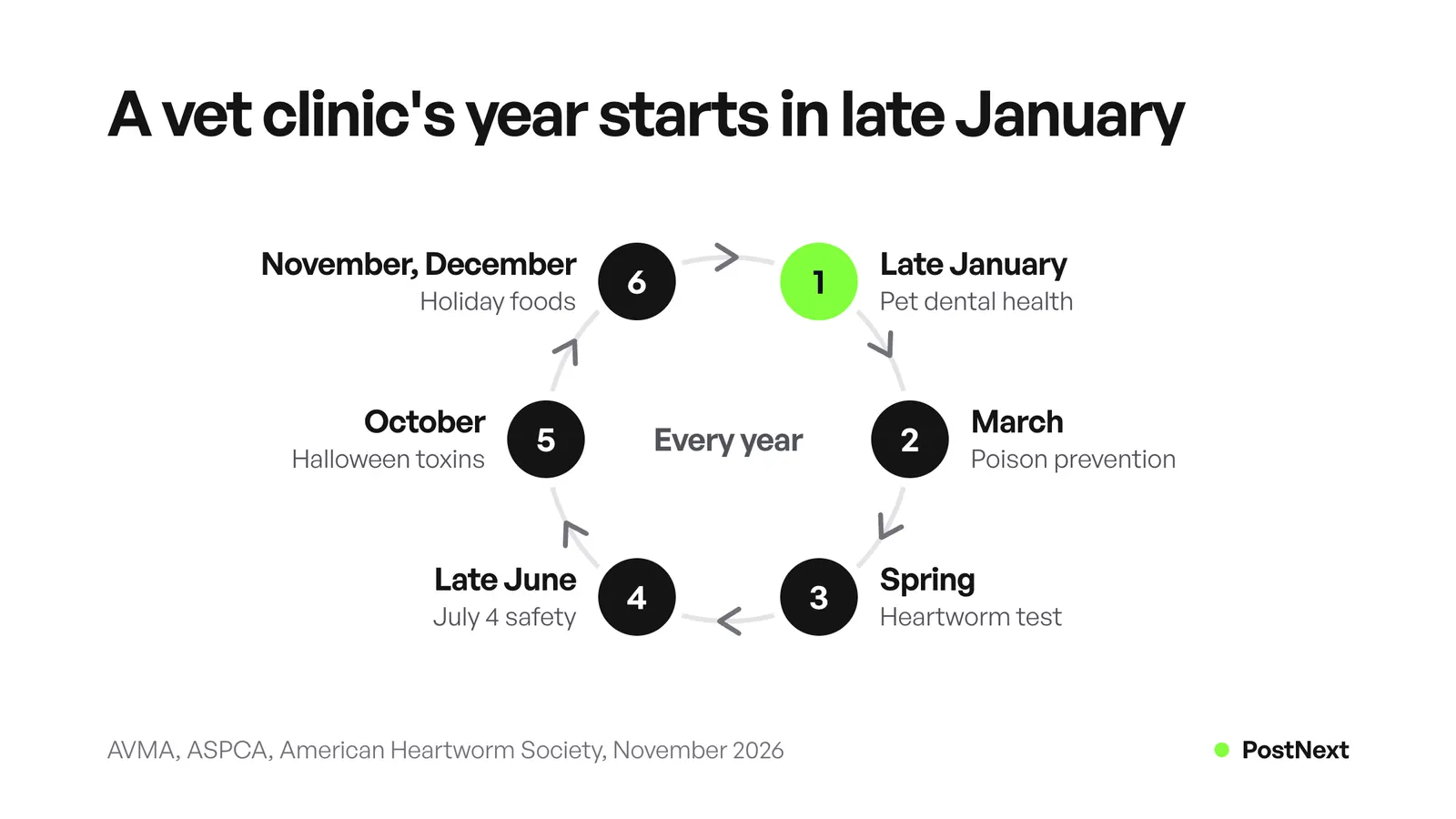
A vet clinic’s year has fixed topics: pet dental health in February, poison prevention in March, heartworm and ticks in spring, fireworks before July 4, toxic foods before Halloween and the winter holidays. Schedule these posts a month ahead. People search for them before the date, not on it.
| When | Post idea | Source |
|---|---|---|
| Late January, February | National Pet Dental Health Month: many dogs and cats show signs of gum disease by age 3 | AVMA |
| March | National Poison Prevention Week: the ASPCA’s top 10 pet toxins and its hotline | ASPCA |
| Spring, then every 12 months | ”Think 12”: a heartworm test every 12 months and prevention 12 months a year | American Heartworm Society |
| Late June | July 4: ID tags, microchip details up to date, a current photo, pets inside during fireworks | AVMA |
| October | Halloween: chocolate is No. 4 on the toxin list at 13.6% of cases, and dogs are the most common culprit | ASPCA |
| November, December | Holiday food: grapes, raisins, xylitol gum, onions and garlic lead the food group, No. 2 at 16.4% | ASPCA |
| Any month | Medicines: over-the-counter drugs and supplements are No. 1 at 16.9% | ASPCA |
AVMA Pet dental care and July 4 safety pages, ASPCA The Top 10 Toxins of 2025 (calls about more than 376,000 items in 2025), American Heartworm Society Heartworm Basics, checked November 2026.
The timing matters. In our search data, “national pet dental health month” was searched 390 times in January 2026 and 390 times in February, then 40 times in March (Google Ads data via DataForSEO, US). A dental post on February 1 is already late for half the interest. Post the first one in the last week of January.
How often should a vet clinic post on social media?
Two or three posts a week on each channel is enough for a vet clinic: one person, one patient or care tip, and one piece of news or seasonal advice. Buffer’s study of more than 100,000 users found accounts that posted in 20 or more of 26 weeks got 450% more engagement per post than accounts that posted in 4 weeks or fewer.
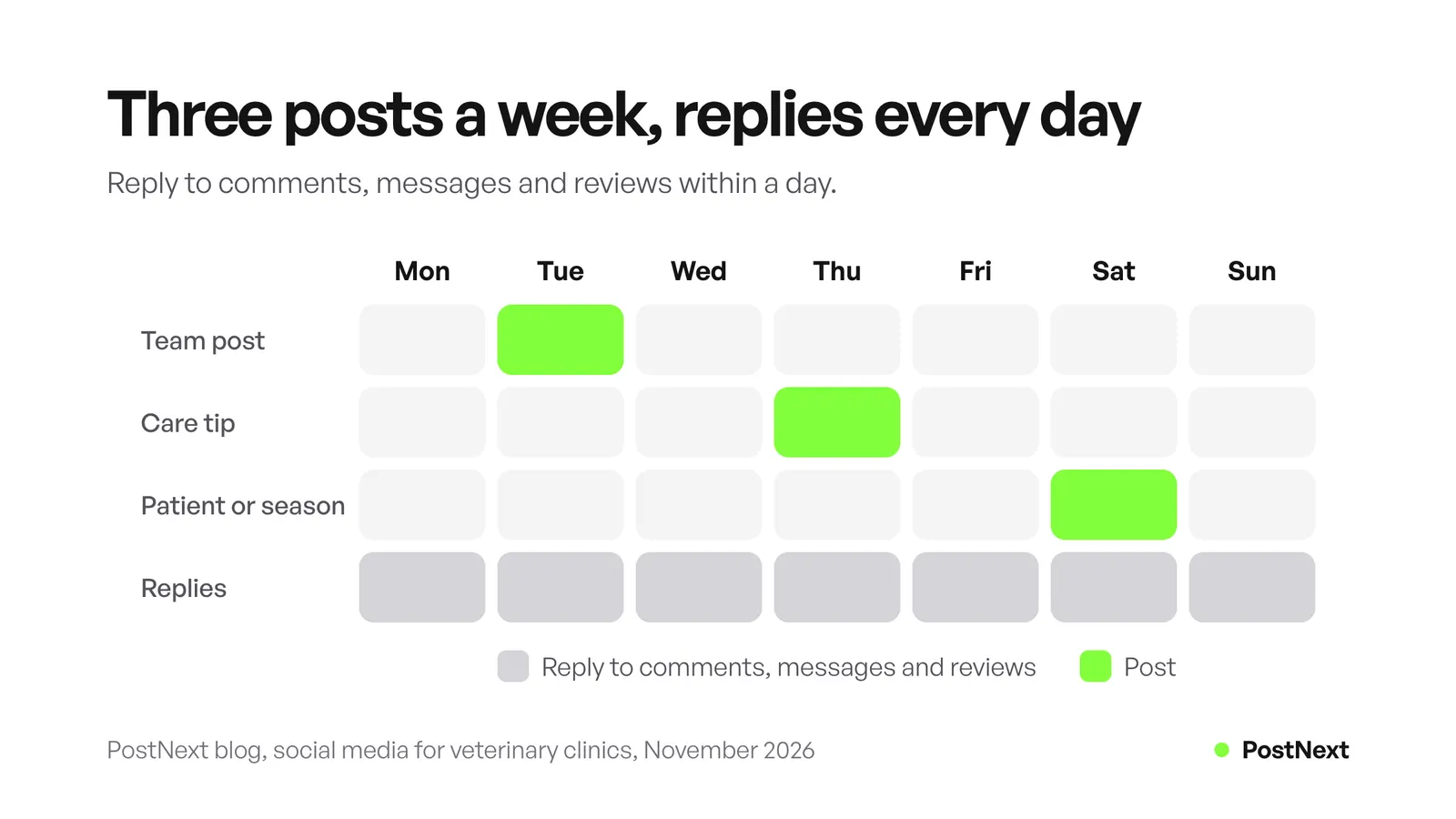
A week can look like this:
- Tuesday: a team member or a behind-the-scenes photo.
- Thursday: a care tip or a front-desk question.
- Saturday: a happy patient with permission, or the seasonal post.
Reply to comments, messages and reviews within a day. The AVMA says social media profiles need to be watched “including on weekends”, because a complaint posted on Saturday morning is read all weekend. Give one person that job, and give them your reply scripts.
How does PostNext help a vet clinic?
PostNext lets a clinic plan a month of team posts, care tips and seasonal reminders in one sitting and publish each at its time. It posts to Instagram, TikTok, YouTube, LinkedIn, X, Threads and Bluesky from one calendar. Repeat this post sends the same post every few days, weeks or months, which suits the poison hotline post or a monthly heartworm reminder.
You can set a repeat to run forever, until a date or for a number of posts. Each repeat counts as one post on your plan. The steps are on the repeat a post help page. For Instagram, PostNext publishes posts, Reels and carousels from the Instagram scheduler, and the Instagram comment inbox lets you read, answer and delete comments in one place. It does not cover DMs. On the Teams plan, a post can go to approval before it is scheduled, so the practice manager can check the owner’s consent first.
PostNext does not post to Facebook or Google Business Profile today, two channels most clinics need; both are on its roadmap. Schedule Facebook posts in Meta Business Suite, which allows 20 minutes to 29 days ahead, and Google posts in your Google profile. The free plan covers 1 channel, 10 posts and 10 AI credits a month, enough for two Instagram posts a week. See PostNext for veterinary clinics for how a clinic sets it up.
Frequently Asked Questions
Can a vet give medical advice on social media?
A vet can post general advice for anyone, such as heartworm prevention or puppy vaccine timing. Advice about one pet is telemedicine, and the AVMA says it needs a veterinarian-client-patient relationship, apart from emergency advice until the pet can be seen. State rules vary, so check with your state board.
Does HIPAA apply to veterinarians?
No. HIPAA protects health information about people, not animals. Client information is still confidential under the AVMA’s Principles of Veterinary Medical Ethics, and many states have their own rules on veterinary records. Ask the owner before you post a patient, and leave diagnoses and bills out of captions.
Can a vet clinic post surgery photos on Instagram?
Yes, with limits. Meta puts a warning screen on images of animals with visible innards and shows them only to adults, and images with visible blood are limited to users 18 and older. Sensitive posts cannot run as ads. Show the team, the covered drape and the pet going home instead.
How should a vet respond to a bad online review?
Thank the reviewer, say you take the comment seriously, and ask them to call a named person. Do not discuss the pet’s care or confirm details from the record. The AVMA’s guide adds the rule of 3: never make a third reply, and never offer a discount to remove a review.
How often should a veterinary clinic post on social media?
Two or three times a week on each channel, every week: a team or behind-the-scenes post, a care tip, and a patient or seasonal post. Buffer’s study of more than 100,000 users found posting in 20 or more of 26 weeks brought 450% more engagement per post than posting in 4 weeks or fewer.
What should vets post in February?
February is National Pet Dental Health Month, sponsored by the AVMA. Post a dental check reminder, a tooth-brushing video and a photo of a dental cleaning without blood. Start in the last week of January, because searches for the month are as high in January as in February.
Sources
- AVMA, U.S. pet ownership statistics, from the 2026 AVMA Pet Ownership and Demographic Sourcebook (7,547 people surveyed, early 2026), checked November 2026.
- AVMA, Principles of Veterinary Medical Ethics: VCPR, advertising and testimonials, confidentiality and record keeping, checked November 2026.
- AVMA, Veterinary telehealth: the basics, checked November 2026.
- Electronic Code of Federal Regulations, 21 CFR 530.3 (veterinarian-client-patient relationship) and 45 CFR 160.103 (HIPAA definitions), checked November 2026.
- AVMA, Responding to complaints and criticisms and Set rules to help manage social media, checked November 2026.
- Meta Transparency Center, Violent and graphic content and Privacy violations, checked November 2026.
- TikTok, Community Guidelines: Sensitive and mature themes, released August 25, 2026, checked November 2026.
- ASPCA, The Top 10 Toxins of 2025, published 2026, checked November 2026.
- AVMA, Pet dental care and National Pet Dental Health Month and July 4 safety, checked November 2026.
- American Heartworm Society, Heartworm Basics, checked November 2026.
- BrightLocal, Local Consumer Review Survey 2026, 1,002 US adults, published February 2026, checked November 2026.
- Pew Research Center, Social Media Fact Sheet, 5,511 US adults, published October 2026, checked November 2026.
- Google, Business Profile photo guidelines, special hours and Maps review policy, checked November 2026.
- Buffer, Consistent Posting Study (buffer.com/resources/consistent-posting-study), January 2025, checked November 2026.
- Search volumes: Google Ads data via the DataForSEO API, United States, November 2025 to October 2026, pulled November 25, 2026.
- PostNext, small business page, comment inbox, repeat a post and pricing pages, checked November 2026.