
AI marketing agents in Claude Code are subagents: Markdown files that give Claude a role, a set of tools and its own context window. Skills hold the repeatable playbooks they follow. In November 2026, the setups that hold up give each agent one job and a check it cannot pass by itself, then hand finished drafts to a scheduler such as PostNext.
Key Takeaways
- Three building blocks. CLAUDE.md holds the rules for every session, skills hold the step-by-step playbooks, subagents do one job in their own context window.
- Skills first. A skill’s body loads only when it is used, so 20 playbooks cost almost nothing until one runs (Anthropic, November 2026).
- One check per agent. In our own Claude Code video studio, an independent review agent failed 14 of 15 delivered Shorts that the builder had already passed.
- Agents cost the same limits. Each subagent’s requests count toward your plan’s usage limits. One night of about 30 agents used about 12 million tokens in an hour and hit a 5-hour limit.
- Publishing is a separate step. PostNext’s MCP server lets an agent save drafts and schedule posts on X, Instagram, LinkedIn, TikTok and Threads. Drafts never publish on their own.
What is an AI marketing agent in Claude Code?
An AI marketing agent in Claude Code is a subagent with a marketing job: research, writing, design, reporting or review. Anthropic defines a subagent as a specialised assistant with its own context window, its own system prompt, chosen tools and separate permissions. Claude reads each subagent’s description and delegates a task when the description matches. The agent returns a summary, not its whole working history. If your team works in the Claude app instead of the terminal, Claude for marketing covers the connectors and plugins.
That last part is the reason to use agents for marketing at all. Research for a campaign means reading many pages, competitor posts and reports. Done in the main conversation, all of that text stays in context and pushes out your brand rules. Done in a subagent, only the findings come back.
A subagent lives in a Markdown file. Project agents sit in .claude/agents/ and travel with the repository, so a team that shares the repo shares the agents. Personal agents sit in ~/.claude/agents/ and load in every project on your machine. Claude Code is part of paid Claude plans (Pro and above) or a Console account, not the free plan.
What is the difference between a skill, a subagent and CLAUDE.md?
CLAUDE.md is a file of standing rules that Claude Code reads at the start of every session. A skill is a folder with a SKILL.md playbook that loads only when a task needs it or when you type its name. A subagent is a separate worker with its own context window. Rules go in CLAUDE.md, procedures in skills, and jobs that read a lot or need a fresh view in subagents.
| Part | What it holds | When it loads | Marketing example |
|---|---|---|---|
| CLAUDE.md | Facts and rules for every task | Every session | Brand voice summary, banned words, “drafts only, never publish” |
Skill (.claude/skills/<name>/SKILL.md) | A step-by-step procedure, scripts, templates | When the description matches, or /name | Write a LinkedIn post, build a carousel, write a campaign brief |
Subagent (.claude/agents/<name>.md) | A role, a tool list, a model | When Claude delegates, or you ask for it by name | Market researcher, post reviewer, report analyst |
| MCP server | Tools in another app | When a tool is called | A scheduler, an image generator, an analytics source |
Source: Anthropic Claude Code documentation on memory, skills and subagents (code.claude.com/docs, checked November 2026).
Anthropic’s own guidance on when to make a skill is plain: when you keep pasting the same instructions into chat, or when a section of CLAUDE.md “has grown into a procedure rather than a fact”. A brand voice guide is a fact file. “How we write a launch thread” is a procedure. Split them that way and CLAUDE.md stays short enough to be read every time.
How do you map a marketing team to agents and skills?
List the marketing tasks you do every week, turn each repeated task into a skill, then create an agent only where a job needs its own context or an independent view. Writing a post is a skill. Researching a market is an agent, because it reads a lot. Reviewing a post is an agent, because the writer should never grade its own work.
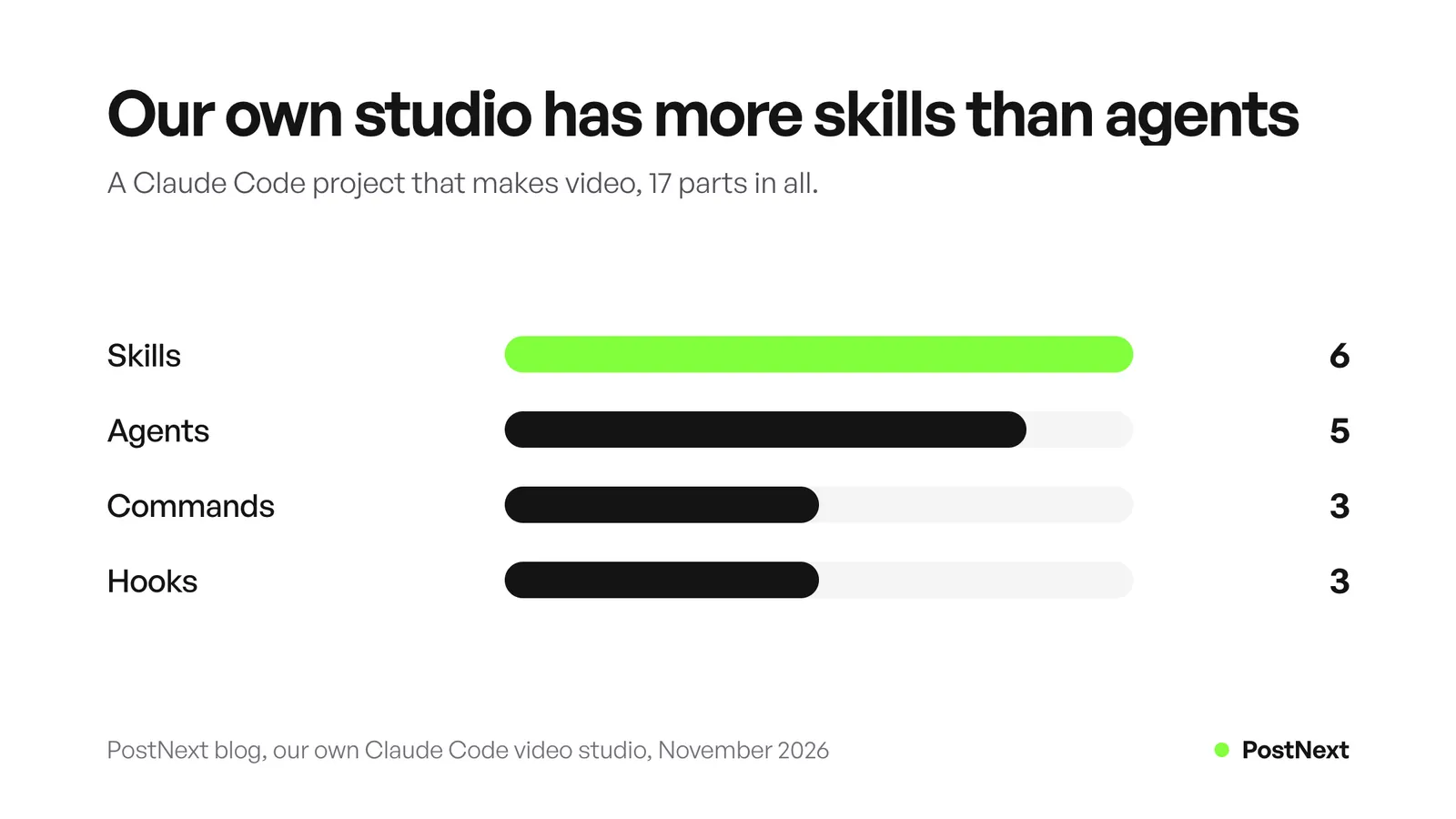
Most teams end up with more skills than agents. A sensible first map for a small brand:
| Job | Build it as | Why | Tools it needs |
|---|---|---|---|
| Write posts for each network | Skill | A fixed procedure with your format rules | Read, Write |
| Turn a blog post into posts | Skill | Same steps every time | Read, a scheduler |
| Campaign brief | Skill | A template to fill | Read, Write |
| Market and competitor research | Subagent | Reads many pages, returns findings only | Web search, fetch |
| Post reviewer | Subagent | Must read the draft cold, without the brief | Read only |
| Weekly results report | Subagent | Reads exports and returns the numbers | Read, Bash |
| Visuals | Skill plus an MCP server | The skill holds the brand look, the server makes the image | An image tool |
For visuals, the design skill holds the brand look and an image tool does the drawing, for example DesignerBox’s MCP server for product photos and ads. For the post-writing skills, start from your written brand social media guidelines, because a skill can only follow rules that exist on paper.
Keep the agents few. Anthropic warns that agent descriptions take up context: when the combined descriptions of your own subagents pass 15,000 tokens, Claude Code shows a warning at startup. Five clear agents beat fifteen overlapping ones, because Claude picks an agent by its description, and two similar descriptions make the choice a coin toss.

How do you create a marketing subagent?
Ask Claude Code to write one, or create the file yourself in .claude/agents/. Only two fields are required: name and description. Add a tools list to limit what the agent can touch and a model to choose its cost. Claude Code notices a new or changed file within a few seconds, with no restart.
A post reviewer that can read but never edit or publish:
---
name: post-reviewer
description: Reviews social media drafts before they are scheduled. Use after any post is written, before it goes to the calendar.
tools: Read, Grep
model: sonnet
---
You review social media drafts for a brand. You get only the draft and
the file brand/voice.md. You never see the brief.

For each draft, answer:
1. What would a stranger think this post is about after one read?
2. Which claim has no source in the draft or in brand/facts.md?
3. Which line breaks a rule in brand/voice.md?

End with PASS or FAIL and one line on the biggest problem.
Three details in that file matter more than the wording. The tool list has no Write and no scheduler, so the reviewer cannot change or post anything. It reads the draft without the brief, so it judges what a reader will see, not what the writer meant. And it runs on a cheaper model, which is fine for a reading job.
Older guides tell you to type /agents to open a creation wizard. Anthropic’s documentation says that wizard existed on Claude Code v2.1.197 and earlier. On current versions, /agents prints a reminder to ask Claude or edit the folders directly. The frontmatter also has a skills field that loads a skill’s full text into the agent at start, so a writer agent can carry your post-writing skill with it.
How do you write a marketing skill?
Create a folder in .claude/skills/ with a SKILL.md file inside. The top of the file has a description that tells Claude when to use it. The body holds the steps. The folder name becomes the command, so .claude/skills/linkedin-post/ runs with /linkedin-post, and Claude also starts it on its own when your request matches the description.
---
description: Writes a LinkedIn post from a source file. Use when asked for a LinkedIn post, a launch post or a recap.
---
1. Read the source file the user names, then brand/voice.md and brand/facts.md.
2. Write one post: the point in the first line, under 1,300 characters,
   one ask at the end, no hashtags in the body.
3. Use only numbers that appear in the source or in brand/facts.md.
4. Save it to drafts/linkedin/<date>-<slug>.md.
5. Hand the file to the post-reviewer agent. Fix what it flags once.
Skills can also hold scripts and templates next to SKILL.md. A carousel skill can keep the slide template in the same folder, and a report skill can keep the script that reads your analytics export. The script does the same thing every time, which a prompt cannot promise.
One trap for teams: personal skills in ~/.claude/skills/ do not load in Cowork or in cloud sessions, including cloud scheduled tasks. Anthropic’s docs say a cloud task reports the skill as not found. Put the skills a scheduled job needs in the project’s .claude/skills/ and commit them.
Why does each agent need a check it cannot pass by itself?
Because an agent that builds something also passes it. We run a Claude Code project as our own video studio, with 5 project agents, 3 commands, 6 skills and 3 hooks. Its lessons file records an independent review agent failing 14 of 15 delivered Shorts. The builder had already checked those frames and passed them.
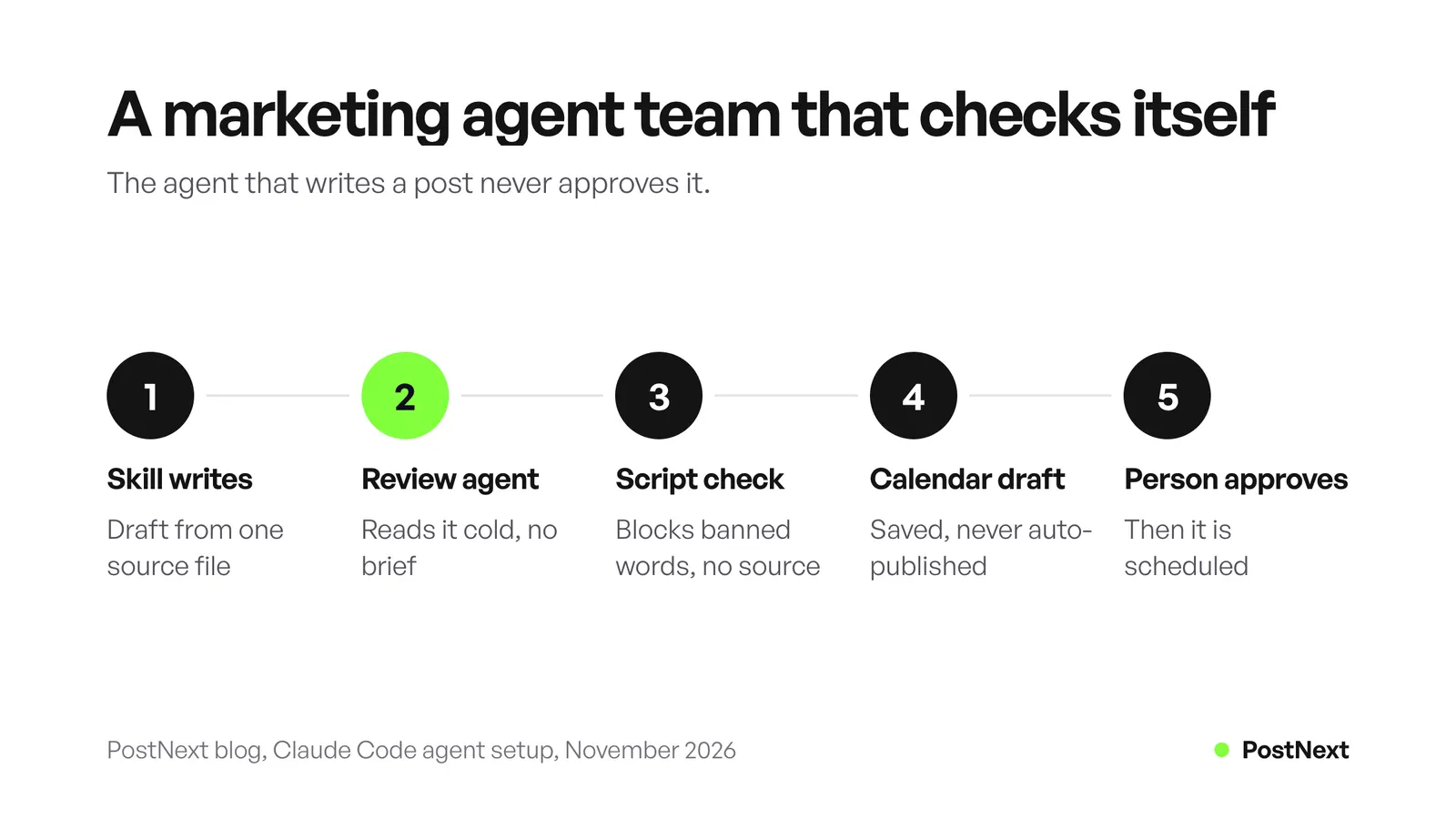
Two days earlier the same pattern showed up in a second form: a frame review on 10 “finished” reels found 6 real defects, and the builder’s own quick read had passed 4 of them. Neither failure came from a weak model. Both came from asking the same context to make a thing and judge it.
So the studio’s agents each do one check on one thing, and each gets only what its definition allows. Its operating manual puts it in one line: “an agent handed your conclusion returns it.” The script judge gets the script and a scoring rubric, never the brief. The “stranger reader” gets only the words on screen and says what a stranger understood. A script fails if any one of six scores is under 4 out of 5, and the writer never scores its own work.
The second lesson is that a rule in a file is not a check. The studio’s manual says a rule there is one sentence plus the tool or file that enforces it, and marks the rules that have no check yet. Its script checker exists because the same mistake shipped four times in one week, each time after the lesson was already written down. For a marketing team, the cheap version is a hook or a script that fails a draft with a banned word, a missing source or a link to the wrong page, before any person reads it.
The third lesson is about shared files. Three sessions edited the same project in one night, so the studio added a claims file. Each session writes which files it is changing and until when. A hook stops the first edit of a claimed file once and shows the claim. Nothing is locked, but nobody edits a file blind. Any team with two people running Claude Code in one repo needs the same idea.
How does the team publish to social media?
Connect a scheduler as an MCP server and give one agent or skill the job of saving drafts there. With PostNext, one command adds the server: claude mcp add --transport http --scope user postnext https://mcp.postnext.io/api, then /mcp to sign in. The agent can then save drafts and schedule posts on X, Instagram, LinkedIn, TikTok and Threads.
The tools an agent team uses most, from PostNext’s MCP reference (postnext.io/mcp/docs, November 2026):
| Tool | What the agent does with it | Plan |
|---|---|---|
list_connected_accounts | Finds which channels exist before writing | Every plan |
create_post_draft | Saves a post of 1 to 2,200 characters with up to 10 images or videos | Every plan |
request_asset_upload | Uploads an image or video from your folder | Every plan |
schedule_post | Puts a draft in the queue at a set time | Every plan, counts toward monthly posts |
get_best_time_to_post | Suggests a time from the account’s own history | Paid plans |
get_post_metrics | Reads likes, comments and impressions on X; likes and comments on Instagram | Every plan |
Keep a person between the draft and the post. PostNext’s MCP drafts never publish on their own, so an agent team can fill a week of drafts and a person schedules or approves them in the social media calendar. On the Teams plan, posts can go through an approval step first, which fits the content approval process most brands already run by email.
Two limits to plan around. Over MCP, get_post_metrics returns engagement for X and Instagram only; LinkedIn, Threads and TikTok return the publish status and link. And the MCP server covers five networks: PostNext’s postnext-social-manager skill uses the REST API and adds YouTube and Bluesky. The full setup, with prompts, is on PostNext’s page for posting from Claude Code, and our guide to Claude Code for marketing covers turning a changelog into posts.
How much does it cost to run an AI marketing team in Claude Code?
The agents cost your Claude plan’s usage, and the scheduling costs your scheduler’s plan. Anthropic’s documentation says each subagent sends its own requests, which count toward the same usage limits as your main conversation. Five agents running at once all draw on that one allowance. PostNext includes MCP access on every plan.
The usage side is where AI marketing agents surprise people. In our studio’s log, three large agent runs at once, about 30 agents, used about 12 million tokens in an hour and hit the account’s 5-hour limit. The fix was not a bigger plan. It was running the request a person was waiting for first and the long sweep after, and choosing cheaper models for reading jobs with the model field.
| Cost | What sets it | How to keep it down |
|---|---|---|
| Claude usage | Every agent’s requests, in your plan’s limits | Fewer agents, model: sonnet or haiku for reading and review jobs |
| Context | Agent descriptions and CLAUDE.md load every session | Short descriptions; procedures in skills, not in CLAUDE.md |
| Scheduler posts | PostNext Free: 10 scheduled posts a month on 1 channel; paid plans: 1,000 a month | Save drafts freely, schedule only what was approved |
| AI credits | PostNext Free: 10 AI credits; Premium: 150 a month | Let Claude write, so PostNext credits are not needed for drafting |
PostNext figures from postnext.io/pricing and postnext.io/mcp/docs, checked 26 November 2026.
What should you build first?
Build one skill and one review agent around the task you repeat most, connect the scheduler, and run it for two weeks before adding anything. For most social teams that is “write this week’s posts from one source”. Add a research agent when you start a new market, and a reporting agent when you have a month of results worth reading.
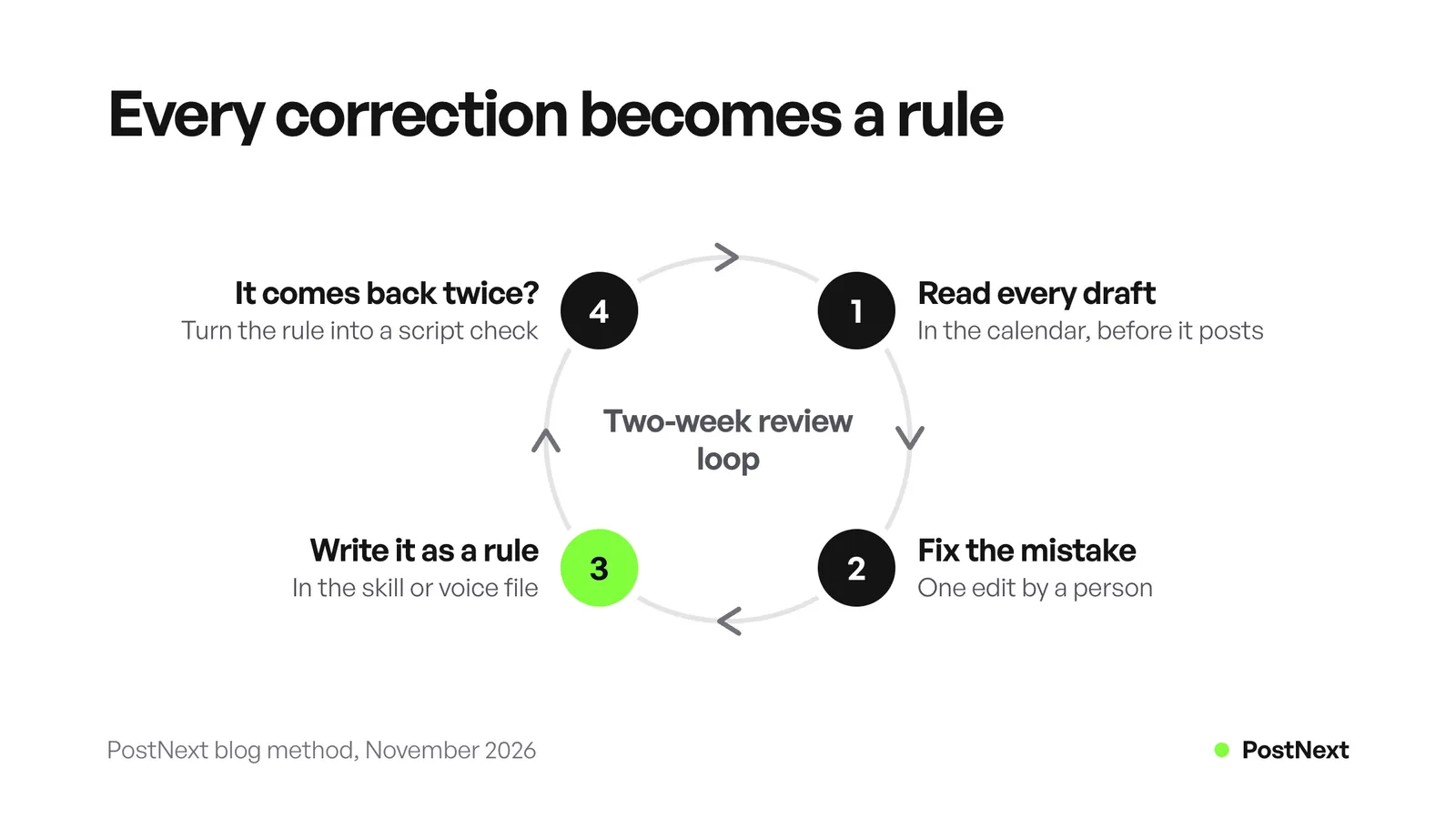
A first week that works:
- Write
brand/voice.mdandbrand/facts.md: your tone, banned words, and the product facts a post may state. - Write one skill that turns a source file into posts for your two main networks.
- Write one review agent with read-only tools that never sees the brief.
- Add the scheduler as an MCP server and tell the skill to save drafts only.
- Read every draft in the calendar for two weeks. Each mistake you correct goes into the skill or the voice file as a rule.
- When the same mistake returns twice after a rule, turn the rule into a script check.
Step 5 is where the team gets better. Our studio keeps every correction as a dated rule in one lessons file, and that file, not the number of agents, is what changed the output. If you want the wider picture of how assistants connect to social accounts first, read our guide to the social media AI agent.
Frequently Asked Questions
What are AI marketing agents?
AI marketing agents are AI assistants with one marketing job each, such as research, writing, design or reporting. In Claude Code they are subagents: Markdown files with a role, a list of allowed tools and a model. Claude hands a task to the agent whose description matches and gets a summary back.
What is the difference between Claude Code skills and subagents?
A skill is a playbook that loads into the current conversation when it is needed. A subagent is a separate worker with its own context window, tools and permissions. Use skills for procedures and subagents for jobs that read a lot or need an independent view, such as review.
How many agents does a marketing team need in Claude Code?
Start with one or two. A writing skill plus a read-only review agent covers most weekly social work. Add a research agent and a reporting agent when those jobs appear. More agents use your usage limits faster and make Claude’s choice between similar descriptions less reliable.
Can Claude Code agents post to social media by themselves?
They can schedule posts when a scheduler is connected as an MCP server. With PostNext, agents save drafts and can schedule them on X, Instagram, LinkedIn, TikTok and Threads. Drafts never publish on their own, so a person can approve every post first.
Do Claude Code subagents cost extra?
There is no separate fee, but each subagent’s requests count toward the same usage limits as your main conversation. Several agents at once use the allowance faster. Setting a cheaper model in an agent’s model field lowers the cost of reading and review jobs.
Do I need to code to build an AI marketing team in Claude Code?
No. Agents and skills are Markdown files written in plain sentences, and Claude Code can write them for you when you describe the job. You need to be comfortable with folders and a terminal. Claude Code needs a paid Claude plan or a Console account.
Sources
- Anthropic, Create custom subagents (checked 26 November 2026): context windows, frontmatter fields, the 15,000-token description warning,
/agentson v2.1.197 and earlier, usage limits. - Anthropic, Extend Claude with skills (checked 26 November 2026): SKILL.md, skill locations, loading only when used, skills in Cowork and cloud sessions.
- Anthropic, How Claude remembers your project (checked 26 November 2026): CLAUDE.md.
- PostNext, Post to social media from Claude Code and the MCP tool reference at postnext.io/mcp/docs (checked 26 November 2026): command, channels, tools, plan rules.
- PostNext pricing, postnext.io/pricing (checked 26 November 2026).
- Our Claude Code video studio: operating manual, agent definitions and lessons file (entries dated October and November 2026).