Social media for wedding planners works when the feed shows how a wedding comes together, not only how it looked. Couples book a planner many months before the day, and they choose the one whose work and calm they can see. This PostNext guide covers where couples look, six posts that bring enquiries, a plan that fits a long engagement, and whose wedding photos a planner may post.
Key Takeaways
- Couples plan for over a year: The Knot’s Real Weddings Study puts the average US engagement at 14 months, and 44% of couples are engaged for one to two years.
- Instagram is the portfolio: Pew’s 2026 survey found 51% of US adults use Instagram, and 79% of adults aged 18 to 29.
- Show the planning, not only the photos: timelines, layouts and the morning of the day show what couples pay a planner for.
- The photographer owns the photos: US copyright belongs to the person who took the picture, so a planner needs the photographer’s permission to post them.
- The couple says yes too: get written consent from the couple before you post their faces, names or venue.
- Free products in a styled shoot need a disclosure: the FTC says free or discounted products are a material connection.
Why should a wedding planner use social media?
A wedding planner should use social media because couples choose a planner by the weddings they have seen. A couple cannot test your calm on the day or your skill with a timeline before they book. A feed of real weddings, the planning behind them and kind words from past couples is the closest they get to seeing you work.
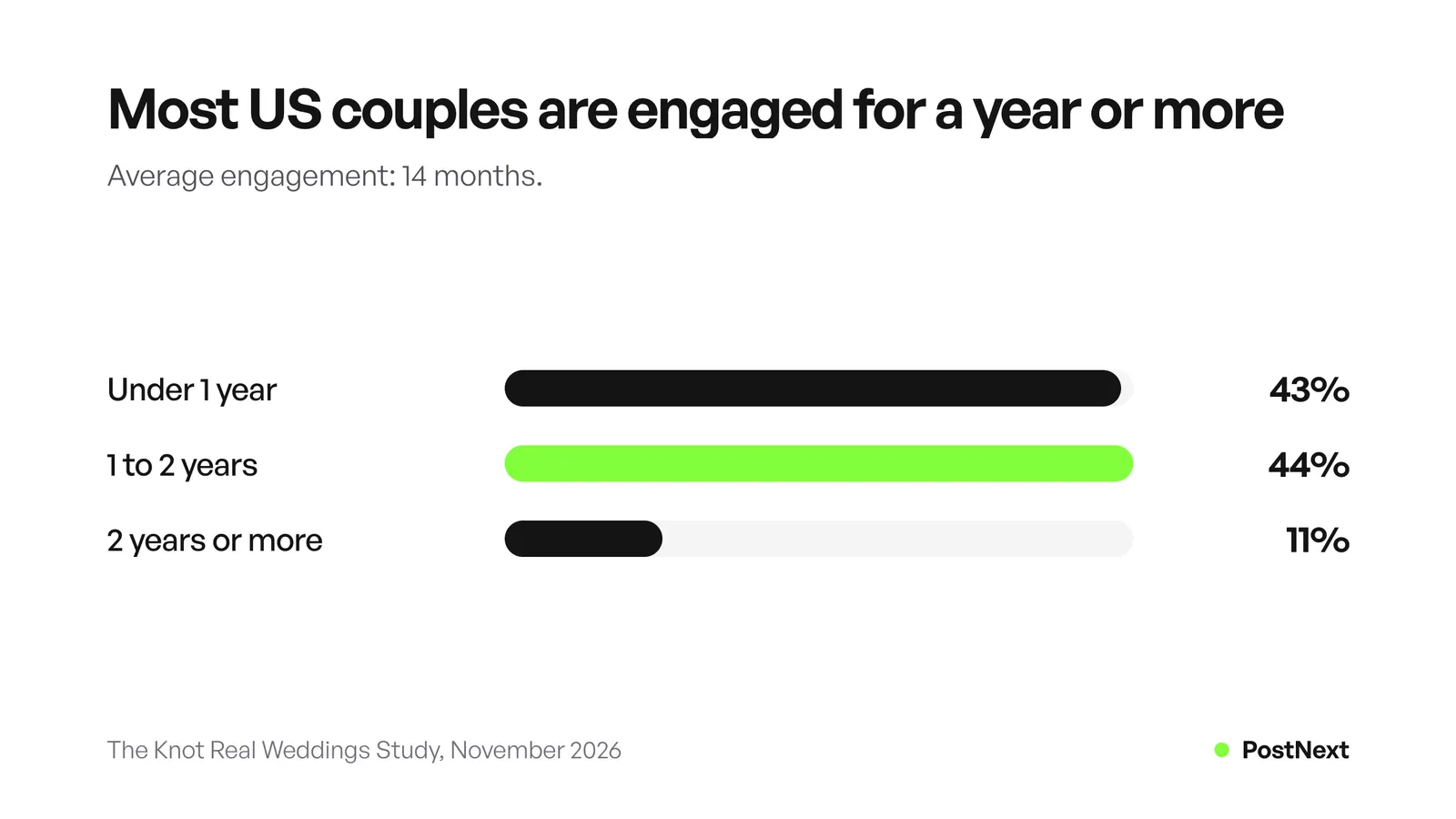
The buying cycle is long. The Knot’s Real Weddings Study puts the average US engagement at 14 months: 43% of couples are engaged for under a year, 44% for one to two years and 11% for two years or longer. A couple who follows you in month two may enquire in month four and book in month five. The feed keeps you in front of them through all of it.
Reviews and directories matter as much as posts. Many planners get a share of their enquiries from wedding directories, venue referrals and past couples. A feed helps each one: a venue manager who sees your work refers you with more confidence, and a couple who heard your name from a friend checks your Instagram before they write.
Which social media platforms should wedding planners use?
Most wedding planners need Instagram as the main portfolio, Pinterest for couples who save ideas, and TikTok or YouTube Shorts for behind-the-scenes video. Facebook helps with older family members who help pay, and with venue and vendor groups. LinkedIn helps planners who also run corporate events.
| Channel | Best job for a wedding planner | Who it reaches |
|---|---|---|
| Real weddings, Reels of the setup, vendor credits | 51% of US adults; 79% of adults 18-29 | |
| Boards of themes, colours and layouts that couples save | Pew did not report Pinterest use for 2026 | |
| TikTok | Day-of video, planning tips, the setup in 30 seconds | 37% of US adults; 65% of adults 18-29 |
| YouTube | Longer wedding films, venue tours, Shorts | 84% of US adults |
| Parents and family, vendor groups, venue partners | 70% of US adults | |
| Corporate events, venue and hotel partners | 31% of US adults |
Pew Research Center, Social Media Fact Sheet (5,511 US adults, survey January to June 2026), checked November 2026.
Choose by the couples you want. A planner for small, relaxed weddings may get most enquiries from TikTok and Instagram Reels. A planner for large weddings with a big budget may need Instagram, Pinterest and a strong venue network. Two channels you post on every week beat five you post on once a month.
What should a wedding planner post on social media?
A wedding planner should post real weddings, the planning behind them, and answers to the questions couples ask. Each post should show one moment or answer one question, and lead to one place: your enquiry form or your packages page. Six post types cover a year, and one wedding gives you material for a month.
1. The real wedding, in one carousel
Post one wedding as a carousel of 8 to 10 photos: the venue, the ceremony, the tables, the couple, and one detail. Credit every vendor in the caption. Our Instagram carousel ideas show other ways to order the slides.
2. The setup, sped up
Film the empty room in the morning and the finished room before guests arrive, from the same spot. Thirty seconds of setup shows the work a planner does, which the final photos hide.
3. The timeline or the floor plan
Show a real wedding day timeline or a table layout, with names removed. Couples save these posts, and they show how you think.
4. A planning answer
Answer one question per post: how far ahead to book a venue, how to plan a rain option, how many hours a reception needs. Use the questions couples ask in first calls; those are the ones the next couple is searching for.
5. The vendors you work with
Post the florist, the caterer, the band or the jeweler who made the rings, with a photo of their work and a tag. Vendors share these posts with their own followers, and couples see you as someone with a good team. See our guide on social media for florists for the other side of that relationship.
6. A note from a past couple, with permission
Post a review in the couple’s own words, with their first names and a photo, after they agree in writing. A thank-you note from a couple says more than any line you write about yourself.
Whose wedding photos can a planner post?
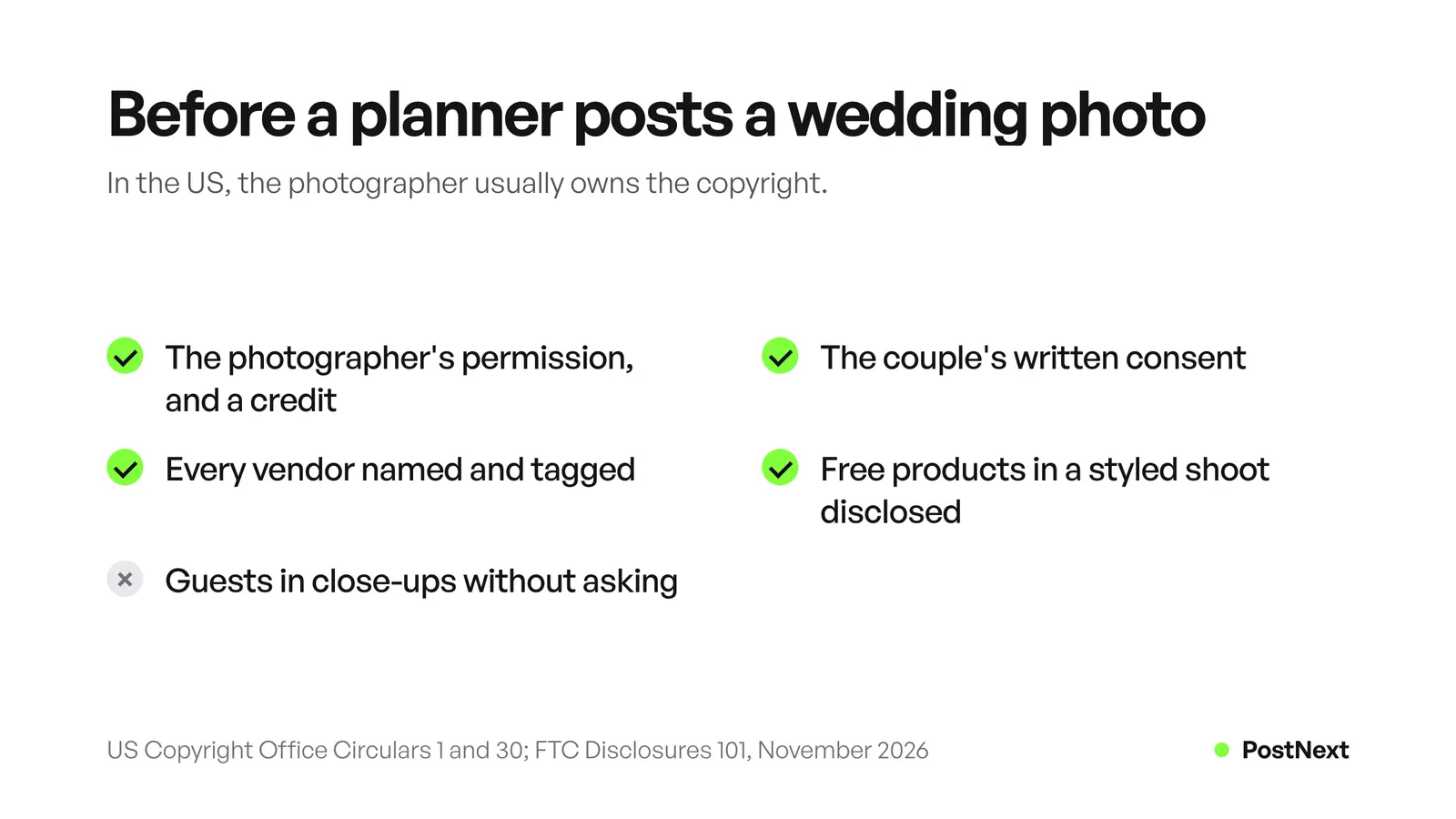
A planner can post wedding photos when both the photographer and the couple agree. In the United States, copyright in a photo belongs to the person who took it. A planner who did not take the photo needs the photographer’s permission, and needs the couple’s consent to show their faces and names. Get both in writing before the wedding.
The point that surprises planners is that paying for photos does not move the copyright. The US Copyright Office says a commissioned work is a “work made for hire” only in two cases. It must fall into one of nine categories, such as a contribution to a collective work or part of a film. Both sides must also sign a written agreement. Wedding photos rarely fit those categories, so the photographer usually keeps the copyright, even when the couple paid for the shoot.
| Situation | What you need | Who to ask |
|---|---|---|
| Photos from the couple’s photographer | A licence to post, and a credit in the post | The photographer |
| Faces, names or the venue in the post | Consent to share | The couple |
| Photos you took yourself on your phone | Consent for anyone recognisable in them | The couple, and guests in close-ups |
| A video from a guest | Permission to repost, and a credit | The guest |
| A styled shoot with vendors | Agreement on who may use the photos, and how | The photographer and every vendor |
US Copyright Office, Circular 1 (Copyright Basics) and Circular 30 (Works Made for Hire), checked November 2026. This is a summary, not legal advice.
A short process prevents most problems:
- Put it in your contract. Add a line that asks the couple’s consent for social media posts, with a box to tick for faces and names.
- Ask photographers early. At the planning stage, ask each photographer if you may post a set number of photos with a credit, and keep the reply.
- Credit every vendor. Name and tag the photographer, florist, venue and other vendors. Instagram Collab invites, which put a post on two accounts, are added in the Instagram app.
- Keep guests out of close-ups. Unless a guest agrees, use photos where guests are not the subject.
Styled shoots raise one more rule. When vendors give free flowers, dresses or rentals for a shoot, the FTC says free or discounted products are a material connection. A plain line in the post, such as “Flowers given by [florist] for this shoot”, keeps it honest. Our guide on how to repost on Instagram covers credit when you share a vendor’s or guest’s post.
How should a wedding planner plan posts across the year?
A wedding planner should plan posts for when couples decide, not only for when weddings happen. Couples choose a planner many months before their date, so the feed should stay busy in the months with no weddings. Plan a quarter at a time and fill quiet months with planning answers and weddings from the season before.
A simple year for a planner with a summer and autumn wedding season:
- Winter: the quiet months for most planners. Post last season’s best weddings, your packages and planning answers for couples who are starting to look.
- Spring: post setups and vendor features as the season starts, and the first weddings of the year.
- Summer and autumn: post each wedding within two weeks while couples who attended still talk about it. Schedule posts ahead, because there is no time on wedding weekends.
- Every month: at least one planning answer and one vendor post.
Three posts a week is enough for most planners. Buffer’s study of more than 100,000 users found accounts that posted in 20 or more of 26 weeks got 450% more engagement per post than accounts that posted in 4 weeks or fewer. A planner who posts only in the off season loses the couples who looked in June.
How should a wedding planner turn followers into enquiries?
Make the next step clear in every post, and answer messages within a day. A couple who likes your work wants to know three things: are you free on their date, what do you cost, and how do they start. Put an enquiry link in your profile, a “from” price on your packages page, and your service area in your bio.
Use a link in bio page that sends couples to your enquiry form, packages and recent weddings, so they do not have to message you to find them. Reply to every comment and message with a question back, such as their date and venue, because that starts the conversation.
Reviews close the loop. BrightLocal’s 2026 survey of 1,002 US adults found 97% read reviews for local businesses and 89% expect owners to respond. Ask each couple for a review two weeks after the wedding, when they have their photos and the day is still fresh.
How does PostNext help a wedding planner?
PostNext for wedding planners lets a planner write a month of posts in one sitting and publish each one at its time, including on wedding weekends. It posts to Instagram, TikTok, YouTube, LinkedIn, X, Threads and Bluesky from one calendar. The Instagram scheduler publishes feed posts, Reels, image Stories and carousels of 2 to 10 photos or videos.
What fits a planner’s year:
- Schedule the season ahead: write the summer’s planning answers in spring and schedule them, so the feed stays active on wedding weekends.
- One clip, three channels: upload one setup video and post it as a Reel, a TikTok and a YouTube Short, each with its own caption.
- Repeat posts: a monthly post such as “dates left this year” can repeat every 1 to 365 days, weeks or months.
- Comments: the Instagram comment inbox lets you read and reply to comments in one place, on every plan. It does not cover direct messages.
What PostNext does not do today: it does not post to Pinterest or Facebook (both are listed as coming soon), Collab invites are added in the Instagram app, and it does not run paid ads. The free plan covers 1 channel, 10 posts and 10 AI credits a month; see pricing for the paid plans.
Frequently Asked Questions
What is the best social media platform for wedding planners?
Instagram is the best fit for most planners, because couples judge a planner by real weddings in photos and short video. Pew’s 2026 survey found 51% of US adults use Instagram, and 79% of adults aged 18 to 29. Add Pinterest for couples who save ideas and TikTok for setup videos.
Can a wedding planner post photos taken by the wedding photographer?
Only with the photographer’s permission. In the United States, copyright belongs to the person who took the photo, and paying for a shoot does not usually move it. Ask the photographer for permission to post, credit them in the post, and get the couple’s consent too.
How far ahead do couples look for a wedding planner?
Many couples start looking soon after they get engaged. The Knot’s Real Weddings Study puts the average US engagement at 14 months, so a couple may follow a planner for weeks or months before they enquire. Post every week so you are there when they decide.
How often should a wedding planner post on Instagram?
Three times a week is enough for most planners, if you keep it up all year. Buffer’s study found accounts that posted in 20 or more of 26 weeks got 450% more engagement per post than accounts that posted in 4 weeks or fewer.
Do styled shoots need a disclosure?
Yes, when vendors gave products or services for free. The FTC says free or discounted products are a material connection, so the post should say so in plain words, such as “Flowers given by [florist] for this shoot”. Tags like “sp” or “collab” are too vague.
What should a wedding planner post in the off season?
Post last season’s weddings, planning answers, vendor features and your packages. Couples plan for more than a year on average, so some are choosing a planner in every month, including the months with no weddings.
Sources
- The Knot, What’s the Average Engagement Length Right Now?, from The Knot Real Weddings Study (a vendor study), checked November 2026.
- US Copyright Office, Circular 1: Copyright Basics, checked November 2026.
- US Copyright Office, Circular 30: Works Made for Hire, checked November 2026.
- Federal Trade Commission, Disclosures 101 for Social Media Influencers, checked November 2026.
- Pew Research Center, Social Media Fact Sheet, 5,511 US adults, survey January to June 2026, checked November 2026.
- BrightLocal, Local Consumer Review Survey 2026, 1,002 US adults, published February 2026, checked November 2026.
- Buffer, Consistent Posting Study (buffer.com/resources/consistent-posting-study), January 2025, checked November 2026.
- PostNext pages read November 2026: Instagram channel, automation, pricing.