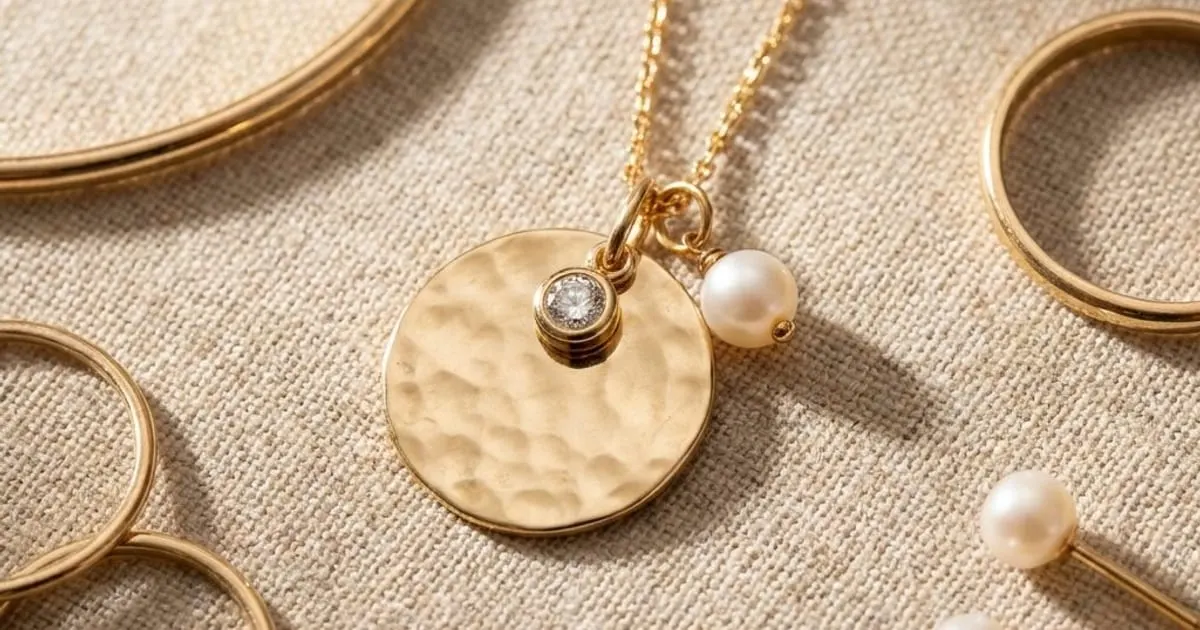
Social media for jewelers works when the feed shows what a buyer cannot judge in a photo: how a piece is made, how it looks on a hand, and exactly what it is made of. Post close-up video, the bench, and finished commissions, and write captions that name the metal and the stone correctly. This PostNext guide covers channels, six posts that sell, and the US caption rules.
Key Takeaways
- Instagram first, TikTok second: Pew’s 2026 survey found 51% of US adults use Instagram (56% of women, 79% of adults under 30) and 37% use TikTok.
- Video beats a white background: a stone moving in daylight shows what a still photo hides. Film 10 seconds of every finished piece.
- The FTC Jewelry Guides cover social posts: they apply to “advertising, promotional materials, and all other forms of marketing”, so a caption counts.
- “Gold” alone means 24 karat: write “14K gold” or “14 karat gold”, with the karat as visible as the word gold.
- Lab-grown needs its label next to the name: “laboratory-grown diamond” or “lab-created sapphire”. The FTC says “faux” is not enough.
- Treated stones get the treatment in the post: when buyers order without seeing the piece, the FTC says the disclosure belongs in the product description.
- Proposal photos need two yeses: the couple’s, and the photographer’s if someone else took them.
Why should a jeweler use social media?
A jeweler should use social media because buyers judge fine jewelry by the person who makes or sells it. Most people cannot grade a stone or test a metal, so they look for proof of skill and honesty before they spend. A feed of real pieces, real hands and clear captions gives that proof before anyone walks into the shop.
The feed also does a job the shop window cannot. An engagement ring buyer often looks for weeks before they book a consultation, and they look late at night on a phone. Your posts are the shop they visit first.
Reviews still carry weight next to the feed. BrightLocal’s 2026 survey of 1,002 US adults found 97% read reviews for local businesses, and 68% will only use a business with four or more stars. A good feed and a weak review page send mixed signals, so ask every happy customer for a review.
There is a fair case for keeping it small. A one-person bench jeweler with a waiting list may get more from a tidy Google profile and one good post a week than from daily video. Start with what you can keep up for a year.
Which social media platforms are best for jewelers?
Instagram is the main channel for most jewelers, because buyers compare pieces by photo and short video. TikTok and YouTube Shorts reach younger buyers with making-of video. Pinterest suits brides and gift planners who save ideas for later. Facebook still matters for local customers over 40 and for events in the shop.
| Channel | Best job for a jeweler | Who it reaches |
|---|---|---|
| Close-up Reels, carousels of one piece, product tags | 51% of US adults; 56% of women; 79% of adults 18-29 | |
| TikTok | Making-of video, stone reveals, sizing answers | 37% of US adults; 65% of adults 18-29 |
| YouTube | Longer bench videos, how a ring is set, Shorts | 84% of US adults |
| Local customers, trunk shows and events, reviews | 70% of US adults; 77% of women | |
| Saved ideas for engagement rings and wedding bands | Pew did not report Pinterest use for 2026 |
Pew Research Center, Social Media Fact Sheet (5,511 US adults, survey January to June 2026), checked November 2026.
Choose by the buyer you want more of. A shop that sells engagement rings to couples in their late twenties needs Instagram and TikTok. A shop that sells repairs, watch batteries and gifts to a local crowd needs Facebook and a current Google profile more than TikTok.
What should a jeweler post on social media?
A jeweler should post pieces in motion, the work behind them, and the people who wear them. Each post answers one buyer question: what does it look like, how was it made, what is it made of, and will it suit me. Six post types cover those questions, and a small shop can make all six from one week of work.
1. The 10-second piece in daylight
Film each finished piece by a window, turning slowly in your fingers. Daylight shows how a stone moves, which a studio shot on white often hides. Put the metal and the stone in the first line of the caption, written the way the rules below describe.
2. The bench, from sketch to setting
Show one commission across four or five clips: the sketch, the wax or CAD model, the casting, the setting, the polish. This is the post that explains a custom price without saying a number. It works as a Reel or as an Instagram carousel with one step per slide.
3. On the hand, at real size
Show the piece worn, next to a coin or a ruler in one frame, so buyers see the real size. Carat weight means little to most people. A 1-carat stone on a size 6 finger means a lot more.
4. The answer to a question buyers ask
Take the questions people ask at the counter and answer one per post: how to choose a ring size, the difference between 14K and 18K gold, what lab-grown means, how to clean pearls. These posts get saved and shared, and they show you know your trade.
5. A commission story, with permission
Tell the story of one custom piece: who it was for (first name only, or none), what they asked for, and what you made. Get written permission before you post anyone’s name, face or proposal.
6. Care, repairs and resizing
Show a before and after of a cleaned, repaired or resized piece. These posts bring in the customer who already owns jewelry, which keeps the bench busy between big sales.

What must a jewelry caption say under the FTC rules?
In the United States, a jewelry caption must describe the metal and stones the way the FTC Jewelry Guides (16 CFR Part 23) say. The guides apply to “labeling, advertising, promotional materials, and all other forms of marketing”, which includes social posts. Name the karat, label lab-grown stones next to their name, and disclose treatments.
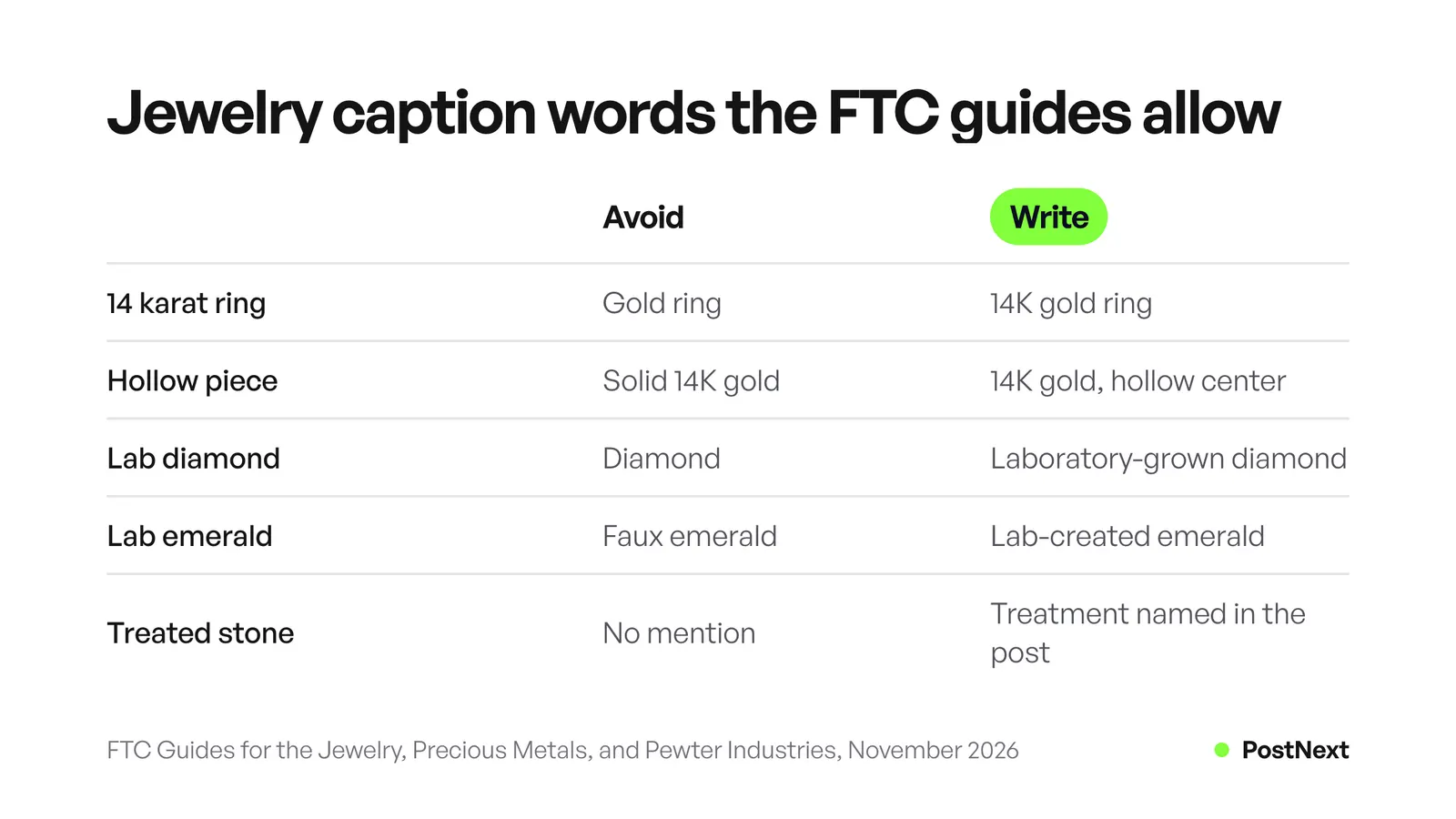
The guides are FTC guidance, not a law with fines of its own. The FTC says it may act under the FTC Act when a claim goes against them, so most US jewelers treat them as the rulebook. Here is how they apply to common caption lines.
| A caption says | Allowed under the Jewelry Guides? | Why |
|---|---|---|
| ”Gold ring” for a 14 karat piece | No | ”Gold” alone means 24 karat gold throughout |
| ”14K gold ring” | Yes | The karat comes right before “gold”, as visible as the word |
| ”Solid 14K gold” for a hollow piece | No | A hollow piece must say “hollow” and cannot be called solid |
| ”Gold plated” with no karat | No | Plate and filled pieces need the karat of the gold layer |
| ”Diamond” for a lab-grown stone | No | Lab-grown needs “laboratory-grown” or “laboratory-created” beside the word |
| ”Faux emerald” for a lab stone | No | The FTC says “faux” is not an adequate disclosure |
| ”Real” or “natural” for a lab stone | No | These words cannot describe an artificially made product |
| ”Lab-grown sapphire” | Yes | The label sits right before the stone name |
FTC Guides for the Jewelry, Precious Metals, and Pewter Industries, 16 CFR Part 23, sections 23.0, 23.3, 23.12, 23.25 and 23.27 (eCFR, current text), checked November 2026. This is a summary, not legal advice.
What this means for the posts a jeweler makes:
A Reel with text on screen. If the screen says “gold” or “diamond”, the karat or the lab-grown label goes on screen too, in the same size. The guides ask for “equal conspicuousness”, so a small line in the caption under a big on-screen word falls short.
Treated stones. Section 23.24 says to disclose a treatment when it is not permanent, when it creates special care needs, or when it has a significant effect on value. For a shop, a sale can disclose this at the counter. For anything sold online without seeing the piece, the FTC says the disclosure goes “in the solicitation for, or description of, the product”. If a post links to a buy page, put it there and in the post.
“Cultured” diamonds. The guides allow “cultured” for a lab-grown diamond only with a clear disclosure such as “laboratory-grown”. Use the plain label first; most buyers do not know what “cultured” means.
Imitation stones. Words like “stone”, “gem” or “birthstone” on a lab-made or imitation piece need “laboratory-created”, “imitation” or “simulated” right before them.
Outside the US, check your own country’s rules on metal and stone descriptions before you copy these examples.
How often should a jeweler post?
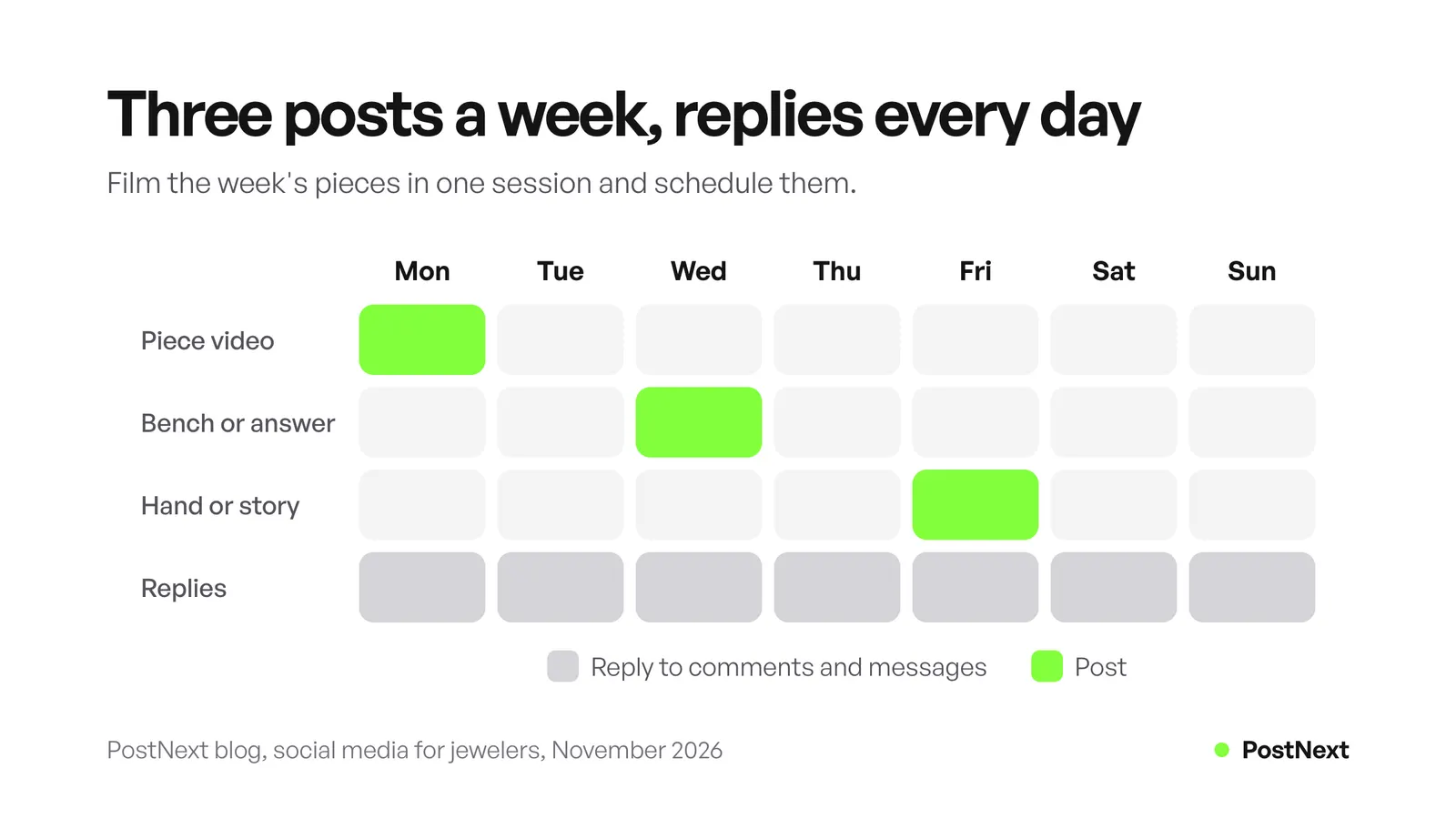
Three posts a week is a rhythm most small jewelers can keep all year. Buffer’s study of more than 100,000 users found accounts that posted in 20 or more of 26 weeks got 450% more engagement per post than accounts that posted in 4 weeks or fewer. Steady weeks matter more than a big launch week.
The calendar for jewelers has clear peaks: the run-up to Christmas, Valentine’s Day and Mother’s Day. Post gift and engagement pieces six to eight weeks before each peak, not in the last week, because custom work and resizing take time.
A week that works for a small shop:
- Monday: a 10-second piece in daylight.
- Wednesday: the bench, or an answer to a buyer question.
- Friday: a piece on the hand, or a commission story.
- Every day: reply to comments and messages within a day.
Film the week’s pieces in one session, on a bright morning, and schedule them. A jeweler who films only when there is a free moment posts in bursts and goes quiet in December, which is the month that matters most.
How should a jeweler share customer and proposal photos?
Share customer and proposal photos only with written permission from the people in them, and from the photographer when someone else took the picture. In the US, copyright in a photo belongs to the person who took it, unless a written agreement says otherwise. A couple who sends you their proposal photos may not own the right to let you post them.
A short process prevents problems:
- Ask at the sale. Add one line to the order form: may we share photos of your piece, and may we show your hands or face?
- Ask the photographer. For a professional proposal or wedding shoot, ask the photographer for permission and credit them by name in the post. Wedding planners face the same rule with every wedding they post.
- Keep private details out. No full names, ring sizes linked to a person, prices paid, addresses or proposal locations unless the customer asks for them.
- Credit the original post. When a customer posts your piece, follow our guide on how to repost on Instagram for credit and permission.
The same goes for creators. The FTC says a free or discounted piece is a material connection, and the creator must disclose it in the post, in plain words such as “Thanks to [shop] for the free necklace”.
How do product photos and video fit together?
Use clean product photos for your website and shop listings, and real video for social media. The two do different jobs. A listing photo on white helps a buyer compare pieces side by side. A feed post has to stop someone who was not shopping, and a stone moving in daylight does that better than a still.
Most jewelers already have a stock of product photos. Use them as the second slide of a carousel, after a video or an on-hand shot, or as the image for a shop update. When you need more product shots, such as a piece on a styled background for a holiday post, tools for generating visuals can make them from your own photos. Keep the metal colour and the stone true to the real piece. A buyer who receives something different from the picture will say so in a review.
Product tags and Collab invites on Instagram are added in the Instagram app, so add them there on posts that show a piece you have in stock.
How does PostNext help a jeweler?
PostNext for jewelers lets a jeweler plan a month of posts in one sitting and publish each one at its time. It posts to Instagram, TikTok, YouTube, LinkedIn, X, Threads and Bluesky from one calendar. The Instagram scheduler publishes feed posts, Reels, image Stories and carousels of 2 to 10 photos or videos.
What fits a jeweler’s week:
- One clip, three channels: upload a 10-second piece once and post it as a Reel, a TikTok and a YouTube Short, each with its own caption.
- Repeat posts: a monthly post such as “free cleaning on Saturdays” can repeat every 1 to 365 days, weeks or months.
- Comments: the Instagram comment inbox lets you read and reply to comments in one place, on every plan. It does not cover direct messages.
What PostNext does not do today: it does not post to Pinterest or Facebook (both are listed as coming soon), and Instagram product tags and Collab invites are added in the Instagram app. It does not run paid ads. The free plan covers 1 channel, 10 posts and 10 AI credits a month; see pricing for the paid plans.
Frequently Asked Questions
What is the best social media platform for jewelers?
Instagram is the best fit for most jewelers, because buyers judge pieces by photo and short video. Pew’s 2026 survey found 51% of US adults use Instagram, including 56% of women and 79% of adults aged 18 to 29. Add TikTok for making-of video and Facebook for local customers.
Can I call a 14 karat ring “gold” in a post?
Only with the karat in front of it. The FTC Jewelry Guides say “gold” without a karat means 24 karat gold. Write “14K gold” or “14 karat gold”, with the karat as easy to see as the word gold, in the caption and on screen.
How do I describe lab-grown diamonds on social media?
Put “laboratory-grown”, “laboratory-created” or “lab-grown” right before the word diamond, every time it appears. The FTC says lab-made stones cannot be called “real”, “genuine” or “natural”, and that “faux” does not tell buyers the stone was not mined.
Do I need to disclose gemstone treatments in a post?
Yes, when a buyer can order from the post or the page it links to. The FTC says to disclose a treatment that is not permanent, needs special care or changes the value, and to put it in the product description when buyers cannot see the piece in person.
How often should a jewelry store post on Instagram?
Three posts a week is enough for most stores, if you keep it up every week. Buffer’s study found accounts that posted in 20 or more of 26 weeks got 450% more engagement per post than those that posted in 4 weeks or fewer.
Can I post photos a customer sends me?
Ask first, in writing. The customer must agree, and if a professional photographer took the photos, the photographer usually owns the copyright, so ask them too and credit them in the post.
Sources
- Federal Trade Commission, Guides for the Jewelry, Precious Metals, and Pewter Industries, 16 CFR Part 23 (eCFR, current text), checked November 2026.
- Federal Trade Commission, Disclosures 101 for Social Media Influencers, checked November 2026.
- US Copyright Office, Circular 1: Copyright Basics, checked November 2026.
- Pew Research Center, Social Media Fact Sheet, 5,511 US adults, survey January to June 2026, checked November 2026.
- BrightLocal, Local Consumer Review Survey 2026, 1,002 US adults, published February 2026, checked November 2026.
- Buffer, Consistent Posting Study (buffer.com/resources/consistent-posting-study), January 2025, checked November 2026.
- PostNext pages read November 2026: Instagram channel, automation, pricing.