Social media for hotels works when it sends people to book on your own website. Most guests compare hotels on booking sites, then look the hotel up by name before they pay. Your posts are what they find. This PostNext guide covers which channels to use, who should run them, how to count bookings from posts, and the US price rule that applies to any post with a nightly rate.
Key Takeaways
- Social media is where guests check you: 97% of US consumers read reviews for local businesses, and your feed sits next to them in a search.
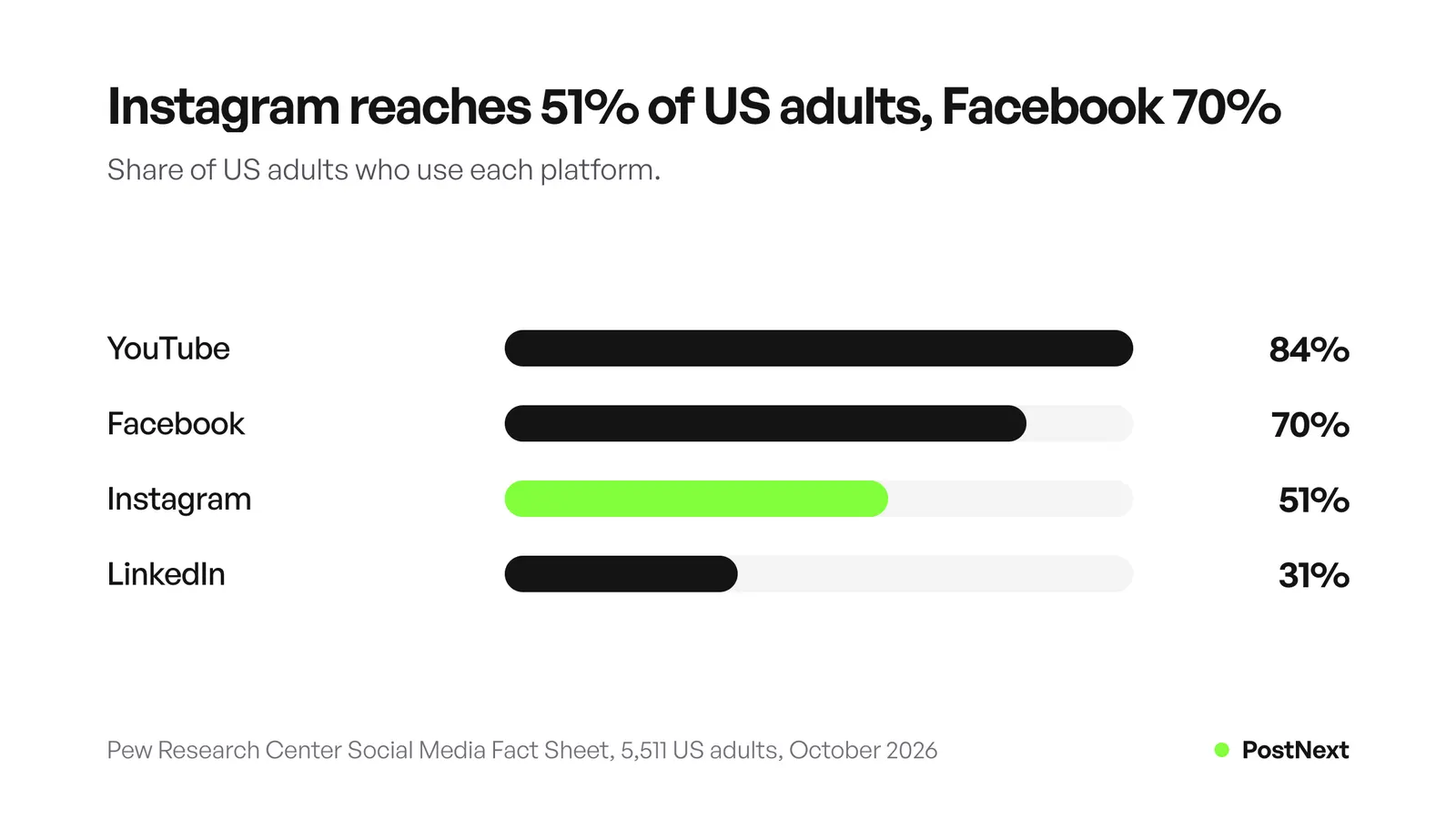
- Pick two or three channels: Pew’s 2026 survey found 84% of US adults use YouTube, 70% Facebook and 51% Instagram.
- One person owns the feed, three people check it: the front desk checks access, the kitchen checks hours, the revenue team checks every rate.
- A post with a nightly rate must show the total price: the FTC’s fees rule (in force since May 12, 2025) says mandatory fees such as a resort fee go into that price.
- No offers on Google Business Profile: Google says hotels can’t create offer posts or posts that mention deals or discounts.
- Creator stays need a disclosure: a free or discounted stay is a material connection the creator must state in the post.
- Count bookings, not likes: tag every link with 3 UTM fields and read the visits in Google Analytics.
Why should a hotel use social media?
A hotel should use social media to win the guest who already likes the place but has not booked yet. Many guests find hotels on booking sites, then search the hotel’s name before they decide where to pay. Your posts, reviews and replies are what they see. A clear feed with a reason to book direct turns that search into a booking on your site.
That makes the goal narrow. You do not need to go viral, and you do not need to beat the booking sites at their own job. You need three things in place when someone searches your name: recent photos that match the rooms as they are today, answers to the questions guests ask, and a link to your own booking page.
Reviews carry most of the weight in that check. BrightLocal’s 2026 survey of 1,002 US adults found 97% read reviews for local businesses, and 89% expect owners to respond to them. A hotel feed that shows real rooms, and a review page full of thoughtful owner replies, make the same case from two sides.
There is a fair argument against heavy effort here. A small hotel with a full summer and a busy front desk may get more from a tidy Google profile and fast review replies than from daily posts. Start there, then add a posting plan you can keep for a year.
Which social media platforms should hotels use?
Most hotels need Instagram for photos and short video, Facebook for local guests and events, and a Google Business Profile for people who search by name. Add YouTube or TikTok if someone can film short video every week, and LinkedIn if you sell meetings and company stays. Two or three active channels beat five that went quiet.
| Channel | Best job for a hotel | Who it reaches |
|---|---|---|
| Rooms, views, food, Reels of a stay | 51% of US adults (Pew, 2026) | |
| Events, local guests, reviews, groups | 70% of US adults (Pew, 2026) | |
| YouTube | Room tours, the walk from the station, longer video | 84% of US adults (Pew, 2026) |
| Google Business Profile | Hours, photos, updates and events for name searches | People who search the hotel by name |
| Meeting rooms, group rates, team hires | 31% of US adults (Pew, 2026) | |
| TikTok | Short video of the stay and the area | Use only if you can film every week |
Pew Research Center Social Media Fact Sheet, published October 2026 (5,511 US adults), checked November 2026. Google Business Profile rules from Google’s own help pages.
Choose by the guest you want more of. A city hotel that sells midweek rooms to companies needs LinkedIn more than TikTok. A beach hotel that fills weekends needs Instagram Reels and Facebook. If guests often ask how to reach you, a YouTube video of the route from the airport answers that question for years.
Who should run a hotel’s social media?
One named person should own the hotel’s social media, with three people who check facts before posts go out. The owner plans the month, takes or collects the photos, writes the captions and replies to comments. The front desk checks arrival and access details, the kitchen checks hours and menus, and the revenue team checks every rate and offer.
The split matters more in a hotel than in most businesses, because so many posts carry facts that change. Breakfast hours move with the season. A package price changes when demand changes. A post that shows last month’s rate is a complaint at check-in.
A simple setup for a small team:
- The owner of the feed (often the marketing manager, front office manager or the hotel owner) plans the month on one day and schedules what is confirmed.
- The fact checkers get the draft posts once a week, not one at a time, and answer in one reply.
- The front desk passes on questions guests ask in person. Those questions are next month’s posts.
If an agency runs the feed, keep the rate check in-house. The agency writes the post; your revenue team approves the number. Our guide to the content approval process shows how to set up roles so nothing goes out unchecked.
How can social media bring direct bookings instead of OTA bookings?
Social media brings direct bookings when every post leads to your own booking page and gives a reason to book there. Online travel agencies (OTAs) such as large booking sites own the comparison. You own the place, the people and the extras. Posts that show what only a direct guest gets give the searcher a reason to book with you.
Reasons that work in a post:
- What a direct booking includes: breakfast, late checkout, parking, a room choice, if your terms allow it. Write the exact terms on the page the post links to.
- A package you can only book with you: dinner and a room, a spa morning, a local event. Name the dates.
- Answers before booking: pets, accessible rooms, connecting rooms, shown with real photos.
Keep the link simple. Put your booking page in the profile, and send each post to the exact room or package page, not the home page. When people ask about prices in Instagram comments, you can invite them to comment a word and send the rates page to everyone who comments in a direct message.
For what to post at each step before a stay, use our list of hotel social media post ideas, sorted by booking stage. This guide covers the plan around those posts.
What must a hotel post show when it gives a price?
In the United States, a hotel post that shows a nightly rate must show the total price, with every mandatory fee included. The FTC’s Rule on Unfair or Deceptive Fees (16 CFR Part 464) has applied to short-term lodging since May 12, 2025. It covers ads and offers anywhere, including social posts. Taxes and government charges may come later, before payment.
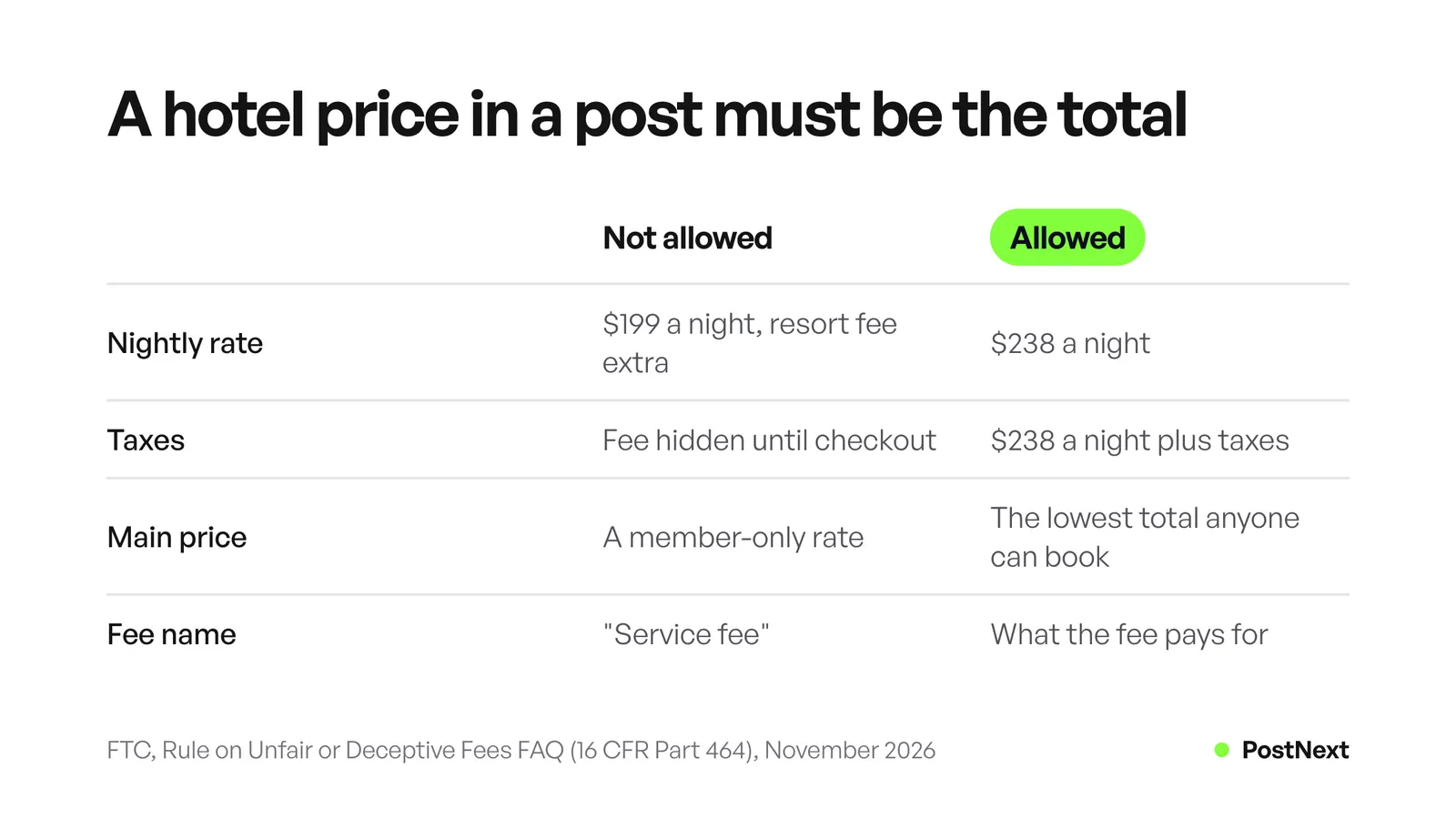
The FTC’s own guide gives the hotel example: a resort charges a nightly rate of $199 plus a mandatory resort fee of $39 a day. The resort fee “must be included in the total price”. So a post can say $238 a night. It cannot say $199 with the resort fee in small print, or “from $199” if no guest can book at that price.
| A post says | Allowed under the fees rule? | Why |
|---|---|---|
| ”$238 a night” ($199 rate + $39 resort fee) | Yes | The total price includes the mandatory fee |
| ”$199 a night, resort fee extra” | No | A mandatory fee is left out of the price |
| ”$238 a night plus taxes” | Yes | Taxes and government charges may be shown later, before payment |
| A member-only rate as the main price | No | A discount not open to everyone cannot be the total price |
| ”50% off midweek stays” with no price | Yes | A general discount without a price does not need a total |
| ”Lowest rate $238” for a room you can book at $238 | Yes | The lowest total may be shown if guests can book it |
FTC, The Rule on Unfair or Deceptive Fees: Frequently Asked Questions (small entity compliance guide, published May 2025), checked November 2026. This is FTC staff’s view, not legal advice.
What this means for the posts a hotel makes:
A Reel or video with a price on screen. The FTC says a disclosure must appear in the same way as the ad. If the price is on screen, the total must be on screen, large enough to read and long enough to notice. If the price is spoken, say the total.
A carousel for a package. Put the total on the first slide that names a price, and make it the most prominent price. You may list the parts (room, resort fee) under it, but the parts cannot be bigger than the total.
A caption with “from” pricing. Use the lowest total that a guest can book on the dates the post covers. When the post runs across a region with different prices, the FTC says to show the highest total for that area.
A fee with a vague name. The FTC says to describe what a fee is for and avoid names like “service fee” or “convenience fee”. An “environmental fee” that does not fund environmental work is its own example of a misrepresentation.
The rule is enforced with refunds and civil penalties, so this is one check the revenue team should own. State laws may add more: the FTC says businesses must follow both the rule and any state law that protects guests more. Outside the US, check your own country’s price rules before you copy these examples.
Two other rules catch hotel posts. Google’s Business Profile policy says hotels “can’t create ‘offer’ posts, or any post that mentions or includes links to deals, promotions, special offers, or discounts” (checked November 2026). Keep packages for Instagram, Facebook and your website. And the FTC’s guide for influencers says a free or discounted stay is a material connection that the creator must disclose in the post itself, not only in a profile or a group of hashtags.
How often should a hotel post on social media?
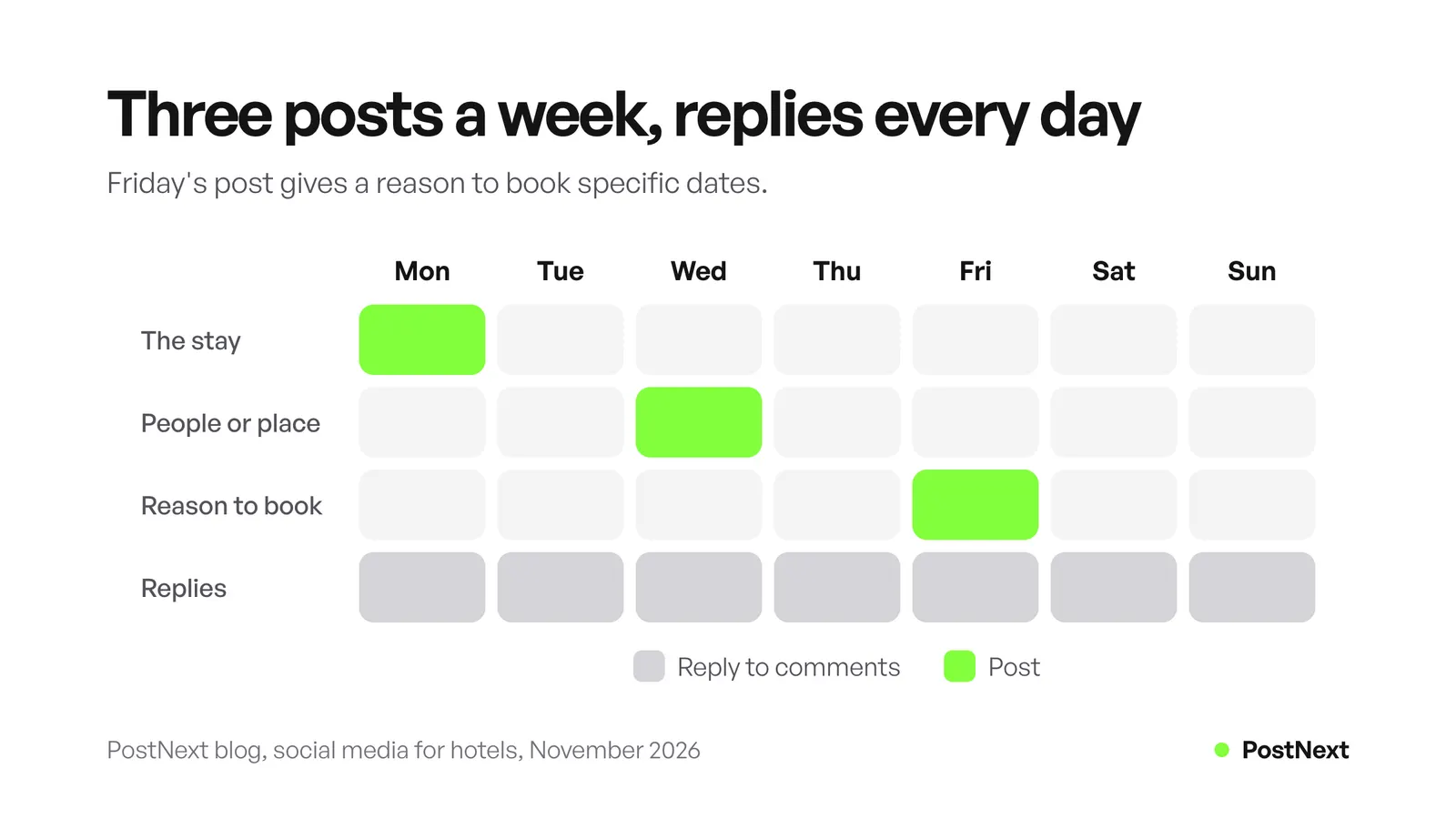
Three posts a week on each main channel is enough for most hotels, every week of the year. Buffer’s study of more than 100,000 users found accounts that posted in 20 or more of 26 weeks got 450% more engagement per post than accounts that posted in 4 weeks or fewer. Steady weeks matter more than busy days.
The hard part for a hotel is the season. The feed goes quiet in the busiest months, because the team is busy with guests. That is the time to post for the quiet months ahead. Plan two months at a time, take photos on a quiet morning, and schedule posts before the rush.
A week that a small team can keep:
- Monday: a post about the stay, such as a room, the view or breakfast.
- Wednesday: the people or the place around you, such as a staff tip or a local walk.
- Friday: a reason to book specific dates, with the total price if you show one.
- Every day: reply to comments, messages and new reviews.
How should hotels work with creators and influencers?
Work with creators whose followers match the guests you want, agree the terms in writing, and make the disclosure part of the deal. A creator stay is a trade: a free or discounted room for posts. The FTC says that trade is a material connection, so the creator must say so in the post, in plain words, where people will see it.
Put these points in a short written agreement before the stay:
- What the creator gets: the nights, the meals, any fee.
- What you get: how many posts, on which channels, and by which date.
- The disclosure: a plain line in the post, such as “Thanks to the hotel for the free stay”. The FTC calls tags like “sp”, “spon” or “collab” too vague.
- Who can use the content: whether you may repost the photos and videos on your own channels, and for how long.
- Other guests: no faces of other guests, room numbers or booking screens in the frame.
Ask for the creator’s audience numbers before you agree, not after. A creator with a smaller following in your city may send more bookings than a large account whose followers live far away. Reposting needs the same care as with guests; see our guide on how to repost on Instagram for credit and permission.
How should hotels handle reviews and messages?
Reply to every review and every message, within a day, in your own words. BrightLocal’s 2026 survey found 89% of consumers expect owners to respond to reviews, and 80% are likely to use a business that responds to all of its reviews. A hotel guest reads the replies to the bad reviews most closely.
Write each reply by hand. BrightLocal found 50% of consumers are put off by templated replies. Thank the guest by name, mention the thing they wrote about, and keep it short. For a complaint, apologise once, say what you changed, and offer a direct contact. Never argue in public, and never share booking details in a reply. Answer comments such as “is parking free?” the same day, and add the answer to the page your posts link to.
How do you measure bookings from hotel social media?
Measure social media by the visits and bookings it sends to your website, not by likes. Add UTM tags to every link in your profiles and posts, then read the visits in Google Analytics. Google Analytics reads utm_source, utm_medium and utm_campaign on a link and shows the visits in its Traffic acquisition report.
A simple naming rule keeps the reports clean:
- utm_source: the channel, such as
instagramorfacebook. - utm_medium:
socialfor posts,biofor the profile link. - utm_campaign: the reason, such as
spring-packageormidweek.
If your booking engine sends the booking back to Google Analytics, you can see bookings by campaign too. If it does not, ask your booking engine provider how to track bookings, and in the meantime compare visits by campaign with the bookings you take for that package. Ask guests at check-in how they found you, and note the answer for a month. Together, those numbers show which posts fill rooms.
How does PostNext help a hotel?
PostNext for hotels lets a hotel team plan a month of posts, have the facts checked and publish each one at its time. It posts to Instagram, TikTok, YouTube, LinkedIn, X, Threads and Bluesky from one calendar. The Instagram scheduler publishes feed posts, Reels, image Stories and carousels of 2 to 10 photos or videos.
What fits a hotel’s way of working:
- Approvals: on the Teams plan, a post can go to a reviewer before it is scheduled, which suits the revenue team checking every rate. See collaboration for roles and one workspace per client.
- Repeat posts: a weekly post, such as breakfast hours, can repeat every 1 to 365 days, weeks or months.
- Comments: the Instagram comment inbox lets you read and reply to comments in one place, on every plan. It does not cover direct messages.
- LinkedIn: PostNext posts to personal profiles only, not Company Pages, so a sales manager can post meeting-room news from their own profile.
PostNext does not post to Facebook or Google Business Profile today; both are listed as coming soon. Schedule those in Meta’s and Google’s own tools for now. PostNext also does not run paid ads or connect to booking engines. The free plan covers 1 channel, 10 posts and 10 AI credits a month; see pricing for the paid plans.
Frequently Asked Questions
What is the best social media platform for hotels?
Instagram suits most hotels best, because guests choose a stay by photos and short video. Pew’s 2026 survey found 51% of US adults use Instagram and 70% use Facebook. Keep a Google Business Profile current for people who search the hotel by name, and add LinkedIn if you sell meetings.
Can a hotel show a nightly rate on social media?
Yes, if the rate is the total price. In the US, the FTC’s fees rule says mandatory fees such as a resort fee must be in the price shown. Taxes and government charges can come later, before payment. A rate open only to members cannot be the main price.
Does the FTC fees rule apply to Instagram posts?
Yes. The FTC says the rule covers any business that offers, displays or advertises short-term lodging, online or offline. A social post that shows a price for a room is an ad for that room. The disclosure must appear in the same way as the price, on screen if the price is on screen.
How many times a week should a hotel post?
Three times a week on each main channel is a rhythm most hotel teams can keep. Buffer’s study found accounts that posted in 20 or more of 26 weeks got 450% more engagement per post than those that posted in 4 weeks or fewer.
Can a hotel post offers on Google Business Profile?
No. Google’s policy says hotels can’t create offer posts, or any post that mentions or links to deals, promotions, special offers or discounts. Hotels can post updates and events. Put packages on Instagram, Facebook and your own website instead.
Do influencers have to say a hotel stay was free?
Yes, in the United States. The FTC says a free or discounted stay is a material connection, and the creator must disclose it in the post where people will see it. A plain line such as “Thanks to the hotel for the free stay” works.
Sources
- Federal Trade Commission, The Rule on Unfair or Deceptive Fees: Frequently Asked Questions, published May 2025, checked November 2026.
- Federal Trade Commission, Disclosures 101 for Social Media Influencers, checked November 2026.
- Google Business Profile Help, photos, videos and posts content policy, hotel posts, checked November 2026.
- Google Analytics Help, Collect campaign data with custom URLs, checked November 2026.
- Pew Research Center, Social Media Fact Sheet, published October 2026 (5,511 US adults), checked November 2026.
- BrightLocal, Local Consumer Review Survey 2026, 1,002 US adults, published February 2026, checked November 2026.
- Buffer, Consistent Posting Study (buffer.com/resources/consistent-posting-study), January 2025, checked November 2026.
- PostNext pages read November 2026: Instagram channel, automation, collaboration, pricing.