Social media for butchers works when it teaches people what to buy and how to cook it. Post the case each week, show one cut with how to cook it, open holiday preorders early, and answer questions with your knowledge. This PostNext guide gives the weekly plan, a holiday preorder calendar, the USDA cooking temperatures to quote, and the label words that need care in a post.
Key Takeaways
- Teach one cut a week: a short video of a cut and how to cook it is the post supermarkets cannot make.
- Quote the USDA temperatures: steaks, chops and roasts are safe at 145°F with a 3-minute rest, ground meat at 160°F and poultry at 165°F.
- Use label words the USDA way: “natural” means no artificial ingredients or added color and only minimal processing.
- Never write “no hormones” for pork or poultry alone: the USDA says it must be followed by “Federal regulations prohibit the use of hormones.”
- Open preorders early: post turkey and holiday roast preorders weeks before the date.
- Reviews decide the first visit: 97% of US consumers read reviews for local businesses (BrightLocal, 2026).
- Facebook reaches the most adults: 70% of US adults use Facebook, 51% use Instagram (Pew Research Center, 2026).
Does social media work for a butcher shop?
Social media works for a butcher shop because it shows what a supermarket counter cannot: the person who cuts the meat, the cuts that are hard to find elsewhere, and how to cook them. A shopper who sees a tri-tip explained on Thursday comes in for one on Saturday. BrightLocal’s 2026 survey found 97% of US consumers read reviews for local businesses, so your reviews and your posts work together.
A butcher’s real product is knowledge. People walk in unsure which cut to buy for a slow cook, how thick to cut a steak, or how much meat to order for twelve guests. Every one of those questions is a post. A feed that answers them builds the trust that turns a one-time visitor into a regular.
Butcher shops also sell on seasons and events. Grilling weekends, Thanksgiving turkeys, holiday roasts and game days drive orders that the shop needs to plan and the customer needs to book. Social media is where you open those orders and remind people before the deadline.
Which social media platforms should a butcher use?
A butcher should use Facebook and Instagram first, and Google Business Profile for hours, reviews and preorder links. Pew Research Center’s 2026 survey found 70% of US adults use Facebook, 51% use Instagram and 84% use YouTube. Facebook reaches 78% of adults aged 30 to 49 and 71% of those aged 50 to 64, the households that buy for family meals and holidays.
| Platform | US adults who use it (2026) | Best use for a butcher shop |
|---|---|---|
| 70% (78% of ages 30-49, 71% of ages 50-64) | Weekly specials, holiday preorders, posts families share | |
| 51% (64% of ages 30-49) | The case, cut-of-the-week Reels, cooking tips | |
| YouTube | 84% | Longer butchery and cooking videos, Shorts from the same clips |
| TikTok | 37% (65% of ages 18-29) | Optional; cutting videos for younger customers |
| Google Business Profile | Not a social network | Hours, reviews, photos, order links |
Source: Pew Research Center, Americans’ Use of Social Media in 2026, published October 2026.
Start where your regulars are. A neighborhood shop with families as customers gets most from Facebook and Google. A shop selling dry-aged steaks to food lovers can grow on Instagram and YouTube. One cutting video can go to all three video platforms.
What should a butcher post each week?
A butcher should post the case, one cut explained, a cooking tip and the people behind the counter each week. The cut-of-the-week video is the core post: show the cut, say what it is good for, and give one cooking tip with a safe temperature. Add the weekend special on Thursday and a photo of the full case when it is freshly stocked.
| Day | Post type | Example |
|---|---|---|
| Monday | Cut of the week | A 30-second Reel: the cut, where it comes from on the animal, how to cook it |
| Wednesday | Cooking tip | ”How long to rest a roast” with the USDA rest time |
| Thursday | Weekend special | Photo of the special with price and how long it lasts |
| Saturday | The case or the team | The freshly stocked case, the butcher breaking down a side |
| Seasonal | Preorder | ”Turkey preorders open,” with the order deadline |
An example plan built from the post types above. Move the days to fit your deliveries.
Customer questions make the best topics. Keep a list at the counter for two weeks: which cut for stew, how much brisket for ten people, how to cook a pork shoulder. Each answer is a short video. Our list of Instagram Reel ideas has more formats you can film behind the counter.
Which cooking temperatures should a butcher post?
A butcher should post the USDA’s safe minimum internal temperatures, because customers search for them and trust a butcher who gets them right. The USDA Food Safety and Inspection Service lists 145°F with a 3-minute rest for beef, pork, veal and lamb steaks, chops and roasts, 160°F for ground meats, and 165°F for poultry. Quote them exactly and link to the chart.
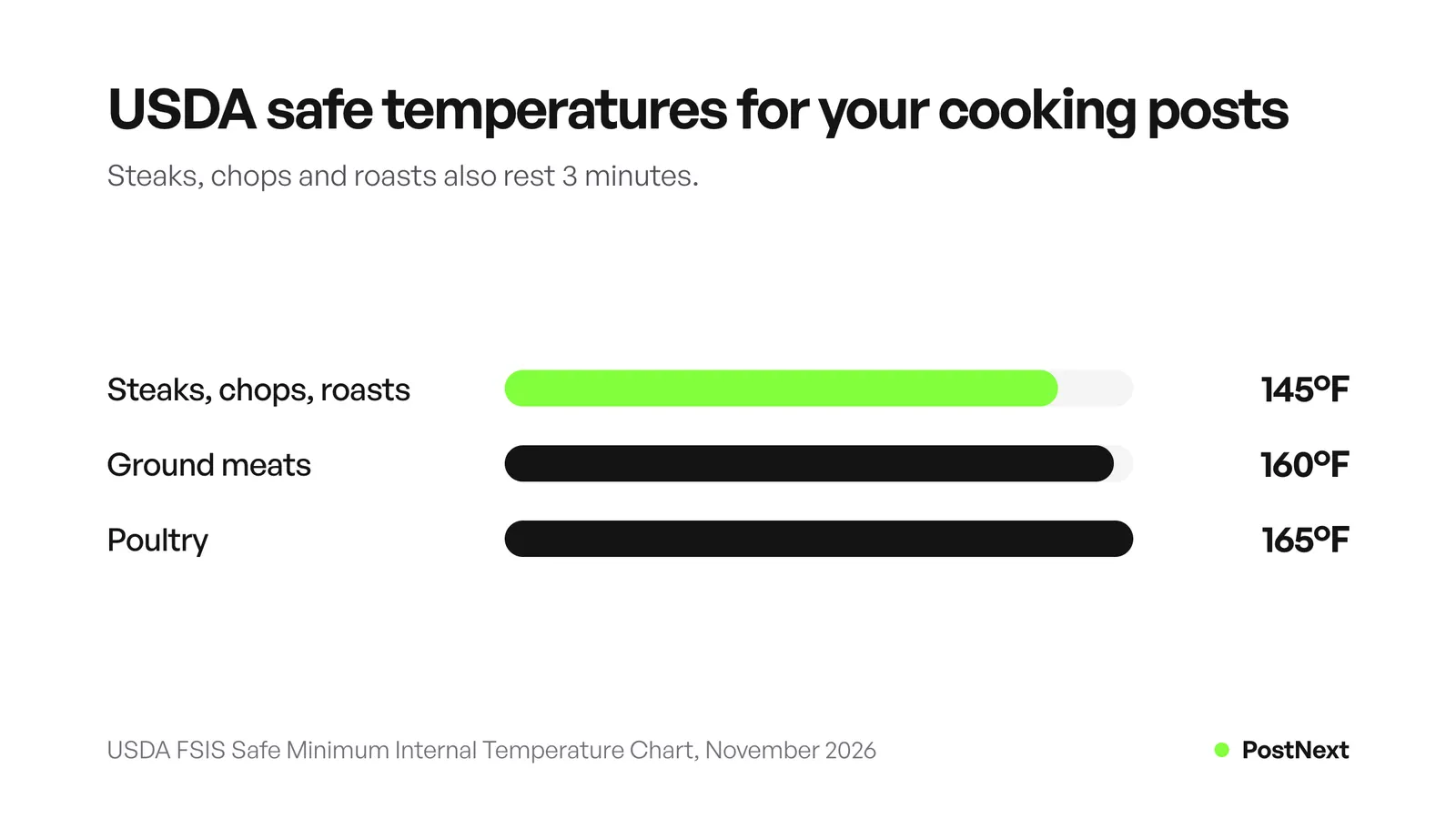
| Meat | USDA safe minimum internal temperature | Rest time |
|---|---|---|
| Beef, pork, veal and lamb steaks, chops and roasts | 145°F (62.8°C) | At least 3 minutes |
| Ground meats | 160°F (71.1°C) | None listed |
| Poultry | 165°F (73.9°C) | None listed |
Source: USDA Food Safety and Inspection Service, Safe Minimum Internal Temperature Chart, read November 2026.
Pair every cooking tip with the right temperature, and tell people to use a food thermometer. A post that says “pull the pork chop at 145°F and rest it 3 minutes” is more useful, and safer, than “cook until done.” When customers ask for rare steak, explain that it is their choice. Keep your own posts on the USDA numbers.
Which meat label words need care in a social media post?
Label words such as “natural,” “no hormones” and “fresh” have USDA definitions, so use them in posts the way the USDA defines them. The USDA Food Safety and Inspection Service says “natural” means no artificial ingredient or added color and only minimal processing. It says “no hormones added” cannot be used for pork or poultry unless followed by “Federal regulations prohibit the use of hormones.”
| Word | What the USDA says | How to use it in a post |
|---|---|---|
| Natural | No artificial ingredient or added color, only minimally processed; the label must explain the term | ”Natural: no artificial ingredients, minimally processed” |
| No hormones (pork or poultry) | Cannot be used unless followed by “Federal regulations prohibit the use of hormones” | Add that sentence every time, or leave the claim out |
| No hormones administered (beef) | May be approved when the producer documents that no hormones were used | Use it only for beef your supplier documents |
| No antibiotics added | May be used when the producer documents the animals were raised without antibiotics | Use it only with your supplier’s documentation |
| Fresh (poultry) | Never below 26°F | Do not call frozen-and-thawed poultry fresh |
| Organic | Set by the USDA National Organic Program | Use it only for certified organic products |
Source: USDA Food Safety and Inspection Service, Meat and Poultry Labeling Terms, read November 2026.
These rules are written for labels, and a social media post that sells the same meat should match them. A “hormone-free chicken” post makes a claim the USDA would not allow on the package. Keep your supplier’s paperwork for every claim you post, and ask your supplier before you repeat a word from their marketing.
How do you post holiday preorders for a butcher shop?
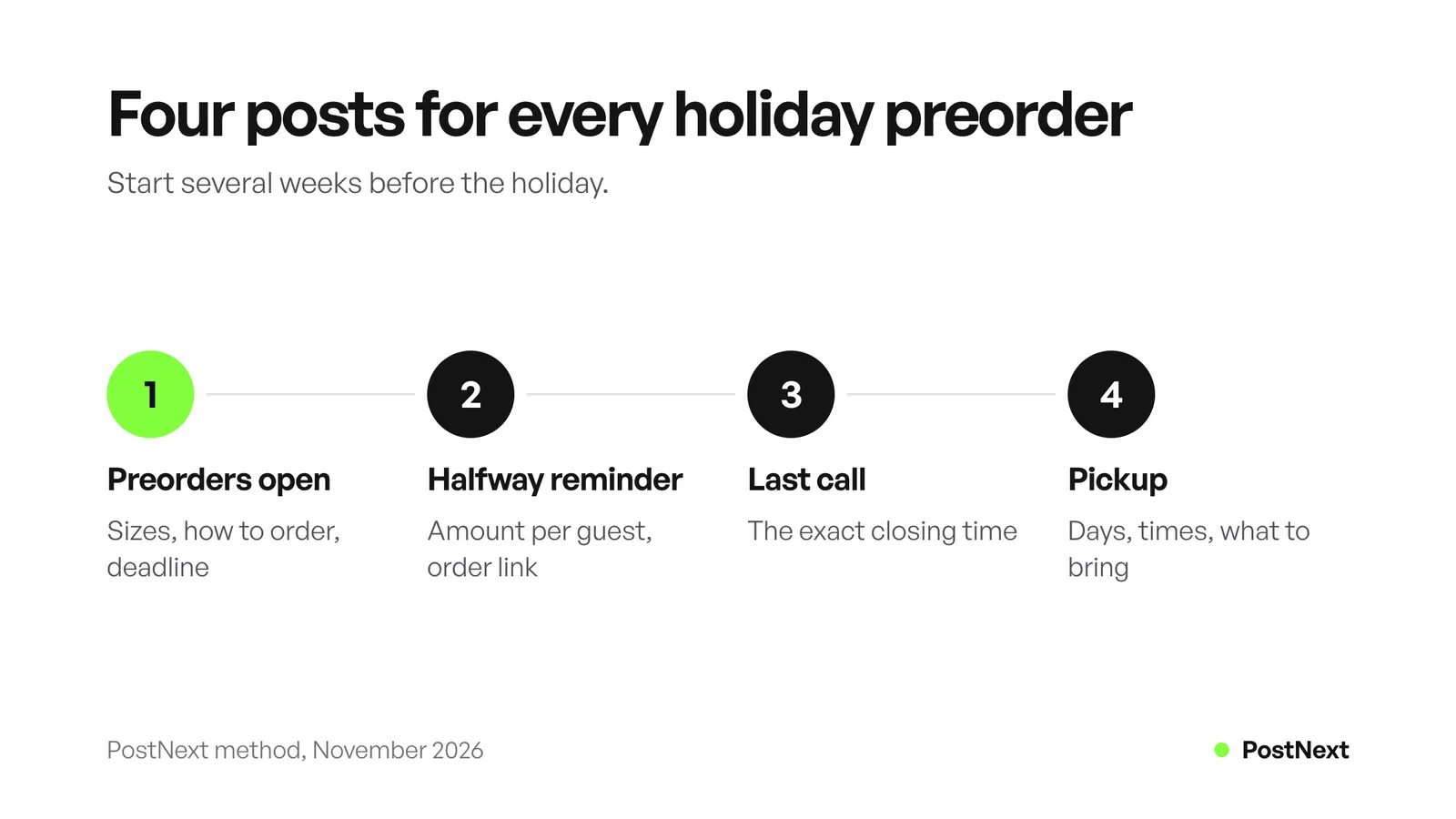
Post holiday preorders in four steps: open the orders, remind people halfway, post a last call before the deadline, and post pickup times. Start several weeks before the holiday, because families plan the main dish early and your supplier needs the numbers. Put the preorder link in your bio, on Facebook and on Google, which allows order links on your Business Profile.
| Step | When | What to post |
|---|---|---|
| 1. Preorders open | Several weeks before the holiday | What you offer, sizes, how to order, the deadline |
| 2. Halfway reminder | About halfway to the deadline | ”How much turkey per guest” guide, link to order |
| 3. Last call | A few days before the deadline | ”Orders close Friday at 6 p.m.” |
| 4. Pickup | The week of the holiday | Pickup days and times, what to bring |
An example sequence. Set the dates from your own supplier deadlines.
Write all four posts when you set the holiday menu and schedule them. Do the same for each big date: Thanksgiving, Christmas, Easter, the Fourth of July and big game days. A shop with five preorder seasons has 20 planned posts a year before it adds a single cut of the week. A link in bio page holds the preorder form, the price list and your hours in one place.
What rules apply to butcher shop reviews?
Google bans rewards for reviews, and the FTC bans buying positive reviews. Google Maps policy says a business may not offer “payment, discounts, free goods and/or services” in exchange for a review, so “a free pound of sausage for a 5-star review” breaks it. Ask every customer for an honest review, for example with a QR code at the register, and give nothing for it.
If you send a local food creator a free box of steaks, the FTC says the creator must disclose that in the post itself, and tags like “sp” or “collab” are too vague. Reply to every review, good or bad, in a calm and short way. A reply that explains how you fixed a problem shows new customers how you treat people.
How does PostNext help a butcher shop?
PostNext lets a butcher plan a month of cut-of-the-week videos, specials and preorder posts in one sitting and publish each at its time. It posts to Instagram, TikTok, YouTube, LinkedIn, X, Threads and Bluesky from one calendar.
On Instagram, it publishes feed posts, carousels, Reels and image Stories.
The automation features repeat a post every 1 to 365 days, weeks or months, which suits a yearly “turkey preorders open” post or a weekly Thursday special. The comment inbox lets you read and answer Instagram comments in one place, on every plan. It sends no direct messages.
Know the limits. PostNext does not post to Facebook or Google Business Profile today; both are marked “Soon” on the pricing page, so post Facebook specials in Meta Business Suite and update Google in your profile for now. The free plan covers 1 channel, 10 posts and 10 AI credits a month, enough for two Instagram posts a week. The PostNext for butchers page shows what the paid plans add.
Frequently Asked Questions
What should a butcher shop post on social media?
Post a cut of the week with how to cook it, a cooking tip with the USDA safe temperature, the weekend special, and the freshly stocked case or the team. Add holiday preorder posts several weeks before each big date, with the order deadline in every post.
Which social media is best for a butcher shop?
Facebook and Instagram for most shops, plus Google Business Profile for hours, reviews and order links. Pew Research Center’s 2026 survey found 70% of US adults use Facebook and 51% use Instagram. Facebook reaches 78% of adults aged 30 to 49.
Can a butcher say meat is hormone-free?
Not for pork or poultry without the USDA’s sentence. The USDA says “no hormones added” cannot be used for pork or poultry unless followed by “Federal regulations prohibit the use of hormones.” For beef, “no hormones administered” may be used when the producer documents it.
What does natural mean on meat?
The USDA says “natural” means a product has no artificial ingredient or added color and is only minimally processed, and the label must explain what the term means. Use the same explanation in a post, for example “Natural: no artificial ingredients, minimally processed.”
When should a butcher open holiday preorders?
Several weeks before the holiday, so families can plan and your supplier gets the numbers in time. Post four times: when orders open, a halfway reminder, a last call before the deadline, and the pickup times.
Can a butcher shop give a discount for a Google review?
No. Google Maps policy bans any reward for a review, including discounts and free products. The FTC also bans buying positive reviews. Ask every customer for an honest review and give nothing in return.
Sources
- USDA Food Safety and Inspection Service, Safe Minimum Internal Temperature Chart and Meat and Poultry Labeling Terms, checked November 2026.
- Pew Research Center, Americans’ Use of Social Media in 2026, 5,511 US adults, published October 2026, checked November 2026.
- BrightLocal, Local Consumer Review Survey 2026, 1,002 US adults, published February 2026, checked November 2026.
- Google, Maps prohibited and restricted content and local business links, checked November 2026.
- US Federal Trade Commission, Consumer Reviews and Testimonials Rule: Questions and Answers and Disclosures 101 for Social Media Influencers, checked November 2026.
- PostNext, Instagram channel page, automation, comment inbox and pricing pages, checked November 2026.