Social media for breweries works best when it follows the beer: brew day, the tank, the can art, release day and the last keg. Post each step of a release, give people a reason to visit the taproom on quiet nights, and keep every post inside the alcohol advertising rules. This PostNext guide gives the release plan, the weekly mix and the TTB, Beer Institute and Meta rules that apply.
Key Takeaways
- The market is shrinking, so the taproom matters more: US craft breweries fell 2.9% to 9,578 in 2025, and craft volume fell 4% (Brewers Association).
- Your feed is an ad to TTB: the federal regulator treats a brewery’s social media page as an advertisement, so its required statements and bans apply.
- Reach adults only: the Beer Institute code asks brewers to place ads where at least 73.8% of the audience is of legal drinking age.
- Meta limits alcohol ads in the US to people 21 or older.
- Plan around releases: five posts per beer, from brew day to the last keg, gives a calendar that writes itself.
- Reviews count before the first visit: 97% of US consumers read reviews for local businesses (BrightLocal, 2026).
Does social media help a brewery sell more beer?
Social media helps a brewery sell more beer by bringing people to the taproom and to release days. The Brewers Association counted 9,578 US craft breweries in 2025, down 2.9% from 2024, and 3,784 taproom breweries. Craft brewer volume fell 4% in 2025 while total US beer production and imports fell 5.7%. In a shrinking market, the beer you sell over your own bar is the beer you control.
A taproom sells an experience as much as a pint. People choose where to spend a Friday evening based on what they see: the new hazy IPA on tap, the food truck outside, the trivia night, the dog-friendly patio. A post that shows those things on Thursday fills seats on Friday.
Breweries also have more to show than most local businesses. Grain bags, steam, steel tanks, can art, a pour with a perfect head: each step of brewing is worth a photo. The job is to plan those moments so they arrive when they sell beer, not only when someone remembers to grab a phone.
Which social media platforms should a brewery use?
A brewery should use Instagram and Facebook first, and Google Business Profile for hours, events and reviews. Pew Research Center’s 2026 survey found 70% of US adults use Facebook, 51% use Instagram and 84% use YouTube. Instagram suits release photos and short taproom videos. Facebook suits events, which are how many breweries fill weeknights.
| Platform | US adults who use it (2026) | Best use for a brewery |
|---|---|---|
| 51% (64% of ages 30-49) | Release photos, can art reveals, taproom Reels, Stories with today’s tap list | |
| 70% (78% of ages 30-49) | Events, trivia and live music nights, food truck schedule | |
| YouTube | 84% | Shorts from taproom clips, a brew day video |
| Google Business Profile | Not a social network | Hours, events, photos and reviews |
Source: Pew Research Center, Americans’ Use of Social Media in 2026, published October 2026.
Be careful with platforms where much of the audience is under 21. Pew’s age group 18 to 29 includes people who cannot legally drink, and 65% of that group uses TikTok. The Beer Institute’s code asks brewers to place advertising where at least 73.8% of the audience is of legal drinking age. If you use TikTok, keep it to brewing process and the team, and read the platform’s own rules on alcohol content first.
What alcohol advertising rules apply to brewery posts?
Three sets of rules apply to most US breweries: TTB’s advertising rules, the Beer Institute’s industry code, and each platform’s alcohol policy. TTB’s Industry Circular 2013-01 says its advertising rules apply to social media and treats a brewery’s page as one advertisement. For malt beverages, TTB’s rules apply where state law sets similar requirements, so check your state’s rules too.
TTB. The circular says the mandatory statements, such as the name and address of the responsible advertiser, must appear on a brewery’s social media page, and the banned statements apply to every post. Short posts do not each need the mandatory statements, but the profile they come from must carry them. Content made by a fan and reposted by the brewery becomes part of the brewery’s advertising. Put your legal name and city in the bio, and read each repost before you share it.
Beer Institute code. Many brewers follow the Beer Institute Advertising and Marketing Code. It asks for placements where at least 73.8% of the audience is of legal drinking age, and for reasonable steps toward age confirmation on brewer-owned social media channels. It also asks that advertising not appeal mainly to people under the legal drinking age.
Meta. Meta’s alcohol ad policy allows alcohol ads in the United States only to people 21 or older. Set the age when you boost a release post or an event.
FTC. If you give a local creator free beer or a free tour for a post, the FTC says the creator must disclose it in the post itself, and tags like “sp” or “collab” are too vague.
What should a brewery post each week?
A brewery should post four kinds of content each week: what is on tap, what is happening in the taproom, how the beer is made, and the people who make it. Keep the tap list current every day with a Story, and plan the feed posts ahead. A weekly rhythm that mixes these four keeps regulars informed and gives new visitors a reason to come.
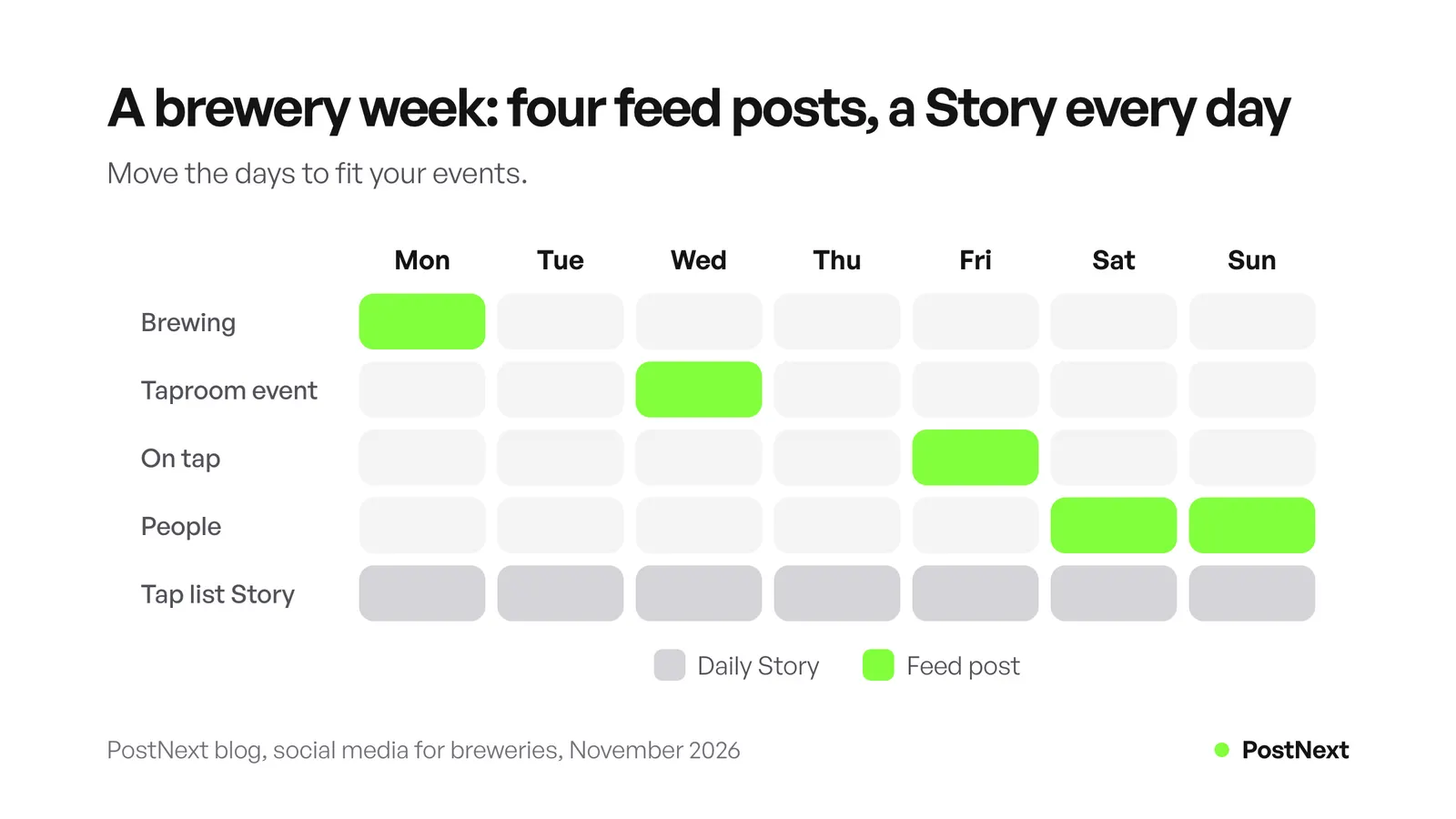
| Day | Post type | Example |
|---|---|---|
| Monday | Brewing | Grain going into the mash tun, a 15-second Reel |
| Wednesday | Taproom event | ”Trivia Thursday, 7 p.m., food truck from 5” |
| Friday | On tap this weekend | Carousel of the four beers on tap with style and strength |
| Weekend | People | The brewer, the bar team, a regular’s 100th pint |
| Daily | Story | Today’s tap list and opening hours |
An example plan built from the post types above. Move the days to fit your events.
Keep the beer claims plain: the style, the alcohol by volume, the hops, the taste. The Beer Institute code asks for no unproven health claims, and no suggestion that people need beer for social, professional, athletic or financial success. Our list of Instagram Story ideas has more formats for a daily tap list.
How do you plan brewery posts around a beer release?
Plan five posts for each new beer: brew day, the beer in the tank, the label or can art reveal, release day, and the last keg or last cans. That sequence builds interest over the weeks a beer spends between the brewhouse and the tap. The release day post then lands with people already waiting for it.
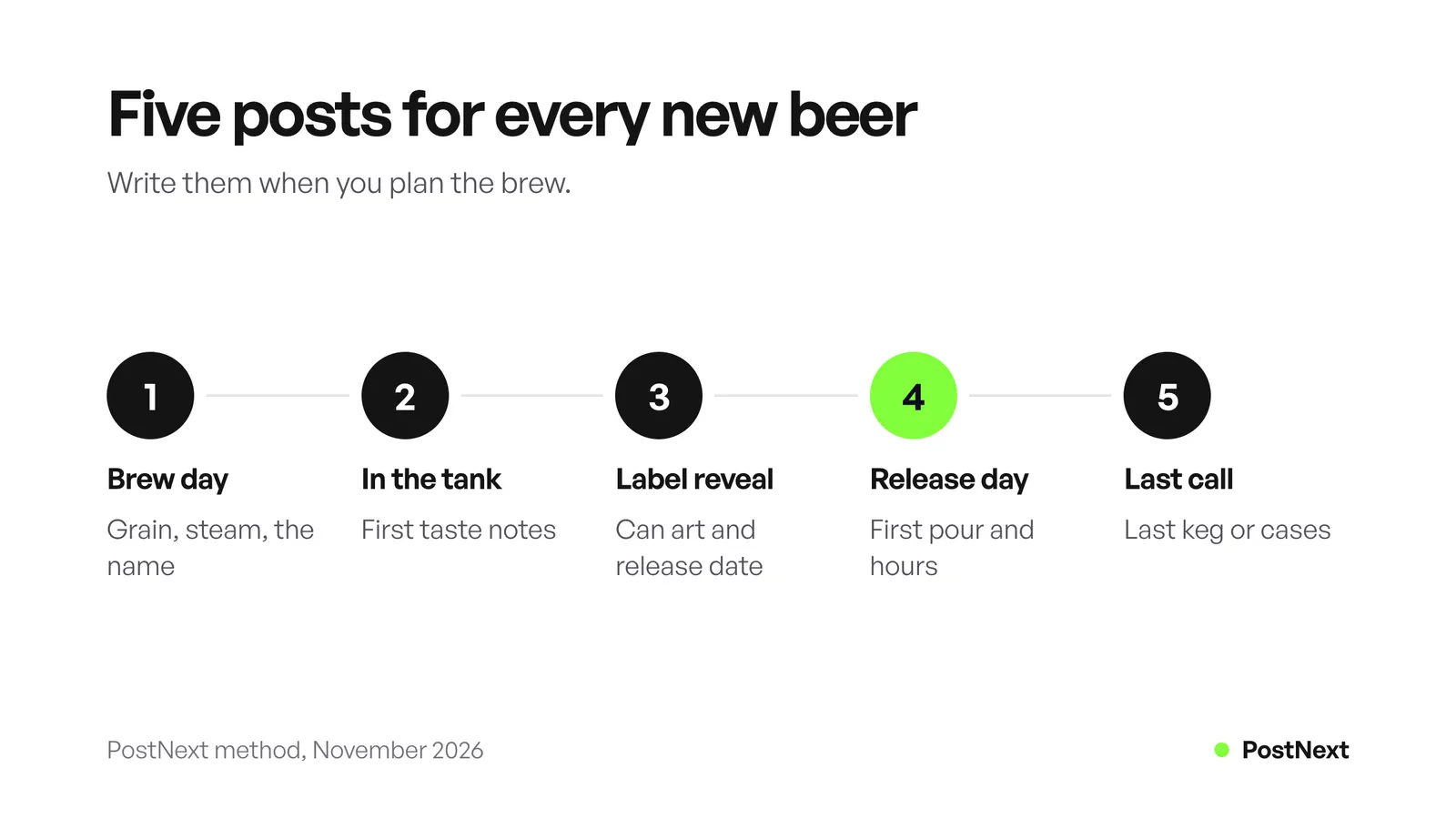
| Step | When | What to post |
|---|---|---|
| 1. Brew day | Day 1 | Grain, steam and the brewer, with the beer’s name |
| 2. In the tank | About a week later | A sample pulled from the tank, the brewer’s first taste notes |
| 3. Label reveal | A few days before release | The can or tap handle art, release date and time |
| 4. Release day | Release day | The first pour, hours, cans to go, food truck |
| 5. Last call | When stock runs low | ”Last keg on tap” or “last cases” |
An example sequence. Set the dates from your own brewing schedule.
Write all five posts when you plan the brew, and schedule them on the dates you expect. If the beer needs another week in the tank, move the last three posts by a week. A brewery that releases a new beer each month has 60 planned posts a year before it adds a single event.
Use Instagram’s Collab feature when you brew with another brewery or host a food truck. The post appears on both accounts’ feeds with one shared set of likes and comments. The PostNext guide to Collab posts on Instagram shows the steps.
How do you fill a brewery taproom on quiet nights?
Fill quiet nights with a recurring event and post it the same way every week. Trivia, live music, a run club, a food truck rotation or a pub quiz give people a fixed reason to come. Look at your sales by day and hour, find the two quietest open nights, and give each one an event. Then post it on Facebook as an event and on Instagram two days before.
Recurring events are easier to post than one-off ones, because the post repeats. Write the trivia post once, schedule it to repeat every week, and change only the theme. On Google, Business Profile posts include an Event type and a Repeats option for weekly posts, so the event also shows on your listing. Our restaurant content calendar has a four-week plan you can adapt for a taproom.
Ask every visitor for an honest Google review, and never pay for one. Google Maps policy bans offering “payment, discounts, free goods and/or services” for a review, so a free pint for a 5-star review breaks the rules. A sign at the bar with a QR code is allowed.
How does PostNext help a brewery?
PostNext lets a brewery plan a whole release sequence and a month of taproom posts in one sitting, then publish each at its time. It posts to Instagram, TikTok, YouTube, LinkedIn, X, Threads and Bluesky from one calendar.
On Instagram, it publishes feed posts, carousels, Reels and image Stories.
The automation features repeat a post every 1 to 365 days, weeks or months, which suits a weekly trivia night. The comment inbox lets you read and answer Instagram comments in one place on every plan, such as “is the new IPA in cans?” It sends no direct messages. A link in bio page can hold the tap list, events and cans to go.
Know the limits. PostNext does not post to Facebook or Google Business Profile today; both are marked “Soon” on the pricing page, so create Facebook events in Meta Business Suite and post Google events in your profile for now. Collab invites are added in the Instagram app. The free plan covers 1 channel, 10 posts and 10 AI credits a month. The PostNext for breweries page shows what the paid plans add.
Frequently Asked Questions
What should a brewery post on social media?
Post what is on tap, what is happening in the taproom, how the beer is made and the people who make it. Plan five posts for each new beer, from brew day to the last keg, and post today’s tap list as a Story every day you are open.
Do TTB advertising rules apply to Instagram?
TTB’s Industry Circular 2013-01 says its advertising rules apply to social media, and it treats a brewery’s page as an advertisement. For malt beverages, the rules apply where state law sets similar requirements. Put the responsible advertiser’s name and address on the profile, and keep banned statements out of every post.
How old must the audience be for brewery ads?
Meta allows alcohol ads in the United States only to people 21 or older. The Beer Institute code asks brewers to place ads where at least 73.8% of the audience is of legal drinking age, and to take reasonable steps toward age confirmation on their own social media channels.
How often should a brewery post?
Three or four feed posts a week and a daily tap list Story is a pace most taprooms keep. Plan the release posts when you plan the brew, and schedule recurring events once so they repeat every week.
Can a brewery give free beer for reviews?
No. Google Maps policy bans any reward for a review, including free items and discounts, and the FTC bans buying positive reviews. Ask every visitor for an honest review and give nothing in return.
Should a brewery be on TikTok?
Only with care. Pew’s 2026 survey found 65% of US adults aged 18 to 29 use TikTok, and part of that group is under 21. Many brewers follow the Beer Institute’s 73.8% adult-audience standard. If you post there, keep to brewing process and the team, and read TikTok’s own alcohol rules first.
Sources
- Brewers Association, National Beer Sales and Production Data, 2025 figures, checked November 2026.
- Alcohol and Tobacco Tax and Trade Bureau, Industry Circular 2013-01: Use of Social Media in the Advertising of Alcohol Beverages, May 13, 2013, checked November 2026.
- Beer Institute, Advertising and Marketing Code, checked November 2026.
- Meta, Advertising Standards: Alcohol, checked November 2026.
- Pew Research Center, Americans’ Use of Social Media in 2026, 5,511 US adults, published October 2026, checked November 2026.
- BrightLocal, Local Consumer Review Survey 2026, 1,002 US adults, published February 2026, checked November 2026.
- Google, Maps prohibited and restricted content and Business Profile posts, checked November 2026.
- US Federal Trade Commission, Disclosures 101 for Social Media Influencers, checked November 2026.
- PostNext, Instagram channel page, automation, comment inbox and pricing pages, checked November 2026.