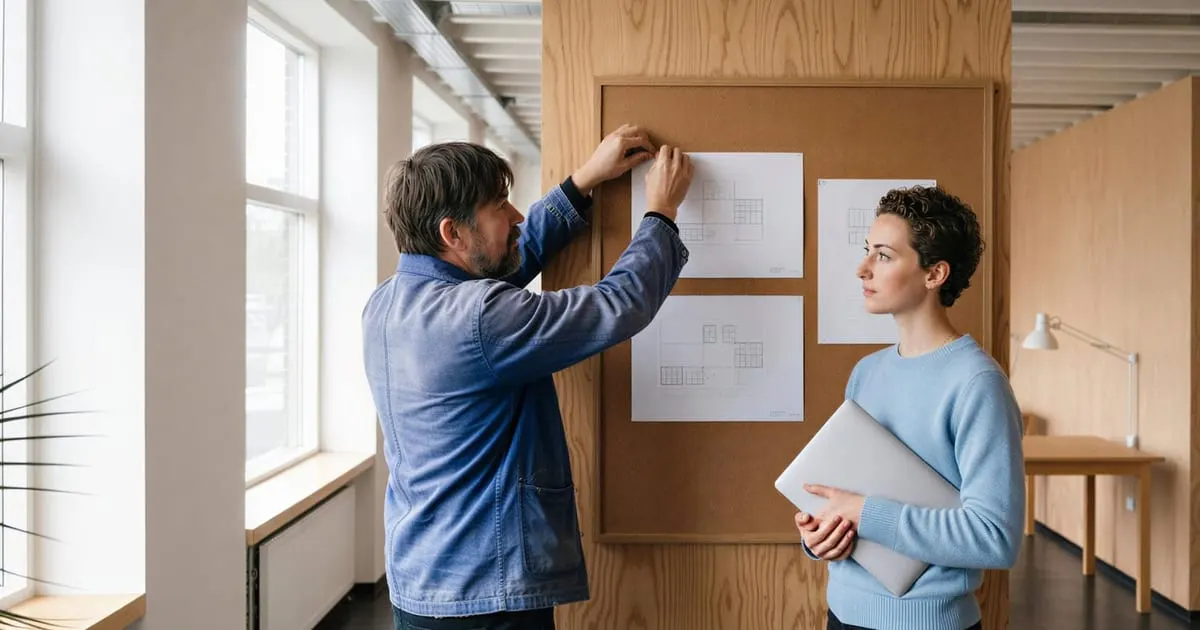
Social media for architects works as a public portfolio and a record of how you think. Most work comes from repeat clients and referrals: in AIA’s firm survey, 70% of billings came from repeat clients. People who hear your name look you up. Post each project at every stage, put commercial work on LinkedIn and homes on Instagram, and credit everyone who worked on it. This PostNext guide shows how.
Key Takeaways
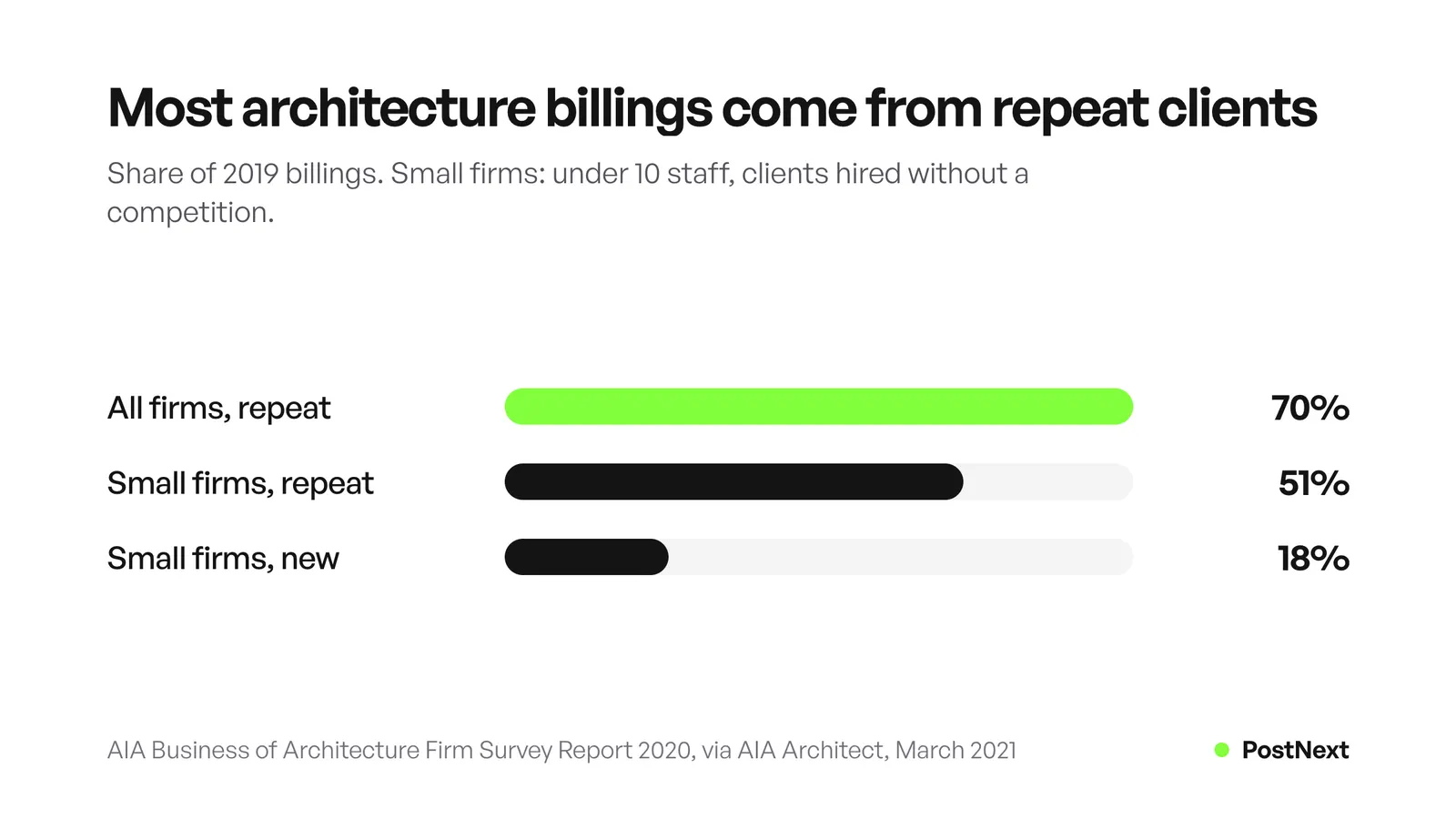
- Referrals come first: 70% of US firm billings came from repeat clients in AIA’s survey of 2019 work. Social media is where a referral checks you.
- LinkedIn for commercial clients, Instagram for homes: 51% of US college graduates use LinkedIn, and 51% of US adults use Instagram (Pew, 2026).
- One project gives you posts for years: site, sketches, models, approvals, construction, completion and a visit one year later.
- Accurate credit is a professional rule: AIA Rule 4.201 and ARB Standard 1.2 both require accurate claims about your work.
- You may not own your project photos: a commissioned photographer usually keeps the copyright, so get a written licence that covers social media.
- Two posts a week is enough: Buffer found accounts posting in 20 or more of 26 weeks got 450% more engagement per post.
Does social media help architects win work?
Social media helps architects win work by confirming a referral. AIA’s firm survey found 70% of US architecture firm billings came from repeat clients in 2019. For firms with fewer than 10 employees, 51% of billings came from repeat clients hired without a competition, and 18% from new clients hired without one. Most of that work starts with a name passed from one person to another.
That name gets checked. A developer, a school board member or a couple planning a house looks at your feed before they call. They want built work like theirs and a sign of how you think.
| How the work arrives | What the client checks online | What to post |
|---|---|---|
| Repeat client | That you are still active and growing | New projects, awards, team news |
| Referral from a client or consultant | Built work similar to their project | Finished projects with the brief and the result |
| Invited shortlist or competition | Your thinking and your track record | Process, design reasoning, completed work |
| Public tender or framework | References and the bid document | Little: social media plays a small part here |
Billing shares from AIA’s Business of Architecture Firm Survey Report 2020 (2019 data), reported by AIA Architect in March 2021, checked November 2026. Newer AIA editions are sold or open to members only.
Social media has limits. If most of your work is public and won through tenders and frameworks, the bid and the references decide, and social media mostly helps you hire. For residential and small commercial practices it matters more.
Which social media platforms should architects use?
Architects do best on LinkedIn for commercial, public and institutional clients, and on Instagram for homeowners and design-led work. Pew Research Center’s 2026 survey of 5,511 US adults found 51% use Instagram and 31% use LinkedIn. LinkedIn use rises to 51% among college graduates and 45% in households earning $100,000 or more, where many clients of architects sit.
| Platform | Who you reach | Best post for an architect | US adults using it |
|---|---|---|---|
| Developers, facility managers, public clients, consultants, future staff | A finished project with the brief, constraints and result | 31% (51% of college graduates) | |
| Homeowners, design press, other designers | Carousels of a finished home, site progress, models | 51% | |
| YouTube | Clients who want a walk-through | A two-minute tour of a completed building | 84% |
| Local homeowners and community groups | Local projects and planning news | 70% |
Pew Research Center, Social Media Fact Sheet, published October 2026 (survey January to June 2026), checked November 2026.
Pick two and keep them active. Houses and extensions: start with Instagram and LinkedIn. Offices, schools or healthcare: start with LinkedIn. A dead account looks worse than none, because a client reads it as a quiet practice.
Residential practices can add Houzz, where homeowners compare professionals, much as interior designers use it. Houzz says a free business account adds you to its Find Professionals directory, and each project is “a collection of photos and information” under your profile.
Should an architecture practice post from a LinkedIn Company Page or personal profiles?
Post from both, with different jobs. A director’s profile has a face and a voice, so it suits project stories, opinions and site visits. The Company Page holds the record: every finished project, awards and job openings. A small practice with one director can start with the personal profile alone.
Two LinkedIn features join them. Page super admins and content admins can schedule Page posts inside LinkedIn. Employee Notifications let a Page admin tell employees about a Page post once per day. LinkedIn counts as employees the members who list your Page in their work experience, so ask your team to add it.
A simple split for a five-person practice:
- Company Page: one finished project a month, plus job openings. Schedule them in LinkedIn.
- Director’s profile: one or two posts a week. Site visits, a decision on a current project, a lesson from a finished one.
- Team profiles: what they worked on, in their own words, when they want.
Write for the client. A post on why you raised a floor by 600 mm to keep a view gets read by a developer. Design theory gets likes from peers and no calls. Our list of LinkedIn post ideas has more formats that work from a personal profile, and the PostNext lesson on the LinkedIn company page covers the Page setup.
What should architects post on social media?
Post your built work, your process and your reasons. A finished building shows you can deliver. A sketch or a site photo shows how you got there. A note on a decision, such as why you turned the house to face the garden, shows how you think. A feed of only glossy photos hides the last two.
Rotate these six post types:
- The finished project. Four to eight photos in a carousel, with the brief and the result in two lines. Name the town, not the street.
- The drawing or model. A hand sketch, a section, a card model on the desk. These cost nothing to photograph.
- The site visit. Foundations, the frame going up, a facade test panel. People follow a project to the end.
- The decision. One constraint and how you solved it: a tight plot, a planning condition, a small budget.
- The render beside the photo. The render during design, the matching photo after completion. It shows that what you draw gets built. Label the render.
- The people. The team, the contractor, the engineer, the client in the finished space with their consent.
On Instagram, carousels suit architecture, because one post can hold the plan, the exterior and three rooms. Our Instagram carousel ideas include slide-by-slide outlines for a project story. Point the link in your bio to a page with your current projects; More.You has a guide to adding a link to your Instagram bio.
How do you turn one project into a year of posts?
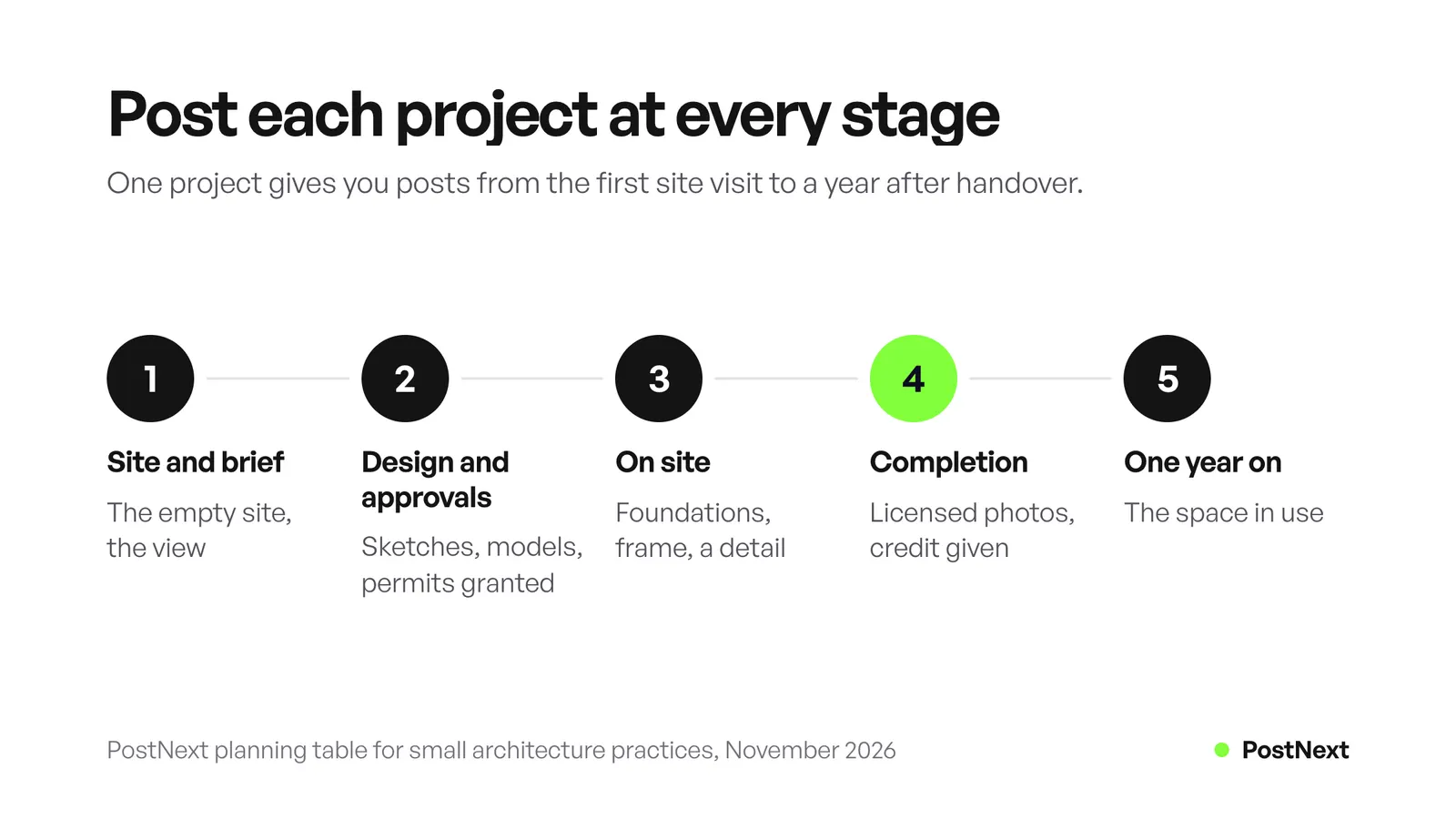
Follow the project from the first site visit to one year after handover, and post at each stage. A house runs for many months and a school for years, so one project gives you material for a long time. Run three at once and one is always at a stage worth showing.
| Stage | What to post | Ask first |
|---|---|---|
| Site and brief | The empty site, the light, the view, the problem to solve | Client consent to show the site |
| Sketches and models | Hand sketches, massing models, two options you tested | Nothing, if the client agreed above |
| Approvals | Planning or permit granted, with one drawing | Wait until the decision is public |
| On site | Foundations, frame, a detail being built, the contractor at work | The contractor, for photos of their team |
| Completion | Photographer’s images in a carousel, the brief and result | A written licence from the photographer |
| One year on | The space in use, a short client quote, what you learned | The client, for the quote and any people in the photos |
A planning table for a small practice, built from the steps of a typical project. Check your contract with each client for publicity terms before you post.
Competitions have their own rules. Read the conditions of entry before you post a design, and post it once the result is public. A shortlisted entry with your reasoning makes a strong post, win or lose.
Who owns the copyright in photos of your buildings?
In most cases the photographer owns the copyright in photos of your building, even when you paid for the shoot. Under US law, a commissioned photo is a work made for hire only if it fits one of nine categories and both sides sign a written agreement saying so. UK law gives the first copyright to the author, the photographer, unless the photographer is your employee.
What that means in practice:
- Get a written licence that names social media, your website, award entries and press, and says how long it lasts.
- Credit the photographer in every post. Tag them on Instagram and LinkedIn.
- Send the licence terms to the client too. Clients often want to post the same photos.
- Your team’s work photos belong to the practice. Under both laws, an employee’s work belongs to the employer unless you agree otherwise.
The reverse also holds. US law says the copyright in a built architectural work does not cover pictures of it when the building is visible from a public place, and UK law has a similar rule for buildings. So a stranger may photograph your building, but you still need their permission to repost their photo. Our guide to social media for photographers covers the photographer’s side of this.
This is general information, not legal advice. Check your contracts and ask a lawyer if a dispute comes up.
What do the AIA and ARB codes say about promoting your practice?
Both codes require honest claims about your work. AIA Rule 4.201 says members “shall not make misleading, deceptive, or false statements or claims about their professional qualifications, experience, or performance”. It adds that they must state “the scope and nature of their responsibilities” for work they claim. In the UK, ARB’s Architects Code says architects meet Standard 1 when they “Promote their services responsibly and accurately”.
On social media, that turns into five habits:
- Say what you did. Executive architect, design architect, interiors only or concept stage: state it. AIA’s commentary says the rule exists to stop members “claiming or implying credit for work which they did not do”.
- Name the team. AIA Rule 5.301 asks members to “recognize and respect the professional contributions” of employees and colleagues. Tag the engineer, the landscape architect and the contractor.
- Label renders. A render posted as if it were a photo of a built project is a misleading claim.
- Use the title correctly. In the UK, ARB says it is a criminal offence to use the title “architect” in business or practice without being on the Architects Register. ARB lists social media as a place where misuse often happens. Check your bio, your practice name and your staff profiles.
- Keep confidential projects private. Some clients do not want their house or their site online. Ask before the first post, in writing.
In the US, each state licensing board sets its own rules on the title. Check yours.
How often should an architecture practice post?
Two posts a week on each channel is enough for a small practice: one project post and one post on process or thinking. Buffer’s study of more than 100,000 users found that accounts posting in 20 or more of 26 weeks got 450% more engagement per post than accounts posting in 4 weeks or fewer. Steady weeks beat busy days.
Batch the work once a month. Block two hours, collect the team’s site photos, write the captions and schedule them. If your clients are companies, the B2B social media strategy guide adds goals and measures.
How does PostNext help an architecture practice?
PostNext lets a practice plan a month of posts in one sitting and publish each at its time. It schedules to Instagram, LinkedIn, X, TikTok, YouTube, Threads and Bluesky from one calendar. On Instagram it publishes feed posts, carousels, Reels and image Stories from a professional account.
For LinkedIn, PostNext publishes text, image and GIF posts to personal profiles only. It does not post to Company Pages or Showcase Pages, and it does not post video, documents or polls. So PostNext handles the directors’ and team profiles, and you schedule Company Page posts in LinkedIn. You can connect several personal profiles within your plan’s channel limit. The LinkedIn channel page lists what it publishes.
PostNext does not post to Facebook or Pinterest today; both are listed as coming soon. The Instagram comment inbox lets you read and reply to comments in one place. It does not cover direct messages. The free plan covers 1 channel, 10 posts and 10 AI credits a month, enough for two posts a week on one profile. Paid plans start with a 7-day trial. PostNext for architects follows one building project post by post, with caption templates you can copy.
Frequently Asked Questions
Is social media worth it for a small architecture practice?
Yes, as a portfolio people check after a referral. AIA’s survey found 70% of US firm billings came from repeat clients in 2019, so most work comes from people who already know you. Two posts a week of finished projects and process keep that name credible. For practices that win most work by public tender, it matters less.
Should architects use Instagram or LinkedIn?
Use LinkedIn for commercial, public and institutional clients, and Instagram for homeowners and design-led work. Pew’s 2026 survey found 51% of US college graduates use LinkedIn and 51% of all US adults use Instagram. Most small practices need both.
Can I post photos of a client’s house?
Only with the client’s permission, given before the first post and best in writing. Leave out house numbers, street names and anything that shows where the house is. Check the photographer’s licence too, because a paid shoot does not give you the copyright.
Do I own the photos I paid an architectural photographer for?
Usually not. The photographer owns the copyright unless the photos are a work made for hire under a signed agreement, or the photographer is your employee. Get a written licence that names social media and credit the photographer in each post.
Can PostNext post to a LinkedIn Company Page?
No. PostNext publishes to personal LinkedIn profiles only. Schedule Company Page posts in LinkedIn, where super admins and content admins can schedule them, and use PostNext for the directors’ and team profiles.
Sources
- AIA, Code of Ethics and Professional Conduct, 2024 edition, current as of February 1, 2024, checked November 2026.
- AIA Architect in Architect magazine, Circling Back, on the AIA Business of Architecture Firm Survey Report 2020 (2019 data), March 2021, checked November 2026.
- Architects Registration Board, The Architects Code, 2025, and title protection policy, checked November 2026.
- US Copyright Office, Circular 30: Works Made for Hire, revised August 2024, checked November 2026.
- US Code, 17 U.S.C. § 120, scope of copyright in architectural works, checked November 2026.
- UK legislation, Copyright, Designs and Patents Act 1988, section 11 and section 62, checked November 2026.
- Houzz Pro Learn, How to create a free Houzz business account and How to upload project photos, checked November 2026.
- Pew Research Center, Social Media Fact Sheet, published October 2026, checked November 2026.
- LinkedIn Help, Employee Notifications on LinkedIn Pages, checked November 2026.
- Buffer, Consistent Posting Study (buffer.com/resources/consistent-posting-study), January 2025, checked November 2026.
- PostNext, LinkedIn and Instagram channel pages and pricing page, checked November 2026.