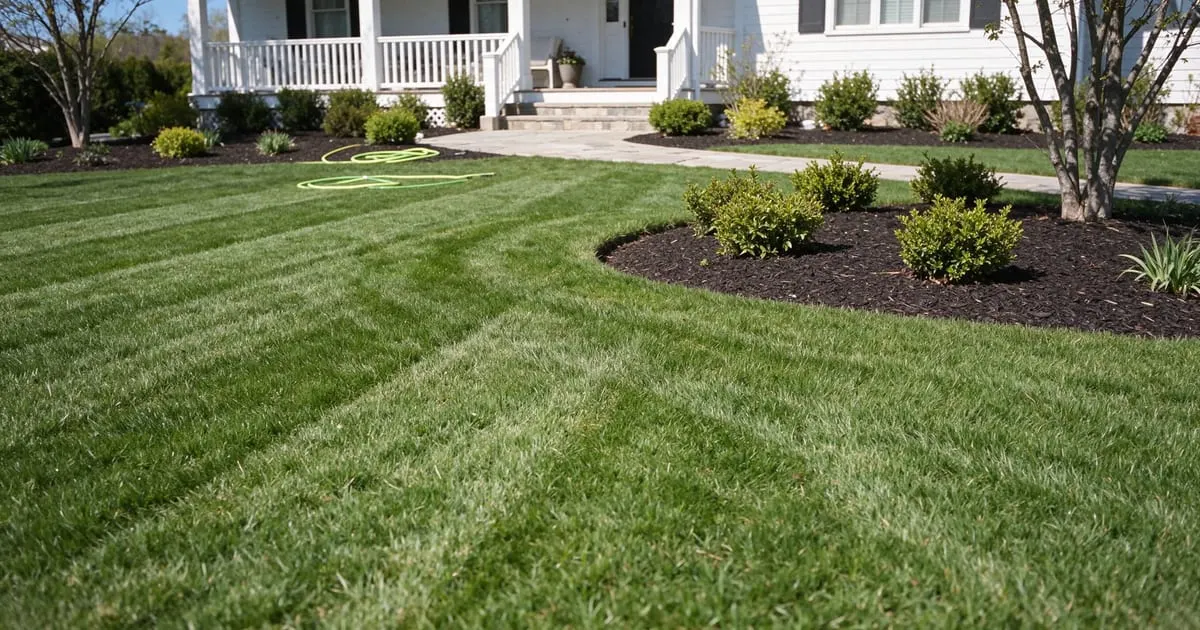
Landscaping social media works when you publish each post before people search for the job. In US Google data, searches for spring cleanup peak in March and April, leaf removal in November and snow removal in January. Show real before-and-after photos, keep lawn treatment posts inside what the product label says, and stay active on two platforms. This PostNext guide gives the dates and the rules.
Key Takeaways
- Post before the search peak: US searches for “landscaping near me” rose from 49,500 in December 2025 to 165,000 in March 2026.
- Each service has its own month: snow removal searches reached 110,000 in January, and Christmas light installation 135,000 in November.
- Never call a lawn treatment “safe”: the federal label rule lists 5 safety claims as misleading, even with “when used as directed”.
- Check fertilizer dates before you post: New York bans lawn fertilizer from December 1 to April 1.
- Reviews come first: 97% of consumers read local reviews, and 68% will only use a business with 4 stars or more.
- Two posts a week is enough: in Buffer’s study, accounts that posted in 20 or more of 26 weeks got 450% more engagement per post.
When do homeowners search for landscapers?
Homeowners search for landscaping in two waves, a large one in March and April and a second one in October. In Google Ads data for the US, searches for “landscaping near me” grew from 49,500 in December 2025 to 165,000 in March 2026. Each service then has its own peak, from spring cleanup in March to snow removal in January. Post each one a few weeks before its peak.
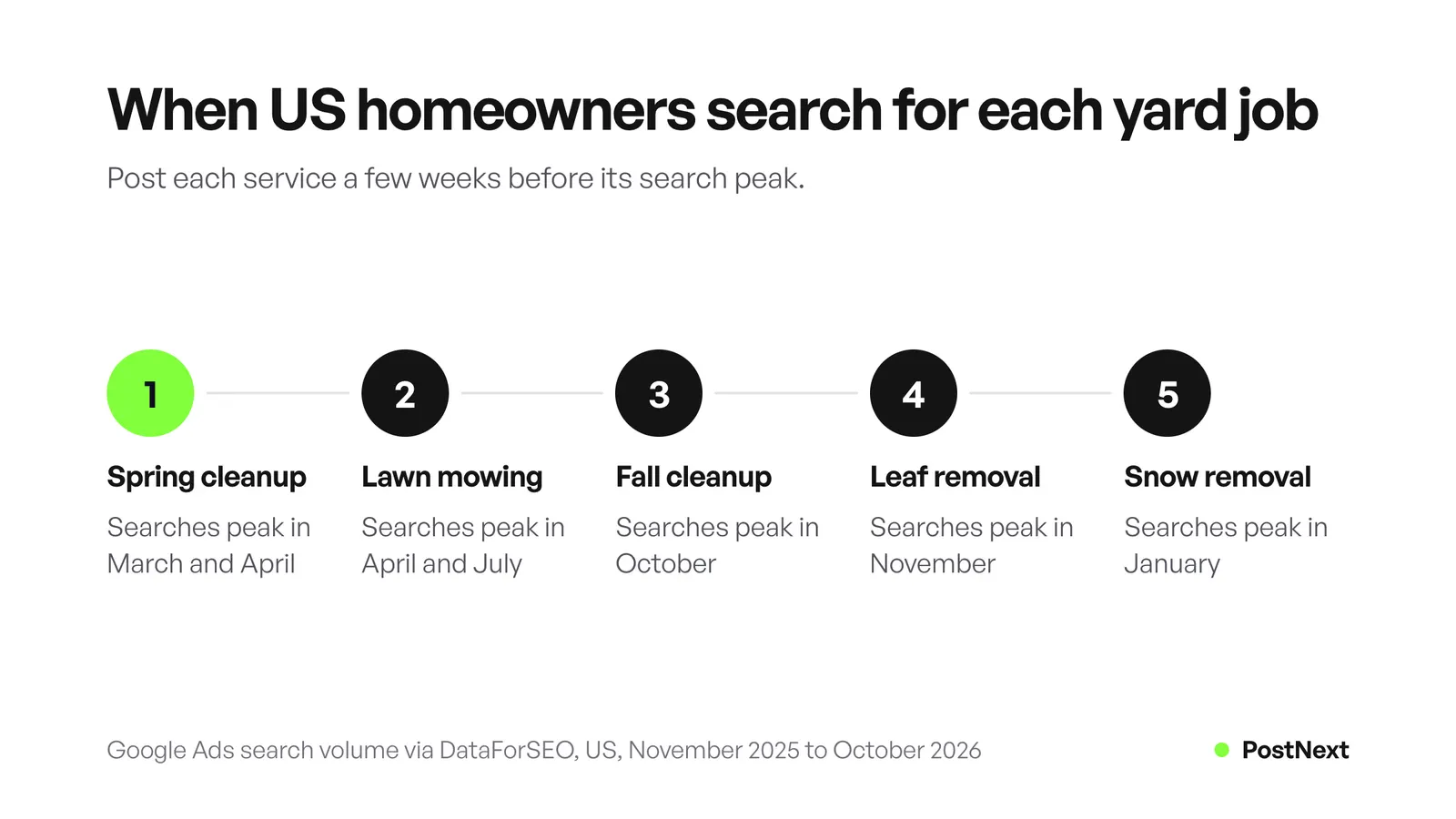
| Service people search for | Searches peak in | Searches in the peak month |
|---|---|---|
| Landscaping near me | March and April | 165,000 |
| Lawn aeration | March and April, again in September | 201,000 |
| Spring cleanup | March and April | 2,400 |
| Lawn mowing service | April and July | 60,500 |
| Sprinkler repair | April, May and July | 14,800 |
| Fall cleanup | October | 2,900 |
| Leaf removal | November | 14,800 |
| Christmas light installation | November | 135,000 |
| Snow removal | January | 110,000 |
US Google searches per month, Google Ads data read through DataForSEO, November 2025 to October 2026, read November 2026. Google rounds these numbers.
Spring is the main booking window. Searches for “lawn care near me” in March 2026 (165,000) were about five times the December 2025 level (33,100).
Two services climb for longer. Snow removal searches rose every month from September to January, and Christmas light searches quadrupled from September to October. Start those offers in October. Snow also follows the weather, so one heavy January can move the peak.
Does social media work for landscapers?
Social media works for landscapers as proof and as a reminder. Many homeowners hear your name from a neighbor or find you in a search, then check your photos and reviews before they call. BrightLocal’s 2026 survey found 97% of US consumers read reviews for local businesses, and a vendor survey of 2,000 homeowners by Scorpion found 74% research a referral online before calling.
In Houzz’s 2026 study of 10,176 of its US users who renovated in 2025, 54% did an outdoor project, such as a lawn, a fence, a deck or an irrigation system. The same study found 44% bought lawn and garden supplies, so some homeowners try the work themselves. Your posts can show what is hard to do alone: a level patio base, clean bed edges, a new lawn that grows evenly.
Social media is still the second check. Google comes first, and 71% of consumers use it for reviews (BrightLocal, 2026). For a two-truck business, a complete Google Business Profile and a steady flow of reviews matter more than daily posts. Do those first, then post twice a week.
Which social media platforms should landscapers use?
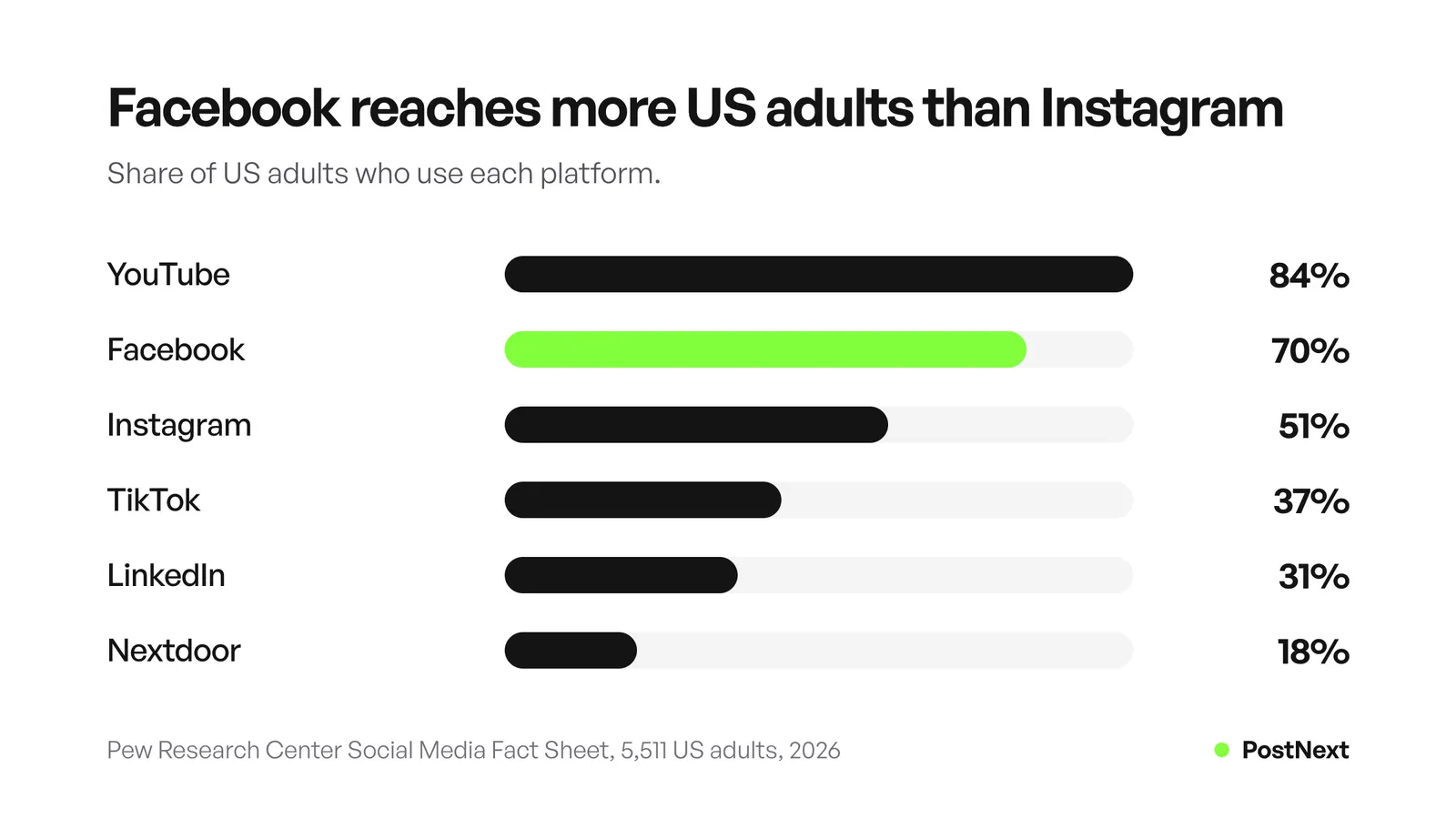
Most landscapers need a Google Business Profile, a Facebook Page and Nextdoor, plus Instagram or YouTube for photos and clips. Pew’s 2026 survey of 5,511 US adults found 84% use YouTube, 70% use Facebook, 51% use Instagram, 37% use TikTok and 18% use Nextdoor. Choose two that you will keep active every week, and keep the Google profile current.
| Platform | Best job for a landscaper | Why |
|---|---|---|
| Google Business Profile | Service area, reviews, photos of finished yards | 71% of consumers use Google for reviews |
| Facebook Page | Jobs, seasonal tips, local groups | 70% of US adults; 34% wrote a review there in the past year |
| Nextdoor | Recommendations from neighbors | Free Business Page for home service providers; 18% of US adults |
| Before-and-after photos, plant close-ups | 51% of US adults | |
| YouTube | Full builds, how-to clips such as mowing height | 84% of US adults |
| Commercial maintenance bids to property managers | 31% of US adults |
Reach figures from Pew Research Center 2026 (5,511 US adults); review figures from BrightLocal 2026 (1,002 US adults); Nextdoor from its own business page. Checked November 2026.
Make the Google profile a service-area business, the type Google uses for companies that work at the customer’s address. List up to 20 service areas by town or postal code, within about 2 hours of driving. Our guide to Google Business Profile image sizes has the photo and post specs.
For commercial maintenance bids, post finished sites and crew photos from the owner’s LinkedIn profile, where a property manager can see your work history. TikTok suits short clips of a crew laying new sod.
How should landscapers post before-and-after photos?
Take both photos from the same spot, at the same height and at the same time of day. Light changes how green grass looks, so a sunny after next to a cloudy before makes the job look better than it was. Ask the customer first, keep the house number and street out of the frame, and name the town instead of the address.
Mark a fixed spot on the first visit, such as a corner of the driveway or a fence post. Use the phone’s 1x lens for both photos, because a wide lens makes a small yard look larger. Crop and straighten, and leave the color alone. The FTC’s guide for small business ads says advertising must be truthful and not deceptive, and that you need proof before an ad runs. A filter that turns a patchy lawn bright green shows a result you did not deliver.
Treatment results need more care than installs. A photo of a weed-free lawn three weeks after a herbicide is a claim about what the product did. EPA’s label manual rejects claims such as “Kills All Insects” that promise more than the label lists. Name the weeds you treated, as the label lists them, and how many weeks have passed.
Keep these out of every frame:
- The house number, the mailbox and street signs.
- License plates on cars in the driveway.
- Children, and anyone who has not agreed to be in the post.
- Gate codes, alarm signs and open garage doors.
Post the pair as a carousel so people swipe from before to after. Our list of Instagram carousel ideas includes a before-and-after outline you can reuse.
What can a lawn care company say about pesticides and fertilizer?
Say what the product label says and nothing more. The federal label rule lists “safe”, “nonpoisonous”, “noninjurious”, “harmless” and “nontoxic to humans and pets” as misleading claims, even with “when used as directed”. EPA’s label manual adds that advertising must not make claims the label does not make. Plain fertilizer is not a pesticide, but a weed and feed product is.
| Words in a post | What the rule says | Say this instead |
|---|---|---|
| ”Safe for pets”, “kid-safe” or “non-toxic” | Safety claims are misleading on a pesticide label (40 CFR 156.10). The FTC says a non-toxic claim needs proof for people and the environment | ”Keep children and pets off the lawn until the spray has dried.” This is EPA’s own advice |
| ”Organic lawn treatment” | EPA’s manual calls “Organic” and “For Organic Lawns” misleading safety claims on a pesticide label | Quote the label. “For Organic Lawn Care” is allowed on labels that meet EPA’s criteria |
| ”All natural” | EPA does not allow “natural” in the labeling of any registered pesticide | Describe the method: “We pulled the weeds by hand and mulched the beds." |
| "EPA approved” | Implies a federal agency endorses it. EPA says agencies do not endorse any service company or product | ”Ask us for the product label before we treat." |
| "Eco-friendly lawn care” | The FTC says not to make unqualified general environmental claims | Name one real benefit: “Phosphorus-free fertilizer unless a soil test shows a need." |
| "Kills every weed” | EPA rejects claims wider than the label | Name the weeds the label lists |
eCFR 40 CFR 156.10(a)(5); US EPA Label Review Manual, chapter 12 (revised November 2013); US EPA, Tips for Selecting a Pest Control Service; FTC Green Guides, 16 CFR 260.4 and 260.10. Checked November 2026.
EPA’s label rules bind the companies that make and sell pesticides. Environmental claims in your own posts fall under the FTC’s Green Guides, which cover claims about “a product, package, or service” in any medium. Our guide for pest control companies quotes two state advertising rules for licensed applicators.
Post your license instead of a safety claim. EPA tells homeowners that each company must have at least one certified, licensed commercial applicator, and that the state department of agriculture can confirm the license. If you hold a WaterSense labeled irrigation certification, post that too: EPA’s WaterSense program tells homeowners to ask about it.
One warning on EPA’s list matters to full-service landscapers. It tells homeowners to beware of companies that want to do pest control “as part of a package deal, such as general home repair or tree trimming”. If you sell weed control with mowing or tree work, say who applies it and show that person’s license.
Fertilizer rules come from states and counties. New York bans lawn fertilizer from December 1 to April 1, and bans phosphorus on lawns unless you are starting a new lawn or a soil test shows a need. The law names landscapers and lawn care professionals, with fines up to $500 for a first violation. Pinellas County, Florida, bans nitrogen and phosphorus on “turfgrass or landscape” from June 1 to September 30. A “feed your lawn now” post in the wrong week advertises work that the local rule does not allow.
What is a seasonal social media plan for landscapers?
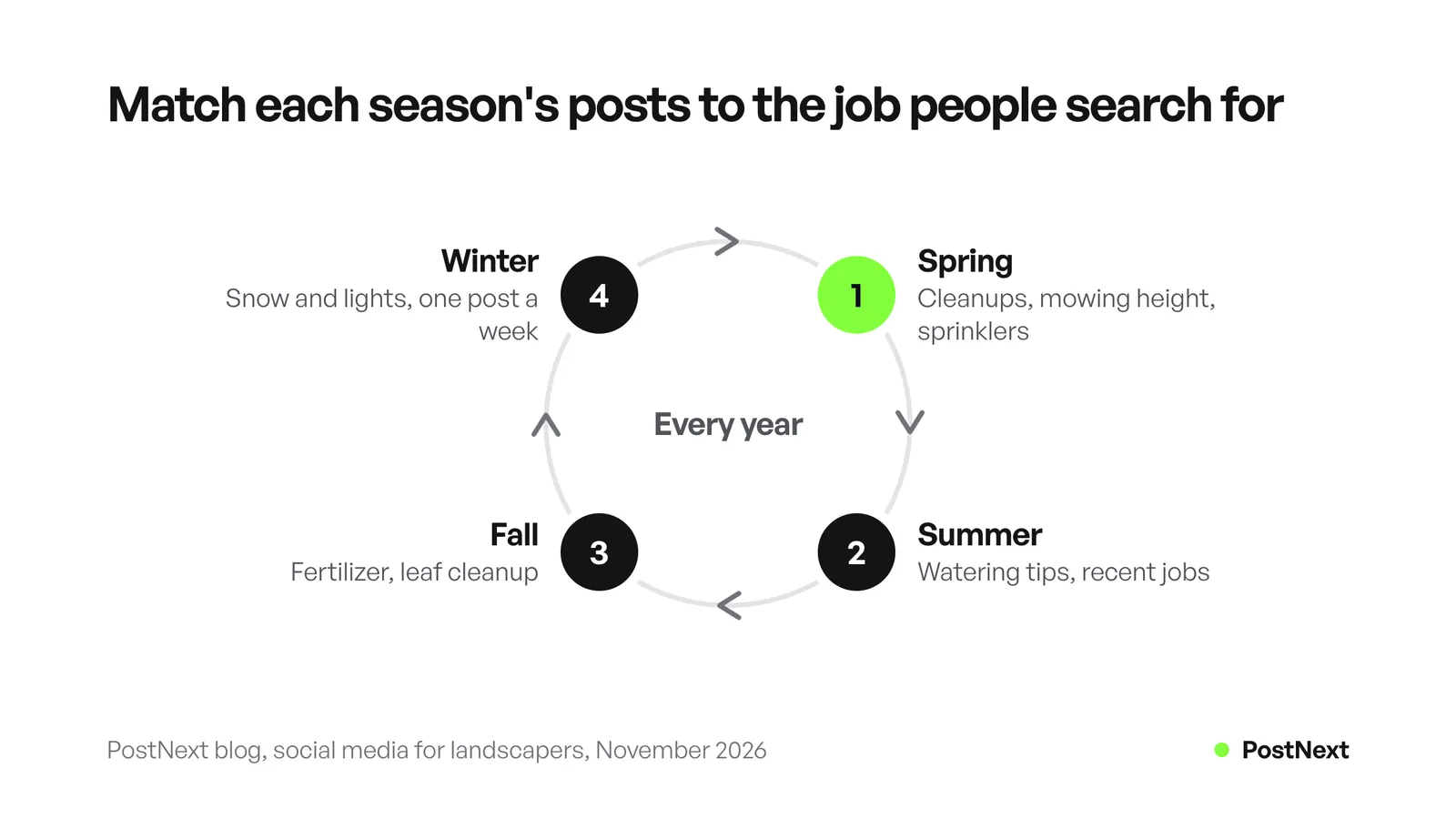
A seasonal plan matches each post to the job people are about to search for and the advice they need that month. Spring brings cleanups, mowing height and sprinkler checks. Summer brings watering, fall brings fertilizer and leaves, and winter brings snow removal and holiday lights. Write the posts in the quiet months and schedule them. Each tip below has a public source.
| When | Post idea | Source of the advice |
|---|---|---|
| February | Spring cleanup and aeration booking dates | Search data above |
| Early April | Apply crabgrass preventer in early April in central Illinois | Illinois Extension |
| April and May | Sprinkler Spruce-Up: inspect, connect, direct, select. Leaks and broken heads can waste up to 25,000 gallons and $280 in a six-month season | US EPA WaterSense |
| May to August | Mow at 2½ to 3 inches, and never cut more than one-third of the leaf at once | Illinois Extension |
| Summer | No watering at midday. Time how long the sprinkler takes to fill a tuna can to half an inch | US EPA WaterSense |
| Late summer to early fall | A key time to fertilize cool-season lawns. Aerate in spring or fall, when the soil is moist | Illinois Extension |
| October and November | Leaf cleanup. Keep leaves and clippings out of storm drains | Pinellas County, Florida |
| October to January | Snow removal and holiday light booking dates | Search data above |
Advice as worded by Illinois Extension (mowing, fertilizing and thatch pages), US EPA WaterSense (Sprinkler Spruce-Up and Watering Tips) and Pinellas County, Florida (fertilizer ordinance page). Checked November 2026.
The Illinois dates suit cool-season lawns. Warm-season lawns in the South follow other months, and fertilizer rules differ too: Pinellas County’s ban covers the summer, New York’s the winter. Ask your state extension office for local dates, and put them in one content calendar during the winter.
Winter is for selling the next season. If you offer neither snow removal nor holiday lights, post last summer’s best yards in January and February, when “landscaping near me” searches start to climb.
In season, two posts a week is enough: one recent job and one tip from the table. In winter, post once a week. Buffer’s study of more than 100,000 users found accounts that posted in 20 or more of 26 weeks got 450% more engagement per post than accounts that posted in 4 weeks or fewer. Plan the year the way HVAC companies plan their two booking seasons: write the tips once, schedule them, and add a fresh job photo each week.
How should landscapers handle reviews and messages?
Reply to every review and message within a day. In Scorpion’s survey of 2,000 homeowners, 88% expect a response within 24 hours. BrightLocal’s 2026 survey found 89% of consumers expect owners to respond to reviews, and 80% are likely to use a business that responds to all of its reviews.
Ask for the review when the customer sees the finished yard, by text, with a direct link. BrightLocal found 78% of consumers were asked to leave feedback in the past year, so asking is normal. Rating floors are rising: 68% will only use a business with 4 stars or more, up from 55% in 2025.
Never trade a discount for a good review. The FTC’s rule on consumer reviews bans any reward tied to a review with a particular sentiment, positive or negative, and it bans fake reviews. “A free edge trim for a five-star review” breaks that rule. Thank every reviewer by hand instead: BrightLocal found 50% of consumers are put off by templated replies.
How does PostNext help a landscaping business?
PostNext lets a landscaper plan a season of tips and job photos in one sitting and publish each one at its time. It posts to Instagram, TikTok, LinkedIn, X, YouTube, Threads and Bluesky from one calendar. Repeat this post sends a recurring post every 1 to 365 days, weeks or months, which suits a yearly reminder such as the spring Sprinkler Spruce-Up.
Set that reminder to repeat every 12 months with recurring posts, and each repeat counts toward your monthly posts. You can import a spreadsheet of up to 100 tips: dated rows are scheduled and undated rows wait as drafts. TikTok posts wait in your TikTok inbox unless you turn on Post directly. YouTube, open to a limited set of accounts for now, keeps uploads private until you publish them in YouTube Studio.
The web app works in a phone browser, so you can schedule the after photo before you leave the site. On Instagram, the comment inbox lets you answer plant questions in one place. It does not cover DMs. PostNext for landscapers has caption templates, a weekly posting plan and post ideas for landscaping jobs.
PostNext does not post to Facebook or Google Business Profile today, and most landscapers need both. The pricing page lists both as coming soon. Schedule those in Meta Business Suite and in your Google profile for now. PostNext also does not book visits, send invoices or edit videos. The free plan covers 1 channel, 10 posts and 10 AI credits a month, and paid plans start with a 7-day trial that asks for a card.
Frequently Asked Questions
What should a landscaper post on social media?
Post before-and-after photos from the same spot, finished jobs, seasonal tips with a public source, real reviews with permission and the booking dates for each service. Time each post to the month people search for that job, from spring cleanup in March to snow removal in January.
Which social media is best for landscaping companies?
A Google Business Profile and a Facebook Page matter most for most landscapers. Pew’s 2026 survey found 70% of US adults use Facebook and 18% use Nextdoor, which offers free Business Pages for home service providers. Add Instagram or YouTube for before-and-after photos and clips.
Can a lawn care company say its treatment is safe for pets?
No. The federal label rule lists “safe” and “nontoxic to humans and pets” as misleading claims, even with “when used as directed”. Quote the label’s own directions instead, and repeat EPA’s advice to keep children and pets off treated areas until the spray has dried.
Can I call my lawn care organic?
Only in the label’s own words. EPA’s label manual lists “Organic” and “For Organic Lawns” as misleading safety claims on a pesticide label, while “For Organic Lawn Care” is allowed on products that meet EPA’s criteria for the National Organic Program. Describe your method, such as hand weeding or compost.
When should landscapers start posting for spring?
In February. US searches for “landscaping near me” climbed from 60,500 in January 2026 to 74,000 in February and 165,000 in March. Spring cleanup searches followed the same curve. Posts that go out in February are on your feed when people start to look.
Sources
- Google Ads search volume for the US (location 2840, English), read through DataForSEO, November 2025 to October 2026, checked November 2026.
- Pew Research Center, Social Media Fact Sheet, 5,511 US adults, published October 2026, checked November 2026.
- BrightLocal, Local Consumer Review Survey 2026, 1,002 US adults, published February 2026, checked November 2026.
- Scorpion, The state of home services marketing, survey of 2,000 homeowners, January 2026, checked November 2026. Scorpion sells marketing services.
- Houzz, 2026 U.S. Houzz & Home Study: Renovation Trends, 10,176 Houzz users who renovated in 2025, checked November 2026.
- eCFR, 40 CFR 156.10, Labeling requirements, paragraph (a)(5), checked November 2026.
- US EPA, Label Review Manual, Chapter 12: Labeling Claims, revised November 2013, checked November 2026.
- US EPA, What if I produce other types of products? (weed and feed), updated February 2026, checked November 2026.
- US EPA, Tips for Selecting a Pest Control Service, checked November 2026.
- eCFR, 16 CFR Part 260, Guides for the Use of Environmental Marketing Claims, sections 260.1, 260.4 and 260.10, checked November 2026.
- eCFR, 16 CFR Part 465, Use of Consumer Reviews and Testimonials, sections 465.2 and 465.4, checked November 2026.
- FTC, Advertising FAQs: A Guide for Small Business, checked November 2026.
- New York State DEC, Lawn Fertilizer (NYS Nutrient Runoff Law), checked November 2026.
- Pinellas County, Florida, Fertilizer Ordinance, checked November 2026.
- US EPA WaterSense, Sprinkler Spruce-Up, Watering Tips and Irrigation with a Pro, checked November 2026.
- Illinois Extension, Mowing Your Lawn, Fertilizing Your Lawn and Managing Thatch in Lawns, checked November 2026.
- Google Business Profile Help, service-area businesses, checked November 2026.
- Nextdoor, Nextdoor for small business, checked November 2026.
- Buffer, Consistent Posting Study (buffer.com/resources/consistent-posting-study), January 2025, checked November 2026.
- PostNext, landscapers page (postnext.io/for/landscapers), pricing page and recurring posts page, checked November 2026.