
Social media marketing for coaches works when your posts show how you coach and what clients get, in words the FTC allows. In the International Coaching Federation’s 2026 consumer study, 76% of people said evidence of results matters when they choose a coach. This PostNext guide covers where to post, one weekly clip for three apps, and the claims you can make.
Key Takeaways
- Proof decides: 76% of consumers say evidence of results matters when they choose a coach, and 77% value credentials (ICF, 2026).
- A client’s result reads as typical: the FTC says “Results not typical” does not fix that, so state what clients usually get.
- Income claims carry the most risk: in April 2026, Publishing.com agreed to pay $1.5 million to settle FTC charges over income claims.
- LinkedIn fits executive and business coaches: 51% of US college graduates use it.
- One clip fills three apps: keep it vertical and under 3 minutes, the limit for YouTube Shorts and every TikTok account.
- Client stories need written consent: the ICF Code of Ethics treats them as confidential otherwise.
- Three posts a week is enough: one teaching clip, one proof post and one invite.
Does social media marketing work for coaches?
Social media works for coaches when it answers the doubts people have before they pay. Most people have heard of coaching, but few have tried it. The ICF’s 2026 consumer study found that 74% of consumers know about coaching and only 17% have experienced it. Posts that show how you work, who you help and what changed for a client close that gap.
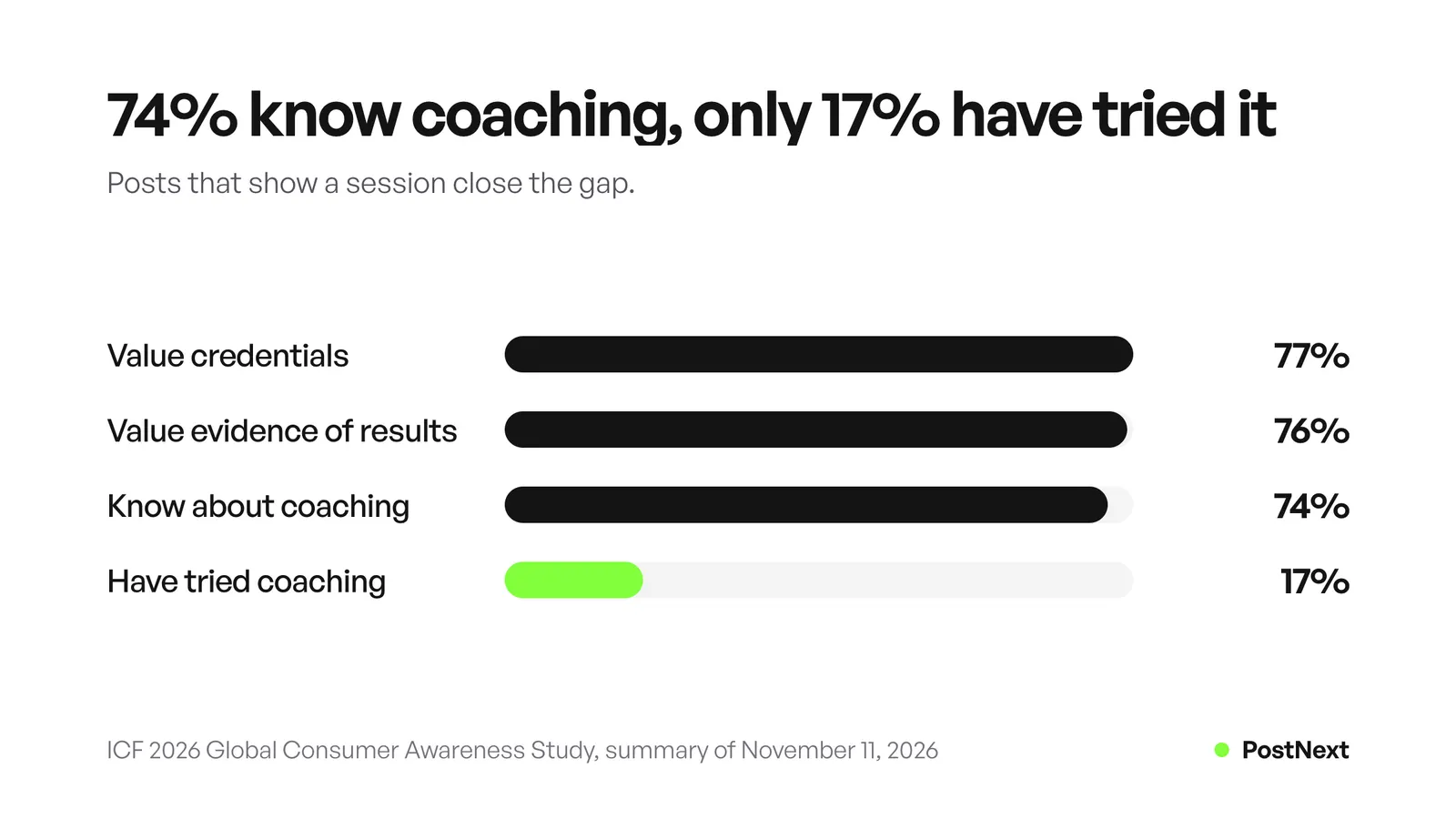
| What the study found | Share | What to post |
|---|---|---|
| Aware of coaching | 74% | How a session with you runs, step by step |
| Have tried coaching | 17% | What happens in a first call, and what it costs |
| Of people not considering it, say they do not need it | 74% | The moment people need you, such as a first manager job |
| Value professional credentials | 77% | Your training and credential, stated exactly |
| Value evidence of results | 76% | A client’s change, shared with consent, next to the usual result |
| Satisfied after coaching | Over 8 in 10 | A request to every client for an honest review |
International Coaching Federation, 2026 Global Consumer Awareness Study, as summarized by ICF on November 11, 2026 (the summary gives no sample size), checked November 2026.
People know the word “coach” but not what happens in a session with you, so they cannot judge whether it is worth the money. ICF names cost and doubts about value as barriers too. A post that teaches one exercise from your method, next to a result you can back up, answers both.
There is a fair argument against spending much time here. CoachNow, which sells software to coaches, argues that a website, an email list and a free offer matter more than social media. If referrals already fill your diary, keep one channel active and spend the rest of the week with clients.
Which social media platforms are best for coaches?
Choose the platform your clients already use. Executive, business and career coaches do best on LinkedIn, which 51% of US college graduates use. Life and wellness coaches usually do best on Instagram, used by 64% of adults aged 30 to 49. YouTube reaches 84% of US adults and keeps clips findable in search. Pick two and post on both every week.
| Coach type | Start with | Add | Pew 2026 figure |
|---|---|---|---|
| Executive and leadership | YouTube | LinkedIn: 51% of college graduates | |
| Business and sales | LinkedIn: 45% of adults in $100,000+ households | ||
| Career | TikTok or YouTube | LinkedIn: 37% of adults aged 30 to 49 | |
| Life | Instagram: 64% of adults aged 30 to 49 | ||
| Health and wellness | YouTube | Instagram: 56% of women; YouTube: 84% of adults |
Pew Research Center, Americans’ Use of Social Media in 2026 (5,511 US adults, January 30 to June 18, 2026), share who ever use each platform, checked November 2026.
More than half of coaches specialize in leadership. In the ICF’s 2025 Global Coaching Study, run by PwC with more than 10,000 participants in 127 countries, 54% of coaches said they specialize in leadership and executive coaching. Career coaches add TikTok, used by 65% of adults aged 18 to 29, for short answers to job questions. Facebook reaches 77% of US women, so a life coach who runs a Facebook group should keep it going.
Fitness coaches have extra rules on nutrition advice and before-and-after photos, covered in our guide to social media for personal trainers.
What should coaches post on social media?
Post to answer four doubts: do I need this, is it worth the money, is this coach qualified, and does it work. One teaching clip, one proof post and one invite each week cover all four. The clip gives away one real part of your method, the proof post shows a client’s change with consent, and the invite offers a first call.
- Need. Name the moment people look for a coach, such as a first manager job or a layoff.
- Value. Teach one exercise to try tonight, so people test your advice before they pay.
- Qualifications. State your training and credential exactly.
- Results. Share a client’s change with written consent and the usual result.
Start with the first doubt: of the people not considering coaching, 74% say they do not need it. On credentials, the ICF Code says “ICF Certified” applies only to holders of an ICF credential such as ACC, PCC or MCC. The next section covers the rules on results.
Use your own material. The ICF Code asks coaches to credit others and claim only their own work, so skip quote cards and other coaches’ clips. For opening lines on a personal profile, see our LinkedIn post ideas.
Three posts a week is a pace a solo coach can keep for a year. Two months of it gives a new visitor 24 posts to judge you by.

What can coaches claim about client results?
Share a client’s result only if it is what clients usually get, or if the post also says what they usually get. The FTC’s Endorsement Guides say people read a testimonial’s result as typical, and “Results not typical” or “Individual results may vary” does not change that. A client’s opinion of you, such as “she asks the right questions”, makes no result claim.
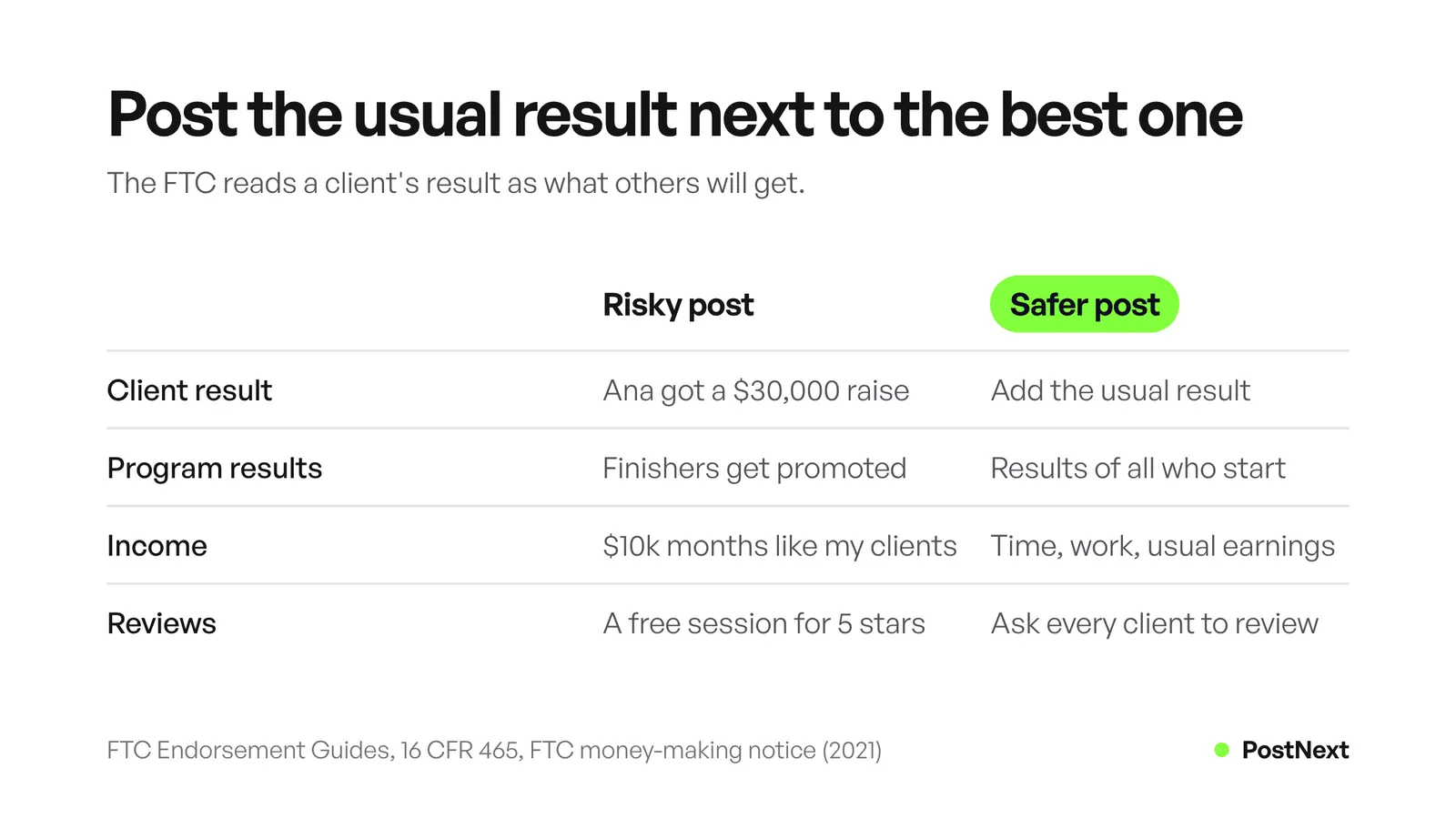
Programs with a set length have a trap the FTC describes. If you quote the results of clients who finished your program, you must account for the ones who quit. The Guides’ example is a program where people who stayed six months typically lost 35 pounds, but only one in five starters stayed that long, so the disclosure fails. State the result for everyone who starts, and use the median when a few big wins pull the average up.
| Post you want to write | What the FTC says | A safer version |
|---|---|---|
| ”Ana got a $30,000 raise after 8 sessions.” | A specific result is read as what others will get | Add the result clients usually get, or share a change in role |
| ”Clients who finish my 12-week program get promoted.” | Results must cover people who start, not only finishers | Say what happens to everyone who starts |
| A big result above “Results not typical” | The line does not change how readers understand the result | Remove the result or state the usual one |
| A free session for a 5-star review | Rewards for reviews of one sentiment are banned (16 CFR 465.4) | Invite every client to post an honest review |
| A testimonial from your assistant or a relative | Staff, and relatives you ask, must disclose the connection (16 CFR 465.5) | Name the relationship, or leave it out |
| A link to a course that pays you a commission | ”Affiliate link” alone may not be understood | ”I get a commission if you buy through this link.” |
FTC Endorsement Guides (16 CFR 255.2), FTC’s Endorsement Guides: What People Are Asking, and the Consumer Reviews and Testimonials Rule (16 CFR Part 465), checked November 2026. General information, not legal advice.
The same rule bans buying fake followers to look more important for business, and the ICF Code asks you to tell clients about any referral fee. Life and wellness coaches have one more line to watch. If a client says coaching ended her anxiety, the post makes a health claim, and the FTC wants competent and reliable scientific evidence for those. Its health guidance says testimonials are not that evidence. If you are also a licensed therapist, the ICF Code asks you to tell clients which role you are in.
What are the FTC rules on income claims for business coaches?
If you sell business or money coaching that promises income, the FTC’s rules on money-making opportunities can apply to your posts. In its own words, deceptive earnings claims are already illegal. A post that names a client’s income needs context next to it: the time and work it took, the share of clients who earned that much and what clients usually earn.
The FTC’s 2021 Notice of Penalty Offenses on money-making opportunities lists practices it has found deceptive. These are the ones that turn up in coaching posts, each a problem when it is not true:
- “Make $10k months like my clients” with no usual figure next to it.
- “Only 3 spots left” when you sell to anyone who pays.
- “Join today or miss out” when the offer is still open next week.
- “Risk-free” for a program that costs money and time.
- “No experience needed” when results depend on experience.
The FTC still brings these cases. In April 2026, Publishing.com, which sold a self-publishing course and an add-on sold as extra coaching, agreed to pay $1.5 million to settle FTC charges. One email promised buyers they could “copy the EXACT system hundreds of my students use to make $1k to $3k a month in passive income.” The FTC also said the company rewarded positive testimonials. At times it made refunds depend on one.
In January 2025, the FTC proposed bringing business coaching under its Business Opportunity Rule, with written proof required for any earnings claim. Andrew Ferguson, who now chairs the FTC, voted against it. Whatever happens to the proposal, keep the numbers behind every income claim on file.
Can coaches post client stories and session clips?
Yes, with written consent, and without recording the session itself. The ICF Code of Ethics defines confidentiality as protecting any information from in or around the coaching relationship, unless the law requires disclosure, someone faces a threat of harm, or the client gives written consent. A clip of you explaining one idea after the session is the safer format, because it holds no client details.
Put social media into your coaching agreement, since standard 2.2 of the ICF Code asks for a clear agreement about what information is exchanged. When a client agrees to share a story, write down four things:
- the exact words, photo or clip you will use
- the apps you will post it on
- whether their name, face or employer appears
- how they ask you to take it down later
Ask after the result, so the client sees the exact post first. When a company pays for the coaching, check what your contract with it says about publicity before you name the company.
How do you turn one session clip into a Reel, a TikTok and a Short?
Record one idea in your own words right after a session, film it vertically and keep it under 3 minutes. YouTube treats a square or vertical video of up to 3 minutes as a Short, and every TikTok account can post 3-minute videos. Write a separate caption for each app, schedule all three, and give LinkedIn its own version.
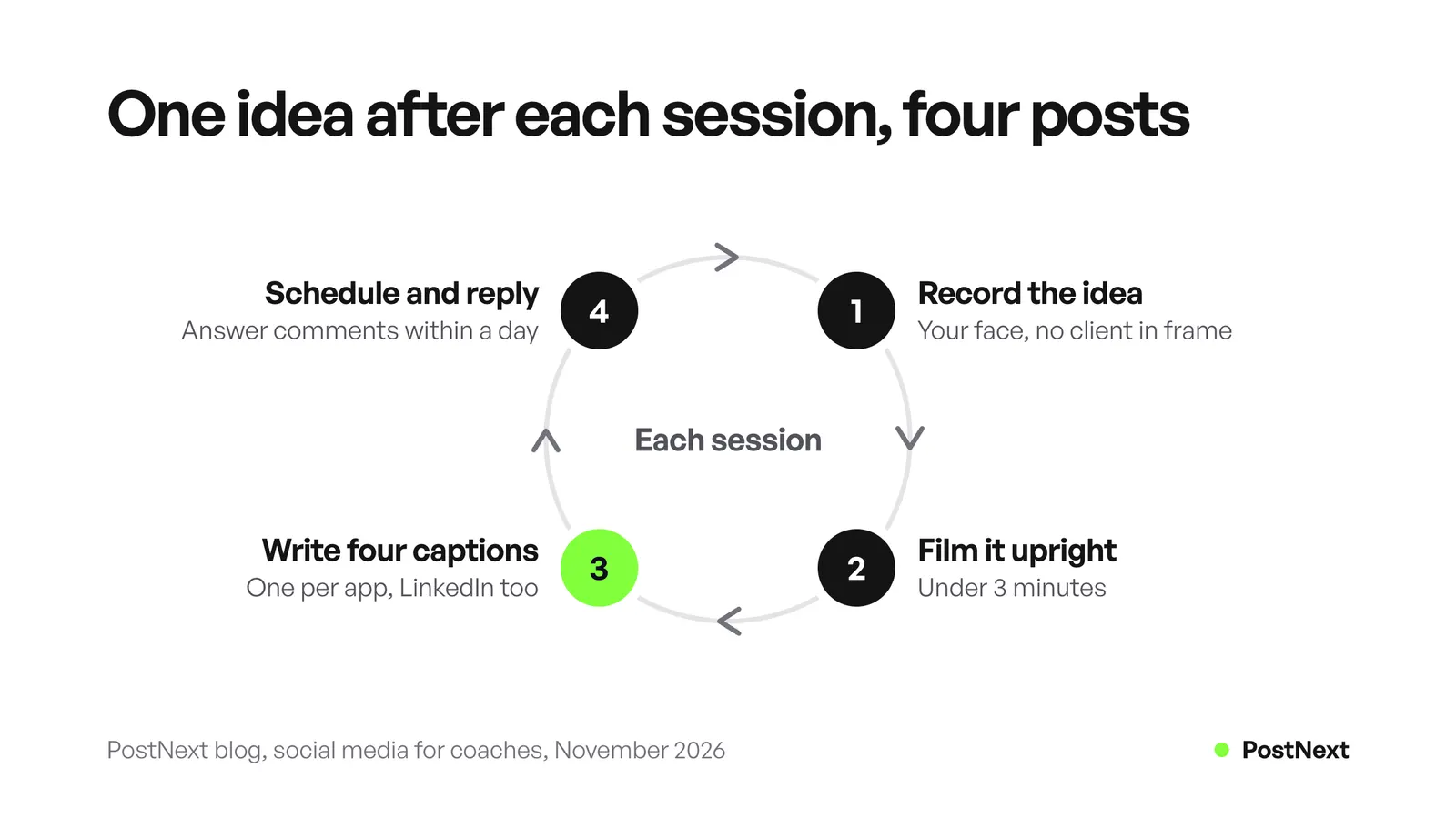
Record the idea, not the session: phone upright, your face, no client in the frame. Keep the sound your own. YouTube warns that copyright-protected music in a video made elsewhere could lead to a Content ID claim, and Instagram’s API cannot attach a music track, so add any music in the Instagram app.
Then write one caption per app:
- Instagram: the idea in one line, then one question for the comments.
- TikTok: the question your clip answers, worded the way people search for it.
- YouTube: a title of up to 100 characters that names the problem.
- LinkedIn: a short text version with a still from the clip, or the clip uploaded in LinkedIn itself.
For export settings that suit all three apps, see our guide to short-form video specs.
How should coaches use LinkedIn?
Post from your personal profile, and add a LinkedIn Service Page. LinkedIn says potential clients can contact a provider through a Service Page for free, whatever their connection degree. The page shows your average response time if you reply within 24 hours, and your response rate if you answer at least 80% of requests. Your posts carry the ideas, and the Service Page collects the requests.
Executive coaches often sell to a company, so the person who pays is not always the person coached. That sale works like B2B social media marketing, with several people to convince. Consultants face the same question about client work, and social media for consultants shows their LinkedIn routine. LinkedIn also lets you invite a client to review your work, and the FTC review rules above apply there too.
How do coaches turn posts into booked calls?
Give every profile the same next step: a free first call, booked from a link in your bio. Ask for the call in one post a week, answer every comment within a day, and ask each new client where they first heard of you. After three months, those answers show which app brings clients and which only brings likes.
Make booking one tap. A booking button on your link in bio page opens your booking page from the post someone liked, with no DM needed. For a free workbook, ask people to comment a word such as PLAN, then send the file by DM to everyone who comments it. Instagram comment-to-DM automation sends those messages for you. Meta allows one private reply per comment, so read the rules for automated DMs before your first launch. In the invite itself, say who the call is for and how long it takes.
How does PostNext help a coach?
PostNext handles the scheduling half of social media marketing for coaches. You upload a session clip once and send it to Instagram, TikTok and YouTube, each with its own caption, and schedule text and image posts to LinkedIn, X, Threads and Bluesky. Repeat this post sends your weekly free-call invite every week until you pause it, which suits a diary that fills and empties.
Each app has its own rules. A clip sent to TikTok waits in your TikTok inbox unless Post directly is on. YouTube uploads arrive as private, so you make each one public in YouTube Studio, and YouTube is open to a limited set of PostNext accounts while Google reviews the app. On LinkedIn, PostNext publishes text, image and GIF posts to your personal profile and adds your first comment, a good place for the booking link; the LinkedIn scheduler page shows the setup. The Instagram comment inbox lists comments from your 25 newest posts on every plan.
Know the limits. PostNext does not cut clips from session recordings, book calls, take payments or send DMs. It does not post video to LinkedIn, and it does not post to Facebook yet, which matters if your clients meet in a Facebook group. Each repeat of a recurring post counts toward your monthly posts. The free plan covers 1 channel, 10 posts and 10 AI credits a month, and paid plans start with a 7-day trial that asks for a card. PostNext for coaches has caption templates for the weekly free call, a session takeaway and a client’s career change shared with consent, plus a five-post weekly plan.
Frequently Asked Questions
Which social media platform is best for coaches?
LinkedIn suits executive, business and career coaches, and Instagram suits most life and wellness coaches. Pew’s 2026 survey found 51% of US college graduates use LinkedIn and 64% of adults aged 30 to 49 use Instagram. Add YouTube for clips people search for.
Can coaches post client testimonials?
Yes, with the client’s written consent and an honest frame. The FTC reads a specific result as typical, so add the result clients usually get. Never reward a client for a positive review, and say so when the person works for you or is related to you.
Does “results not typical” protect a coach?
No. The FTC says lines like “Results not typical” or “Individual results may vary” do not change how people read a client’s result. Either prove the result is typical or state the result clients generally get in the same situation.
Can business coaches post their clients’ income?
Only with context beside the number: the time and work it took, the share of clients who earned that much and the amount clients usually earn. The FTC’s 2021 notice on money-making opportunities lists income figures without that context as deceptive.
Can a coach post a video of a coaching session?
Only with the client’s written consent, and a clip of yourself is the safer choice. The ICF Code treats anything said in or around a session as confidential unless the client agrees in writing. Explain one idea on camera after the session instead.
Can I write “ICF certified” on my social media profile?
Only if you hold an ICF credential. The ICF Code of Ethics says “ICF Certified” applies only to those with a credential such as ACC, PCC or MCC, and standard 5.1 asks coaches to state their qualifications accurately.
Sources
- International Coaching Federation, New Consumer Insights for Your Practice and the Profession, on the 2026 Global Consumer Awareness Study, November 11, 2026, checked November 2026.
- International Coaching Federation, 2025 Global Coaching Study release, conducted by PwC, September 16, 2025, checked November 2026.
- International Coaching Federation, ICF Code of Ethics, checked November 2026.
- Pew Research Center, Social Media Fact Sheet, published October 2026, checked November 2026.
- US Federal Trade Commission, 16 CFR 255.2, consumer endorsements and FTC’s Endorsement Guides: What People Are Asking, checked November 2026.
- eCFR, 16 CFR Part 465, Use of Consumer Reviews and Testimonials, checked November 2026.
- US Federal Trade Commission, Notice of Penalty Offenses Concerning Money-Making Opportunities, 2021, checked November 2026.
- US Federal Trade Commission, Publishing.com to pay $1.5 million, April 13, 2026, and proposed Business Opportunity Rule changes, January 13, 2025, checked November 2026.
- US Federal Trade Commission, Health Products Compliance Guidance, December 2022, checked November 2026.
- YouTube Help, Upload YouTube Shorts and Get started creating YouTube Shorts, checked November 2026.
- TikTok for Developers, Content Posting API media transfer guide, checked November 2026.
- LinkedIn Help, Get started as a service provider on LinkedIn, checked November 2026.
- CoachNow, Social Media for My Coaching Business: Where Do I Begin? (coachnow.com, August 2022), checked November 2026.
- PostNext, coaches page, YouTube and LinkedIn channel pages, Reels planner FAQ and pricing page (postnext.io), checked November 2026.