
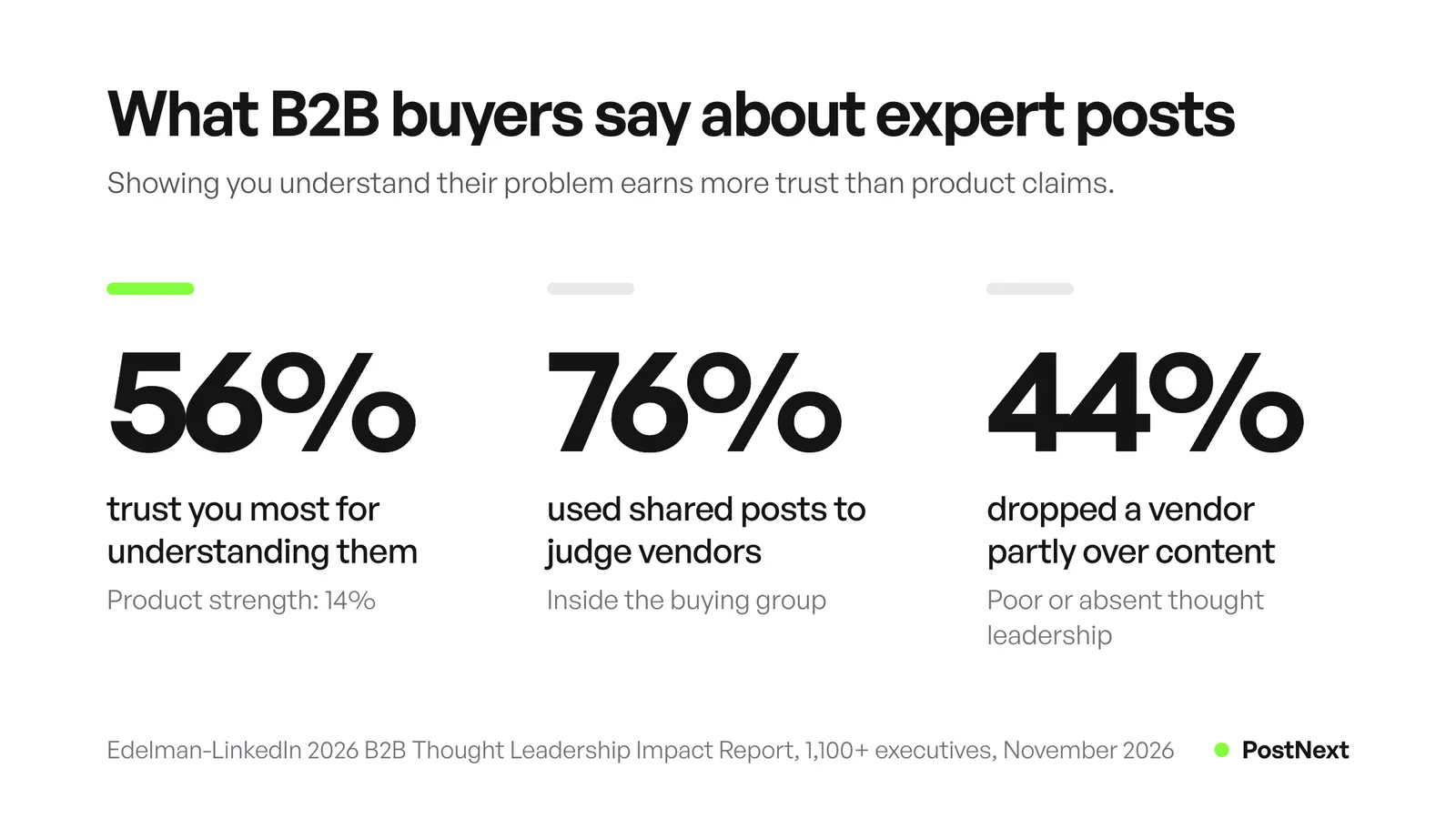
Social media for consultants works when it proves you understand a buyer’s problem before the first call. In a 2026 Edelman-LinkedIn survey of 1,100+ executives, 56% said that understanding raises their trust most, against 14% for product strength. Post on your personal LinkedIn profile two or three times a week. This PostNext guide covers what to post and what client work you may share.
Key Takeaways
- Show you understand the problem: 56% of B2B decision-makers trust a company most when it shows it understands their challenges; 14% when it shows product strength.
- Silence costs deals: 44% say poor or absent thought leadership helped remove a vendor from consideration.
- Start on LinkedIn, from your own profile: a profile-run LinkedIn Service Page lists up to 10 services and collects client reviews; a Company Page version shows no reviews.
- Most sharing is private: 89% of buyers who shared a company’s ideas did it by email, messages or meetings, so likes undercount your reach.
- Two or three posts a week, every week: accounts that posted in 20 or more of 26 weeks got 450% more engagement per post in Buffer’s study.
- Client work needs permission: the IMC USA code bars using confidential client information without the client’s permission, and the FTC says “results not typical” does not fix a misleading result claim.
- Never buy followers: a 2024 FTC rule bans buying fake followers, connections or likes for a commercial purpose.
Does social media work for consultants?
Social media works for consultants as evidence, read before and during a buying decision. Buyers judge whether you understand their situation, and they share what helps them argue a case. The 2026 Edelman-LinkedIn report surveyed more than 1,100 business executives in seven countries. It found that published thinking helps buying groups decide who understands them, and weak or missing thinking removes vendors.
| What B2B decision-makers said | Share |
|---|---|
| Understanding their challenges does the most to raise trust | 56% (product strength: 14%) |
| Thought leadership in the buying group helped judge whether a vendor understood their needs | 76% |
| It helped the buying group decide which vendor to select | 52% |
| Poor or absent thought leadership helped remove a vendor | 44% |
| Those who shared it did so privately (email, messages, work chats, meetings) | 89% (publicly: 67%) |
| Used AI to summarize thought leadership during vendor evaluation | 84% |
Edelman-LinkedIn 2026 B2B Thought Leadership Impact Report, survey of more than 1,100 business executives in seven countries, published November 2026, checked November 2026. LinkedIn co-produces the report.
Read the source with care. LinkedIn sells to the same buyers this report describes, and the survey covers companies of every size, not solo consultants alone. The direction still fits how consulting is bought: a few people, a large fee, and a decision made in meetings you never attend. One post that names a client’s problem well travels into those meetings by email.
The counterargument is fair. Many consultants win their work through referrals and past clients, and a strong network outweighs a strong feed. Posting does not replace those relationships. It gives the people who refer you something to forward, and it shows a stranger what you think before they call.
Which social media platform is best for consultants?
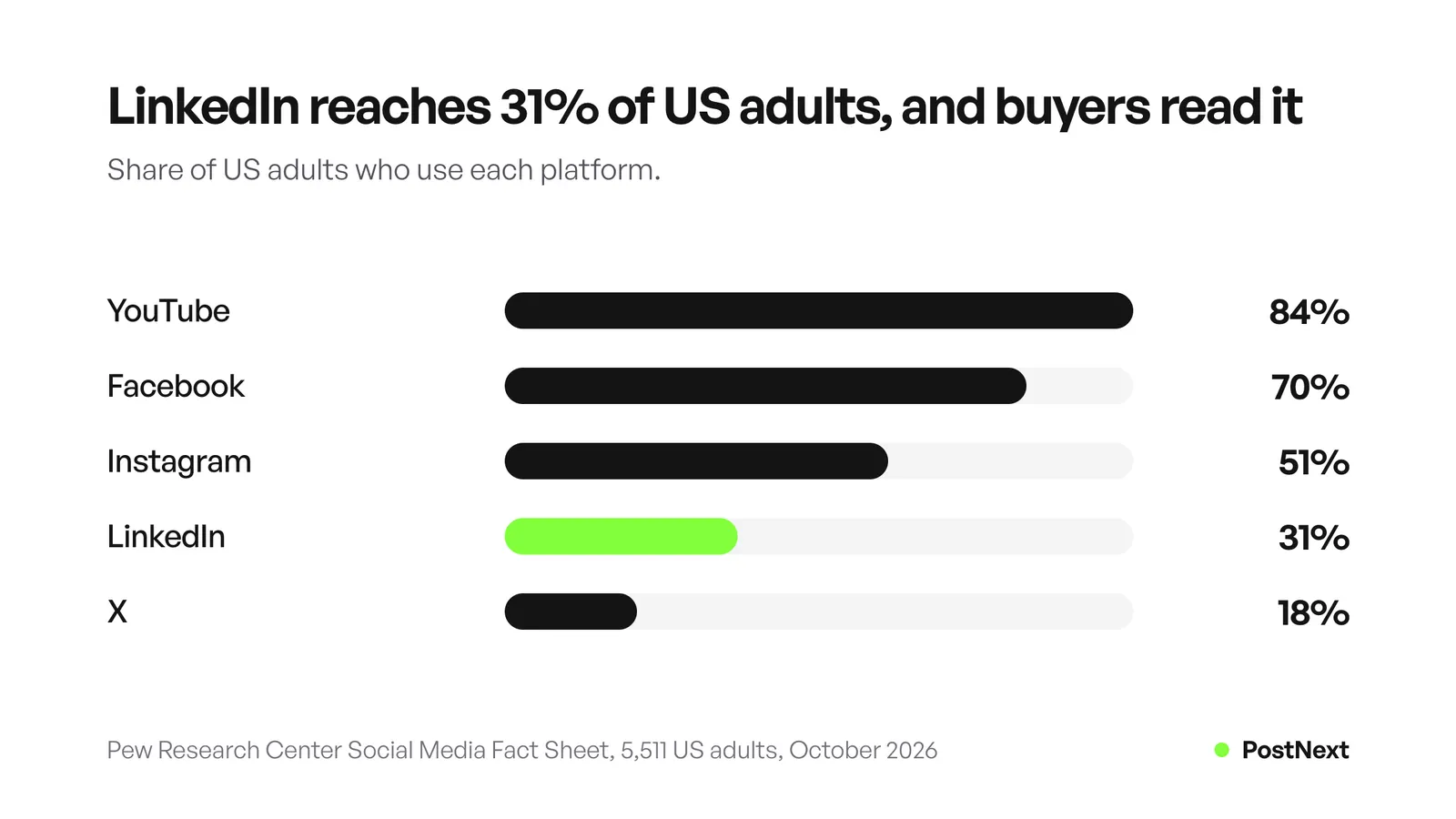
LinkedIn is the best platform for most consultants who sell to businesses, because the people who hire consultants read it for work. In Pew’s 2026 survey of 5,511 US adults, 31% use LinkedIn, fewer than use Facebook or YouTube. LinkedIn says its feed picks posts using signals such as a member’s industry, skills, experience and geography.
| Platform | US adults who use it | Best job for a consultant |
|---|---|---|
| 31% | Main channel: posts, comments, Service Page, messages with buyers | |
| YouTube | 84% | Short explainers of a method, recorded talks and webinars |
| 70% | Local business owners and groups, if you consult to small firms in one area | |
| 51% | Visual fields such as brand, design or hospitality consulting | |
| X | 18% | Following one industry’s news and sharing short opinions |
Pew Research Center Social Media Fact Sheet, 5,511 US adults, published October 2026; ranking signals from the LinkedIn newsroom, March 2026. Checked November 2026.
Reach is the wrong measure here. A consultant needs the right 300 people to know them. On LinkedIn your title and past employers sit next to every post. Add a second channel only if your buyers gather there: a consultant to restaurants needs Instagram more than X.
Should a consultant post from a personal profile or a company page?
Post from your personal profile. Clients hire a person, and LinkedIn’s own tools for service providers favour the profile. A Service Page run from your profile lists up to 10 services, has no entry rules and lets you invite clients to review you. The Company Page version lists the same 10 services but shows no reviews, and only companies of 500 employees or fewer qualify.
| LinkedIn services | Run from your profile | Run from a Company Page |
|---|---|---|
| Who manages requests | Only you | Any super or content admin of the Page |
| Number of services | Up to 10 | Up to 10 |
| Who can set it up | No requirements | Companies of 500 employees or fewer |
| Client reviews | You can invite clients to review you | Not available |
| Cost | Free; extras with Premium Business | Free; extras with Premium Company Page |
LinkedIn Help, Service Pages FAQs and “Offer services on your profile or Company Page”, checked November 2026. You cannot switch later between profile and Page.
A Service Page works on a request and proposal model. A buyer finds you in search, sends a project request for free, and you reply with a proposal. LinkedIn shows your average response time when you reply within 24 hours, and your response rate when you answer at least 80% of requests. Terms and payment happen outside LinkedIn.
Some features need a paid plan. With Premium Business, Sales Navigator or Recruiter Lite you get a “Request services” button that also appears on your posts, plus media and your latest review on the profile. LinkedIn says it is adding these features gradually, so your account might not have them yet. In a small firm, the Company Page holds the firm’s name and job posts, and each partner posts from their own profile.
What should consultants post on social media?
Post your thinking about your clients’ problems: the patterns you see, the mistakes you help people avoid, and the method you use. The Edelman data points the same way. Buyers trust the company that understands their challenges, and they forward content that contains useful data or evidence (73%) or fits a decision already under way (57%).
Rotate these five post types:
- The pattern. The mistake you see in every client of one type, and what it costs.
- The method. One step of how you work, such as the five questions in your first meeting.
- The opinion. Common advice in your field you disagree with, and why.
- The anonymous case. A client problem, what you did and what changed, with permission or with identifying details removed.
- The working week. A workshop you ran, a talk you gave, a book that changed a recommendation.
The pattern post is the easiest place to start: “Every operations team I work with makes the same hiring mistake in its second year.” A point of view nobody could disagree with gives a buyer nothing to judge. So the opinion post matters more than it looks. The anonymous case needs the most care, and the next section covers the rules.
Write for one reader. “Finance directors at manufacturers with 50 to 200 staff” produces sharper posts than “business leaders”. The answer you wrote to a client last week is next week’s post. For opening lines to adapt, see our LinkedIn post ideas.
Skip the content ratios you will read elsewhere, such as 40% education and 10% promotion. The guides that print them cite no study. Post what proves your understanding, and mention your services when a post earns it.
What can a consultant share about client work on social media?
Share a client’s name, numbers or story only with the client’s permission, and make every result claim one you can back up. The IMC USA code of ethics for management consultants bars using confidential client information without the client’s permission. The FTC treats a result in a testimonial as what others should expect, and a “results not typical” line does not change that.
The rules come from three places. The Institute of Management Consultants USA binds its members and Certified Management Consultants to a written code. Rule 5.0 covers confidential client information, and rule 14.0 bans advertising in a deceptive manner. The FTC’s Endorsement Guides cover client testimonials, and the guide to social media marketing for coaches shows how they apply to a client-result post. Its 2024 rule on reviews and testimonials, 16 CFR Part 465, bans fake testimonials and buying fake followers. Your contracts and NDAs come first: read them before you post about any engagement.
| Post you want to write | What the rule says | A safe version |
|---|---|---|
| ”How we cut Acme’s costs by 30%“ | IMC 5.0: protect confidential client information; use it only with the client’s permission | Ask in writing first, or write “a 40-person logistics firm” with no detail that identifies it |
| A client’s quote praising your work | FTC: a quote must reflect the client’s real, honest experience | Use their exact words, with written consent, and never edit the meaning |
| ”Clients save 30% on average” with “results not typical” | FTC: the disclaimer does not change how readers understand the claim | State the result you can prove is typical, or say what clients generally get |
| A post from your employee praising the firm | FTC: readers may not know where they work | They write “my company’s” or “my employer’s” in the post |
| Buying followers or likes to look established | 16 CFR 465.8 bans buying fake followers, connections or likes for a commercial purpose | Grow slowly from real comments and conversations |
Institute of Management Consultants USA Enforceable Code of Ethics (reaffirmed 2018); FTC, Endorsement Guides: What People Are Asking; eCFR 16 CFR Part 465. Checked November 2026. This table is general information, not legal advice.
The anonymous case is the post type most worth learning. Strip the client’s name, city, size and any number a competitor could match to them, and keep the problem and the change. When a client agrees to be named, get it in writing and keep the email.
How often should consultants post on LinkedIn?
Two or three posts a week on LinkedIn, every week, is a rhythm that fits around client work. The regularity matters more than the number. Buffer’s study of more than 100,000 users found that accounts posting in 20 or more of 26 weeks got 450% more engagement per post than accounts posting in 4 weeks or fewer.
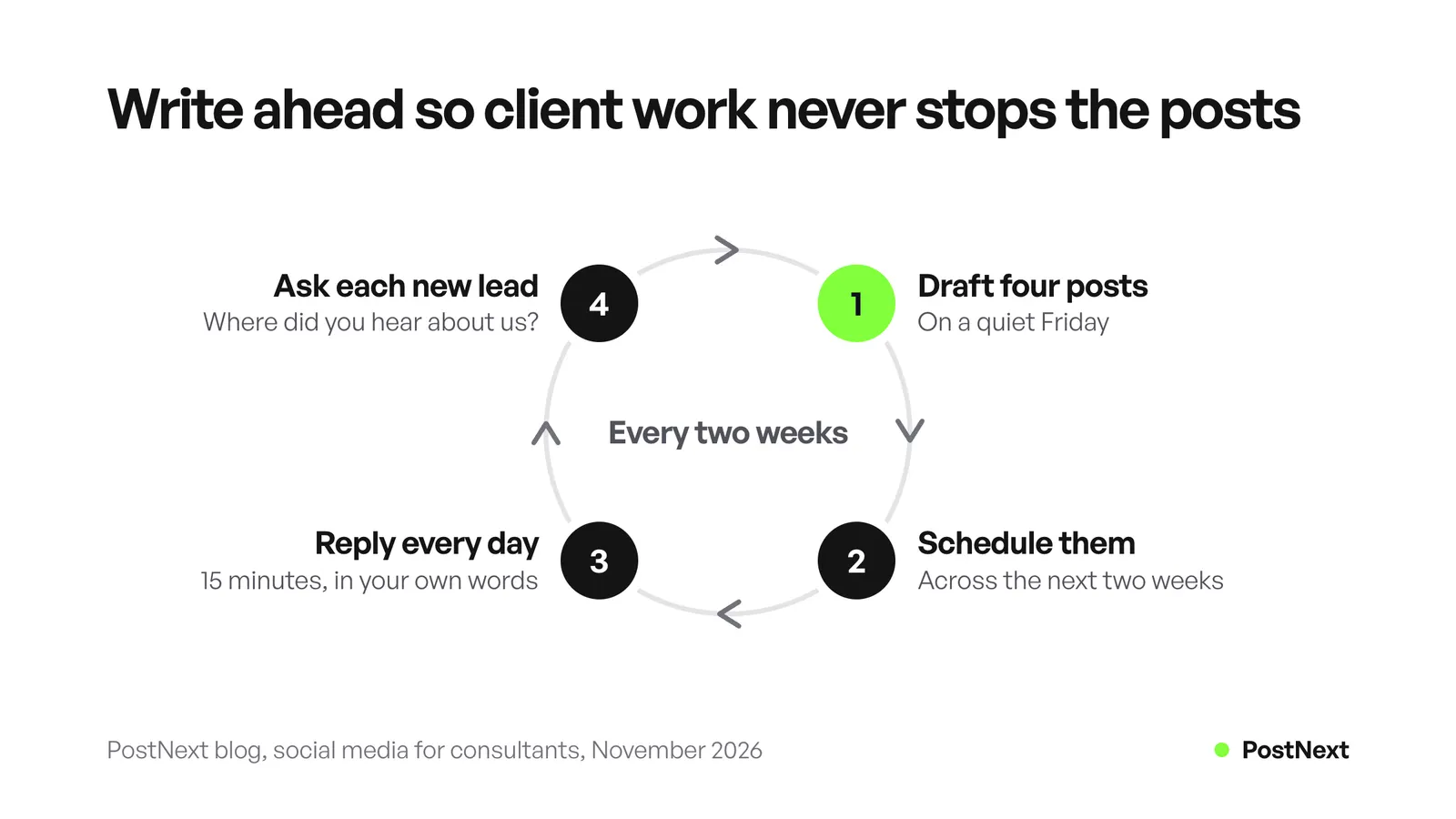
Client work comes in waves, so write ahead: draft four posts on a quiet Friday and schedule them across the next two weeks. To publish at set times, see our guide to scheduling LinkedIn posts for free.
Comments count as much as posts. Spend 15 minutes a day replying to everyone who comments on your post and adding a real point to posts by people you want to work with. Write each reply yourself. LinkedIn said in March 2026 that it is working to make engagement pods ineffective and to curb comment automation and third-party tools that create fake conversations. It also named “comment to agree” prompts as engagement bait it shows less. Our explainer on the LinkedIn algorithm covers what LinkedIn has confirmed about ranking.
How do consultants turn LinkedIn posts into clients?
Make your profile the next step after every post: a headline that names who you help and the result, a Service Page, and an easy way to start a conversation. Then ask every new client where they first heard of you. Most of the path stays out of sight: 89% of buyers who shared a company’s ideas did it privately.
Fix the profile before you post more. A reader who likes a post clicks your name. “Independent consultant” says nothing. “Pricing consultant for B2B software firms with 10 to 100 staff” tells the right buyer to keep reading. The free PostNext lesson on LinkedIn headline examples has formulas by role.
End some posts with one low-pressure offer: a checklist, a short review call or the template from the post. Answer service requests within a day, which also earns the response-time label on your Service Page. Note each new lead’s answer to “where did you hear about us?”. After three months you will know whether the posts bring work, which likes cannot tell you.
How does PostNext help a consultant?
PostNext schedules LinkedIn text, image and GIF posts to personal profiles, which is where a consultant posts. You write a week of posts in one sitting, pick the times, and PostNext publishes each one and adds your first comment, a good place for a link to your article or booking page. It also posts to X, Instagram, TikTok, YouTube, Threads and Bluesky from the same calendar.
A small firm can connect several personal profiles within its plan’s channel limit, one post per profile, so each partner posts in their own name. Repeat this post sends a recurring post every 1 to 365 days, weeks or months, which suits a monthly workshop reminder. AI Repurpose turns a blog link or pasted text into draft posts for LinkedIn, X, Instagram and Threads.
Know the limits before you choose it. PostNext does not post to LinkedIn Company Pages or Showcase Pages, and it does not publish LinkedIn video, documents (PDF carousels) or polls; post those in LinkedIn itself. It does not send LinkedIn messages or answer service requests. The free plan covers 1 channel, 10 posts and 10 AI credits a month, enough for two LinkedIn posts a week. See the LinkedIn scheduler page for how a post is set up. PostNext for consultants has a weekly posting plan and caption templates you can copy.
Frequently Asked Questions
Is LinkedIn worth it for consultants?
Yes, for consultants who sell to businesses. In the 2026 Edelman-LinkedIn survey, 76% of B2B decision-makers said shared thought leadership helped them judge whether a vendor understood their needs, and 44% said poor or absent thought leadership helped remove a vendor. LinkedIn co-produces that report, so weigh it with your own lead notes.
How often should a consultant post on LinkedIn?
Two or three times a week, every week. Buffer’s study of more than 100,000 users found accounts posting in 20 or more of 26 weeks got 450% more engagement per post than accounts posting in 4 weeks or fewer. Write ahead in quiet weeks so busy client weeks do not break the run.
Can consultants post about client projects?
Yes, with the client’s permission or with every identifying detail removed. The IMC USA code bars using confidential client information without permission, and your contract or NDA may add its own terms. Read your contract first, ask in writing, and keep result claims to numbers you prove are typical.
Should an independent consultant have a LinkedIn company page?
It is optional. Post from your personal profile, because people hire people and a profile-run Service Page collects client reviews. A Company Page suits a firm with several partners or staff, and only companies with 500 employees or fewer qualify to offer services on one.
Is a LinkedIn Service Page free?
Yes. Any member who offers a service creates one at no cost, and buyers contact you for free. A Premium Business, Sales Navigator or Recruiter Lite plan adds a “Request services” button, media, your latest review on the profile and extra matched requests. LinkedIn is adding the Premium features gradually.
Is it legal to buy LinkedIn followers?
In the US, no, when you use them to look more important for business. The FTC rule 16 CFR 465.8 bans buying fake indicators of social media influence, which include followers, connections, likes and comments. LinkedIn also says it acts against engagement pods and comment automation.
Sources
- Edelman and LinkedIn, 2026 B2B Thought Leadership Impact Report and Edelman’s summary, Thought leadership isn’t just what you say, more than 1,100 business executives in seven countries, November 2026, checked November 2026. LinkedIn co-produces the report.
- Pew Research Center, Social Media Fact Sheet, 5,511 US adults, published October 2026, checked November 2026.
- LinkedIn Help, Get started as a service provider, Service Pages FAQs, offering services on a profile or Company Page and Premium features for Service Pages, checked November 2026.
- LinkedIn newsroom, What’s changing in the LinkedIn Feed, March 2026, checked November 2026.
- Institute of Management Consultants USA, Enforceable Code of Ethics, reaffirmed March 2018, checked November 2026.
- US Federal Trade Commission, FTC’s Endorsement Guides: What People Are Asking, checked November 2026.
- eCFR, 16 CFR Part 465, Use of Consumer Reviews and Testimonials, checked November 2026.
- Buffer, Consistent Posting Study, January 2025, checked November 2026.
- PostNext, LinkedIn scheduler and pricing page, checked November 2026.