
Social media for car dealerships works when posts show real cars, real people and honest numbers. Buyers expect pressure and fine print, so a feed of walkaround videos, handovers and clear payment terms stands out. This PostNext guide covers which channels to use, six posts that bring test drives, and the US credit and lease rules that apply the moment a post shows a monthly payment.
Key Takeaways
- Facebook and YouTube reach the most buyers: Pew’s 2026 survey found 70% of US adults use Facebook and 84% use YouTube. Instagram reaches 51% and TikTok 37%.
- Video of the actual car beats a stock photo: a 30-second walkaround of the vehicle on the lot answers the questions a buyer would ask on the phone.
- “$299 a month” is a trigger term: under Regulation Z, a post may include a payment amount, a down payment, a number of payments or a finance charge. If it does, the post must also show the down payment, the repayment terms and the APR.
- Lease posts have five extra disclosures: under Regulation M, a lease payment in a post means you must say it is a lease, the total due at signing, the payment schedule, the security deposit and any end-of-lease charge.
- The FTC CARS Rule is gone, deception rules are not: the Fifth Circuit vacated the CARS Rule on January 27, 2025, but the FTC Act still bans deceptive ads.
- Salespeople must disclose they work for you: the FTC says an employment relationship is a material connection when an employee promotes the business.
Why should a car dealership use social media?
A car dealership should use social media because many buyers look a dealer up online before they visit, and they look for one they can trust. A feed of real cars on your lot, the people who will sell them and the customers who bought them answers that question better than any banner ad. It turns a stranger into someone who asks for a test drive.
Reviews sit next to the feed in that check. BrightLocal’s 2026 survey of 1,002 US adults found 97% read reviews for local businesses, and 89% expect owners to respond to them. A buyer who sees honest walkarounds on Instagram and calm, specific replies to bad reviews on Google sees the same dealer twice.
There is a limit to what organic posts do. Many dealers also list cars on listing sites, Facebook Marketplace and paid inventory ads, and those need their own tools and budget. Organic social media is the part that builds trust and brings people back for their next car and their service visits.
Which social media platforms should car dealerships use?
Most dealerships need Facebook for local buyers and Marketplace, YouTube for walkarounds and reviews, and Instagram for new arrivals and handovers. Add TikTok if a salesperson enjoys being on camera every week. LinkedIn helps sales managers who sell fleet vehicles to local companies.
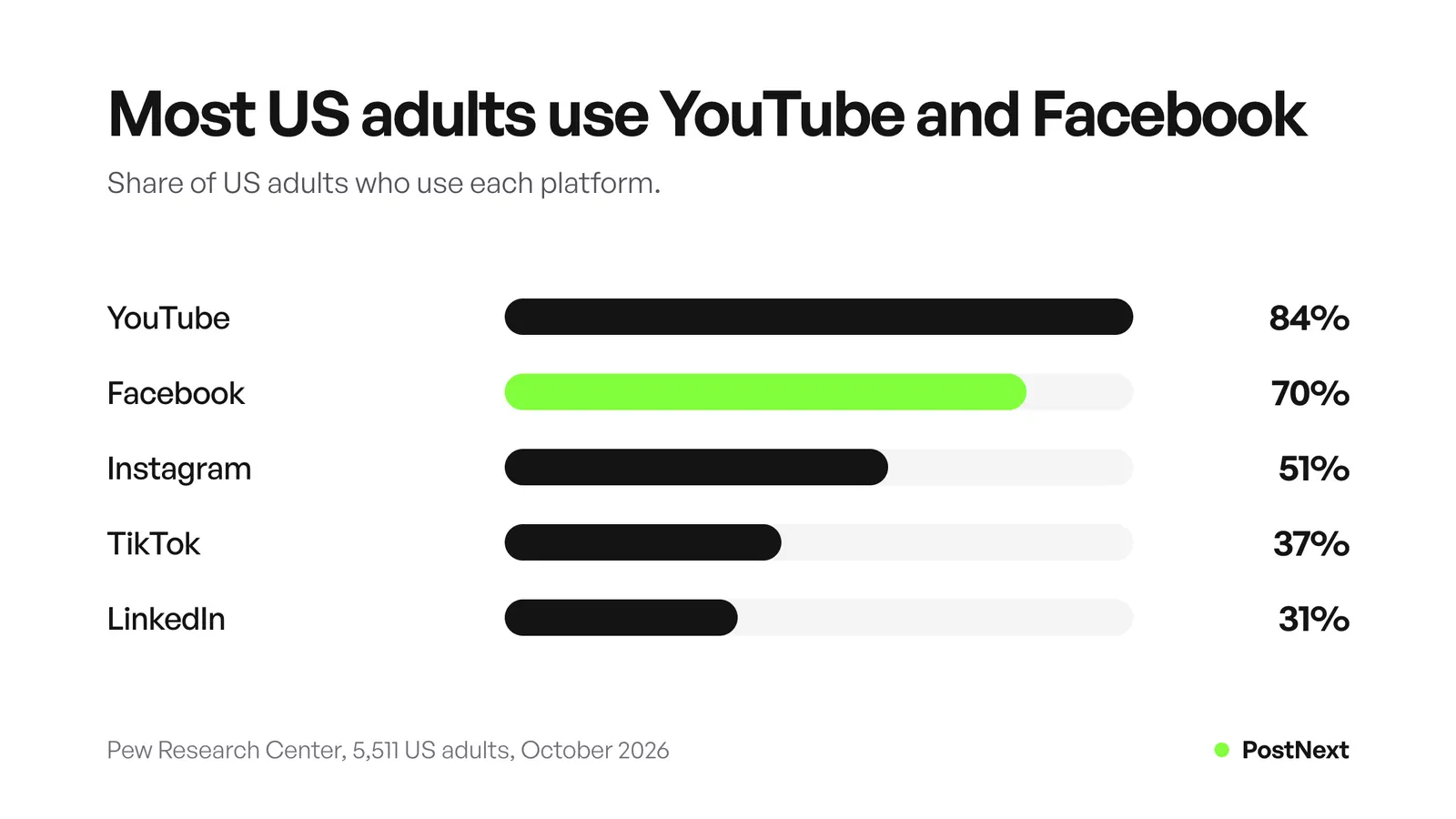
| Channel | Best job for a dealership | Who it reaches |
|---|---|---|
| Local buyers, Marketplace listings, events, reviews | 70% of US adults | |
| YouTube | Walkarounds, test drives, how-to videos, Shorts | 84% of US adults |
| New arrivals, handovers, Reels of the lot | 51% of US adults | |
| TikTok | Salesperson videos, quick answers, behind the scenes | 37% of US adults; 65% of adults 18-29 |
| Fleet sales, hiring, community news | 31% of US adults |
Pew Research Center, Social Media Fact Sheet (5,511 US adults, survey January to June 2026), checked November 2026.
Choose by what you sell. A used-car lot with a fast turnover needs Facebook and Instagram, with new arrivals every day. A franchise dealer with a large service department needs YouTube how-to videos and Facebook posts for service customers. A dealer who sells work trucks to local firms needs LinkedIn more than TikTok.
What should a car dealership post on social media?
A car dealership should post real vehicles, real people and useful answers. Each post should show one car or answer one buyer question, and send people to one page: the vehicle page, the service booking page or the trade-in form. Six post types cover what buyers want to know.
1. The 30-second walkaround
Film one car on the lot: the outside, the seats, the dashboard with the mileage, the tyres, and any marks. Say the year, model, trim and mileage. For used cars, showing a scratch earns more trust than hiding it.
2. The new arrival
Post a car the day it arrives, before it is detailed if you want speed, or after if you want looks. Put the stock number or the vehicle page in the post so a buyer can find it.
3. The handover, with permission
Take a photo of the buyer with their new car and keys, only after they say yes. These posts are the strongest proof that people buy from you and leave happy. Use first names only, and no licence plates or addresses.
4. The salesperson who answers questions
Have one salesperson answer one question per video: how trade-in values are set, what a certified pre-owned car is, how long a test drive can be. People like to know who they will meet before they visit.
5. Service and care tips
Show a technician checking tyre tread, changing wiper blades or explaining a warning light. These posts keep the dealership in mind between car purchases and fill the service lane. See our guide on social media for auto repair shops for service post ideas.
6. The local side
Post the team at a local event, a car you donated for a raffle, or a new hire. A dealership is a local business, and people like to buy from neighbours.
What must a dealership post show when it gives a payment or rate?
In the United States, a post that shows a monthly payment, a down payment, a number of payments or a finance charge must also show the full credit terms. Regulation Z (12 CFR 1026.24) calls those four items triggering terms. When one appears, the post must also state the down payment, the terms of repayment and the annual percentage rate.
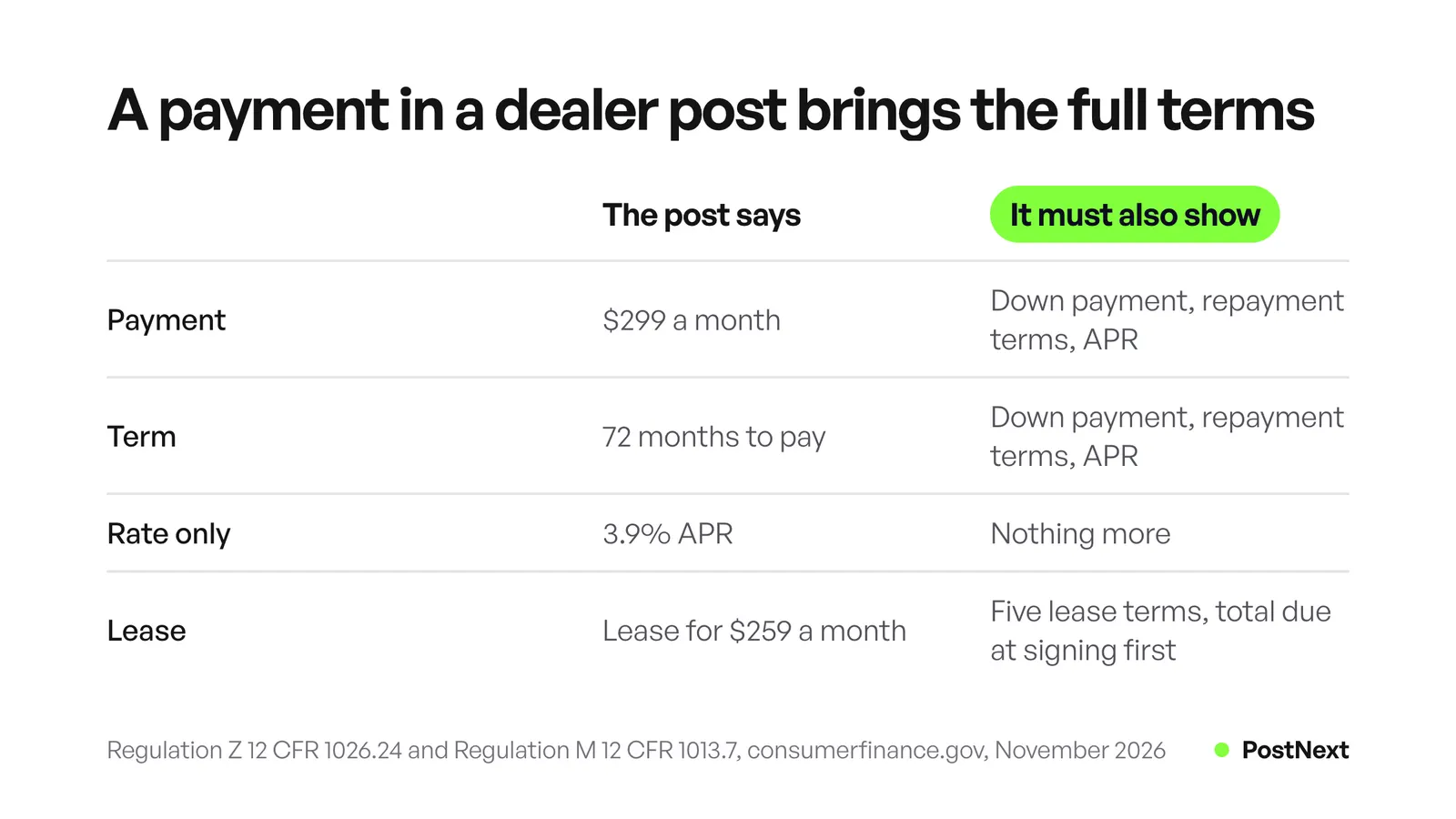
A rate alone works differently. The CFPB’s official interpretation says a statement of the annual percentage rate is not a triggering term. A post may say “3.9% APR available” without the other terms, but it must call the rate an “annual percentage rate” or APR, and say so if the rate can go up after the loan starts.
| A post says | Extra terms required? | What else the post must show |
|---|---|---|
| ”$299 a month” | Yes (amount of payment) | Down payment, repayment terms, APR |
| ”Only $1,000 down” | Yes (down payment) | Repayment terms, APR |
| ”72 months to pay” | Yes (number of payments) | Down payment, repayment terms, APR |
| ”3.9% APR on approved credit” | No | Nothing more under Regulation Z |
| ”Lease for $259 a month” | Yes (lease payment) | It is a lease, total due at signing, payment schedule, security deposit, end-of-lease charge |
| ”$0 due at signing” on a lease | Yes (payment at signing) | The same five lease disclosures |
| ”Easy monthly payments” | No | Not a stated payment amount |
Regulation Z, 12 CFR 1026.24(c) and (d) with the official interpretation; Regulation M, 12 CFR 1013.7(b) and (d); both on consumerfinance.gov, checked November 2026. This is a summary, not legal advice.
What this means for the posts a dealer makes:
A Reel with a payment on screen. If a payment appears on screen, the down payment, the term and the APR belong in the same post, where a viewer will see them. A payment in large type with the terms hidden in a long caption is the pattern regulators look for.
A lease carousel. Regulation M has a prominence rule: apart from the monthly payment, no part of the amount due at signing may be shown more prominently than the total due at signing. For example, “$0 down” in large type next to a $3,995 total due at signing in small type fails that test.
Links to a full table. The rules let an electronic ad put the terms in one table, if every trigger term elsewhere in the ad clearly directs the reader to that table. Whether a link in a social post counts is a question for your compliance lawyer. The simplest choice is to put the terms in the post itself.
Prices. The FTC’s CARS Rule would have set federal rules on dealer price ads and add-ons. The US Court of Appeals for the Fifth Circuit vacated it on January 27, 2025, on procedural grounds. The FTC withdrew it from the Code of Federal Regulations in a final rule of 12 February 2026. The FTC Act still forbids deceptive ads, and your state may have its own dealer advertising rules. Show a price a buyer can pay, and say which fees are extra.
How should salespeople post on their own profiles?
Salespeople can post from their own profiles, and it often works better than the dealership page, because buyers trust a person more than a logo. The rule is disclosure: the FTC says an employment relationship is a material connection, so a salesperson who promotes the dealership must make it clear they work there.
A simple setup for a team:
- Agree the rules in writing. Which channels, what they may post, and that every price and payment goes through one person who checks the credit terms.
- Put the job in the profile and the post. “Sales at [Dealership]” in the bio, and a plain line such as “I work at [Dealership]” in any post about a car for sale.
- Share the dealership’s videos, then add a face. A salesperson can post the walkaround with their own voice-over.
- No customer details. No names, plates, credit details or trade-in values without the customer’s written permission.
LinkedIn works for sales managers who sell fleets to local companies. Our guide to the content approval process shows how to set up one check on rates and payments before anything goes out.
How often should a car dealership post?
Post at least three times a week on each main channel, and every day on Facebook and Instagram if new cars arrive every day. Buffer’s study of more than 100,000 users found accounts that posted in 20 or more of 26 weeks got 450% more engagement per post than accounts that posted in 4 weeks or fewer. Steady weeks matter more than a busy sales weekend.
A week that works for a busy lot:
- Monday: a walkaround of a car that arrived over the weekend.
- Wednesday: a salesperson answers a question, or a service tip.
- Friday: handovers from the week, with permission.
- Every day: new arrivals, and replies to comments and messages within the hour if you can.
How should a dealership handle comments and inquiries?
Answer every comment and message fast, in plain words, and move price talk to a phone call or the vehicle page. A buyer who asks “is this still available?” and waits a day buys from someone else. Name a person who checks comments three times a day, and give them a list of answers to the 10 questions people ask most.
Keep price answers out of public replies unless the price is the one on the vehicle page. When many people ask for the same thing on Instagram, such as the link to a car, invite them to comment a word and send the vehicle page to everyone who comments it in a direct message.
For reviews, reply to every one, good and bad, within a day. BrightLocal found 50% of consumers are put off by templated replies, so write each one by hand. Never mention a customer’s loan, credit or trade-in in a public reply.
How does PostNext help a car dealership?
PostNext for car dealerships lets a dealership plan a week of posts, have the rates checked, and publish each post at its time. It posts to Instagram, TikTok, YouTube, LinkedIn, X, Threads and Bluesky from one calendar. The TikTok scheduler and the Instagram scheduler publish the walkaround videos your team films on a phone.
What fits a dealership’s way of working:
- Approvals: on the Teams plan, a post can go to a reviewer before it is scheduled, so the person who checks credit terms sees every payment first. See collaboration for roles.
- Bulk posts: import up to 100 posts at a time from a CSV file, which suits a batch of new arrivals.
- Repeat posts: a weekly service reminder can repeat every 1 to 365 days, weeks or months.
- LinkedIn: PostNext posts to personal profiles only, not Company Pages, so each sales manager posts from their own profile.
What PostNext does not do: it does not post to Facebook or Facebook Marketplace today (Facebook is listed as coming soon), it does not run paid ads or inventory ads, and it does not read your inventory system. Keep Marketplace and inventory ads in Meta’s own tools. The free plan covers 1 channel, 10 posts and 10 AI credits a month; see pricing for the paid plans.
Frequently Asked Questions
What is the best social media platform for car dealerships?
Facebook and YouTube reach the most buyers. Pew’s 2026 survey found 70% of US adults use Facebook and 84% use YouTube. Facebook also has Marketplace for local car sales, and YouTube suits walkaround videos. Add Instagram for new arrivals and TikTok if a salesperson enjoys being on camera.
Can a dealership post a monthly payment on Instagram?
Yes, with the full terms in the same post. Under Regulation Z, a payment amount is a triggering term, so the post must also show the down payment, the repayment terms and the annual percentage rate. For a lease, Regulation M adds five lease disclosures.
Does a post with only an APR need more disclosures?
No. The CFPB’s official interpretation says a statement of the annual percentage rate is not a triggering term. The rate must be called an “annual percentage rate” or APR, and the post must say if the rate can increase after the loan starts.
Is the FTC CARS Rule still in effect?
No. The US Court of Appeals for the Fifth Circuit vacated the CARS Rule on January 27, 2025, because the FTC skipped a required step in making it, and the FTC formally withdrew it on 12 February 2026. The FTC Act still bans deceptive ads, and your state may have its own dealer advertising rules.
Do salespeople have to say they work at the dealership?
Yes, when they promote the dealership’s cars. The FTC says an employment relationship is a material connection that must be clear in the post. A plain line such as “I work at [Dealership]” works, and the job title belongs in the profile too.
How often should a car dealership post on social media?
At least three times a week on each main channel, and daily on Facebook and Instagram if new cars arrive daily. Buffer’s study found accounts that posted in 20 or more of 26 weeks got 450% more engagement per post than those that posted in 4 weeks or fewer.
Sources
- Consumer Financial Protection Bureau, Regulation Z, 12 CFR 1026.24 Advertising, with official interpretation, checked November 2026.
- Consumer Financial Protection Bureau, Regulation M, 12 CFR 1013.7 Advertising, with official interpretation, checked November 2026.
- US Court of Appeals for the Fifth Circuit, National Automobile Dealers Association v. FTC, No. 24-60013, filed January 27, 2025, checked November 2026.
- Federal Trade Commission, Disclosures 101 for Social Media Influencers, checked November 2026.
- Pew Research Center, Social Media Fact Sheet, 5,511 US adults, survey January to June 2026, checked November 2026.
- BrightLocal, Local Consumer Review Survey 2026, 1,002 US adults, published February 2026, checked November 2026.
- Buffer, Consistent Posting Study (buffer.com/resources/consistent-posting-study), January 2025, checked November 2026.
- PostNext pages read November 2026: TikTok channel, automation, collaboration, pricing.