
Social media for law firms works as a slow trust channel, and every post about your practice falls under the bar rules. In the ABA’s 2024 survey, 80% of lawyers used social media for marketing, and 76% used LinkedIn. Post plain explainers and firm news, keep client facts out, and never promise results. This PostNext guide applies ABA Model Rules 7.1 to 7.3 and 1.6 to each type of post.
Key Takeaways
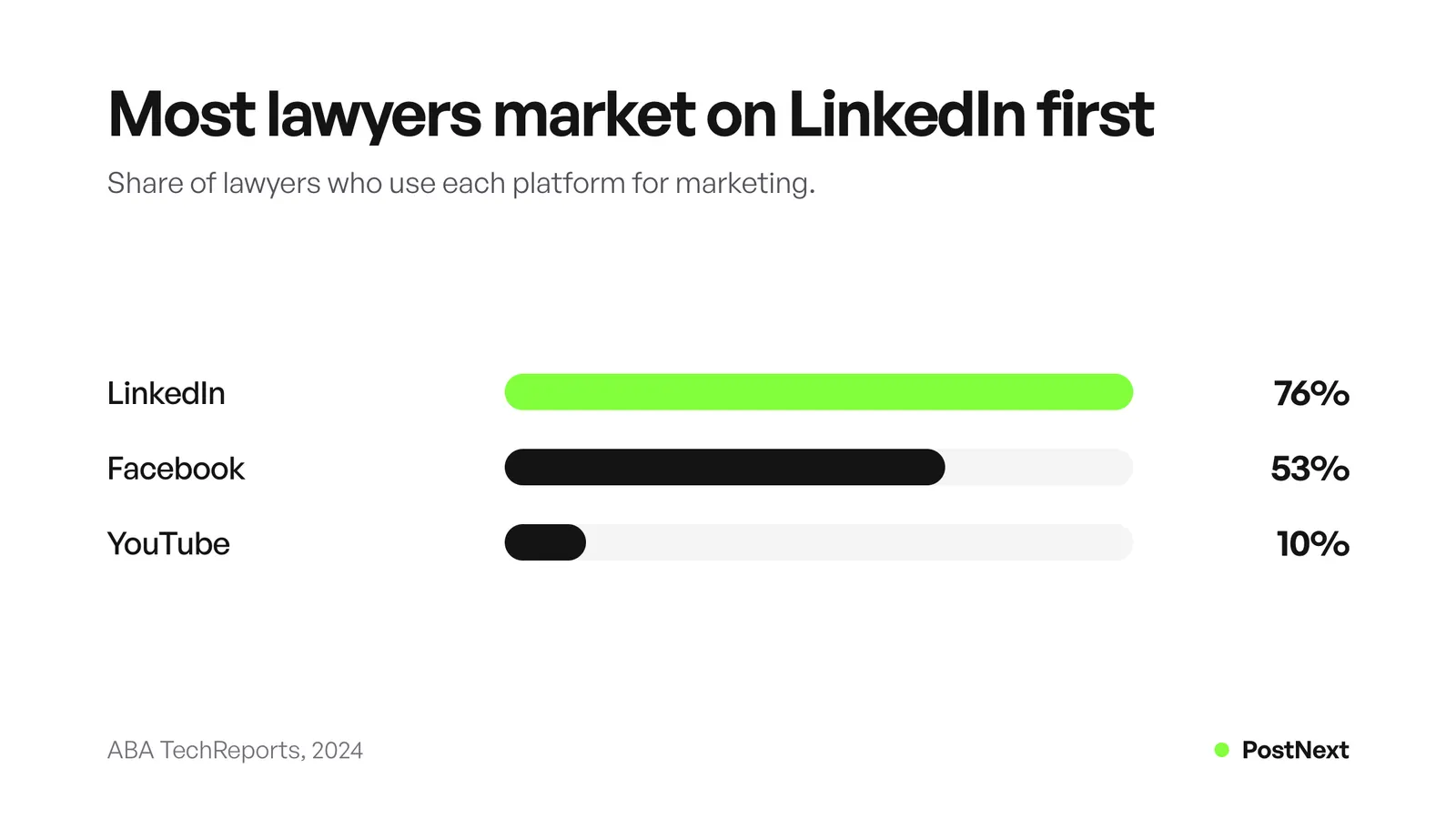
- LinkedIn leads: 76% of lawyers in the ABA’s 2024 survey used LinkedIn for marketing, and 53% used Facebook.
- Small firms use Facebook more: 63% of solo lawyers and 68% of small firms keep a Facebook presence.
- It brings some work: 31% of lawyers who post for work had a client hire them through social media, directly or by referral (ABA, 2023).
- Rule 7.1 covers every post: a true case result still misleads if readers expect the same result in their own case.
- A public record is still confidential: ABA Formal Opinion 480 (2018) says a court record does not free client information for a post.
- Think twice before you answer a bad review: in cases cited by ABA Formal Opinion 496, lawyers who replied with client details were suspended for 6 to 18 months.
- State rules differ: New York dropped its “Attorney Advertising” label on June 1, 2026, while Florida still wants paid, boosted posts filed for review.
Does social media work for law firms?
Social media works for law firms as a trust channel that brings some clients, not most. In the ABA’s 2023 TechReport, 31% of lawyers who use social media for work said a client had hired them through it, directly or by referral. The ABA’s 2024 survey found 80% of lawyers use social media as a marketing tool, down from 89% in 2022.
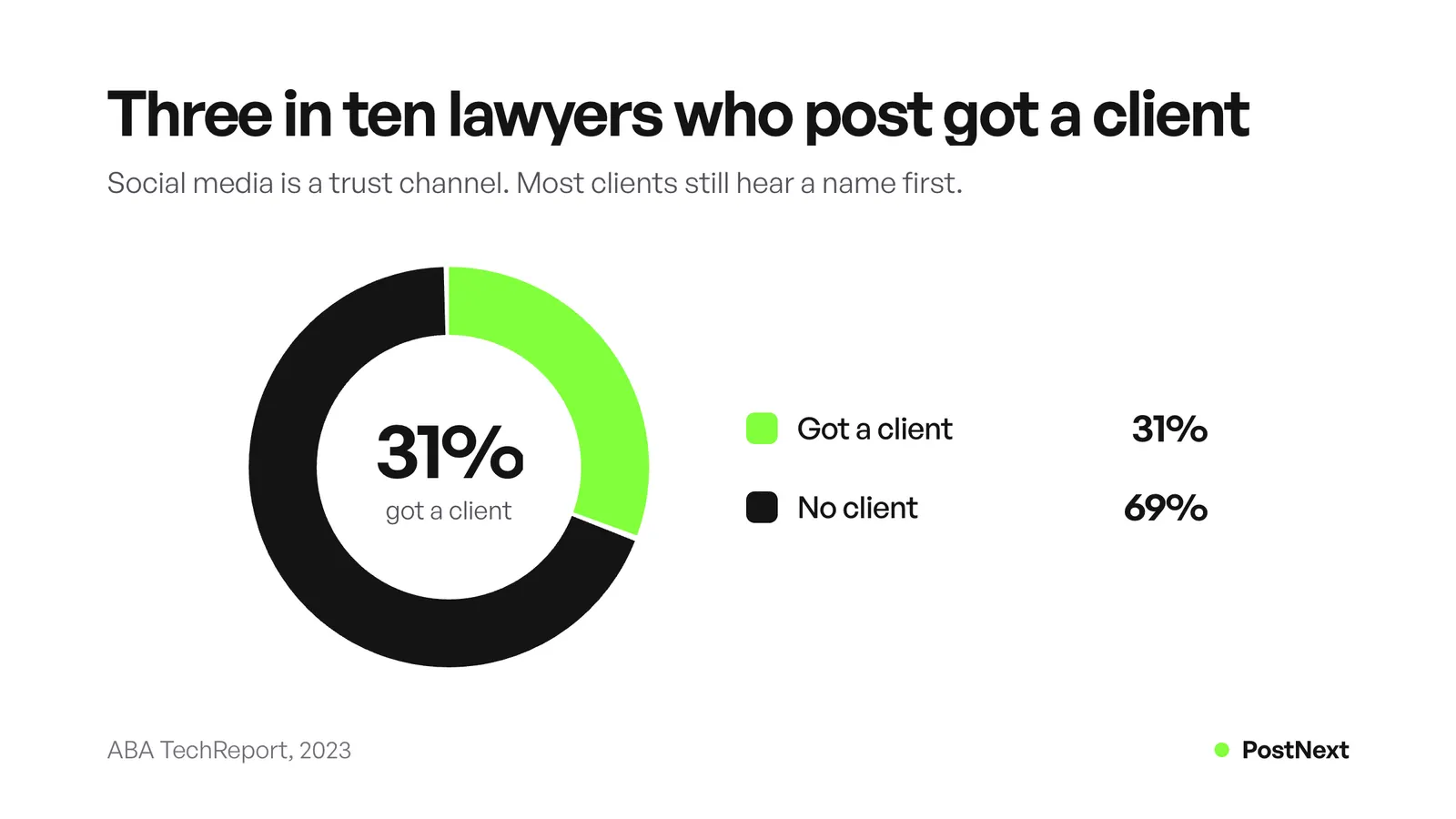
Read those numbers the other way too: the other 69% reported no client from social media. Most people who need a lawyer hear a name first, then look the lawyer up. Your profile and last ten posts answer their real question: does this person understand my problem and explain it clearly?
There is a fair case for doing less. Only 11% of solo lawyers outsource their social media (ABA, 2024), so most write posts between billable hours. If your work comes from referrals, a complete LinkedIn profile and one useful post a week is enough.
Which social media platforms should lawyers use?
Most lawyers should start with LinkedIn, then add Facebook if they serve individuals and families. The ABA’s 2024 survey found 76% of lawyers use LinkedIn for marketing and 53% use Facebook. Pew’s 2026 survey shows why the split matters: LinkedIn reaches 51% of US college graduates but 31% of all adults, while Facebook reaches about 70% of adults at every income level.
| Platform | Lawyers using it for marketing (ABA, 2024) | US adults using it (Pew, 2026) | Fits these practices |
|---|---|---|---|
| 76% (solo lawyers 70%) | 31%, and 51% of college graduates | Business, employment, IP, referrals from other lawyers | |
| 53% (solos 63%, small firms 68%) | 70% | Family, estate, injury, criminal defense | |
| YouTube | 10% | 84% | Short explainers on one common question |
| No figure in the report | 51% | Firm culture, consumer explainers | |
| X | Named, no figure | 18% | Commentary on legal news |
ABA 2024 Practice Management and Solo and Small Firm TechReports; Pew Research Center, Americans’ Use of Social Media in 2026 (5,511 US adults). Checked November 2026. The last column is our reading of the audiences.
Pick by who hires you. Pew found 45% of adults earning $100,000 or more use LinkedIn, against 18% of those earning under $30,000, so business clients are there. Family and injury clients are on Facebook and in local groups. One profile kept current beats four that went quiet. Before you start, read how the LinkedIn algorithm ranks posts.
What should law firms post on social media?
Law firms should post plain answers to the questions clients ask, news about the law that changes what people should do, and real news about the firm and its people. Explainers are the most useful format and the safest: they show how you think without touching a client file. Case results come last, and only with the client’s consent and the context that explains them.
Rotate these six post types:
- The common question: “What happens to my lease when the building is sold?” in five sentences.
- The law change: a new filing rule or statute, with a link to the official source.
- The myth: one wrong belief about wills, custody or contracts in your state.
- The person: a lawyer or paralegal and the work they do.
- The firm news: a new hire, a talk, a pro bono day.
- The result, with permission: see the rules below first.
Write one explainer and use it three ways: a LinkedIn post, a 60-second YouTube video and an FAQ entry on your website. Our LinkedIn post ideas list has 30 formats that suit professional services, and PostNext’s free lesson on writing a LinkedIn post covers hooks and length. On Instagram, keep one link in your Instagram bio that leads to your contact page.
What do the ethics rules say about lawyers on social media?
Four ABA Model Rules cover most lawyer posts. Rule 7.1 bans false or misleading communications about your services. Rule 7.2 requires a name and contact details and bans paying people to recommend you. Rule 7.3 limits solicitation of a specific person who needs help. Rule 1.6 keeps client information confidential online, as everywhere else. Each state adopts its own version, so check your bar’s text.
Rule 7.2(a) lets a lawyer share information about their services “through any media,” so the limits come from what you say. Rule 7.1 governs every communication about your services, paid or not, and its Comment 5 names social media usernames: a handle that claims to be the best in town is a claim you must back up. Two ABA opinions apply the rules online. Formal Opinion 480 (2018) covers blogs and “brief online statements or microblogs.” Formal Opinion 496 (2021) covers replies to online criticism.
What can a lawyer post without breaking the ethics rules?
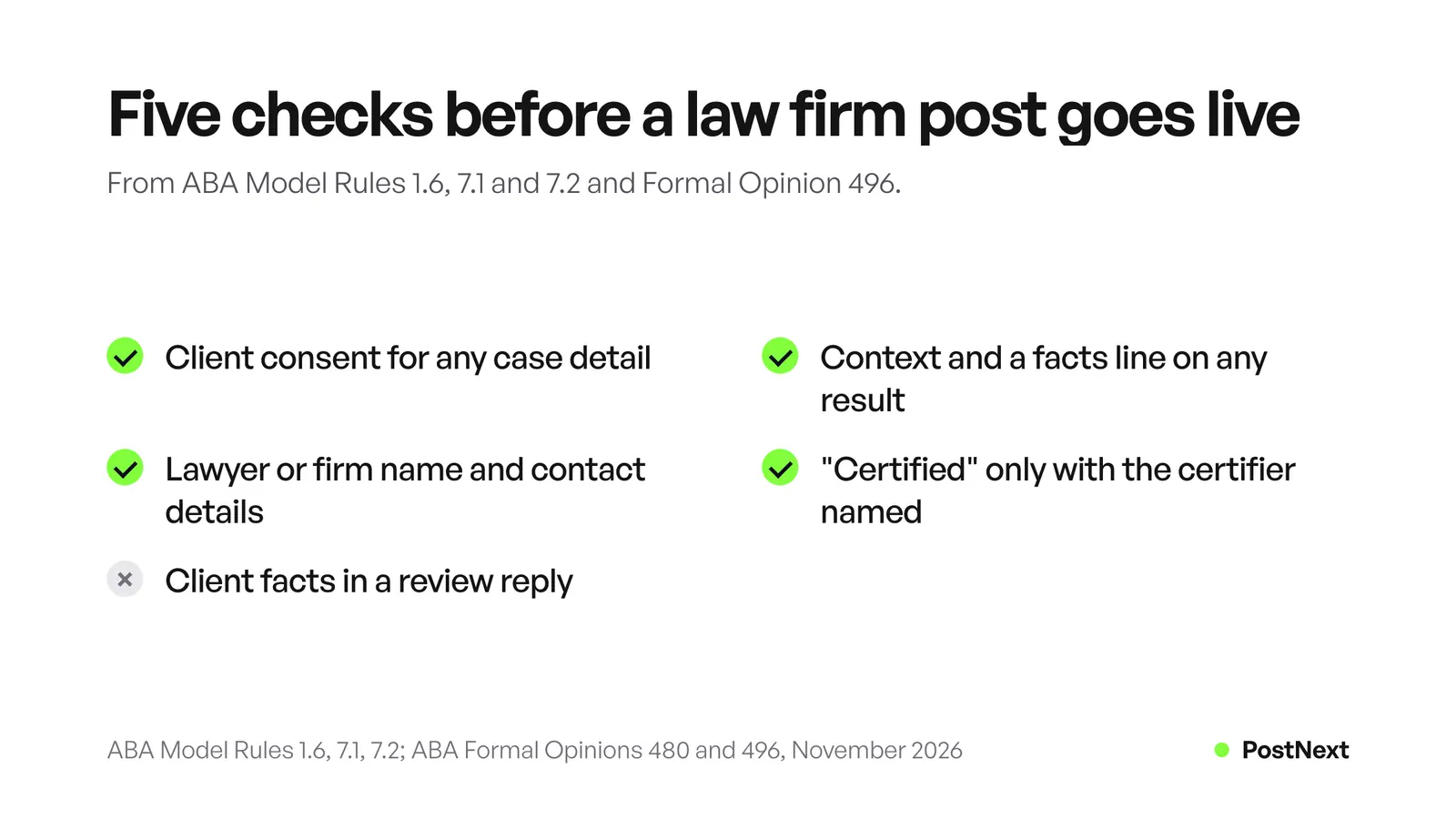
Most posts are safe when they teach without naming a client, promise no outcome and show who is responsible. The risk sits in a few post types: case results, client reviews, specialist claims, comments on someone’s legal problem, posts about pending cases and replies to bad reviews. The table below applies the ABA Model Rules to each type and says how to post it.
| Post type | Rule that applies | How to post it |
|---|---|---|
| Legal tip or explainer | Rule 1.6, Opinion 480 | Use facts no reader could trace to a client |
| Case result or verdict | Rule 1.6, Rule 7.1 Comment 3 | Informed consent, the facts behind the result, a line that results depend on the facts |
| Client review | Rule 7.1, Rule 7.2(b) | Ask permission to share it; never give or promise anything for it |
| ”Specialist” in your bio | Rule 7.2(c) | “Certified” only with the certifying body named |
| Promotional post | Rule 7.2(d) | Lawyer or firm name, plus a phone number, website, email or office address |
| Comment on a stranger’s legal problem | Rule 7.3 | General terms in public; no live call or video pitch |
| Post about a pending case | Rule 3.6, Opinion 480 | Nothing that could prejudice the proceeding |
| Reply to a bad review | Rule 1.6, Opinion 496 | Reveal nothing; invite a private call |
ABA Model Rules of Professional Conduct 1.6, 3.6 and 7.1 to 7.3 with comments, and ABA Formal Opinions 480 (2018) and 496 (2021), checked November 2026. Your state’s version of each rule governs.
The hypothetical is the trap lawyers miss. Opinion 480 says calling a post a “hypothetical” does not help if a reader could work out who the client is. A post about a client who sold the family bakery in a town of 4,000 people names that client in all but words. Change the facts, or write about the rule instead of the case.
Case results need consent and context. Rule 1.6 needs the client’s informed consent, and Opinion 480 says a verdict in the public court record is no exception. Rule 7.1 Comment 3 says a true result misleads if readers expect the same outcome “without reference to the specific factual and legal circumstances” of their case, and that a disclaimer helps. Reviews have one more rule: Rule 7.2(b) bans giving or promising “anything of value” for a recommendation, so ask happy clients for one and offer nothing in return.
How do state bar rules differ on social media?
Every state writes its own lawyer advertising rules, and many follow the ABA model with changes. Two states show the range. New York moved close to the ABA model on June 1, 2026 and dropped its labels and its filing rules for solicitations. Florida keeps a review system: paid, boosted social posts go to the Bar for review unless they contain only basic facts about the lawyer.
New York (since June 1, 2026). The amended rules “essentially adopt” the ABA’s 2018 Rules 7.1 and 7.3, according to a New York State Bar Association analysis. Posts no longer need the “Attorney Advertising” label, and the required line “Prior results do not guarantee a similar outcome” is gone, though the analysis suggests you keep it. The 30-day ban on soliciting after a personal injury or wrongful death is gone too. Each communication still names a responsible lawyer or firm with a phone number or office address.
Florida. The Florida Bar’s networking guidelines (revised August 2020) put any page that promotes your practice under the advertising rules; pages do not need filing. Boosted posts shown to people with no prior relationship must be filed unless they are “tombstone” ads with basic facts only. An unsolicited instant message inviting someone to view your page is a written solicitation under Rule 4-7.18(b). If someone posts a non-compliant claim on your page, you must remove it.
Can lawyers message potential clients on social media?
Under the ABA Model Rules, a written message is not banned solicitation, but a live call or video pitch is. Rule 7.3 bars live person-to-person solicitation for money. Comment 2 says this does not include “chat rooms, text messages or other written communications.” A message must stop when the person says no. Some states add rules for written messages.
Rule 7.3(a) defines solicitation as a message to “a specific person the lawyer knows or reasonably should know needs legal services in a particular matter.” A reply under a stranger’s crash post saying “message me, I can take your case” fits that definition. A general post to all followers does not (Comment 1). Answer questions in public in general terms, keep contact details in your profile, and stop at once if someone says they are not interested.
How should a lawyer respond to a negative online review?
Often the best reply is none. ABA Formal Opinion 496 says lawyers “should consider not responding,” because a reply draws attention and invites more posts from an unhappy critic. If you reply, reveal nothing about the matter: invite the person to contact you privately, or say that professional duties prevent a public reply. A bad review alone does not allow disclosure in self-defense.
Here lawyers differ from other local businesses. BrightLocal’s 2026 survey found 89% of consumers expect owners to respond to reviews, but for a lawyer confidentiality comes first. The cases cited in Opinion 496 show the cost. An Illinois public defender who blogged about clients’ cases got a 60-day suspension. Colorado gave suspensions of 6 and 18 months for review replies with client details. An Indiana disbarment included paying for positive reviews.
A reply that fits the opinion: “Our professional duties prevent us from discussing any client matter in public. Please call our office so we can talk.” If the reviewer was never your client, Opinion 496 says you may say so and ask the site to remove the post.
How often should a law firm post on social media?
Two posts a week on each channel is a pace a busy lawyer keeps. Buffer’s study of more than 100,000 users found that accounts posting in 20 or more of 26 weeks got 450% more engagement per post than accounts posting in 4 weeks or fewer. Steady weeks beat bursts, so plan a month of explainers in one sitting and schedule them.
A firm with more than one lawyer also needs a written policy. In the ABA’s 2023 survey, fewer than 46% of lawyers said their firm had a social media policy, and 49% did not know. One page covers it: who posts, who reviews posts before they go out, what never gets posted, and who answers reviews. Our guides to brand social media guidelines and a content approval process give a template for each part.
How does PostNext help a law firm?
PostNext lets a lawyer plan a month of explainers in one sitting and publish each one at its time to LinkedIn, Instagram, YouTube, X, Threads, Bluesky and TikTok. On LinkedIn it posts to personal profiles only, which suits firms where each lawyer posts as themselves. Several lawyers’ profiles connect within the plan’s channel limit, one post per profile, and PostNext posts the first comment for you.
It does not post to LinkedIn Company Pages, Facebook Pages or Google Business Profile, and it does not send DMs or run ads. If your firm’s main channel is a Facebook Page, schedule it in Meta Business Suite and use PostNext for the lawyers’ LinkedIn profiles. LinkedIn video, documents and polls are not supported, so plan text and image posts.
The review step matters most for a law firm. On the Teams plan, a lawyer sends a draft to approval and a partner reviews it; approving returns the post to drafts marked Approved, so nothing publishes until someone schedules it. The Teams plan has a 5-user minimum. See team collaboration for roles and the LinkedIn scheduler for post types. The free plan covers 1 channel, 10 posts and 10 AI credits a month, enough for two posts a week on one profile. PostNext for law firms has a weekly posting plan and caption templates you can copy.
Frequently Asked Questions
Is it ethical for lawyers to use social media?
Yes. ABA Model Rule 7.2(a) lets a lawyer share information about their services “through any media.” The limits are on content. There are no misleading claims (Rule 7.1) and no client information without consent (Rule 1.6). There is also no live solicitation of a person who needs help (Rule 7.3). Your state’s version of each rule governs.
Do lawyers need a disclaimer on social media posts?
The ABA Model Rules require no fixed label, but Rule 7.1 Comment 3 says a disclaimer helps keep a case result from creating unjustified expectations. New York dropped its “Attorney Advertising” label and required prior-results line on June 1, 2026. Other states keep their own rules.
Can a lawyer post about a case they won?
Only with the client’s informed consent under Rule 1.6. ABA Formal Opinion 480 says information in a public court record is still confidential. Add the facts that drove the result and a line that outcomes depend on the facts.
Can lawyers ask clients for online reviews?
Yes, if you offer nothing for them. Rule 7.2(b) bans giving or promising anything of value for a recommendation. An Indiana lawyer cited in ABA Formal Opinion 496 was disbarred after, among other violations, paying for positive reviews.
Which social media is best for lawyers?
LinkedIn for most lawyers: 76% used it for marketing in the ABA’s 2024 survey. Facebook fits family, estate and injury practices; 63% of solo lawyers use it, and it reaches 70% of US adults.
Can a lawyer call themselves a specialist on LinkedIn?
Under ABA Rule 7.2(c), “certified specialist” needs certification from an approved or ABA-accredited body, named in the post or profile. Comment 9 allows “concentrates in” or “specializes in” when true and not misleading. Check your state’s version first.
Sources
- American Bar Association, Model Rules of Professional Conduct: Rule 7.1 and comments, Rule 7.2 and comments, Rule 7.3 and comments, checked November 2026.
- ABA Standing Committee on Ethics and Professional Responsibility, Formal Opinion 480, March 6, 2018, as reported by the ABA Journal; opinion text checked November 2026.
- ABA Standing Committee on Ethics and Professional Responsibility, Formal Opinion 496, January 13, 2021, summarised in ABA News; opinion text checked November 2026.
- ABA Law Practice Division, 2024 Practice Management TechReport, 2024 Solo and Small Firm TechReport and 2023 Websites and Marketing TechReport, checked November 2026.
- New York State Bar Association, The Amendments to the Advertising Rules (August 2026) and Understanding Changes to New York State Lawyer Advertising Rules (September 2026), checked November 2026.
- The Florida Bar Standing Committee on Advertising, Guidelines for Networking Sites, revised August 19, 2020, checked November 2026.
- Pew Research Center, Americans’ Use of Social Media in 2026, published October 2026, checked November 2026.
- BrightLocal, Local Consumer Review Survey 2026, 1,002 US adults, checked November 2026.
- Buffer, Consistent Posting Study (buffer.com/resources/consistent-posting-study), January 2025, checked November 2026.
- PostNext, LinkedIn scheduler, collaboration and pricing pages, checked November 2026.