
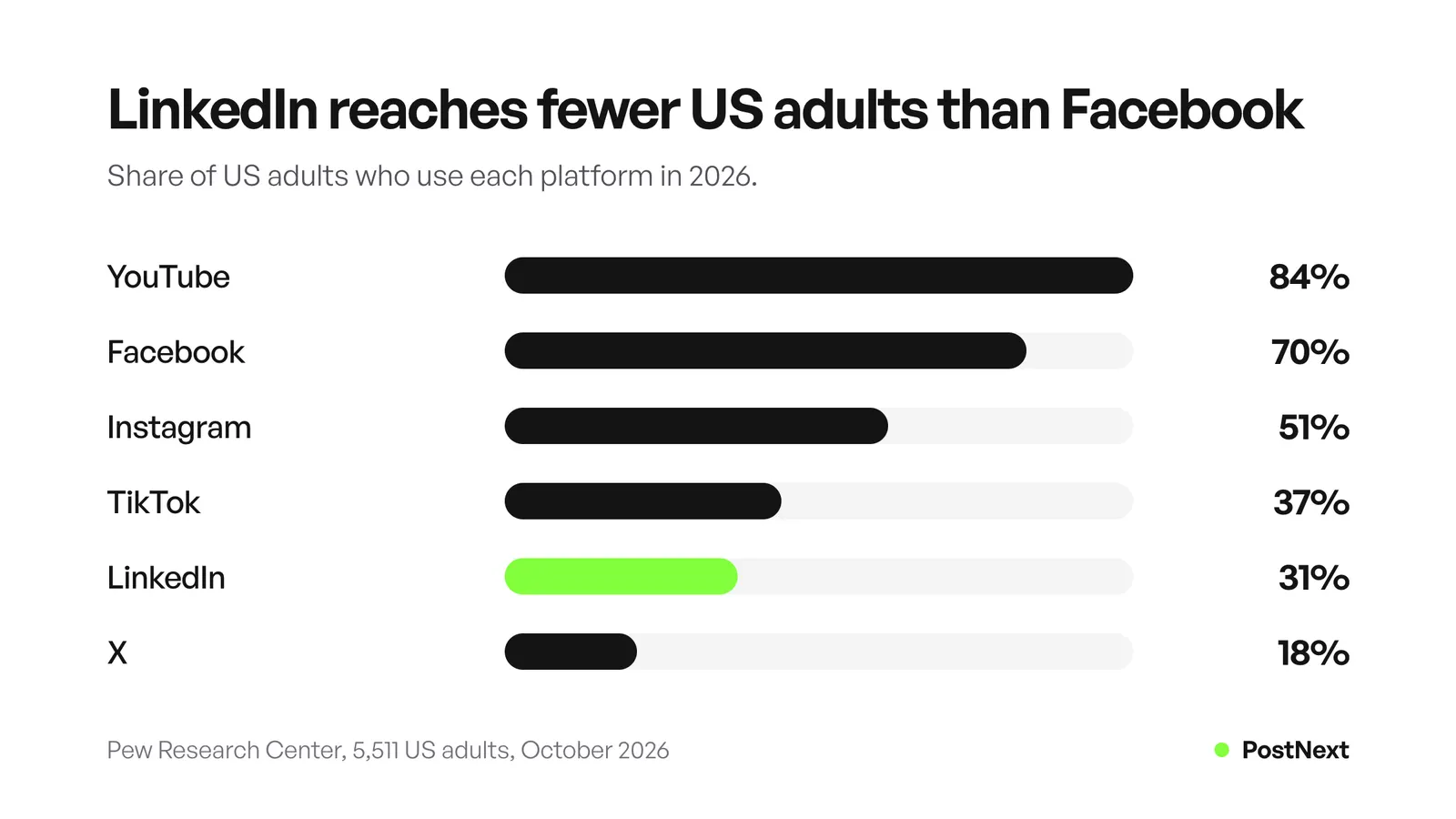
Social media for recruiters works best as a steady presence on two channels, not as a job board. In Pew’s 2026 survey, 70% of US adults use Facebook, 51% Instagram and 31% LinkedIn. Pick channels by who you hire, post two or three times a week, and treat every job post as a legal job advert. This PostNext guide covers each step.
Key Takeaways
- LinkedIn is not where everyone is: 31% of US adults use it, against 70% for Facebook and 51% for Instagram (Pew, 2026).
- Hire by channel: office and tech roles on LinkedIn, hourly and local roles on Facebook and Instagram.
- Free LinkedIn job posts have limits: one active at a time, active for up to 14 days, closed after 30 days if not promoted.
- A social post about a job is a job posting: Colorado, California, Washington, New York and other US states require a pay range in it.
- Wording is regulated: the EEOC names “recent college graduates” as ad wording that may break the law.
- Post your view, not only roles: market patterns, process tips and placements earn more attention than a list of jobs.
- Show up every week: Buffer found accounts posting in 20 or more of 26 weeks got 450% more engagement per post.
Does social media recruiting work?
Social media recruiting works when it reaches the people you hire on the platform they already use. Pew Research Center’s 2026 survey of 5,511 US adults found 84% use YouTube, 70% Facebook, 51% Instagram, 37% TikTok, 31% LinkedIn and 18% X. LinkedIn has stayed near 31% since 2023. For many roles, the candidates are on Facebook first.
Most guides on this topic open with a statistic such as “79% of job seekers use social media”. We tried to trace that number and the other popular ones (73% of millennials, 92% of employers) to a current study and could not. This guide uses Pew for where people are and the platforms’ own help pages for what each tool allows.
| Where candidates spend time | Share of US adults | What it means for recruiting |
|---|---|---|
| YouTube | 84% | Day-in-the-job videos and office tours |
| 70% | Hourly, local and trade roles; community groups | |
| 51% | Team culture, events, roles for younger workers | |
| TikTok | 37% | Short videos for early-career and frontline hiring |
| 31% | Office, tech and senior roles; recruiter search | |
| X | 18% | Niche communities, such as developers and journalists |
Pew Research Center, Americans’ Use of Social Media in 2026 (5,511 US adults, January 30 to June 18, 2026), checked November 2026.
LinkedIn’s own numbers show why it still matters. Its About page lists more than 1.4 billion members and about 9,000 job applications submitted every minute. In LinkedIn’s January 2026 research with Censuswide, 66% of recruiters said finding qualified talent got harder over the past year, and 52% of people said they are looking for a new role in 2026. LinkedIn sells hiring products, so read those as its own survey.
Which social media platforms should recruiters use?
Recruiters should choose platforms by the role, not by habit. LinkedIn suits office, tech and senior roles because candidates list their skills there. Facebook and Instagram reach far more people for hourly, retail, hospitality, healthcare and trade jobs: Pew counts 70% and 51% of US adults on them, against 31% on LinkedIn. Pick two channels and keep both active.
| Who you hire | Main channel | Second channel | Why |
|---|---|---|---|
| Tech, finance, senior office roles | X or YouTube | Skills and job history are on the profile | |
| Hourly, retail, hospitality | Largest reach; local groups | ||
| Healthcare and trades | Local reach plus licensed professionals | ||
| Early-career and graduates | TikTok | Short video, team life | |
| Agency recruiter in one niche | One niche community | Clients and candidates in the same feed |
Channel fit based on Pew Research Center 2026 reach figures and each platform’s purpose. Checked November 2026.
There is a fair argument for staying small. A hiring manager with one open role a year does not need a posting plan. The free LinkedIn job post, the #Hiring frame and a share to your own network cover most of the job. A posting rhythm pays off for agency recruiters and in-house teams who hire every month.
How should recruiters use LinkedIn?
Recruiters should use LinkedIn for three things: a personal profile that says what you hire for, posts that show how you think, and the free hiring tools. LinkedIn lets you post one free job at a time. It stays active for up to 14 days, then pauses. If nobody promotes it, it closes after 30 days. Free job posts must link to your company’s LinkedIn Page.
LinkedIn’s Help Center adds two limits worth knowing. A free post has an application limit, which “typically ranges from 10 to 30 applications depending on the role”. And free posts appear in search results with limited visibility, according to LinkedIn’s page that compares free and paid hiring tools. For one role, that is often enough. For ten roles a month, it is not.
The free features that cost nothing but a few minutes:
- The #Hiring frame. When you add a job to your profile, LinkedIn adds a #hiring frame to your profile photo, and it tells first- and second-degree connections when you hire for a role that fits them.
- #OpenToWork search. Candidates can show they are open to work to all members or to people using LinkedIn Recruiter only, so Recruiter users see more names.
- Posts up to 3,000 characters. Enough for a role with a short story about the team. See our LinkedIn character limits for comments and other fields.
Write from your own profile, not only the company Page. People reply to a person. Our guide to how the LinkedIn algorithm works explains what LinkedIn says it ranks, and the LinkedIn company page lesson shows how to set up the Page your free job posts need.
What should recruiters post on social media?
Recruiters should post their view of the job market, how their process works, and real results, with open roles mixed in. A post on notice periods or salary changes you see this month shows you know the market. A post that explains your interview steps answers candidates’ questions before they ask. A role post works best after those have built trust.
What to post depends on which kind of recruiter you are:
| Post type | Agency recruiter | In-house recruiter | Hiring manager |
|---|---|---|---|
| Market view (salaries, notice periods, skills in demand) | Weekly | Monthly | Rarely |
| Process tips (CV, interview, offer) | Weekly | Weekly | Once per role |
| Team and culture (people, office, events) | Rarely | Weekly | Once per role |
| Placement or new starter, with permission | When it happens | When it happens | When it happens |
| Open role with pay range | 1 to 2 a week | Every new role | Every new role |
| A candidate or client question, answered | Weekly | Monthly | Rarely |
Post mix as PostNext suggests it for each reader. Frequency is a starting point, not a measured rule.
Agency recruiters sell to two audiences at once, clients and candidates, so their view of the market carries the most weight. In-house recruiters sell the company, so team photos and short videos from real employees matter more. Ask people before you post them. For 30 more post types, see our LinkedIn post ideas.
What must a job post on social media include?
A job post on social media must follow the same rules as any job advert. In many US states it must include a pay range, among them Colorado, California, Washington and New York. Under US federal law, its wording must not show a preference by age, sex, race or other protected trait. In the EU, Directive 2023/970 asks for the starting pay or its range and gender-neutral job titles.
Washington’s statute is explicit that social posts count. RCW 49.58.110 defines a posting as “any solicitation intended to recruit job applicants for a specific available position, including recruitment done directly by an employer or indirectly through a third party”. So a LinkedIn post or an Instagram story about one specific role is a posting there.
| Where | What a job post must show | Who it applies to |
|---|---|---|
| Colorado | Pay, benefits, how and when to apply | All employers, internal and public postings |
| California | Pay scale (good faith salary or hourly range) | Employers with 15 or more employees; also when a third party posts |
| Washington | Wage scale or salary range, and a general description of benefits | Employers with 15 or more employees; direct or through a third party |
| New York State | Compensation range; say if the job is commission-based | Businesses with 4 or more employees |
| European Union | Initial pay or its range, gender-neutral titles, no questions on pay history | Member states were due to apply it by June 7, 2026 |
Colorado Department of Labor and Employment, California Labor Code 432.3, Washington RCW 49.58.110, New York State Department of Labor and EUR-Lex Directive 2023/970, checked November 2026. This is a summary, not legal advice; check the law where the job is.
The penalties are real. Colorado’s labor department lists $841,500 in fines across 10 citations under its equal pay law as of November 3, 2026. Washington lets applicants claim $100 to $5,000 per violation, with a five-business-day chance to fix a posting until July 27, 2027.
Wording matters as much as pay. The US Equal Employment Opportunity Commission says an ad that seeks “females” or “recent college graduates” “may discourage men and people over 40 from applying and may violate the law”. Colorado also bars asking for graduation dates or dates of birth in applications, and barring applicants with a criminal record in an advert. Write “2+ years of experience”, not “young and energetic”.
How often should recruiters post on social media?
Recruiters should post two or three times a week on their main channel, every week. Buffer’s study of more than 100,000 users found accounts that posted in 20 or more of 26 weeks got 450% more engagement per post than accounts that posted in 4 weeks or fewer. Showing up every week matters more than one brilliant post a month.
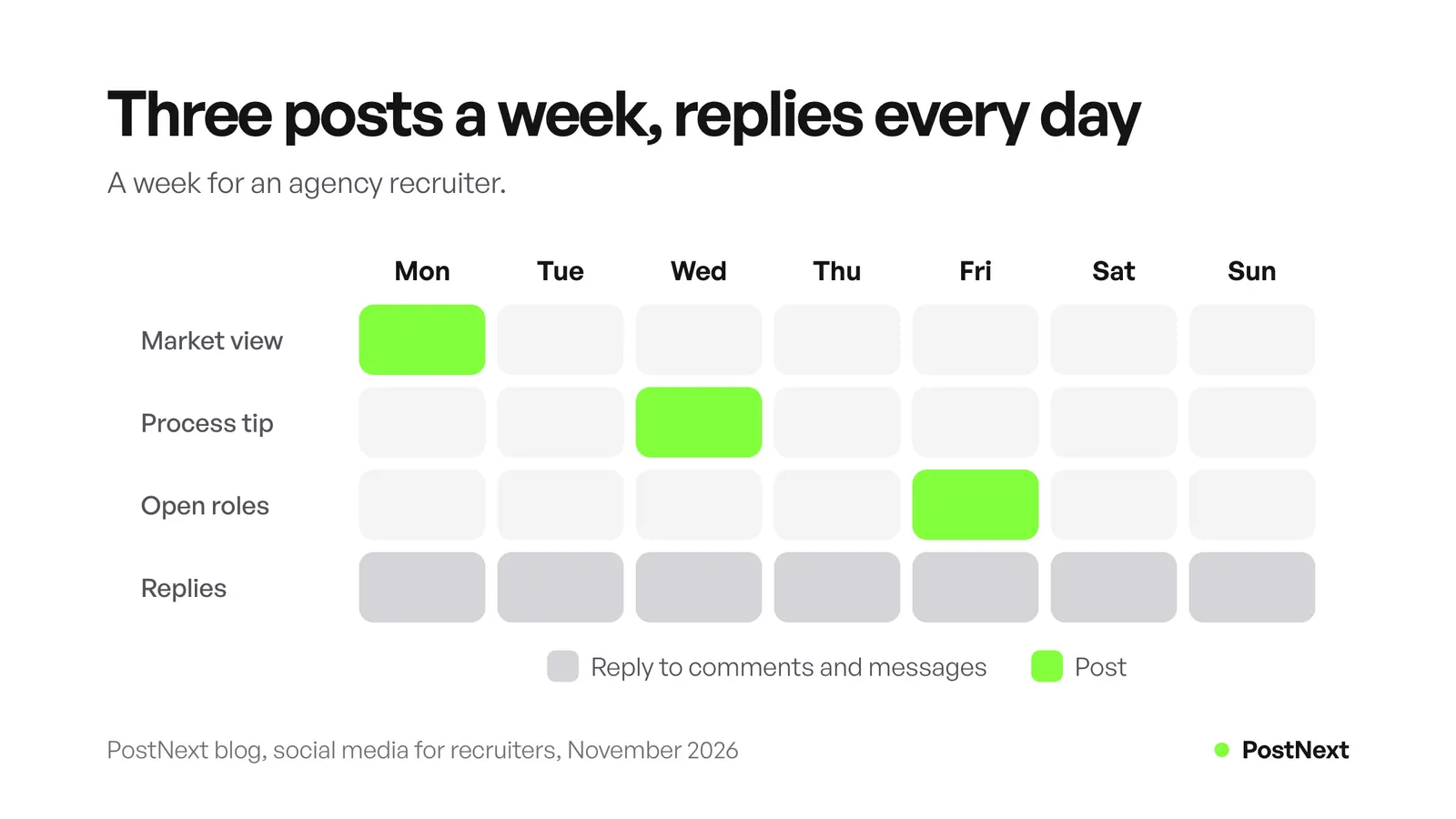
A simple week for an agency recruiter looks like this:
- Monday: a market view, such as what you saw in salaries or notice periods last week.
- Wednesday: a process tip, such as how to answer the salary question in an interview.
- Friday: one or two open roles with pay ranges, or a placement with permission.
- Every day: reply to comments and messages within a day.
Hiring managers need far less. One post when the role opens, one share from a team member, and one update when it is filled is enough. Write the role post in the same week you add the job to LinkedIn, so the #Hiring frame and the post point to the same role.
How do recruiters turn social posts into candidates?
Recruiters turn posts into candidates by making the next step obvious and by replying fast. End each role post with one action, such as “Apply here” with a link in the first comment or “Message me”, and keep the pay range and location in the first two lines. Then reply to every comment and message within a day.
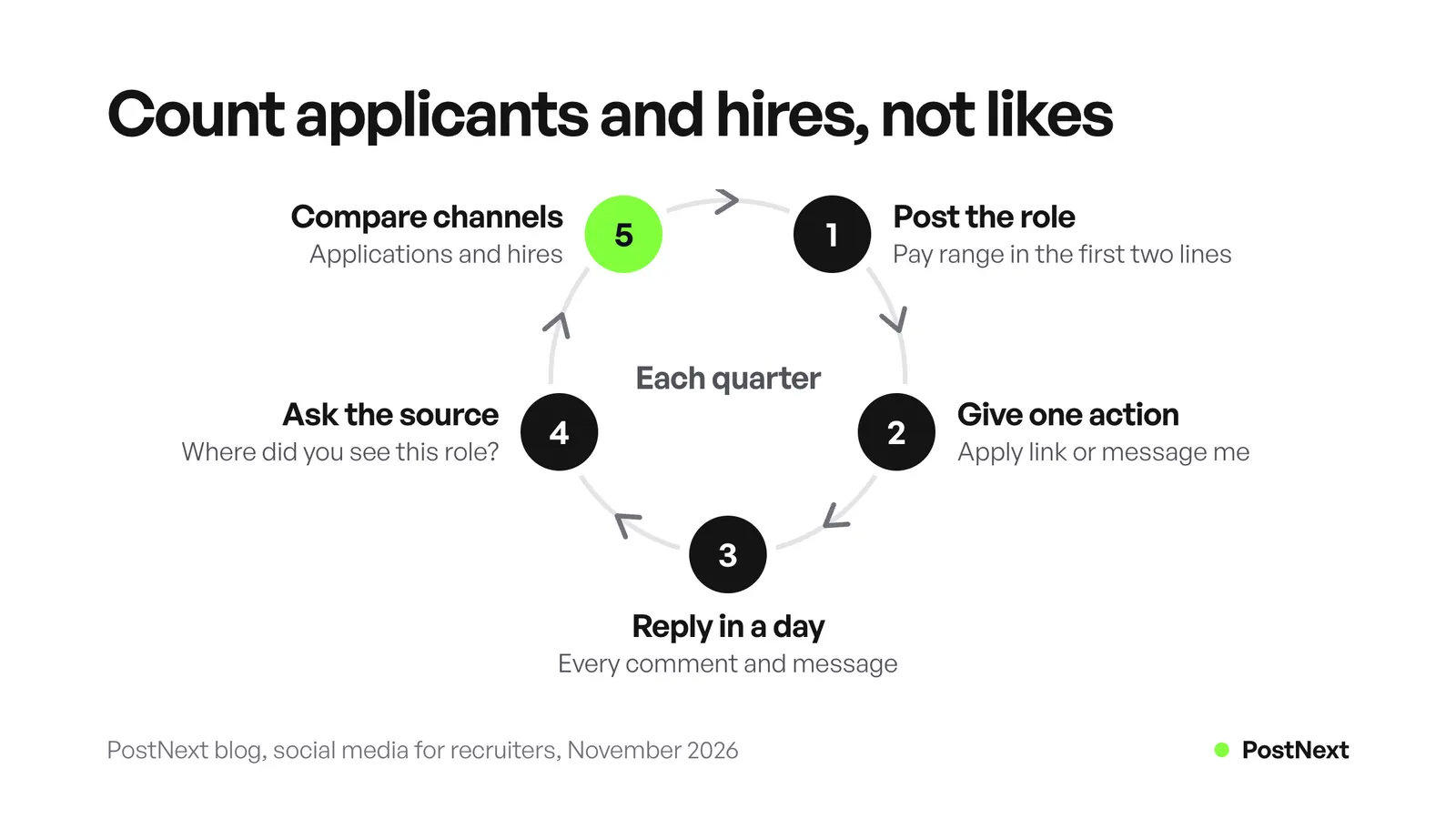
Track where candidates come from. Add a short source question to your application form (“Where did you see this role?”) or use a separate tracking link for each channel. After one quarter, compare applications and hires by channel, not likes. A post with 20 likes that brings two strong applicants beats a post with 500 likes that brings none.
Ask your team to share. A role shared by the person who will manage the new hire reaches their network, which is often full of people with the same skills. Make it easy: write two lines they can copy, and never ask them to post something they do not agree with. If you post about candidates or placements, ask first, and never share a candidate’s details without their consent.
How does PostNext help recruiters?
PostNext lets a recruiter write a week of posts in one sitting and publish each at its time. It schedules text, image and GIF posts to your personal LinkedIn profile and can add your first comment, which is where a job link goes. It also posts to Instagram, TikTok, X, YouTube, Threads and Bluesky from one calendar.
A recruitment team can connect several personal LinkedIn profiles within its plan’s channel limit, one post for each profile, so each recruiter posts in their own voice. The AI writer drafts posts, and best-time suggestions on paid plans read your own last 90 days of posts. On Instagram, the comment inbox lets you reply to comments in one place.
There are limits to know. PostNext publishes to personal LinkedIn profiles only, so company Page posts, LinkedIn video, documents and polls stay in LinkedIn. It does not post to Facebook today; Facebook is listed as coming soon. The free plan covers 1 channel, 10 posts and 10 AI credits a month, enough for two posts a week on LinkedIn. See the LinkedIn scheduler for what it posts. PostNext for recruiters has a weekly posting plan and caption templates you can copy.
Frequently Asked Questions
What should recruiters post on social media?
Post your view of the job market, tips on CVs and interviews, team and culture posts, placements shared with permission, and open roles with pay ranges. Agency recruiters lead with market views; in-house recruiters lead with team posts. Two or three posts a week is enough.
Which social media platform is best for recruiting?
Choose by the role. LinkedIn suits office, tech and senior roles. Facebook reaches the most US adults after YouTube, 70% against LinkedIn’s 31% in Pew’s 2026 survey, so it suits hourly, local and trade jobs. Instagram and TikTok suit early-career hiring.
How many free job posts can you have on LinkedIn?
One active free job post at a time. LinkedIn’s Help Center says a free post stays active for up to 14 days, then pauses, and closes after 30 days if you do not promote it. Applications are capped, typically at 10 to 30 depending on the role.
Do job posts on social media need a salary range?
In many US states, yes. Colorado, California, Washington, New York and others require a pay range in job postings, and Washington’s law covers any solicitation for a specific role, including posts made through a third party. The EU Pay Transparency Directive also requires the starting pay or its range.
What words should recruiters avoid in job posts?
Avoid words that show a preference by age, sex, race, religion, national origin, disability or other protected trait. The EEOC names “females” and “recent college graduates” as examples that may break the law. Describe the skills and experience the job needs instead.
How often should recruiters post on LinkedIn?
Two or three times a week, every week. Buffer’s study of more than 100,000 users found accounts posting in 20 or more of 26 weeks got 450% more engagement per post. A hiring manager with one role can post once when it opens and once when it is filled.
Can you schedule LinkedIn posts for recruiters?
Yes. LinkedIn’s own composer schedules posts from 10 minutes to 3 months ahead, but event and job posts cannot be scheduled there. PostNext schedules text and image posts to personal LinkedIn profiles and adds your first comment.
Sources
- Pew Research Center, Americans’ Use of Social Media in 2026, 5,511 US adults, published October 19, 2026, checked November 2026.
- LinkedIn Pressroom, About us, checked November 2026.
- LinkedIn News, LinkedIn research on talent in 2026, Censuswide, January 7, 2026, checked November 2026. LinkedIn sells hiring products.
- LinkedIn Help, Post a free job, #OpenToWork, social hiring and the #Hiring frame and post length, checked November 2026.
- LinkedIn Talent Solutions, Free vs paid hiring tools on LinkedIn, checked November 2026.
- US EEOC, Prohibited employment policies and practices and Age discrimination, checked November 2026.
- Colorado Department of Labor and Employment, Job postings and hiring and Equal Pay for Equal Work Act, enforcement table updated November 3, 2026, checked November 2026.
- California Labor Code section 432.3, statute text as updated January 1, 2026, checked November 2026.
- Washington State Legislature, RCW 49.58.110, checked November 2026.
- New York State Department of Labor, Pay transparency, checked November 2026.
- EUR-Lex, Directive (EU) 2023/970 on pay transparency, May 10, 2023, checked November 2026.
- Buffer, Consistent Posting Study, January 2025, checked November 2026.
- PostNext, LinkedIn scheduler and pricing page, checked November 2026.