
Founder-led content is video and posts that a company’s founder makes and publishes in their own name, instead of the brand account or hired creators. It works because the founder knows the product, the customer and the reason it exists better than anyone. The practical version is one filming session a week, short videos that answer real customer questions, and a posting pace the founder can keep.
Key Takeaways
- The founder is the messenger. Founder-led content comes from the founder’s own profile, in their own words.
- It is also called founder-generated content (FGC). People use the term when founders film the short videos they would otherwise pay UGC creators to make.
- There is no solid data that it beats brand accounts. Most numbers you see come from agencies that sell it. The case rests on access and speed.
- New accounts can reach strangers on TikTok. TikTok says follower count is not a direct factor in its recommendations.
- Batch the filming. One session can give you a week of videos if you film many short answers back to back.
- Pick a pace you can keep. TikTok suggests a daily target “you can consistently hit”. We suggest three to five short videos a week for a founder.
What is founder-led content?
Founder-led content is anything a founder creates and publishes from their personal profile about the company’s work: short videos, posts, threads and photos. The founder explains what they built, why, and for whom. It differs from brand content, which speaks as “we” from a company page, and from UGC, where paid creators film the product.
The term covers two habits that grew up separately:
- Founder-led marketing on LinkedIn. B2B founders writing first-person posts about the problems their product solves. Most articles on the topic cover this version.
- Founder-generated content on short video. Founders of apps and consumer products filming TikToks and Reels themselves, often in the formats UGC creators use. This guide focuses on this version, because it is where founders get the least practical help.
Founder-led content vs UGC creators: which should you use?
Start with the founder, then add creators. A founder can film today at no cost, answers product questions with authority and can change the message the same afternoon. UGC creators bring more faces, more styles and more volume, but each video costs money, needs a brief and takes days. Most teams that use both let the founder find what works and then brief creators on it.
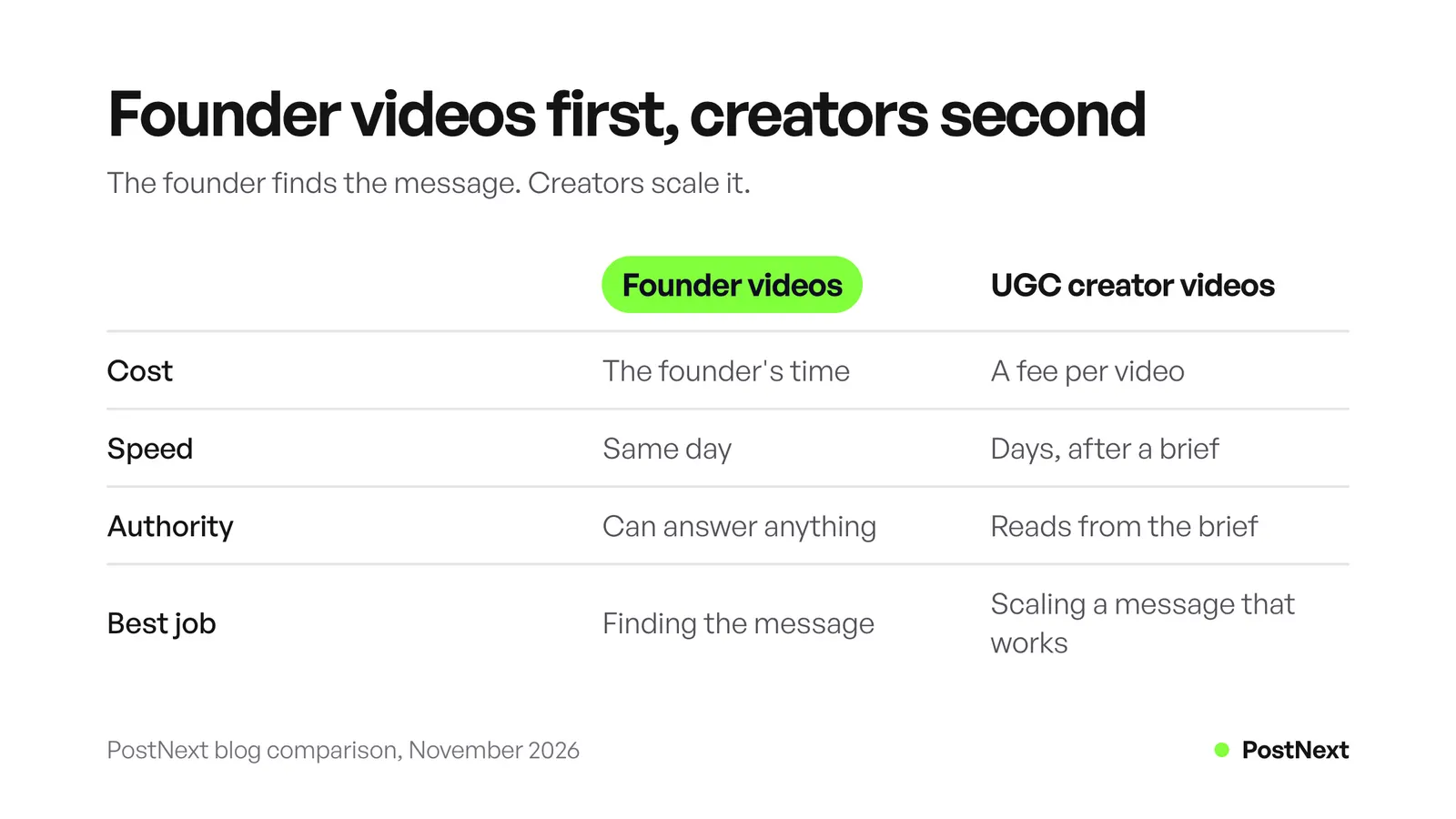
| Founder videos | UGC creator videos | |
|---|---|---|
| Cost | The founder’s time | A fee per video |
| Speed | Same day | Days, after a brief |
| Authority | Built the product, can answer anything | Reads from the brief |
| Range | One face, one voice | Many faces, ages and styles |
| Volume | Limited by one calendar | Grows with budget |
| Best job | Finding the message that works | Scaling a message that already works |
Does founder-led content work?
It can, but no first-party study proves founder posts beat brand accounts. The figures that circulate, such as personal profiles getting several times the reach of company pages, come from agencies and consultants that sell founder content, with no method published. Treat them as claims. The stronger reasons are practical: founders know the product best and can publish without approvals.
One platform fact helps new founder accounts. TikTok’s explanation of its For You feed says that “neither follower count nor whether the account has had previous high-performing videos are direct factors in the recommendation system” (TikTok newsroom, 2020). A founder with zero followers can still reach people who care about the problem, if the video holds their attention.
The case against it is real too. Founder content depends on one person staying consistent, and the founder is usually the busiest person in the company. When the founder gets busy, posting stops. Plan for that from day one with batching and a schedule.
What should a founder film?
Film the answers to the questions customers already ask you. Every sales call, support ticket and comment is a video idea. Short formats work best: one question, one answer, under a minute. Show the product on screen whenever the answer involves it, and say who the product is for in the first seconds.
Eight formats that suit founders, and where each fits:
| Format | What you film | Fits |
|---|---|---|
| The customer question | One question from a call, answered in 30 seconds | TikTok, Reels, Shorts |
| The 20-second demo | Your face, then the screen doing one task | TikTok, Reels, X |
| The build log | What you shipped this week and why | X, LinkedIn, TikTok |
| The opinion | One thing your industry gets wrong, and your view | LinkedIn, TikTok, X |
| The mistake | Something you got wrong and how you fixed it | LinkedIn, TikTok |
| The comment reply | A new video that answers one comment | TikTok, Reels |
| The before and after | A customer’s old way of working, then the new one | TikTok, Reels, LinkedIn |
| The milestone | A real number and what it took | LinkedIn, X |
Never fake a number, a customer or a result. Viewers check, and one invented claim costs more trust than ten good videos earn. For more prompts, see our lists of TikTok ideas with hooks and Instagram Reel ideas.
How do you film a week of videos in one session?
Write the hooks first, film them all in one sitting, then edit later. Choose five to ten customer questions on Monday, write one opening line for each, set up one spot with good light and clean sound, and record every answer back to back. Film each opening line two or three ways. Editing and captions can happen later in the week, or with help.
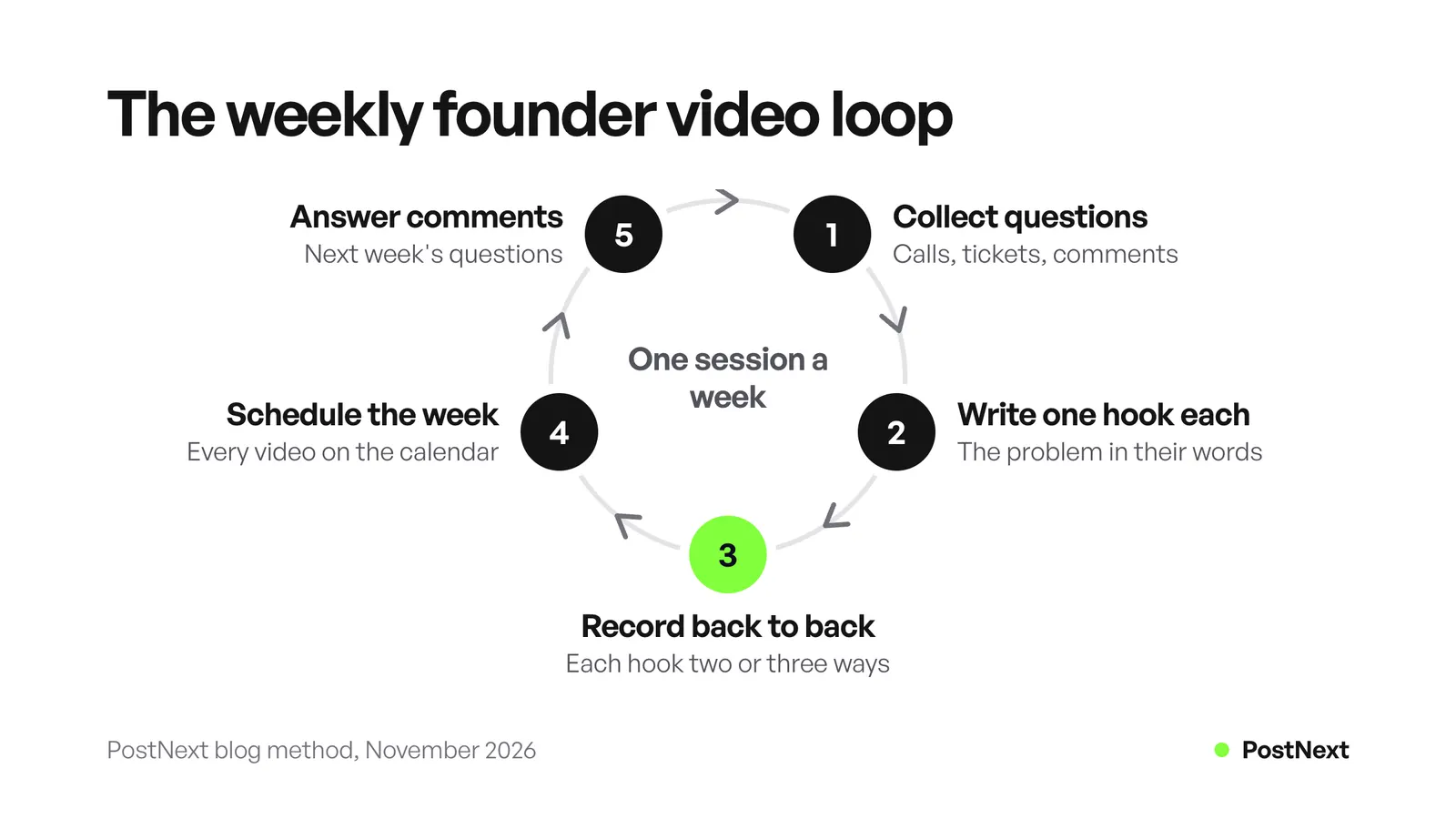
- Collect the questions. Look through last week’s sales calls, support tickets and comments. Pick five to ten.
- Write one hook per question. The first line says the problem in the viewer’s words: “If your invoices take a whole day every month…”
- Set up once. A window or a light in front of you, a phone at eye level, a small microphone. Do not move between videos.
- Record back to back. One answer per take, under a minute. Film each hook two or three ways, so you can test which one holds people.
- Schedule the week. Edit, add captions and put every video on the calendar, so posting does not depend on a free hour later.
Screen recordings save time. For demos, record the screen once and film only your face for the opening line. Our guide to short-form video covers lengths and formats per platform.
How often should a founder post?
Post as often as you can keep up for three months. TikTok’s Creator Academy says “there’s no one-size-fits-all answer” and suggests “setting a daily post target you can consistently hit”. It adds that publishers who post several times a day see more views, but that is advice for media teams. For a founder, three to five short videos a week is a pace that survives a busy month.
Practical rules for the posting rhythm:
- Same weekdays every week. Viewers and the founder both learn the rhythm.
- One message per video. Two ideas means two videos.
- Reuse across platforms, adjusted. A TikTok can become a Reel and a YouTube Short. Change the caption for each.
- Answer comments the same day. Replies are how a viewer becomes a lead, and they give you next week’s questions.
For picking the slots, our roundups on the best time to post on TikTok and the LinkedIn algorithm help.
Why does a new founder account get few views?
Usually because the first seconds do not hold people. TikTok says low views do not always mean a broken rule, and its analytics show when a video was made ineligible for recommendation. Check that first. If nothing is flagged, change the hook and the first frame, not the whole plan. Three rules can limit a founder account.
- Reused content. TikTok makes “unoriginal or reused material without anything new” ineligible for the For You feed, and it does not recommend duplicated content. Post your own footage. Never post the same video twice on one account.
- Music. TikTok says businesses “cannot use the general music library for commercial usage”. A founder promoting their product should pick sounds from the Commercial Music Library.
- Automation that games the system. TikTok bans tools “designed to bypass our systems”. Scheduling through TikTok’s official API is a normal publishing route.
If views drop after a good start, our guide to resetting your TikTok algorithm covers the other causes.
Where should founders post?
Post short videos on TikTok and Instagram Reels, written posts on LinkedIn and X, and reuse the best videos as YouTube Shorts. LinkedIn suits B2B founders, because customers, investors and future hires read it at work. TikTok and Reels suit consumer products and apps, because new accounts can reach people who have never heard of you.
| Platform | Best for founders who sell to | Post as |
|---|---|---|
| Businesses, investors, hires | Your personal profile | |
| TikTok | Consumers, app users, young buyers | Your own account, or a company account with your face |
| Instagram Reels | Consumers, local customers | Your own or the company account |
| X | Developers, builders, other founders | Your personal account |
| YouTube Shorts | Anyone searching for how-tos | The company channel |
PostNext publishes to these from one calendar. Its TikTok scheduler posts videos and photo posts at your time, and the PostNext for founders plan turns release notes into LinkedIn, X and Threads drafts you check before they go out. Two limits to know: PostNext publishes to LinkedIn personal profiles, not company pages, and it does not publish video to LinkedIn, so post LinkedIn videos in the LinkedIn app. For founders who ship code, our guide to Claude Code for marketing turns a changelog into posts.
Frequently Asked Questions
What is founder-generated content?
Founder-generated content (FGC) is short video a founder films themselves, usually in the formats UGC creators use, to promote their own product. It is the short-video version of founder-led content. The founder replaces, or comes before, paid UGC creators.
Is founder-led content better than UGC?
Neither wins on every job. Founder videos cost time, not a fee, and can go out the same day with full product knowledge. UGC creators add faces and volume. Many teams use the founder to find the message that works, then brief creators to scale it.
How often should a founder post on TikTok?
As often as you can keep up for three months. TikTok’s Creator Academy suggests a daily target you can consistently hit. For most founders that means three to five short videos a week, filmed in one session.
Should a founder post from a personal account or the company account?
On LinkedIn and X, from the personal account, because people follow people there. On TikTok and Instagram either works. A company account with the founder’s face keeps the audience with the business if the founder steps back later.
What should a founder post about?
The questions customers ask on calls and in support, short product demos, what shipped this week, mistakes and fixes, and real milestones. One question per video, answered in under a minute.
Can founders use trending sounds on TikTok?
TikTok says businesses must use the Commercial Music Library for commercial activity, organic posts included. A founder promoting their product should pick sounds from that library to avoid muted videos or reach problems.
Sources
- TikTok Newsroom, How TikTok recommends videos #ForYou (2020, read 26 November 2026): follower count not a direct factor, duplicated content not recommended.
- TikTok Creator Academy, Posting cadence tips for all industries (updated 6 July 2026).
- TikTok, For You feed eligibility standards and Integrity and Authenticity (released 25 August 2026, read 26 November 2026).
- TikTok Business Help Center, About the Commercial Music Library (read 26 November 2026).
- PostNext, Social media marketing for startups and TikTok scheduler (read 26 November 2026); LinkedIn channel page (25 November 2026).